Sample Letter for Probating Claims Expiration
Overview of this form
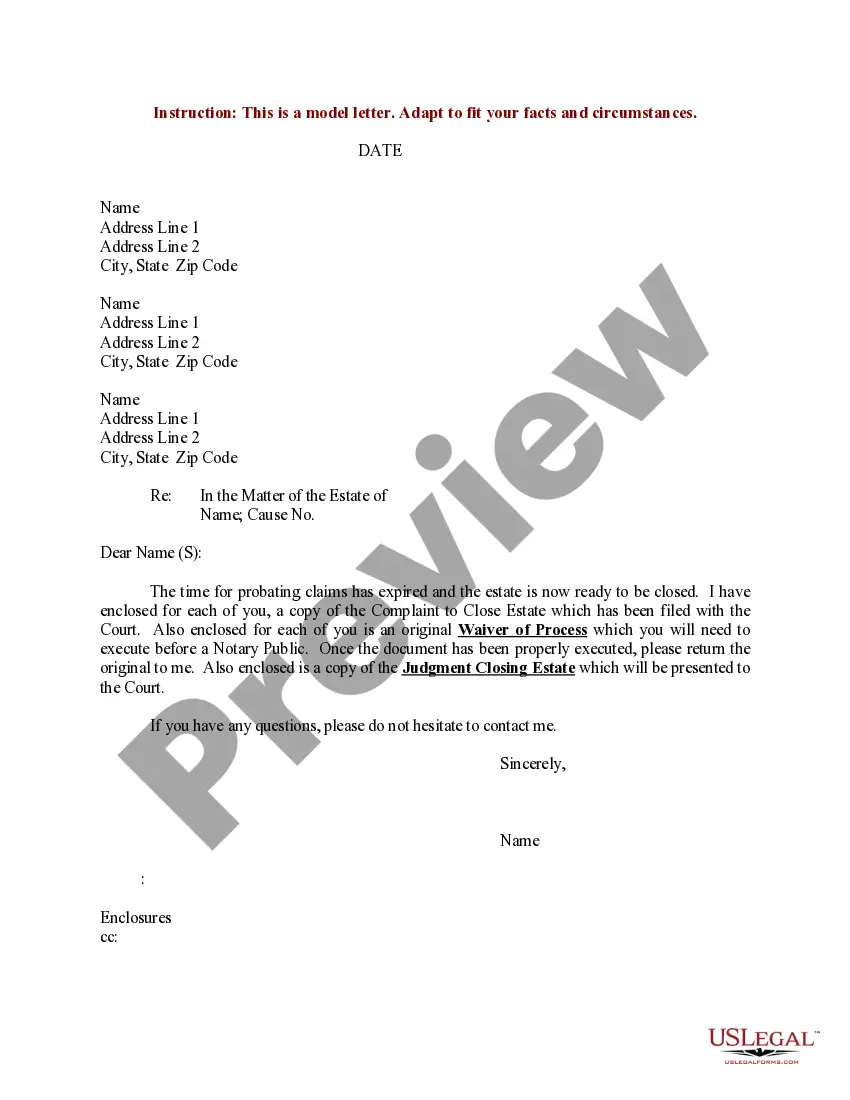
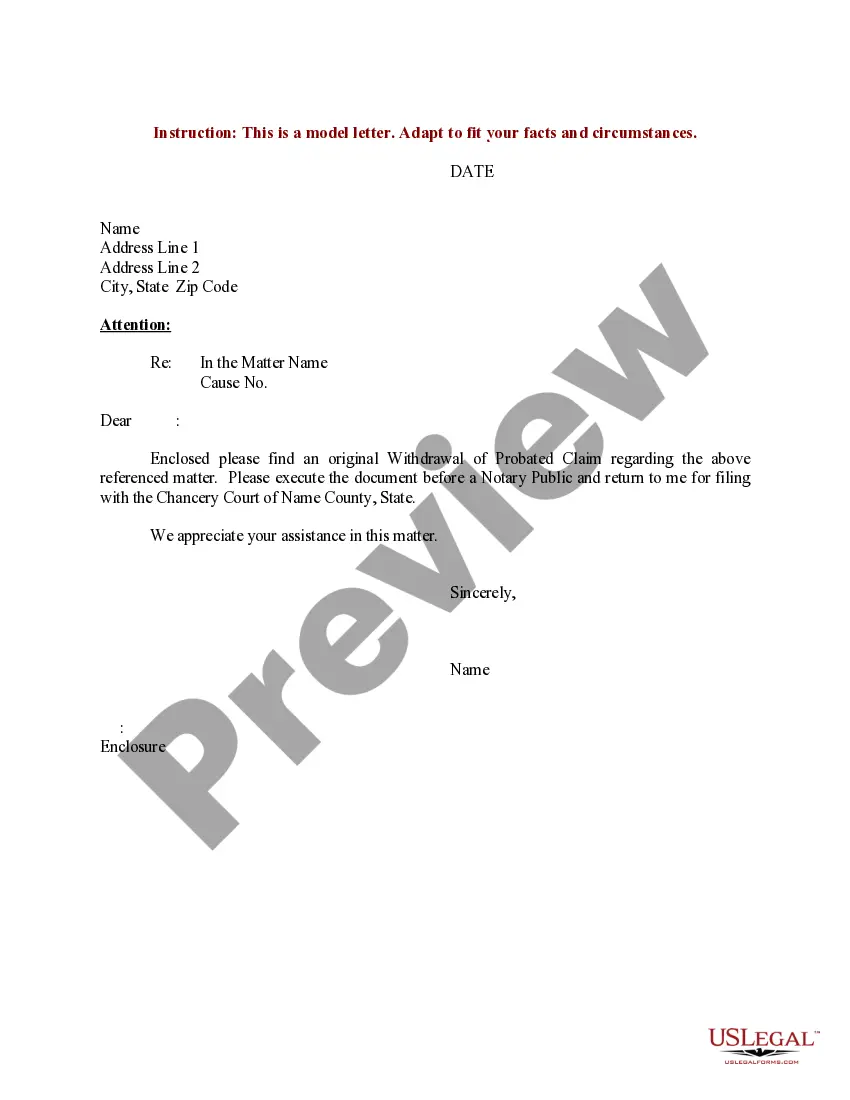
The Sample Letter for Probating Claims Expiration is a legal document designed to notify relevant parties about the expiration of claims associated with a probate case. This letter serves as a formal communication, ensuring that all interested parties are aware of their rights and obligations relating to probate claims. This form differs from other probate-related documents by focusing specifically on the expiration of claims, making it an important tool for estate executors and administrators in managing the probate process effectively.
Main sections of this form
- Date of the notification letter.
- Sender's name and address information.
- Recipient's name and address information.
- Clear statement regarding the expiration of claims.
- Contact information for further inquiries.
- Signature line for the sender.


When to use this form
This form should be used when an estate executor or administrator needs to formally inform beneficiaries and creditors that the time for filing claims on the estate is expiring. It can be utilized in situations where legal deadlines must be communicated to ensure compliance with probate laws, protecting the interests of the estate and its representatives.
Who should use this form
- Executors and administrators of a probate estate.
- Beneficiaries of an estate who need to be informed about claims.
- Creditors seeking to understand their rights in the probate process.
- Legal representatives managing probate matters.
How to prepare this document
- Identify your name and address at the top of the letter.
- Add the date of the notification.
- Enter the recipient's name and address accurately.
- Include a clear statement indicating the expiration of claims.
- Provide your contact information for any questions.
- Sign the letter to finalize it.
Notarization requirements for this form
This form does not typically require notarization unless specified by local law.
Get your form ready online
Our built-in tools help you complete, sign, share, and store your documents in one place.
Make edits, fill in missing information, and update formatting in US Legal Forms—just like you would in MS Word.
Download a copy, print it, send it by email, or mail it via USPS—whatever works best for your next step.
Sign and collect signatures with our SignNow integration. Send to multiple recipients, set reminders, and more. Go Premium to unlock E-Sign.
If this form requires notarization, complete it online through a secure video call—no need to meet a notary in person or wait for an appointment.
We protect your documents and personal data by following strict security and privacy standards.

Make edits, fill in missing information, and update formatting in US Legal Forms—just like you would in MS Word.

Download a copy, print it, send it by email, or mail it via USPS—whatever works best for your next step.

Sign and collect signatures with our SignNow integration. Send to multiple recipients, set reminders, and more. Go Premium to unlock E-Sign.

If this form requires notarization, complete it online through a secure video call—no need to meet a notary in person or wait for an appointment.

We protect your documents and personal data by following strict security and privacy standards.
Common mistakes to avoid
- Failing to include the correct date, which may lead to confusion about deadlines.
- Not double-checking the accuracy of recipient's information.
- Forgetting to sign the letter, rendering it ineffective.
- Using vague language that does not clearly state the expiration of claims.
Benefits of using this form online
- Convenient access to templates that can be downloaded immediately.
- Editability allows customization to fit specific needs and requirements.
- Reliability of forms drafted by licensed attorneys, ensuring legal compliance.
Legal use & context
- The letter serves as an official notification during probate proceedings.
- It helps to establish clear communication regarding claims expirations.
- Utilizing a template aids in compliance with legal standards.
What to keep in mind
- The Sample Letter for Probating Claims Expiration is essential for notifying parties about claims deadlines.
- Accurate completion is crucial to avoid legal issues.
- Using this form helps maintain clarity and communication among all parties in the probate process.
Looking for another form?

Form popularity
FAQ
Notice of Probate: 1-2 Months. Petition to Probate: 1-4 Months. Notice to Creditors, Debts, and Taxes: 4-6 Months. Inventory and Appraise Assets: 1-3 Months. Probate Property Sale: 2-6 Months (or More) Final Accounting: 1-2 Months. Final Distribution and Closing the Estate: 1-3 Months.
There is a strict time limit within which an eligible individual can make a claim on the Estate. This is six months from the date that the Grant of Probate was issued. For this reason, Executors are advised to wait until this period has lapsed before distributing any of the Estate to the beneficiaries.
What Is The Statute Of Limitations To File A Claim Against A Decedent? One year. Upon a person's death, California Code of Civil Procedure section 366.2 provides for an outside time limit of one year for filing any type of claim against a decedent.
Is there a time limit for a claim against a deceased estate? Yes, there is. You have only 6 months from the date of the grant of probate to make a claim. In some very limited circumstances, an extension of this time frame may be granted.
Creditors have one year after death to collect on debts owed by the decedent. For example, if the decedent owed $10,000.00 on a credit card, the card-holder must file a claim within a year of death, or the debt will become uncollectable.
Paying off debts from the estate Well-established practice is that an executor will wait six months after the date of death to allow for any creditors to intimate their claims before making payment to beneficiaries.
The statute of limitations for filing a claim against an estate is a strict one year from the date of the debtor's death (pursuant to California Code of Civil Procedure Section 366.2). This limitation period applies regardless of whether the judgment creditor knew the judgment debtor had died!
Is there a time limit on applying for probate? Though there is no time limit on the probate application itself, there are aspects of the process which do have time scales. Inheritance tax for example, is a very important part of attaining probate in the first place and must be done within 6 months of date of death.
Generally speaking, it depends on both the type of debt and applicable state laws. When someone dies, their assets no matter how meager or massive become their "estate." That includes financial accounts, possessions and real estate. And the estate is generally what creditors go after to try collecting on the debt.