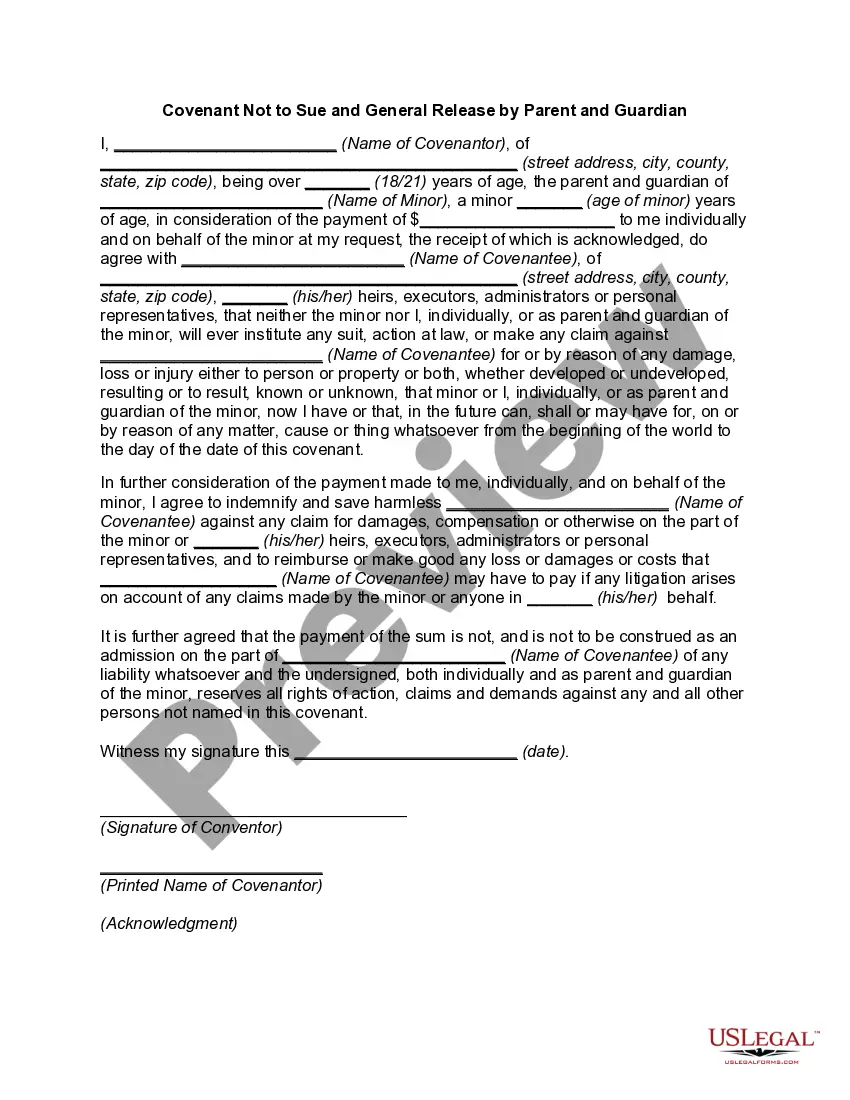
Covenant Not to Sue and General Release by Parent and Guardian
About this form
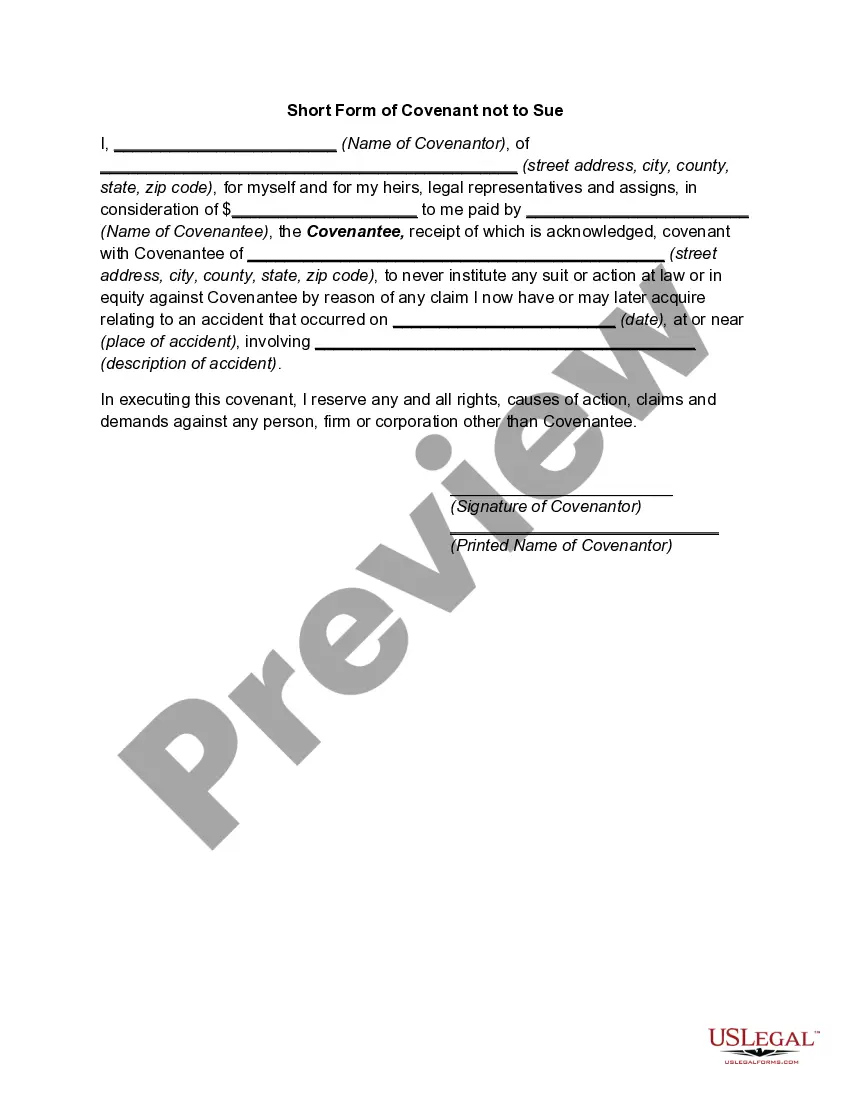
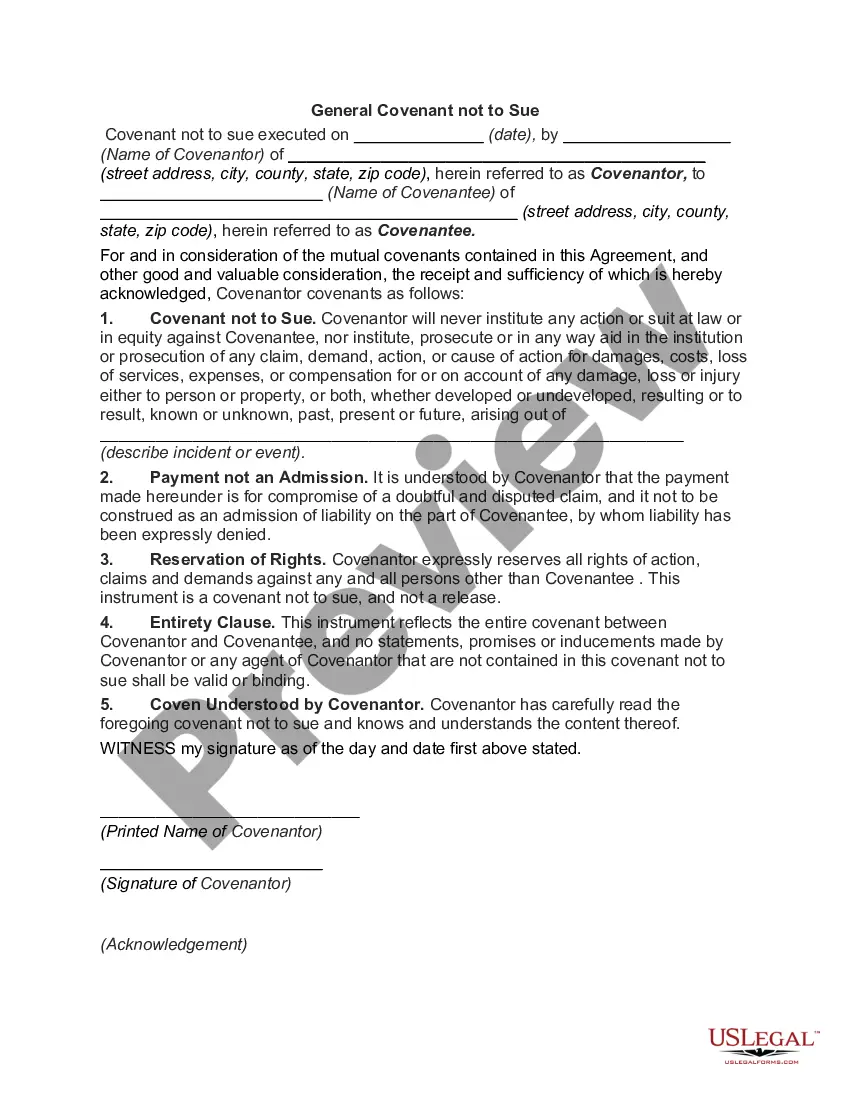
The Covenant Not to Sue and General Release by Parent and Guardian is a legal agreement that prevents a parent or guardian from pursuing legal claims on behalf of a minor against another party, often in exchange for a settlement or payment. This form is essential for safeguarding both the minor's and the party's interests by ensuring that no future lawsuits will arise from the incident covered by the agreement.
Main sections of this form
- Name and address of the covenantor (parent/guardian).
- Name and age of the minor involved.
- Details of the payment received in consideration for the agreement.
- Specific covenant not to sue or make claims against the covenantee.
- Indemnification clause protecting the covenantee from future claims.
- Signature and printed name of the covenantor along with the date.
When to use this form
This form is typically used in situations where a minor has suffered an injury, damage, or loss, and the parent or guardian agrees to settle the matter without pursuing litigation. Common scenarios include accidents involving medical treatment, injuries at school or daycare, or other personal injury claims. It can also be used as part of a settlement agreement when resolving disputes outside of court.
Who this form is for
- Parents or guardians of minors who have a potential legal claim.
- Individuals who are settling disputes involving minors.
- Those seeking to ensure a final resolution to legal claims without the need for court proceedings.
Instructions for completing this form
- Identify and enter the name and address of the covenantor (the parent or guardian).
- Provide the name and age of the minor involved.
- Specify the amount of payment received as consideration for the agreement.
- Fill in the name and address of the covenantee (the party being released from claims).
- Review and sign the form with the date to finalize the agreement.
Is notarization required?
This form does not typically require notarization unless specified by local law. It is recommended to check state rules to ascertain if notarization is necessary for enforceability.
Get your form ready online
Our built-in tools help you complete, sign, share, and store your documents in one place.
Make edits, fill in missing information, and update formatting in US Legal Forms—just like you would in MS Word.
Download a copy, print it, send it by email, or mail it via USPS—whatever works best for your next step.
Sign and collect signatures with our SignNow integration. Send to multiple recipients, set reminders, and more. Go Premium to unlock E-Sign.
If this form requires notarization, complete it online through a secure video call—no need to meet a notary in person or wait for an appointment.
We protect your documents and personal data by following strict security and privacy standards.

Make edits, fill in missing information, and update formatting in US Legal Forms—just like you would in MS Word.

Download a copy, print it, send it by email, or mail it via USPS—whatever works best for your next step.

Sign and collect signatures with our SignNow integration. Send to multiple recipients, set reminders, and more. Go Premium to unlock E-Sign.

If this form requires notarization, complete it online through a secure video call—no need to meet a notary in person or wait for an appointment.

We protect your documents and personal data by following strict security and privacy standards.
Common mistakes
- Failing to provide accurate names and details of the parties involved.
- Not specifying the payment amount clearly.
- Neglecting to sign the form, which can invalidate the agreement.
Benefits of using this form online
- Convenient access to a legally drafted form that can be downloaded instantly.
- Editability allows users to customize the document to fit their specific situation.
- Provides peace of mind knowing that the form has been prepared by licensed attorneys.
- This covenant protects the covenantee from any future claims by the minor or parents related to the incident covered by the release.
- The agreement may not be enforceable if not completed properly or if the covenantor acts outside their legal capacity.
What to keep in mind
- The Covenant Not to Sue and General Release helps prevent future legal claims regarding a minor.
- It is essential to ensure proper identification of all parties and clarity of payment.
- Understanding the legal implications is crucial when signing this form.
Looking for another form?
Form popularity
FAQ
You do not have to sign this authorization form. Instead, you can provide only the medical documentation necessary for the insurer to evaluate your injuries and compensation.
In California, a liability waiver must be clear, unambiguous, and explicit. In other words, waivers cannot be printed in faded ink, in small font, on the back of a paper, or in an otherwise ambiguous form. If the waiver that you sign is not represented clearly, it may not hold up in the event of a lawsuit.
A waiver is not complete until it includes the signatures of both the event host and business owner and that of the participant. The date should also be included alongside the signatures. You may also include a signature line for a witness if necessary.
Get help. Writing a waiver should not be complicated. Use the correct structure. Proper formatting. Include a subject line. Include a caution! Talk about the activity risks. Do not forget an assumption of risk. Hold harmless.
All parties involved in the incident. A statement saying you were involved in the accident that caused the injury. The total amount of the property damage. A statement that releases the defendant from any future claims or damages that are related to the incident.
A liability waiver, or release of liability, is a legal document that a company or organization has you sign in order to protect them from being sued in the event that you are injured.
The General Release is a broad release from all possible civil claims resulting from a dispute. Since the Releasing Party is giving up all known and unknown claims against the other party, care should be taken to ensure that the Releasor is fully aware of their rights.
A release form or a waiver is simply a legal document containing an agreement between two parties.A waiver is an essential document that informs participants of the risks involved in certain activities and also protects you from liability.