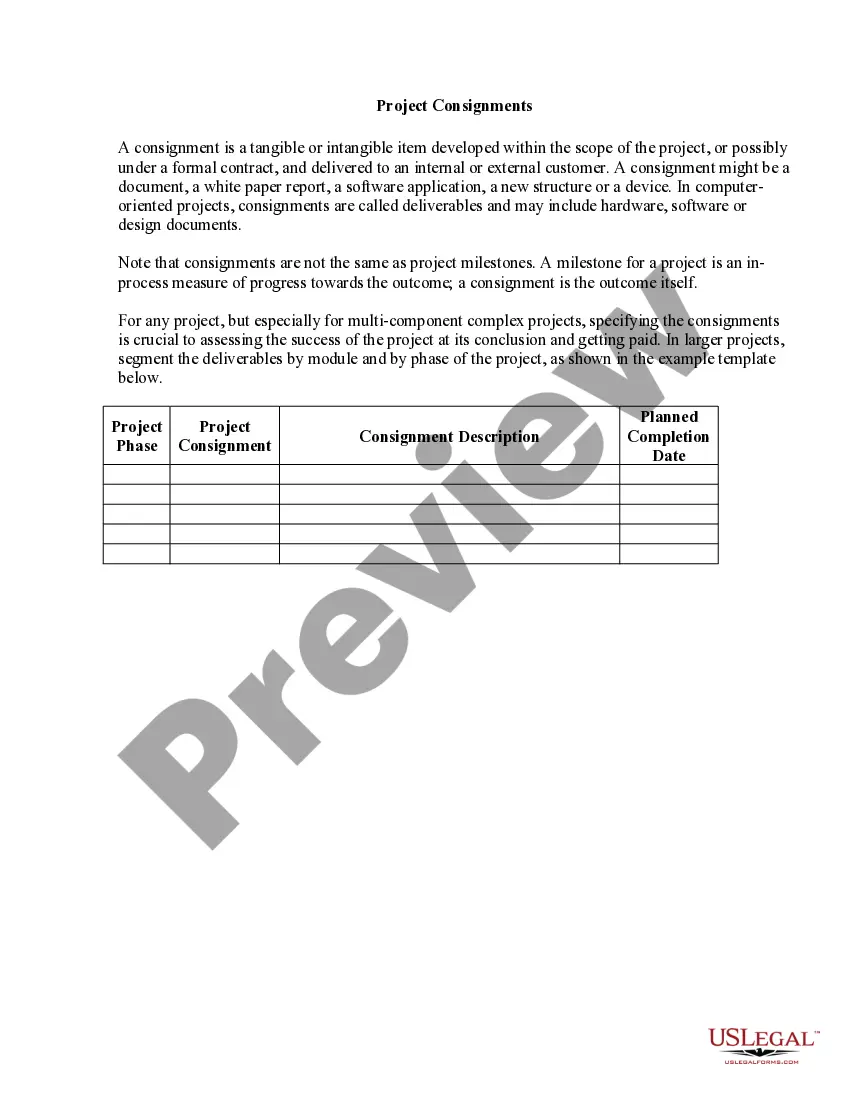
Project Consignments
About this form
The Project Consignments form is a legal document that outlines the tangible or intangible items produced during a project, commonly referred to as deliverables. It specifies the items delivered to an internal or external customer, differentiating between these consignments and project milestones, which are progress markers. Accurately defining these consignments is essential for evaluating project success and ensuring proper payment upon completion. This form is particularly helpful in managing complex projects with multiple components and phases.
Main sections of this form
- Project Phase: Indicates the specific phase of the project related to the consignment.
- Project Consignment: Lists the actual item or service being delivered.
- Consignment Description: Provides a detailed description of the item or service.
- Planned Completion Date: Specifies when the consignment is expected to be delivered.
When to use this document
You should use the Project Consignments form when managing a project that involves various deliverables. This includes projects in technical fields such as software development, where tangible items like applications, hardware, or design documents are involved. It is especially crucial in complex projects, where clear documentation of responsibilities and expectations can prevent misunderstandings and ensure a smooth project delivery.
Who this form is for
- Project managers overseeing projects with multiple deliverables.
- Teams involved in the development of software, hardware, or other technical products.
- Businesses that require formal documentation for customer deliveries.
- Contractors or freelancers needing a structured approach to project deliverables.
Instructions for completing this form
- Identify the project phases relevant to your project.
- List each project consignment as a separate entry.
- Provide a clear description for each consignment to ensure understanding.
- Enter the planned completion date for each consignment to set clear expectations.
- Review all entries for accuracy before finalizing the document.
Does this document require notarization?
Notarization is not commonly needed for this form. However, certain documents or local rules may make it necessary. Our notarization service, powered by Notarize, allows you to finalize it securely online anytime, day or night.
Get your form ready online
Our built-in tools help you complete, sign, share, and store your documents in one place.
Make edits, fill in missing information, and update formatting in US Legal Forms—just like you would in MS Word.
Download a copy, print it, send it by email, or mail it via USPS—whatever works best for your next step.
Sign and collect signatures with our SignNow integration. Send to multiple recipients, set reminders, and more. Go Premium to unlock E-Sign.
If this form requires notarization, complete it online through a secure video call—no need to meet a notary in person or wait for an appointment.
We protect your documents and personal data by following strict security and privacy standards.

Make edits, fill in missing information, and update formatting in US Legal Forms—just like you would in MS Word.

Download a copy, print it, send it by email, or mail it via USPS—whatever works best for your next step.

Sign and collect signatures with our SignNow integration. Send to multiple recipients, set reminders, and more. Go Premium to unlock E-Sign.

If this form requires notarization, complete it online through a secure video call—no need to meet a notary in person or wait for an appointment.

We protect your documents and personal data by following strict security and privacy standards.
Typical mistakes to avoid
- Failing to clearly describe each consignment, leading to confusion.
- Not specifying completion dates, which can cause project delays.
- Mixing consignments with milestones, which could result in unclear expectations.
- Omitting relevant project phases, making tracking difficult.
Benefits of using this form online
- Convenient access to a ready-to-use template that saves time.
- Editable format allows users to customize consignments as needed.
- Reliability of attorney-drafted content ensures legal compliance.
Looking for another form?

Form popularity
FAQ
Consigned goods are products not owned by the party in physical possession of them. The party holding the goods (the consignee) has typically been authorized by the owner of the goods (the consignor) to sell the goods.
The two types of consignment are: Outward Consignment: When goods are sent from one country to another for sale, the consignment is called outward consignment.Inward Consignment: When the goods are sold domestically for sale then it is called inward consignment. X Sent some goods to Y for sale.
Examples of goods often sold on consignment include light bulbs, produce, eggs, poultry, magazines, newspapers, Christmas decorations, garden seeds, batteries for flashlights and potted plants such as those found in supermarkets.
A consignment agreement is a contract between the consignor and the consignee, and should include these basic provisions: Parties. Provide the names and addresses of the consignor and the consignee. Item(s) for sale.Pricing.Payment.Expenses.Record-keeping.Ownership.Insurance.
Examples of goods often sold on consignment include light bulbs, produce, eggs, poultry, magazines, newspapers, Christmas decorations, garden seeds, batteries for flashlights and potted plants such as those found in supermarkets.
When the consignor sends goods to the consignee, a journal entry is not needed. However, when the consignee sells the goods received, they pay the consignor a predetermined sale amount. The consignor would then record a debit to cash and a credit to sales.
For example, a consignment store might sell previously owned prom dresses by offering to pay a 20% revenue fee to anyone who wants to sell a dress through their store. Some examples of goods you may often see for sale using the consignment business model include: Antiques and collectibles. Magazines and newspapers.