Sample Letter for Persuasion - Government Official
Overview of this form
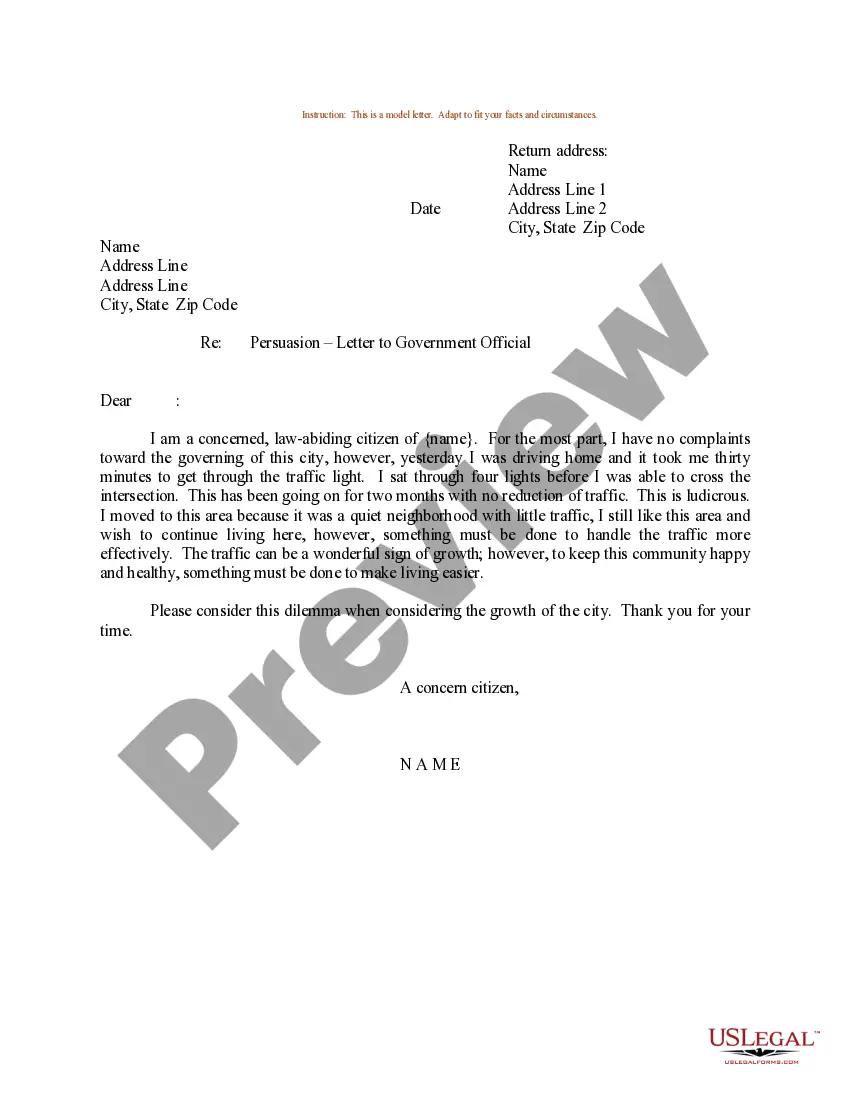
The Sample Letter for Persuasion - Government Official is a template designed to assist individuals in drafting a persuasive letter to a government official. This form provides a structured format, making it easier for users to effectively communicate their concerns or requests on various issues. Unlike generic letter templates, this form is focused specifically on addressing government officials, enhancing its relevance and effectiveness.
Key components of this form
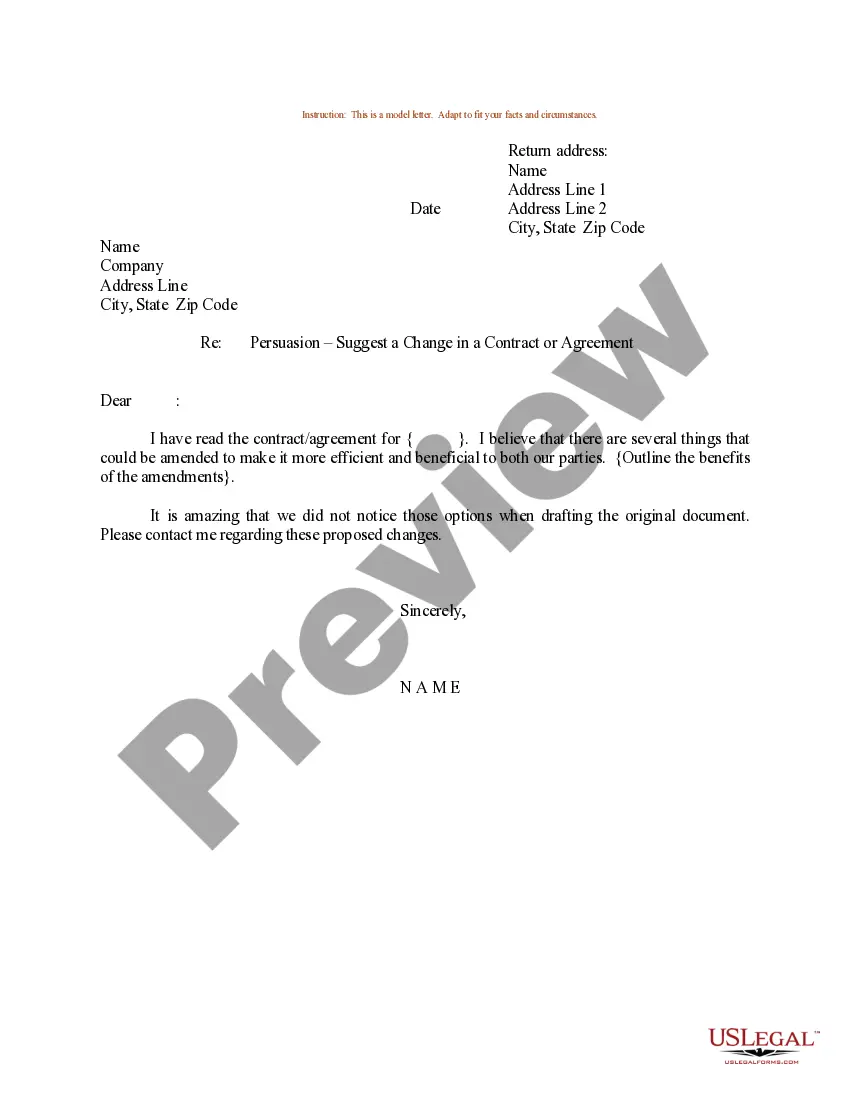
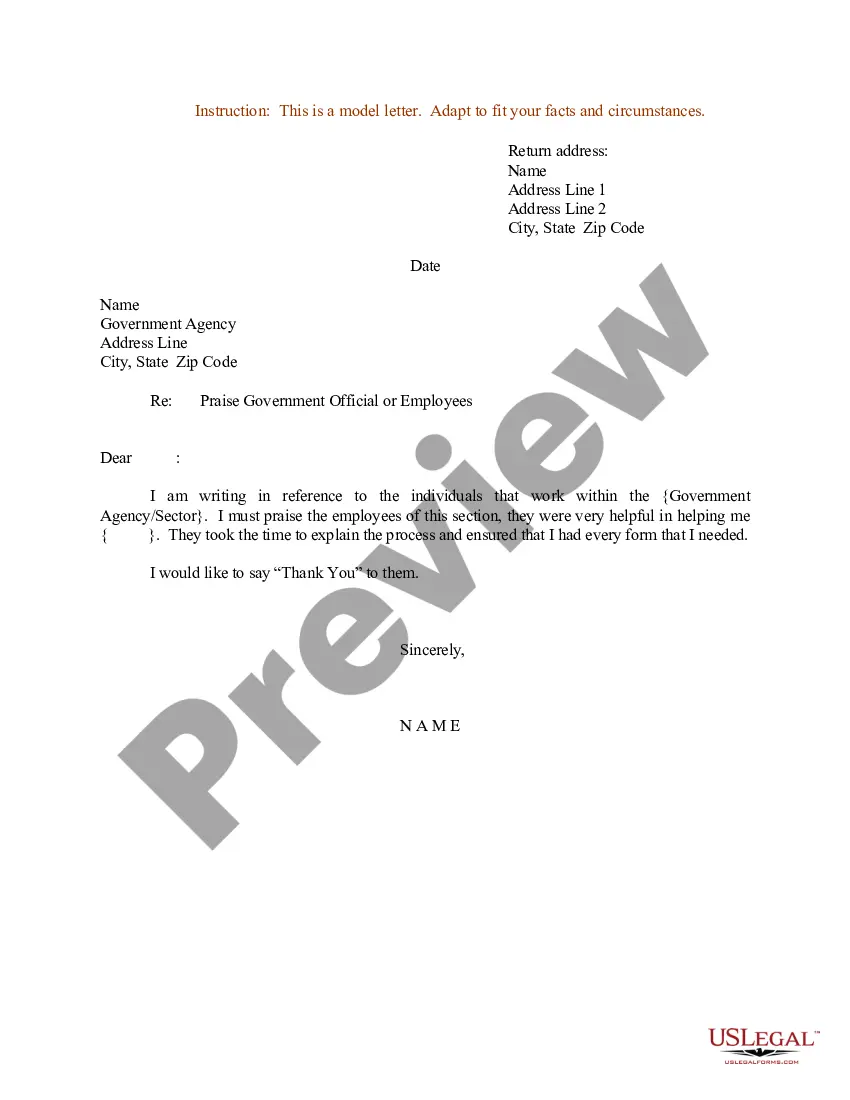
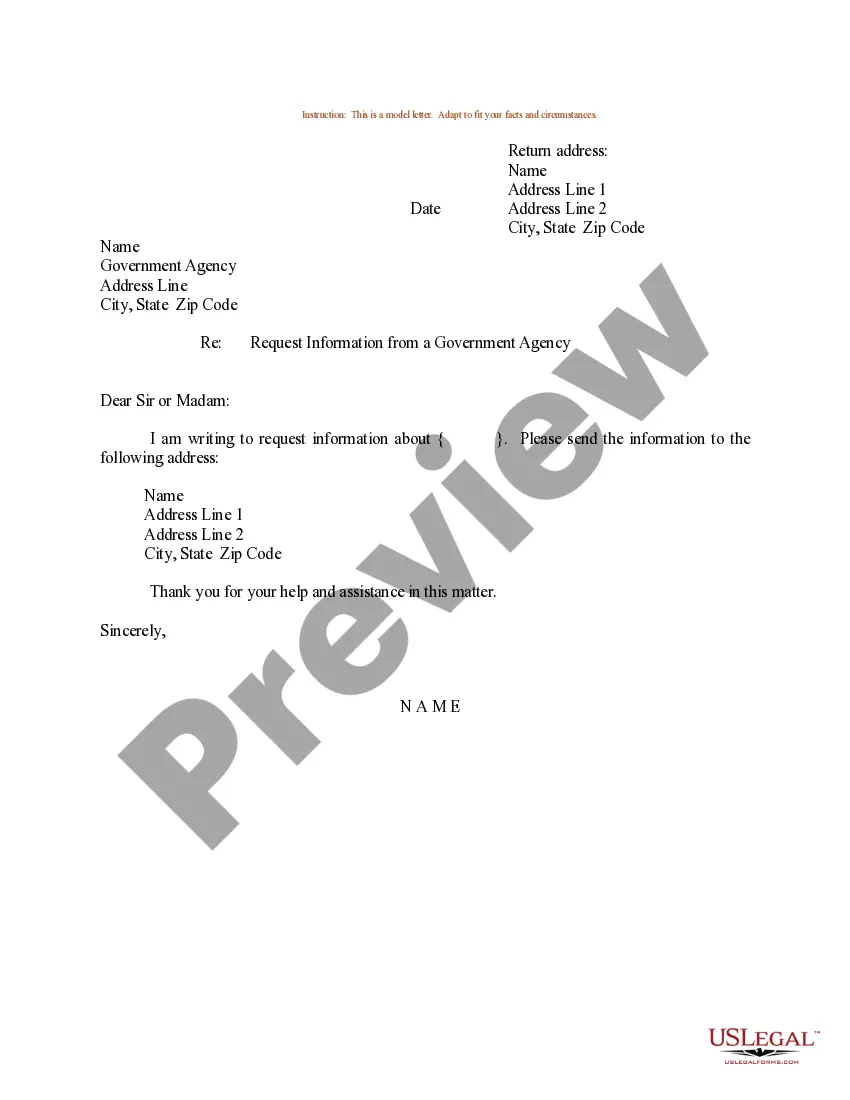
- Return address section for the sender's details.
- Date field for when the letter is written.
- Recipient's address section for the government official's contact information.
- Subject line specifically indicating that this is a persuasion letter.
- Body section for articulating the concerns or requests of the citizen.
When to use this document
This form is useful when you need to express your opinions, concerns, or requests to a government official. Scenarios may include seeking assistance on local issues, advocating for community projects, or addressing legislative matters. Using this template can streamline your communication, ensuring clarity and professionalism.
Who needs this form
- Citizens concerned about local or state issues.
- Advocates seeking to influence government policies.
- Individuals looking to engage with their elected representatives.
Steps to complete this form
- Fill in your return address at the top of the letter.
- Add the date when you are sending the letter.
- Input the recipient's address, ensuring to format it correctly.
- Clearly state the subject line indicating itâs a persuasion letter.
- Compose the body, focusing on your main arguments and requests.
- Conclude with a polite closing and your signature.
Does this document require notarization?
This form does not typically require notarization unless specified by local law. Always check local regulations to verify if notarization is necessary for your specific communication.
Get your form ready online
Our built-in tools help you complete, sign, share, and store your documents in one place.
Make edits, fill in missing information, and update formatting in US Legal Forms—just like you would in MS Word.
Download a copy, print it, send it by email, or mail it via USPS—whatever works best for your next step.
Sign and collect signatures with our SignNow integration. Send to multiple recipients, set reminders, and more. Go Premium to unlock E-Sign.
If this form requires notarization, complete it online through a secure video call—no need to meet a notary in person or wait for an appointment.
We protect your documents and personal data by following strict security and privacy standards.

Make edits, fill in missing information, and update formatting in US Legal Forms—just like you would in MS Word.

Download a copy, print it, send it by email, or mail it via USPS—whatever works best for your next step.

Sign and collect signatures with our SignNow integration. Send to multiple recipients, set reminders, and more. Go Premium to unlock E-Sign.

If this form requires notarization, complete it online through a secure video call—no need to meet a notary in person or wait for an appointment.

We protect your documents and personal data by following strict security and privacy standards.
Common mistakes
- Neglecting to include a clear subject line.
- Forgetting to proofread for spelling and grammar errors.
- Using overly complex language instead of clear, direct communication.
Advantages of online completion
- Convenient access to a professionally crafted template.
- Easy customization to fit your unique situation.
- Instant downloadable format for quick use and distribution.
Legal use & context
- This letter is considered a formal communication and can strengthen your position when engaging with government officials.
- While not legally binding, it establishes a record of your concerns or requests.
- Keep in mind that responses from officials are not guaranteed.
What to keep in mind
- This is a template designed for effective communication with government officials.
- Clarity and specificity in both the subject and body of the letter are essential.
- Using this form can facilitate user engagement in governmental processes.
Looking for another form?
Form popularity
FAQ
A Persuasive Text is a form of non-fiction writing which aims to convince the reader of a certain point of view. Adverts and newspaper columns are good examples of persuasive writing.
Pick a topic you're passionate about. You'll do your best persuading when it's something you truly believe in. Know your audience. Hook the reader's attention. Research both sides. Be empathetic. Ask rhetorical questions. Emphasize your point. Repeat yourself.
If you are writing about an issue, make your position clear right from the start. Explain the issue and clarify your position on it. Support your stance with strong evidence and logical arguments. Tell the reader what you think he/she should do about the problem. Close with a call to action.
Consider to whom the letter is intended. For elected federal and state officials, use the term "Honorable" before their names. Address a senator, chairman or ambassador with their title preceding their last name; for example, write Senator Adam Johns as the first line of address.
Know your addressee. Do not be verbose. Make your letter easy to read. Add call to action. Convince but do not demand. Do not be burdensome. Write in a friendly way and appeal to the reader's feelings. Remain polite and professional.
Sender's address is usually written in 3-4 lines. The subject of the letter should always be underlined. Informal salutations like Dear or My dear should not be used. The introductory paragraph of body should tell the purpose of the letter.
Address or greet the concerned person properly like Dear Sir/Madam. Always mention the subject of writing the letter. Be concise in your letter. The tone of the letter should be very polite and not harsh. Write in a proper format and take care of the presentation of a letter. Mention the address and date correctly.
Pick a topic you're passionate about. You'll do your best persuading when it's something you truly believe in. Know your audience. Hook the reader's attention. Research both sides. Be empathetic. Ask rhetorical questions. Emphasize your point. Repeat yourself.
Establish trust and develop credibility. Understand the reader's purpose and align your own. Pay attention to language. Consider tone. Use rhetoric and repetition.