Sample Letter to Foreclosure Attorney - After Foreclosure - Did not Receive Notice
Understanding this form
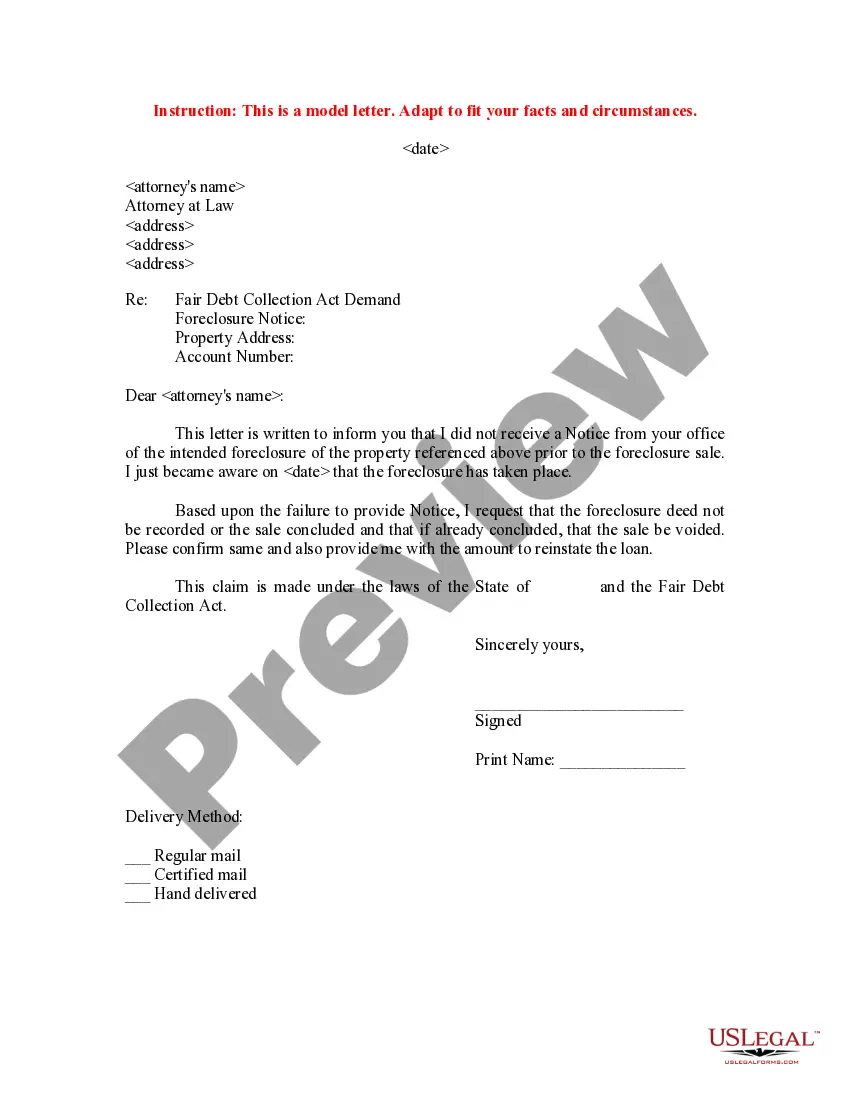
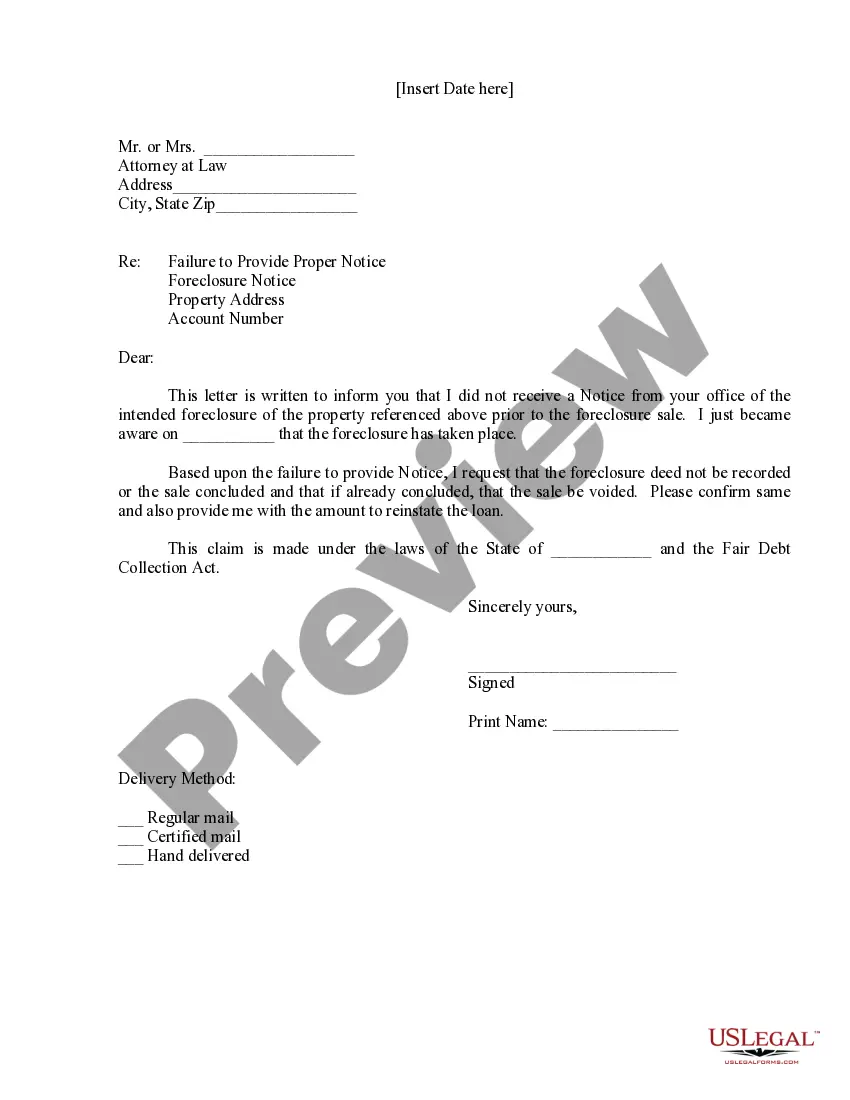
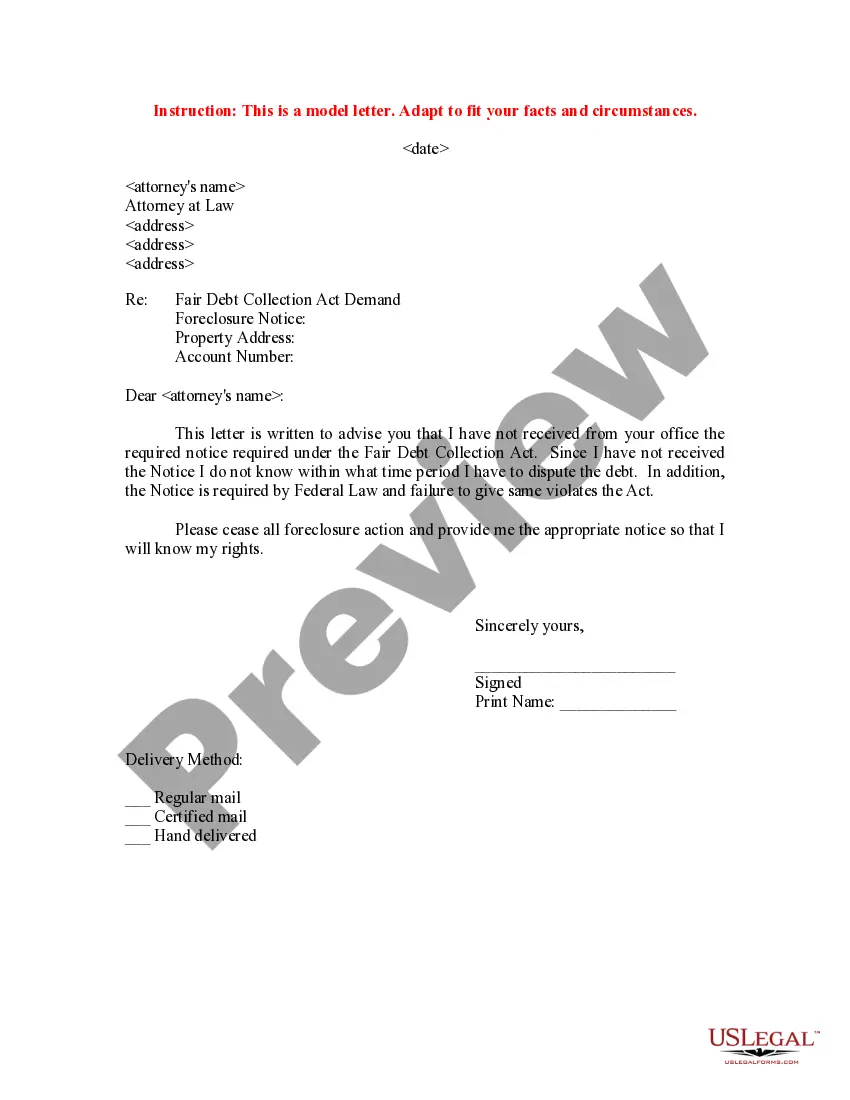
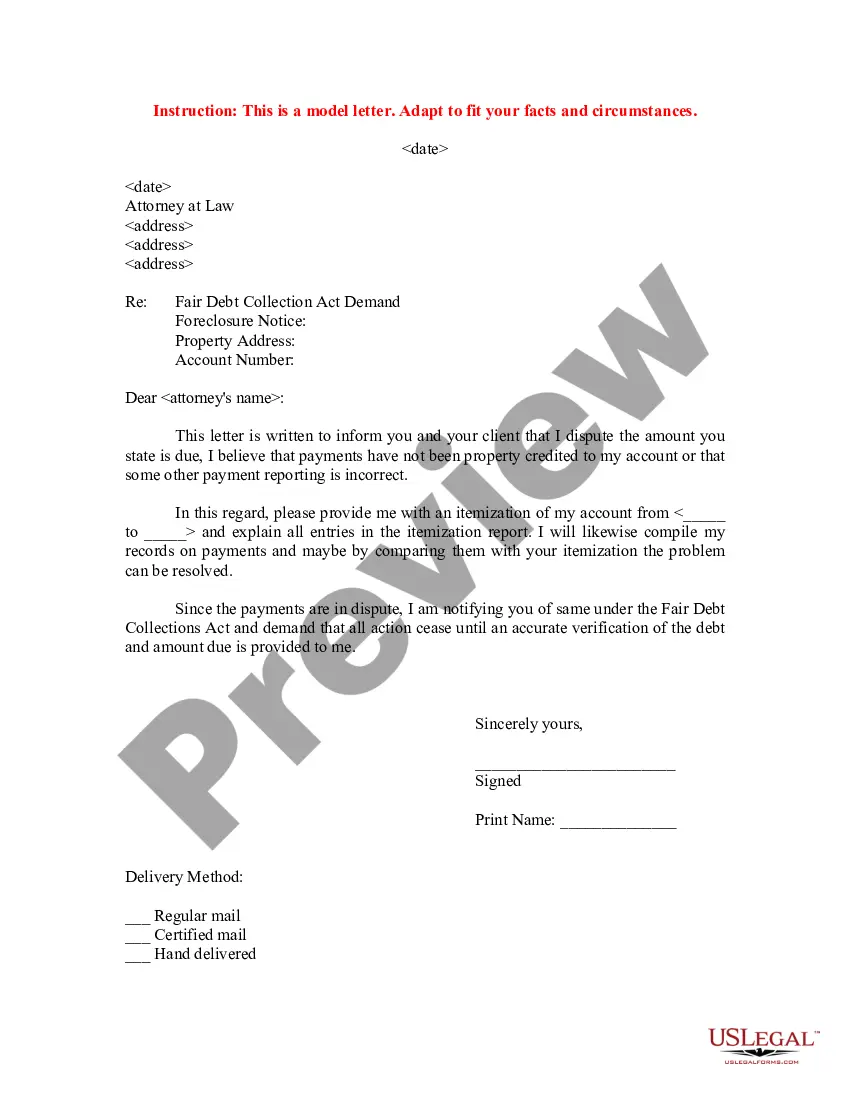
This Sample Letter to Foreclosure Attorney - After Foreclosure - Did not Receive Notice is a template that assists individuals in addressing issues related to foreclosure. It enables homeowners to formally request that their foreclosure deed not be recorded if they did not receive proper notice of the foreclosure process. This letter serves a distinct purpose compared to other forms, focusing specifically on communication with a foreclosure attorney regarding potential violations of the Fair Debt Collection Act.
Form components explained
- Date: Include the date the letter is prepared.
- Attorneys' name: The name of the foreclosure attorney.
- Address: The complete mailing address of the attorney.
- Re: Reference line indicating the purpose of the letter.
- Demand statement: A formal request regarding the recording of the foreclosure deed and reinstatement of the loan.
- Confirmation request: An ask for a confirmation and reinstatement amount.
Situations where this form applies
This form should be used when a homeowner has experienced a foreclosure without receiving the required notice. It is particularly relevant if the homeowner believes that their rights under the Fair Debt Collection Act have been violated and seeks to remedy the situation through the attorney responsible for the foreclosure proceedings.
Who can use this document
- Homeowners who have undergone foreclosure.
- Individuals who did not receive notice of their foreclosure.
- Those seeking to contest the validity of a foreclosure sale.
- People looking to reinstate their mortgage loan after a foreclosure.
How to prepare this document
- Enter the date at the top of the letter.
- Fill in the foreclosure attorney's name in the designated area.
- Provide the complete address of the attorney.
- State the subject of the letter clearly using the reference line.
- Clearly articulate your demand regarding the foreclosure deed and loan reinstatement.
- Request confirmation and specify your need for the reinstatement amount.
Does this document require notarization?
This form does not typically require notarization unless specified by local law. It is recommended, however, to check specific state requirements or consult a legal professional if needed.
Get your form ready online
Our built-in tools help you complete, sign, share, and store your documents in one place.
Make edits, fill in missing information, and update formatting in US Legal Forms—just like you would in MS Word.
Download a copy, print it, send it by email, or mail it via USPS—whatever works best for your next step.
Sign and collect signatures with our SignNow integration. Send to multiple recipients, set reminders, and more. Go Premium to unlock E-Sign.
If this form requires notarization, complete it online through a secure video call—no need to meet a notary in person or wait for an appointment.
We protect your documents and personal data by following strict security and privacy standards.

Make edits, fill in missing information, and update formatting in US Legal Forms—just like you would in MS Word.

Download a copy, print it, send it by email, or mail it via USPS—whatever works best for your next step.

Sign and collect signatures with our SignNow integration. Send to multiple recipients, set reminders, and more. Go Premium to unlock E-Sign.

If this form requires notarization, complete it online through a secure video call—no need to meet a notary in person or wait for an appointment.

We protect your documents and personal data by following strict security and privacy standards.
Mistakes to watch out for
- Failing to include the proper date.
- Using an incorrect attorney name or address.
- Not clearly stating the demand or request for confirmation.
- Omitting personal identification details that may help in processing.
Benefits of using this form online
- Convenience of accessing a legally sound template from anywhere.
- Editable format enabling users to customize their information easily.
- Reliability of having a form drafted by licensed attorneys.
- This letter serves as a formal communication with your attorney regarding legal rights under the Fair Debt Collection Act.
- It may aid in challenging the validity of the foreclosure if notice was improperly served.
- Keep a copy of the letter for your records as proof of your communication.
Key takeaways
- This letter serves as a formal request to challenge a foreclosure due to lack of notice.
- Proper completion is essential to effectively communicate your legal position.
- It is crucial to understand and apply state-specific rules regarding foreclosure processes.
Looking for another form?
Form popularity
FAQ
The borrower defaults on the loan. The lender issues a notice of default (NOD). A notice of trustee's sale is recorded in the county office. The lender tries to sell the property at a public auction.
In most states, lenders are required to provide a homeowner with sufficient notice of default. The lender must also provide notice of the property owner's right to cure the default before the lender can initiate a foreclosure proceeding. Written proof of money owed under the mortgage.
Generally, a homeowner has to be at least 120 days delinquent before a mortgage servicer starts a foreclosure. Applying for a foreclosure avoidance option, called loss mitigation, might delay the start date even further.
The Notice of Default starts the official foreclosure process. This notice is issued 30 days after the fourth missed monthly payment. From this point onwards, the borrower will have 2 to 3 months, depending on state law, to reinstate the loan and stop the foreclosure process.
You can stop the foreclosure process by informing your lender that you will pay off the default amount and extra fees. Your lender would prefer to have the money much more than they would have your home, so unless there are extenuating circumstances, this should work.
Proving Wrongful Foreclosure If you wish to sue the bank for wrongful foreclosure, you must prove the following: The lender owed you, the borrower, a legal duty. The lender breached that duty. The breach of duty caused your injury or loss (damages)
Lenders will seize the home, which is typically used as collateral for the loan and will put the property up for sale to try and recoup losses. The foreclosure process from beginning to end typically takes a lender about 18 months to foreclose on a property during normal times.
"Commencement of Foreclosure" for HUD's purposes is the first public action required by law such as filing a complaint or petition, recording a notice of default, or publication of a notice of sale.
Borrowers may not avoid foreclosure on their property, for example, simply on the basis of a lost promissory note. The lender has a right to "re-establish" the note legally as long as it has not sold or transferred the note to another party.