Waiver, Release and Authorization to Use a Description of Patient's Psychological History and Treatment in a Book without Identifying the Name of Patient
Understanding this form
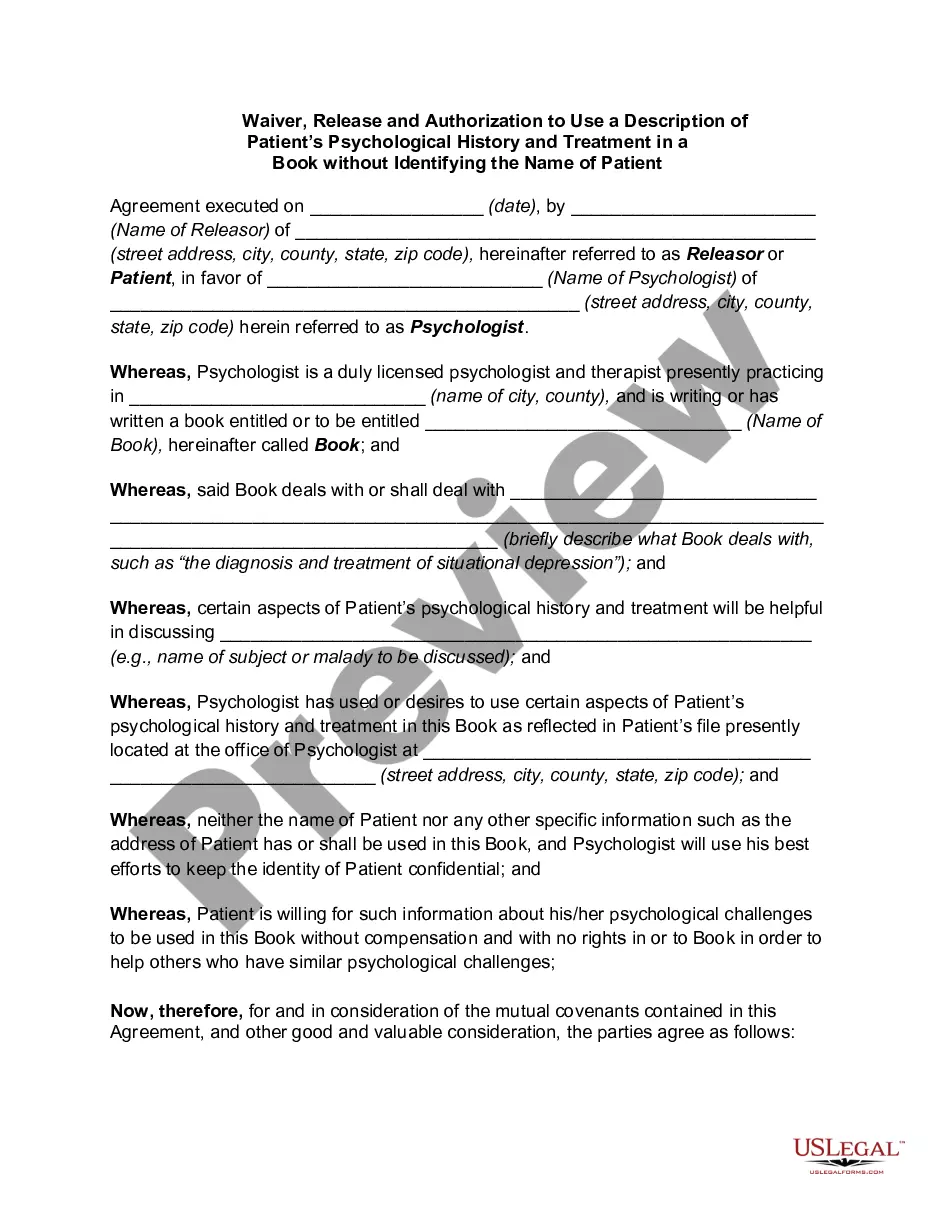
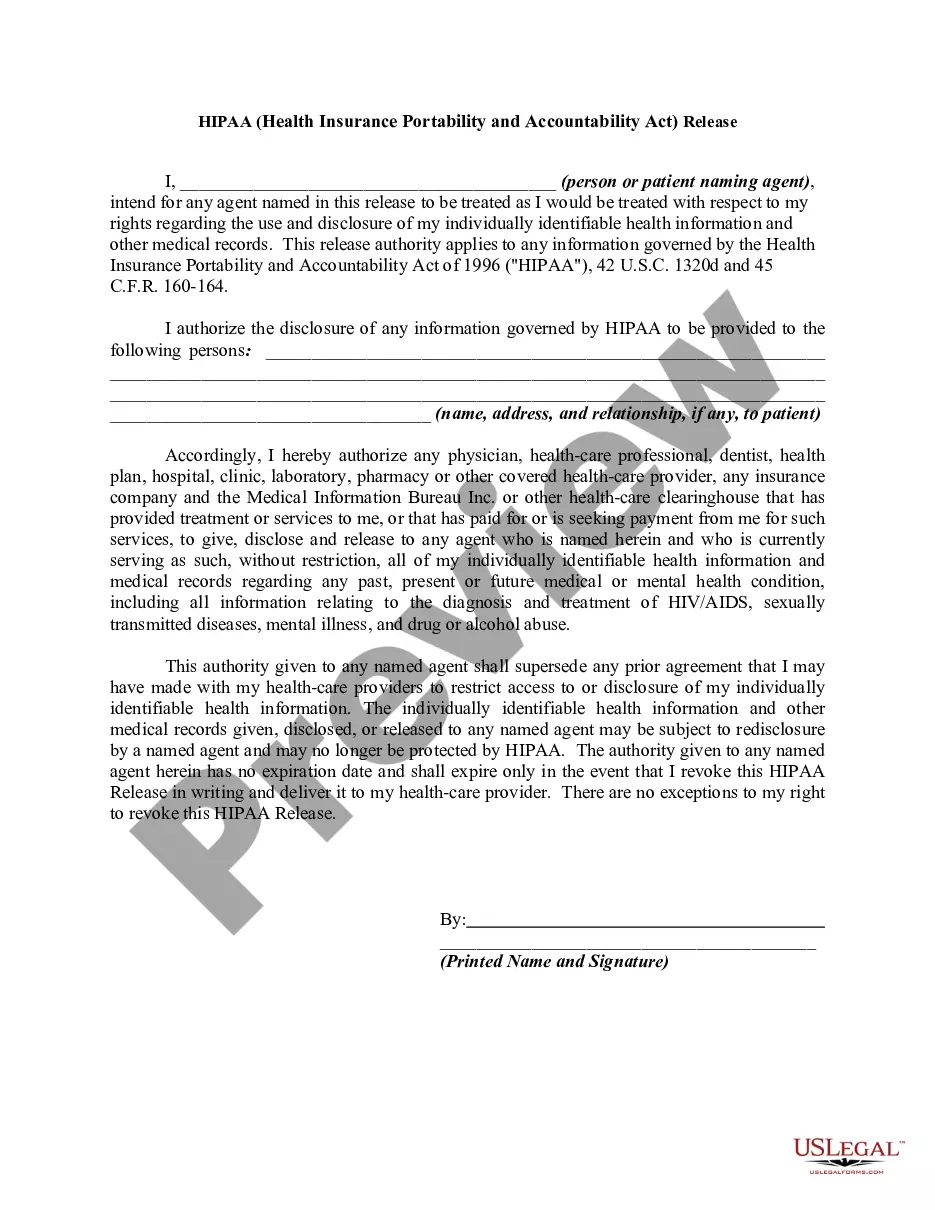
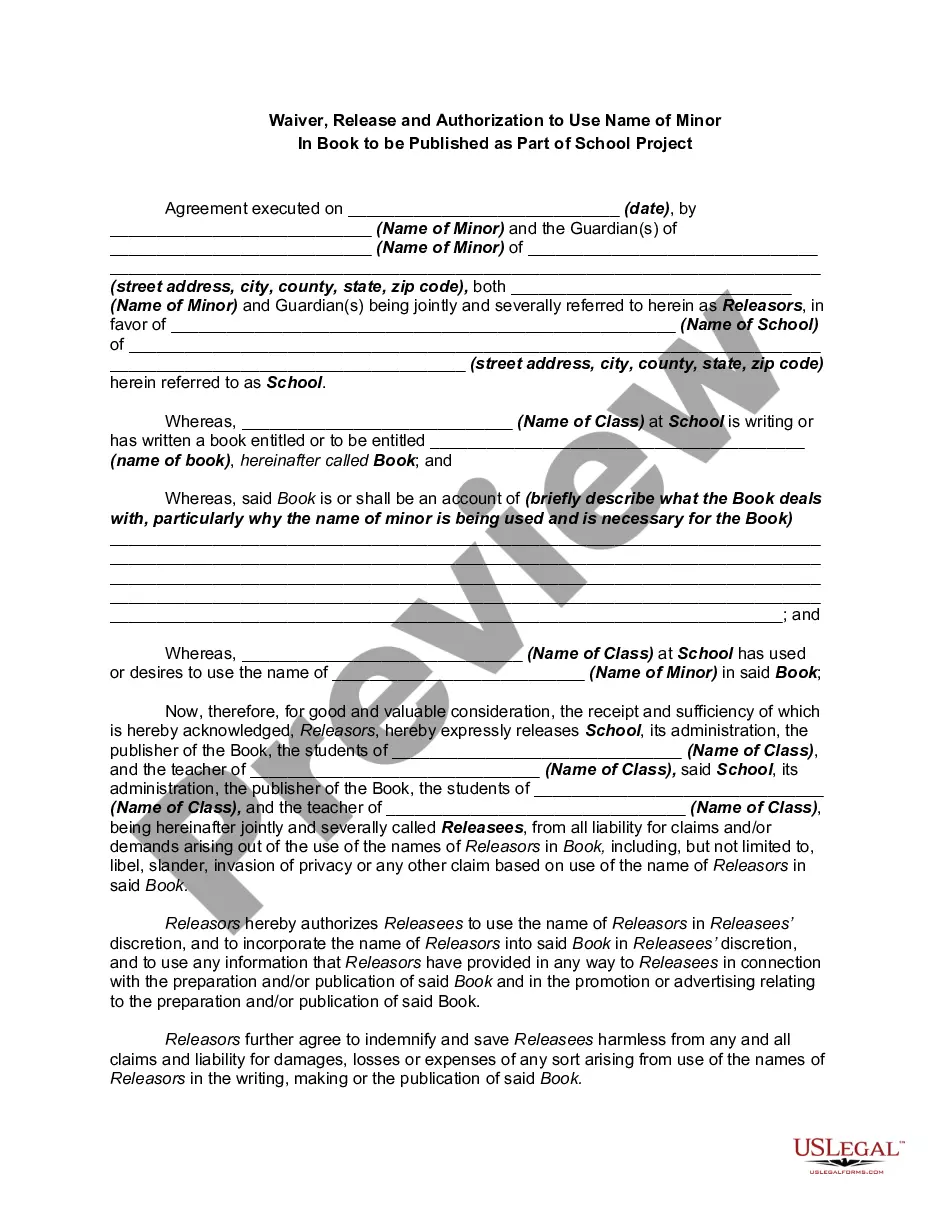
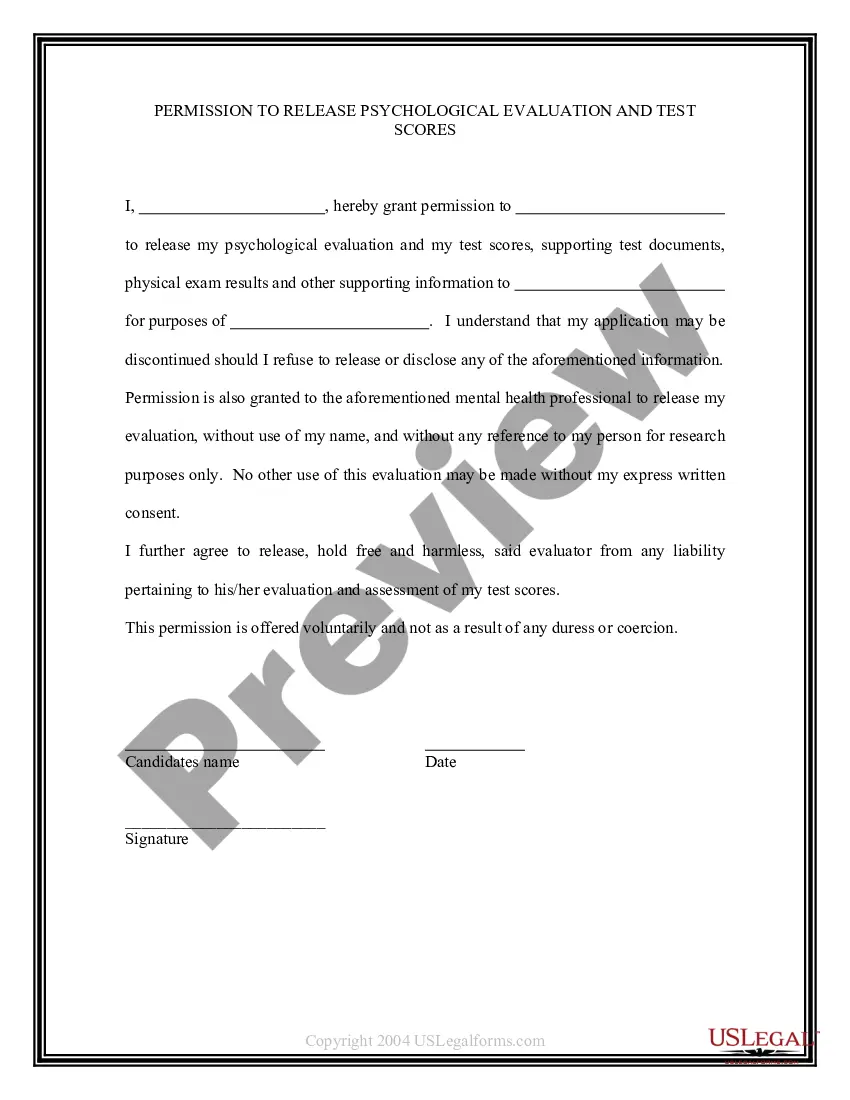
The Waiver, Release and Authorization to Use a Description of Patient's Psychological History and Treatment in a Book without Identifying the Name of Patient is a legal document that allows a psychologist to utilize a patient's psychological history in a published work while ensuring the patient's anonymity. This form is specifically designed to protect the privacy of the patient while permitting the psychologist to share valuable insights from their professional experiences. Unlike other waivers, this document focuses on the use of sensitive psychological information for educational or therapeutic purposes without revealing the patient's identity.
What’s included in this form
- Agreement date and identification of the Releasor (patient) and Psychologist.
- A description of the book and the relevant psychological topics discussed.
- A commitment to confidentiality, ensuring the patientâs name and identifying information are not disclosed.
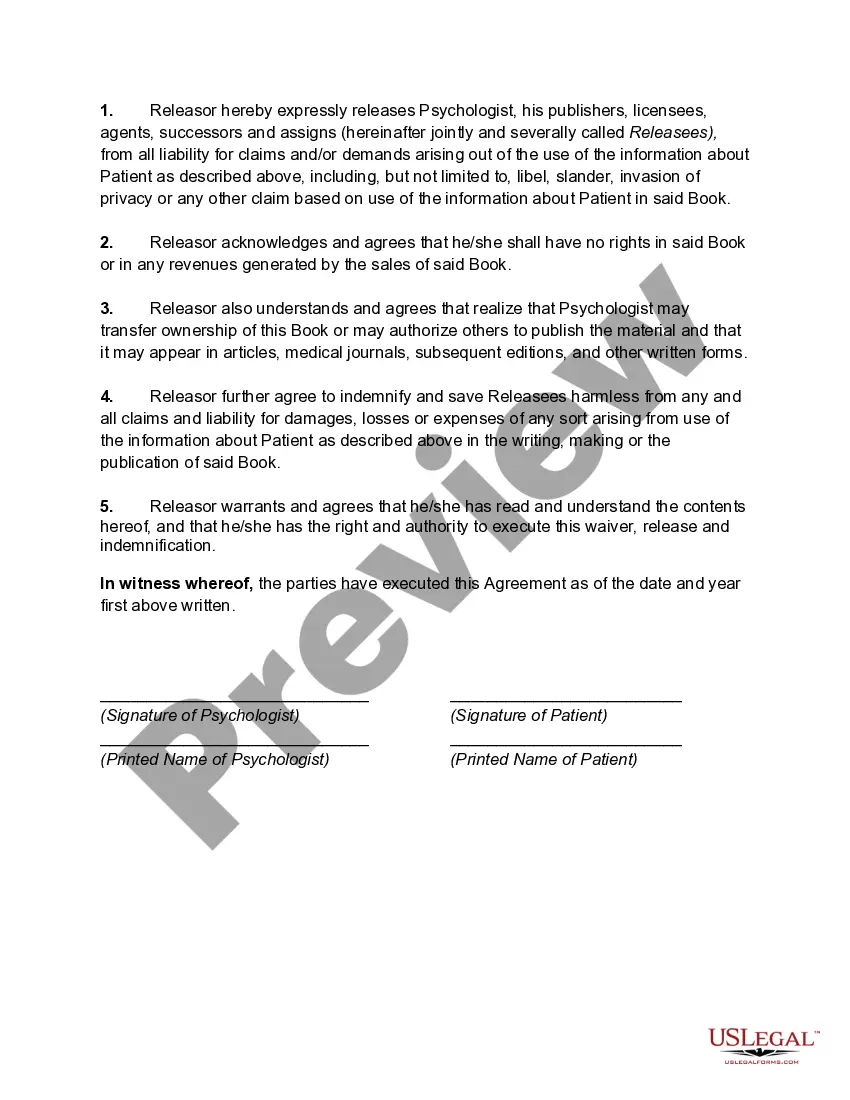
- A release of liability for the Psychologist and associated parties regarding the use of the patientâs information.
- An acknowledgment that the patient has no rights to the book or any generated revenues.
- Indemnification clause protecting the Psychologist against claims related to the use of the information.
When to use this document
This form should be used when a psychologist wishes to incorporate elements of a patient's psychological history into a book, particularly when aiming to illustrate important psychological principles or cases while maintaining the patient's confidentiality. It is suitable when the patient is willing to allow such use without seeking financial compensation or credit in the publication.
Intended users of this form
- Psychologists and licensed therapists planning to write a book that includes case studies or psychological insights drawn from their practice.
- Patients who wish to permit their psychologist to share specific details about their treatment history anonymously.
- Any professional seeking to document psychological issues for educational purposes while safeguarding patient confidentiality.
Completing this form step by step
- Fill in the agreement date at the top of the form.
- Provide the name and address of the Releasor (patient) in the designated sections.
- Enter the name and address of the Psychologist and details about the book.
- Clearly describe the psychological topics to be discussed within the publication.
- Include signatures and printed names of both the Psychologist and the patient at the end of the document.
Notarization requirements for this form
This form does not typically require notarization unless specified by local law. However, notarization can add an extra layer of authenticity to the document and may be advisable depending on the context in which it is used.
Get your form ready online
Our built-in tools help you complete, sign, share, and store your documents in one place.
Make edits, fill in missing information, and update formatting in US Legal Forms—just like you would in MS Word.
Download a copy, print it, send it by email, or mail it via USPS—whatever works best for your next step.
Sign and collect signatures with our SignNow integration. Send to multiple recipients, set reminders, and more. Go Premium to unlock E-Sign.
If this form requires notarization, complete it online through a secure video call—no need to meet a notary in person or wait for an appointment.
We protect your documents and personal data by following strict security and privacy standards.

Make edits, fill in missing information, and update formatting in US Legal Forms—just like you would in MS Word.

Download a copy, print it, send it by email, or mail it via USPS—whatever works best for your next step.

Sign and collect signatures with our SignNow integration. Send to multiple recipients, set reminders, and more. Go Premium to unlock E-Sign.

If this form requires notarization, complete it online through a secure video call—no need to meet a notary in person or wait for an appointment.

We protect your documents and personal data by following strict security and privacy standards.
Mistakes to watch out for
- Failing to include the date of the agreement.
- Not detailing the contents of the book sufficiently to inform the patient.
- Leaving out any signatures or printed names, making the form legally unenforceable.
- Not consulting local laws which might require specific language or clauses.
Why complete this form online
- Convenience of accessing and completing the form from anywhere, at any time.
- Editability allows users to tailor the document to their specific circumstances easily.
- Reliable legal templates prepared by licensed attorneys ensuring compliance with legal standards.
Legal use & context
- This form provides legal protection for the psychologist against potential claims from the patient.
- The patient waives rights to compensation, allowing the psychologist to use the information freely.
- Ensures compliance with confidentiality norms within therapeutic settings.
Quick recap
- The form enables psychologists to share patient insights while ensuring anonymity.
- It includes essential components to protect both the psychologist and the patient.
- Consult local laws to ensure compliance with any state-specific requirements.
Looking for another form?
Form popularity
FAQ
To complete the DD Form 2870, please follow these instructions carefully: Block 1: Patient's name in this block. Block 2: Patient's date of birth in this block. Block 3: Patient's complete social security number in this block. Block 4: Indicate the date(s) of treatment you (the patient) wants released.
Please Print This form is used to release your protected health information as required by federal and state privacy laws. Your authorization allows the Health Plan (your health insurance carrier or HMO) to release your protected health information to a person or organization that you choose.
The HIPAA rules allow disclosure of information that is relevant to the caregiver's involvement in the patient's care.Unfortunately, although all release forms must be HIPAA-compliant, there is no standard form.
Health care providers will ask patients to sign a form saying that they received a copy of the notice of privacy practices. The law does not require patients to sign this. However, signing does not waive a patient's rights under HIPAA, and does not mean that the patient agrees with the privacy policy.
By signing an authorization to release information, a party is consenting to provide another party with access to otherwise confidential information or records about an individual. However, signing a release doesn't mean the complete loss of confidentiality because most authorization forms are subject to limitations.
HIPAA authorization is consent obtained from a patient or health plan member that permits a covered entity or business associate to use or disclose PHI to an individual/entity for a purpose that would otherwise not be permitted by the HIPAA Privacy Rule.
Q: Do I need to notarize the signed form? A: No. The HIPAA Privacy Rule does not require you to notarize authorization forms or have a witness.
At the outset, it is clear that GDPR covers citizens of the EU while HIPAA is restricted to American citizens and healthcare organizations.HIPAA, on the other hand, is an organization-centric regulation and any data handled by organizations outside the US do not come under the purview of HIPAA.
A HIPAA authorization form is a document in that allows an appointed person or party to share specific health information with another person or group. Your appointed person can be a doctor, a hospital, or a health care provider, as well as certain other entities such as an attorney.