Sample Letter forwarding Letter to Municipality regarding Cable Television Consumer Protection and Competition Act of 1992
Overview of this form
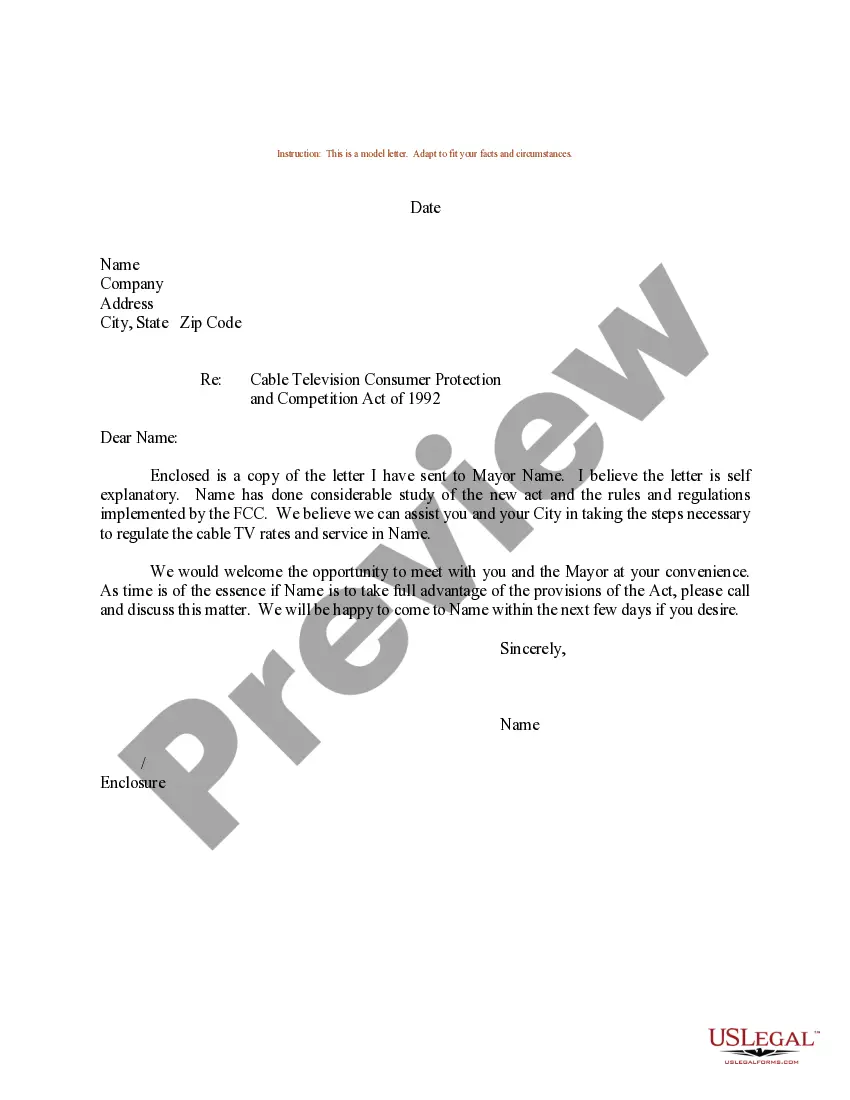
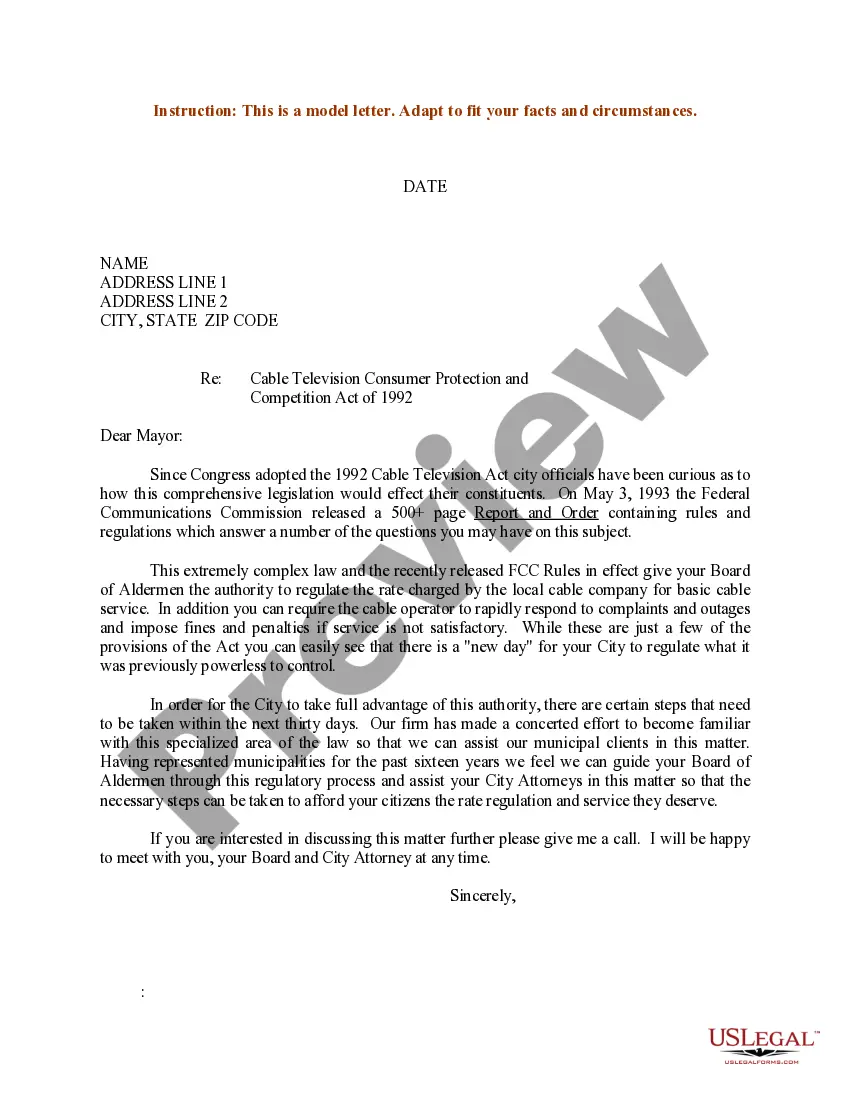
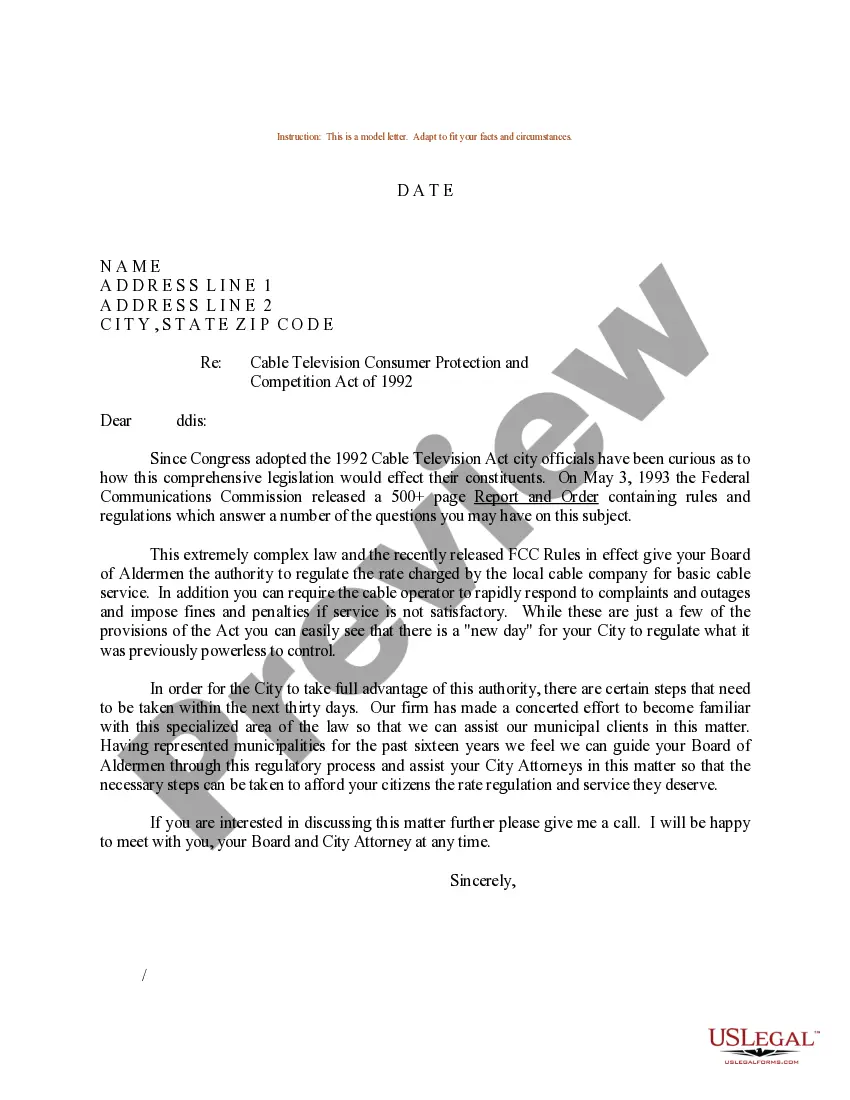
This form is a sample letter that serves as a template for communicating with local municipalities regarding the Cable Television Consumer Protection and Competition Act of 1992. It is designed to help residents or organizations inform their city officials about the provisions of the act and express their desire for regulatory action on cable television rates and services. Unlike other formal legal documents, this letter facilitates direct communication and advocacy, making it accessible for non-legal professionals to engage with municipal governance effectively.
Form components explained
- Date: Specify the date the letter is sent.
- Recipient Information: Include the name, company, address, city, state, and zip code of the recipient.
- Subject Line: Clearly state the subject of the letter regarding the Cable Television Consumer Protection and Competition Act.
- Introductory Greeting: Address the recipient respectfully with their name.
- Body Paragraph: Summarize your communication regarding the enclosed letter sent to the mayor and express your organization's expertise and intent to assist in local regulation efforts.
When this form is needed
This letter should be used when a resident or organization wants to formally communicate with their municipality about the implications of the Cable Television Consumer Protection and Competition Act of 1992. Scenarios may include advocating for fair cable rates, addressing service concerns, or requesting municipal action to regulate cable services. This form can be particularly useful during public hearings, community meetings, or as a follow-up to prior communications with local officials.
Who should use this form
- Residents wishing to advocate for better cable television services in their municipality.
- Organizations focused on consumer rights and advocacy regarding telecommunications.
- Community leaders or representatives who want to address municipal governance on behalf of their constituents.
How to complete this form
- Start by entering the date at the top of the letter.
- Fill in the recipient's name, company, address, city, state, and zip code accurately.
- Clearly state the subject of the letter in the subject line.
- Address the letter to the intended recipient using their name.
- Briefly summarize the purpose of the letter and mention any enclosed documents.
- Sign the letter with your name and provide your contact information if necessary.
Does this document require notarization?
Notarization is generally not required for this form. However, certain states or situations might demand it. You can complete notarization online through US Legal Forms, powered by Notarize, using a verified video call available anytime.
Get your form ready online
Our built-in tools help you complete, sign, share, and store your documents in one place.
Make edits, fill in missing information, and update formatting in US Legal Forms—just like you would in MS Word.
Download a copy, print it, send it by email, or mail it via USPS—whatever works best for your next step.
Sign and collect signatures with our SignNow integration. Send to multiple recipients, set reminders, and more. Go Premium to unlock E-Sign.
If this form requires notarization, complete it online through a secure video call—no need to meet a notary in person or wait for an appointment.
We protect your documents and personal data by following strict security and privacy standards.

Make edits, fill in missing information, and update formatting in US Legal Forms—just like you would in MS Word.

Download a copy, print it, send it by email, or mail it via USPS—whatever works best for your next step.

Sign and collect signatures with our SignNow integration. Send to multiple recipients, set reminders, and more. Go Premium to unlock E-Sign.

If this form requires notarization, complete it online through a secure video call—no need to meet a notary in person or wait for an appointment.

We protect your documents and personal data by following strict security and privacy standards.
Mistakes to watch out for
- Failing to include the date at the top of the letter.
- Not providing complete recipient information, which may delay the delivery.
- Omitting to clarify the subject of the letter, leading to confusion.
- Addressing the letter in a formal manner, which could appear unprofessional.
- Neglecting to proofread for spelling or grammatical errors before sending.
Why use this form online
- Easy access to a professionally crafted template that saves time.
- Editable format allows you to customize the letter to fit your specific needs.
- Quick download ensures you can start advocating immediately.
- Clear instructions simplify the process, making it accessible for everyone.
Looking for another form?


Form popularity
FAQ
Introduce yourself. mention the job (or kind of job) you're applying for (or looking for) show that your skills and experience match the skills and experience needed to do the job. encourage the reader to read your resume.
When to use a letter of transmittal A transmittal letter is normally used to communicate information in writing to recipients outside of your organization who are not fully involved in your project. Here are the most common uses for letters of transmittal: Scientific and technical reports.
Step 1: Put your contact details (and the employer's) in the header. Step 2: Address the hiring manager by their name. Step 3: Hook the hiring manager with a strong introduction. Step 4: Prove that you're the perfect candidate for the job.
/02c8f025402d0r.w025ad/ to send a letter, etc., especially from someone's old address to their new address, or to send a letter, email, etc. that you have received to someone else: I'll forward any mail to your new address.
Follow the directions from the job ad. Attach your resume and a cover letter in the proper format. Find the hiring manager's name and email address. Use a strong subject line. Make your resume email short. Finish with a call to action.
Don't use this overused opening line. I'm writing to apply for the role of2026 is the most overused opening line job seekers use on their cover letters. Cut meaningless buzzwords. Don't mention every past job. Use snappy, short words rather than long phrases.
More to the point, the Post Office confirms that your experience is likely to be fairly typical. Under something called the inland letter post scheme, you are allowed to forward a letter free of charge within 24 hours of receiving it. In practice, the 24-hour rule is not enforced.
Introduce yourself. mention the job (or kind of job) you're applying for (or looking for) show that your skills and experience match the skills and experience needed to do the job. encourage the reader to read your resume.