Payment on Specific Accounts
Overview of this form
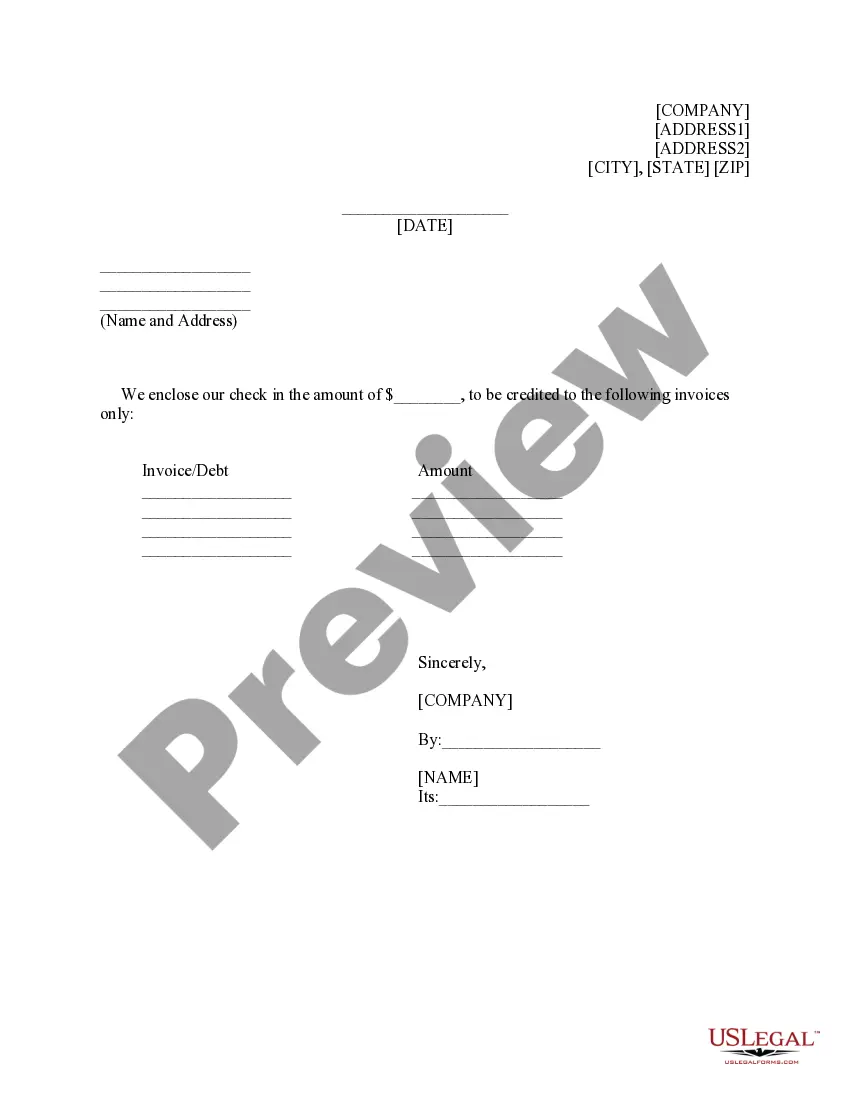
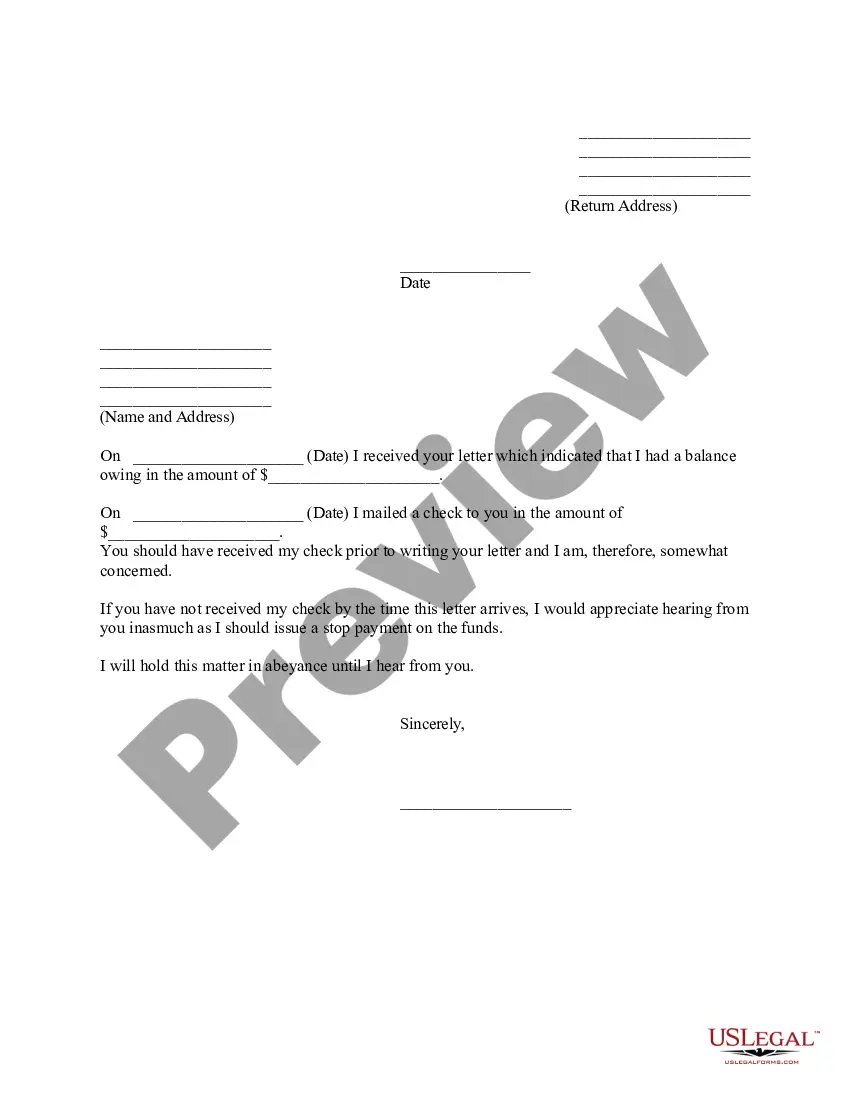
The Payment on Specific Accounts form is a legal document used to specify a payment directed towards certain invoices or debts. This form allows an individual or company to detail which invoices they wish the payment to be credited to, ensuring that funds are allocated accurately. Unlike general payment forms, this document focuses specifically on multiple invoices or debts, providing clarity for both the payer and the recipient.
Form components explained
- Sender's address information.
- Date of payment.
- Recipient's name and address.
- Enclosed check amount.
- List of invoices or debts being paid with corresponding amounts.
- Signature of the authorized representative.
When to use this document
This form is needed when making a payment that should be allocated to specific invoices or debts rather than a general account balance. It is particularly useful in scenarios where a company receives partial payments or when there are discrepancies in billing that need precise highlighting. Use this form to ensure that your payments are processed accurately and to prevent future disputes or confusion regarding outstanding balances.
Intended users of this form
- Businesses that manage multiple invoices from a supplier or service provider.
- Individuals making payments on personal loans or debts that involve multiple charges.
- Accounts payable departments needing clarity in payment processing.
Steps to complete this form
- Enter the sender's address, including street address, city, state, and ZIP code.
- Fill in the date of payment.
- Provide the recipient's name and address.
- Specify the payment amount to be enclosed.
- List each invoice or debt with the respective amounts to be credited.
- Have the authorized person sign and date the form, indicating their position within the company.
Does this form need to be notarized?
Notarization is generally not required for this form. However, certain states or situations might demand it. You can complete notarization online through US Legal Forms, powered by Notarize, using a verified video call available anytime.
Get your form ready online
Our built-in tools help you complete, sign, share, and store your documents in one place.
Make edits, fill in missing information, and update formatting in US Legal Forms—just like you would in MS Word.
Download a copy, print it, send it by email, or mail it via USPS—whatever works best for your next step.
Sign and collect signatures with our SignNow integration. Send to multiple recipients, set reminders, and more. Go Premium to unlock E-Sign.
If this form requires notarization, complete it online through a secure video call—no need to meet a notary in person or wait for an appointment.
We protect your documents and personal data by following strict security and privacy standards.

Make edits, fill in missing information, and update formatting in US Legal Forms—just like you would in MS Word.

Download a copy, print it, send it by email, or mail it via USPS—whatever works best for your next step.

Sign and collect signatures with our SignNow integration. Send to multiple recipients, set reminders, and more. Go Premium to unlock E-Sign.

If this form requires notarization, complete it online through a secure video call—no need to meet a notary in person or wait for an appointment.

We protect your documents and personal data by following strict security and privacy standards.
Mistakes to watch out for
- Failing to specify all relevant invoices or debts can lead to misallocation of payments.
- Leaving out the payment amount or entering an incorrect amount.
- Not including the correct recipient information which can delay processing.
- Omitting the signature or not having the form signed by an authorized representative.
Why complete this form online
- Convenient access to forms that can be downloaded and completed at your convenience.
- Editable fields allow for easy customization based on specific payment scenarios.
- Reliable legal templates drafted by licensed attorneys, ensuring you meet legal standards.
Legal use & context
- The form serves as a clear record of payments made towards specific debts, which can be important for legal and accounting purposes.
- Proper completion can help avoid misunderstandings with creditors regarding payment allocations.
Looking for another form?

Form popularity
FAQ
Accounts payable are bills a company must pay. It's the money a business owes suppliers for provided goods and services. Some examples of accounts payable include cleaning services, staff uniforms, software subscriptions, and office supplies. Accounts payable does not include payroll.
Payment on account is any partial payment of an amount that is owed, either to you or by you, that's not matched to a specific invoice.
When recording an account payable, debit the asset or expense account to which a purchase relates and credit the accounts payable account. When an account payable is paid, debit accounts payable and credit cash.
Accounts Payable Is A Liability. It is the sum of money that your business owes suppliers or creditors for products and services, which turns it into a liability rather than an asset.
Accounts payable is the money a company owes its vendors, while accounts receivable is the money that is owed to the company, typically by customers. When one company transacts with another on credit, one will record an entry to accounts payable on their books while the other records an entry to accounts receivable.
When a customer submits a payment on an account, your bookkeeper makes a journal entry of the amount and the transaction is considered "paid on account." This simply means the customer has made a payment ? which goes in the accounts receivable ledger ? on the full amount owed.