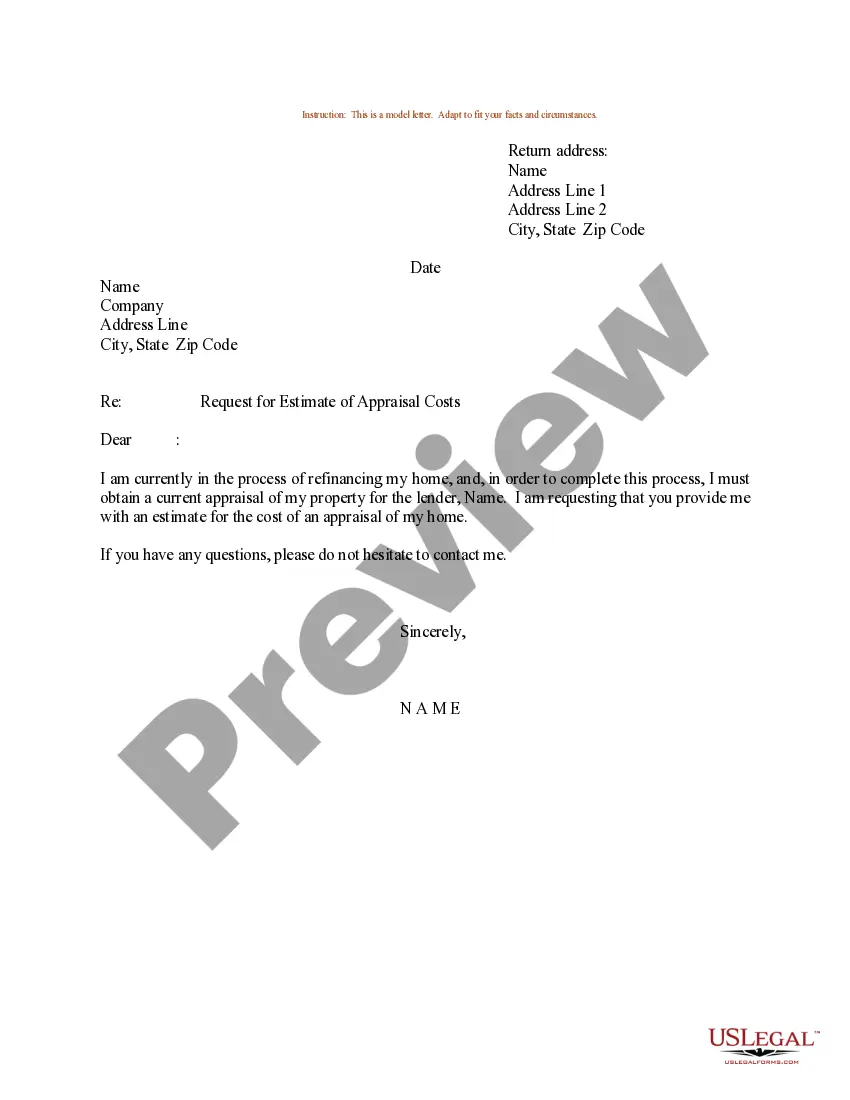
Sample Letter for Request for Estimate of Appraisal Costs
What this document covers
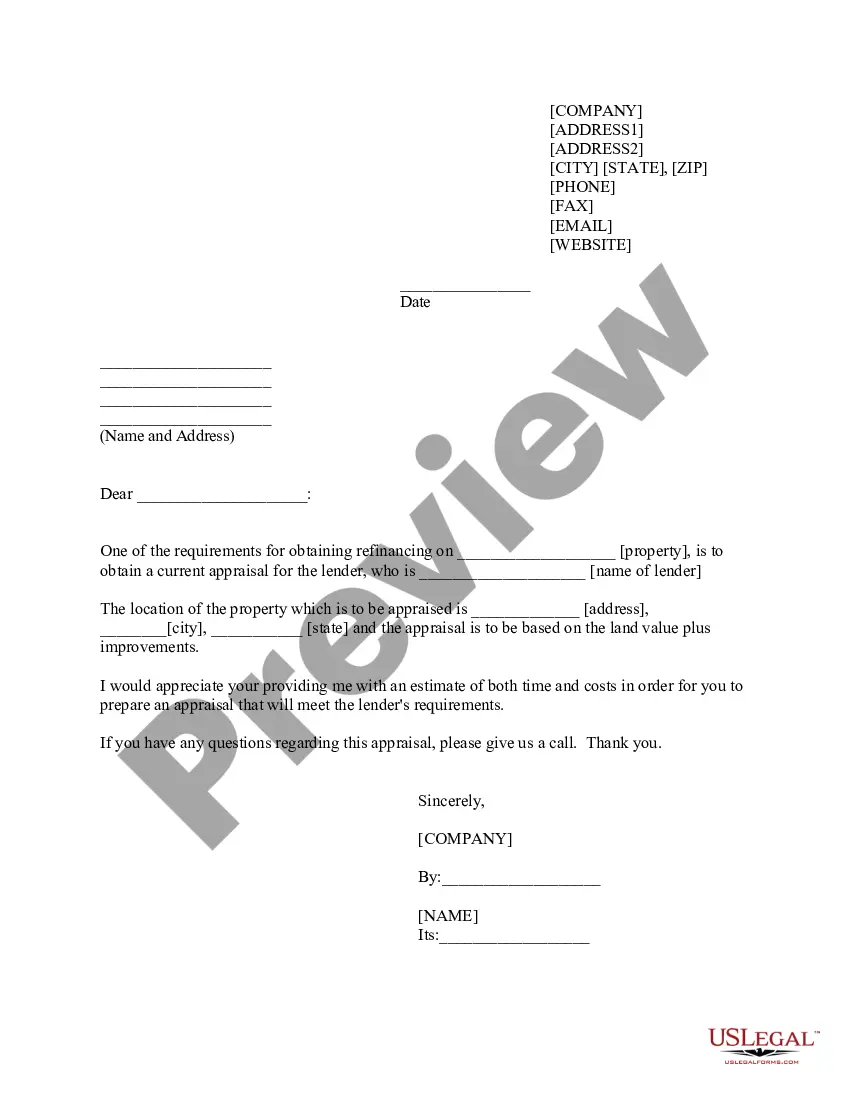
The Sample Letter for Request for Estimate of Appraisal Costs is a formal document used to request an estimated cost for appraisal services. This letter is essential for individuals or organizations looking to understand potential fees associated with property appraisals before proceeding with the service. It differs from informal inquiries as it maintains a professional tone and structure, ensuring clarity and seriousness in the request.
What’s included in this form
- Return address: Your name and contact information
- Date: The date the letter is sent
- Recipientâs address: Name and contact details of the appraisal company
- Subject line: Clearly states the purpose as a request for appraisal cost estimate
- Closing statement: Encouragement to reach out with questions
- Signature: Your name to formalize the request
Common use cases
This letter should be used when you need a formal estimate for appraisal costs, whether for residential or commercial properties. It is ideal when comparing appraisal services, budgeting for real estate transactions, or complying with lender requirements. Using this letter helps ensure you receive a clear and professional response from the appraisers.
Who can use this document
- Homeowners seeking to understand appraisal costs
- Real estate agents assisting clients with property sales
- Investors evaluating property investments
- Businesses needing to appraise commercial property
- Lenders requiring appraisals for financing purposes
How to complete this form
- Provide your return address at the top of the letter.
- Insert the date you are sending the letter.
- Write the appraisal company's name and address clearly below the date.
- Clearly state in the subject line that you are requesting an estimate of appraisal costs.
- Encourage contact for further questions in your closing statement.
- Sign the letter with your name at the bottom.
Is notarization required?
This form does not typically require notarization unless specified by local law. However, to add more formality and credibility, you may choose to have it notarized when sending to certain entities or authorities.
Get your form ready online
Our built-in tools help you complete, sign, share, and store your documents in one place.
Make edits, fill in missing information, and update formatting in US Legal Forms—just like you would in MS Word.
Download a copy, print it, send it by email, or mail it via USPS—whatever works best for your next step.
Sign and collect signatures with our SignNow integration. Send to multiple recipients, set reminders, and more. Go Premium to unlock E-Sign.
If this form requires notarization, complete it online through a secure video call—no need to meet a notary in person or wait for an appointment.
We protect your documents and personal data by following strict security and privacy standards.

Make edits, fill in missing information, and update formatting in US Legal Forms—just like you would in MS Word.

Download a copy, print it, send it by email, or mail it via USPS—whatever works best for your next step.

Sign and collect signatures with our SignNow integration. Send to multiple recipients, set reminders, and more. Go Premium to unlock E-Sign.

If this form requires notarization, complete it online through a secure video call—no need to meet a notary in person or wait for an appointment.

We protect your documents and personal data by following strict security and privacy standards.
Common mistakes to avoid
- Failing to include a return address or contact information.
- Omitting the date, which can create confusion about the timeline.
- Not specifying the property to be appraised clearly.
- Using informal language instead of maintaining a professional tone.
- Neglecting to proofread for mistakes before sending the letter.
Benefits of using this form online
- Convenience: Easily fill out and download the letter from home.
- Editability: Customize with your specific details without hassle.
- Reliability: Forms are drafted by licensed attorneys to meet legal requirements.
- Quick access: Get the form immediately without waiting for physical copies.
Looking for another form?
Form popularity
FAQ
What home appraisers look for: What's the general condition of the house? An appraiser will evaluate and comment on: The materials and conditions of the foundation and exterior walls, the roof surface, screens, gutters and downspouts. The materials and conditions of the floors, walls, and trim.
Location. First, your home appraisal value is based on the location of the home. Structural Construction Materials and Updates. Age of the Home. Design Style of the Home. Curb Appeal. Number of Bedrooms. Number of Bathrooms. Square Footage.
Any unrepaired or ongoing structural damage can hurt your appraisal. Home appraisers are training to look for telltale signs of structural damage, such as cracks in the walls or flooring.
In addition to these two types of appraisals, there are three types of report formats: self-contained, summary, and restricted. Self-Contained Report. In this option, the appraiser provides all of the data and the rationale used in the development of the appraisal.
Start by including the company's letterhead. Be sure to list the specific employee's name. Include a statement of intent. Include the period covered by the appraisal. Give a frank, objective evaluation of the given employee. List the criteria for judgment.
The Uniform Standards of Professional Appraisal Practice set forth the requirements for appraisal reports, which may be presented in one of three written formats: self-contained reports, summary reports, and restricted-use reports.
The comment on Standards Rule 3-3(a) states that 2026 the reviewer is required to develop an opinion as to the completeness, accuracy, adequacy, relevance, and reasonableness of the analysis in the work under review, given law, regulations, or intended user requirements applicable to the work under review.
The Appraisal Report is the most commonly used report option. The Uniform Residential Appraisal Report (URAR) is an example of an Appraisal Report, which is used for most residential appraisals.
The Three Types of Personal Property Appraisals There are three primary types of personal property appraisals that may be used, including the cost approach, the sales comparison approach, and the income approach. In the past, some have referred to the cost approach as the process of summation.