Checklist - FAQ About Patents
What is this form?
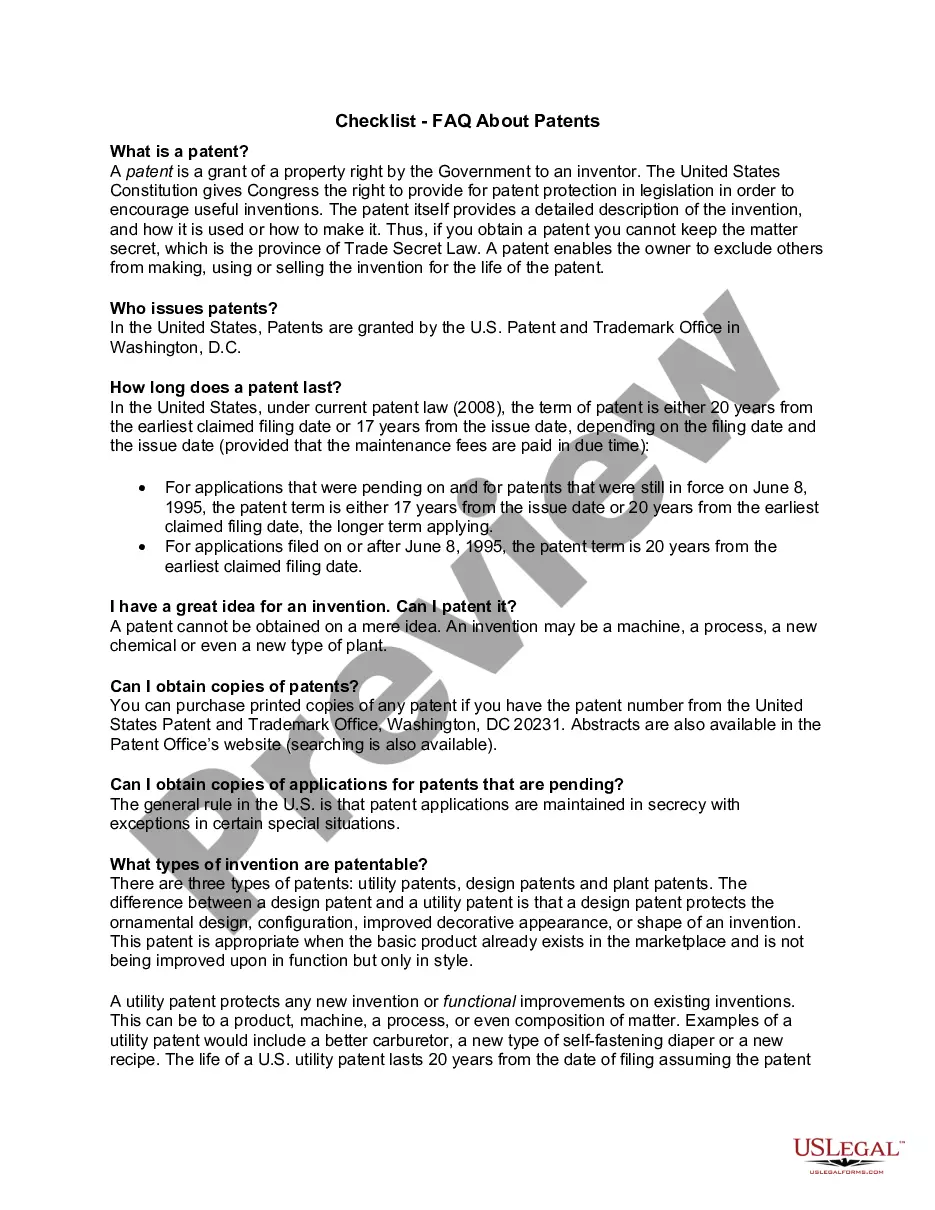
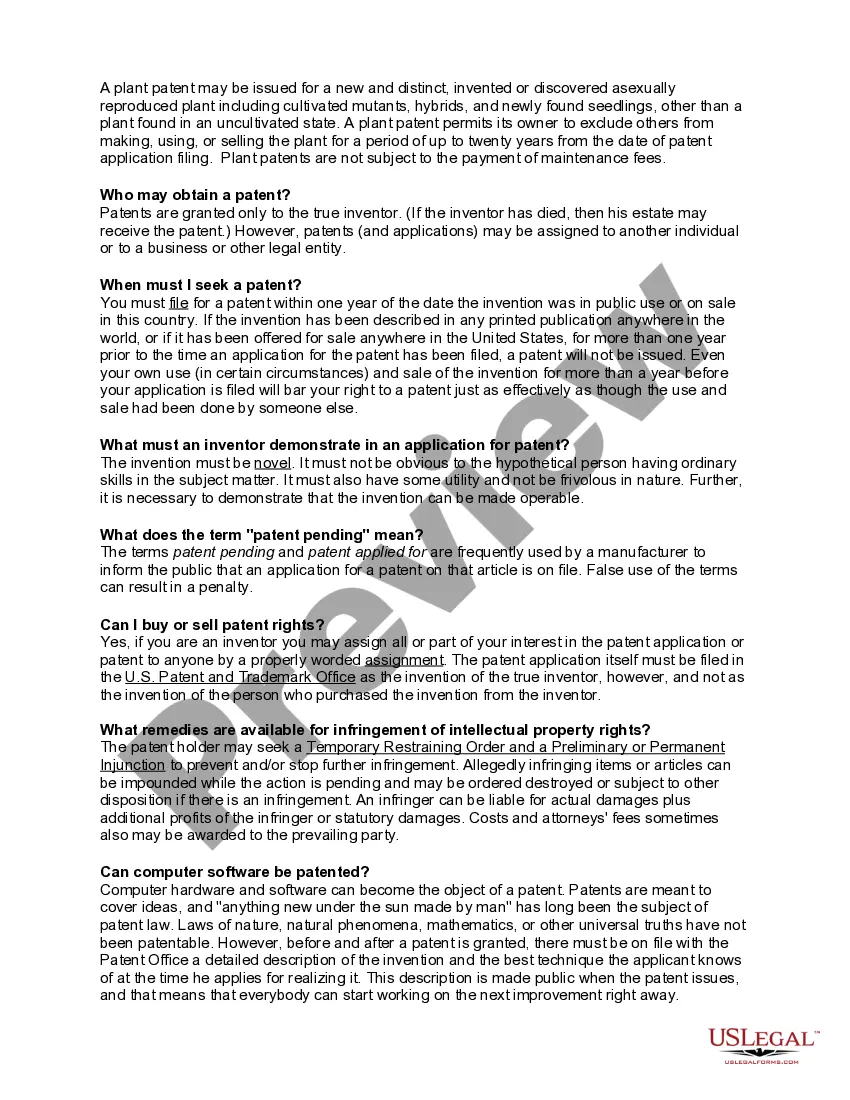
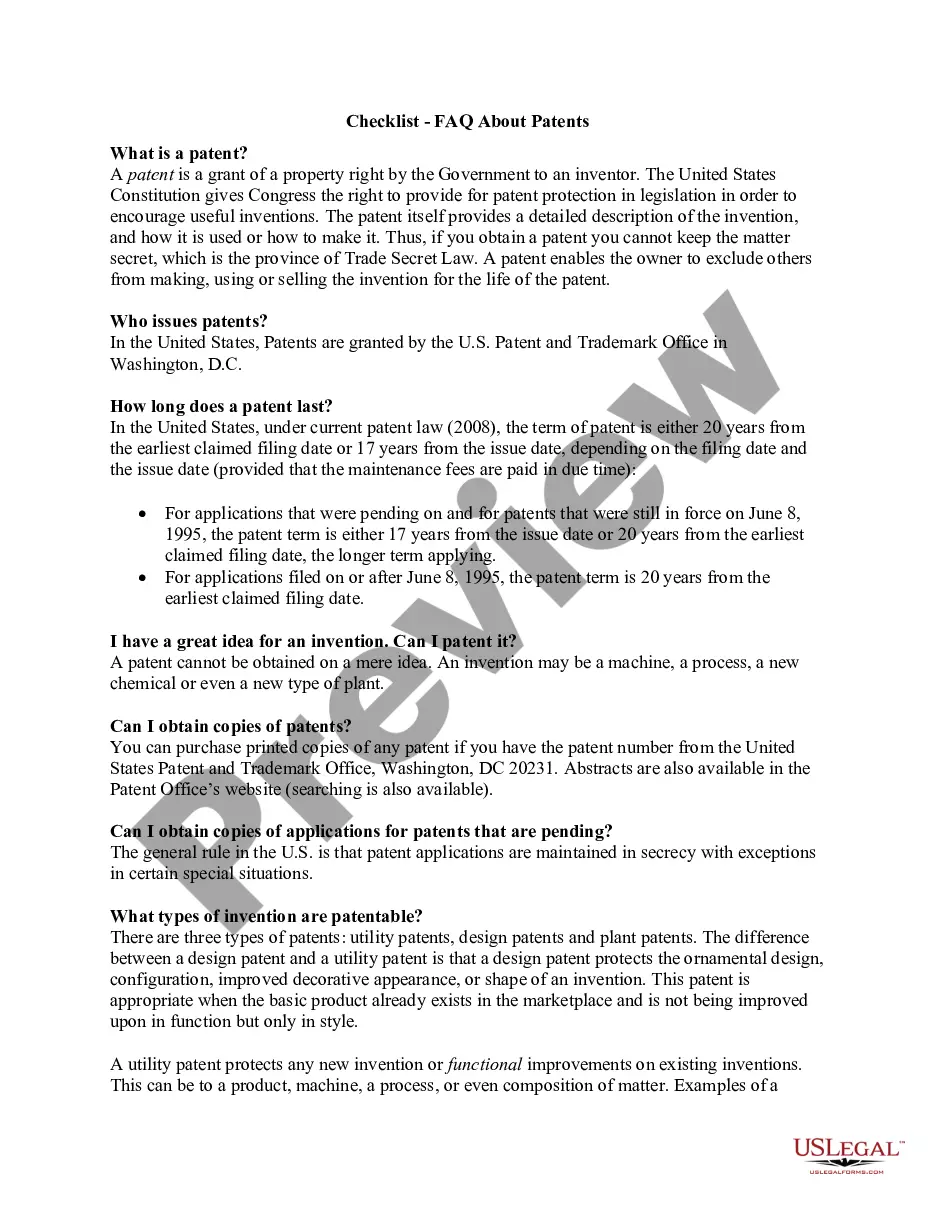
The Checklist - FAQ About Patents provides essential information regarding patents, which are legal grants of property rights to inventors. This form serves to clarify common questions and misconceptions about patents, helping users understand the key processes, requirements, and durations associated with patenting inventions. It differs from other legal forms by focusing specifically on frequently asked questions surrounding patents, offering guidance to both aspiring inventors and those seeking to protect their intellectual property.
Key components of this form
- Definition of a patent and its legal implications.
- Details on who issues patents and the role of the U.S. Patent and Trademark Office.
- Explanation of different types of patents including utility, design, and plant patents.
- Information about the duration of patents and maintenance fees.
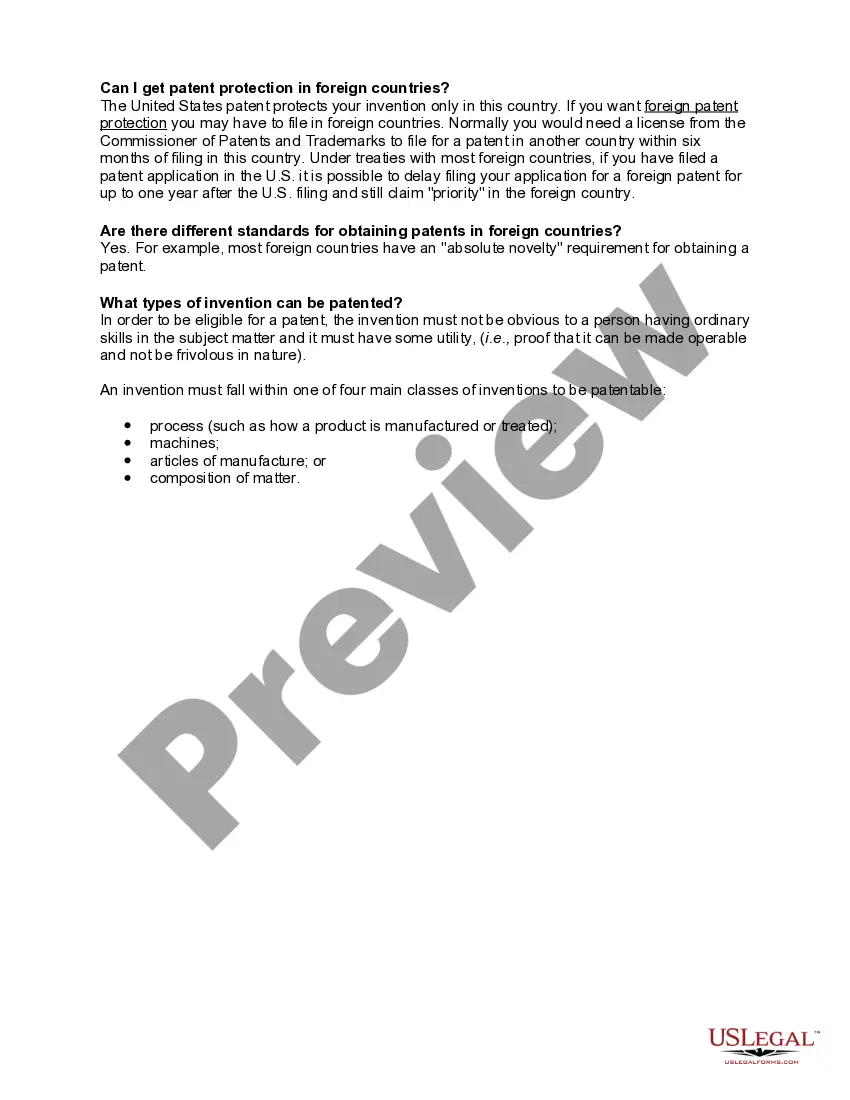
- Guidance on what inventions can be patented and the patent application process.
- Overview of rights and remedies available for patent infringement.
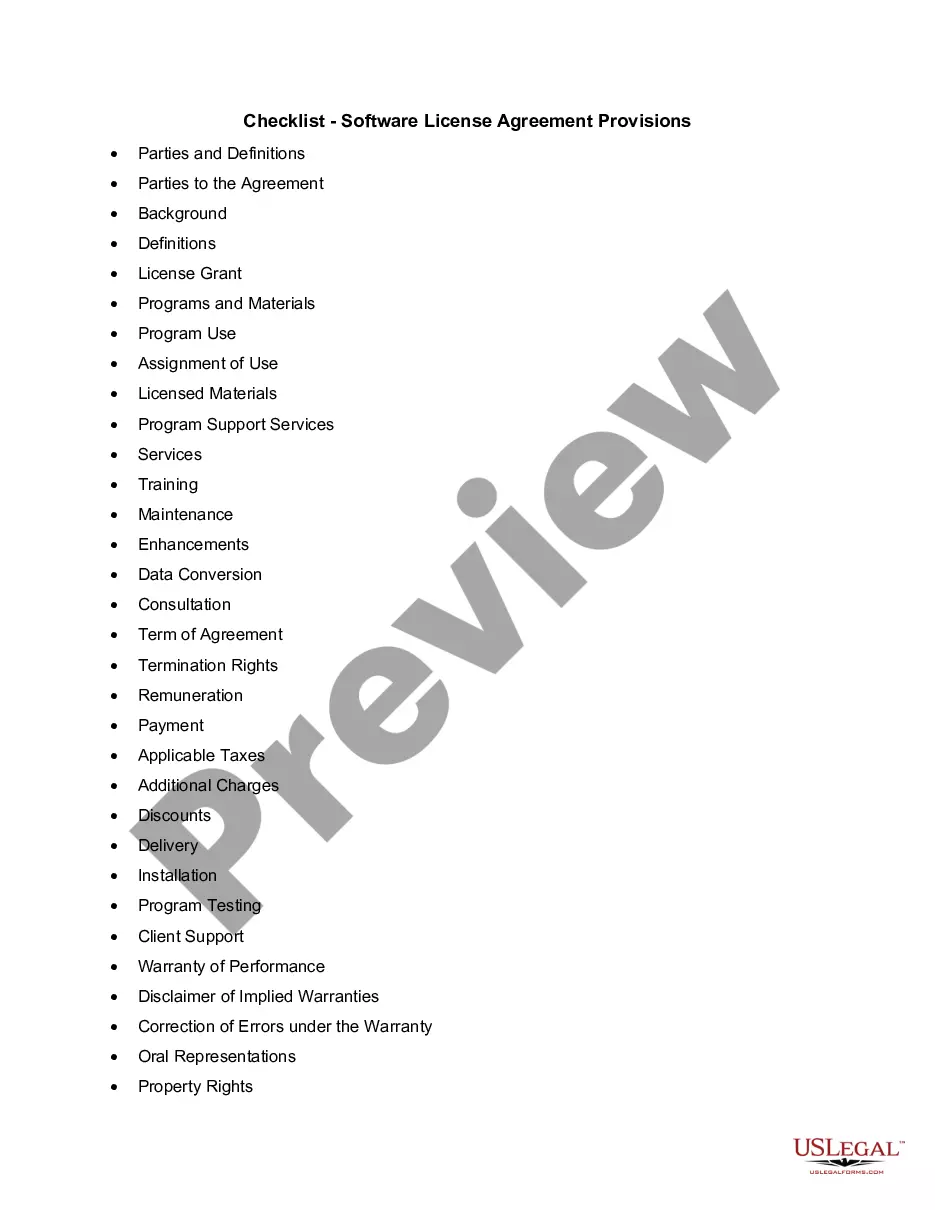
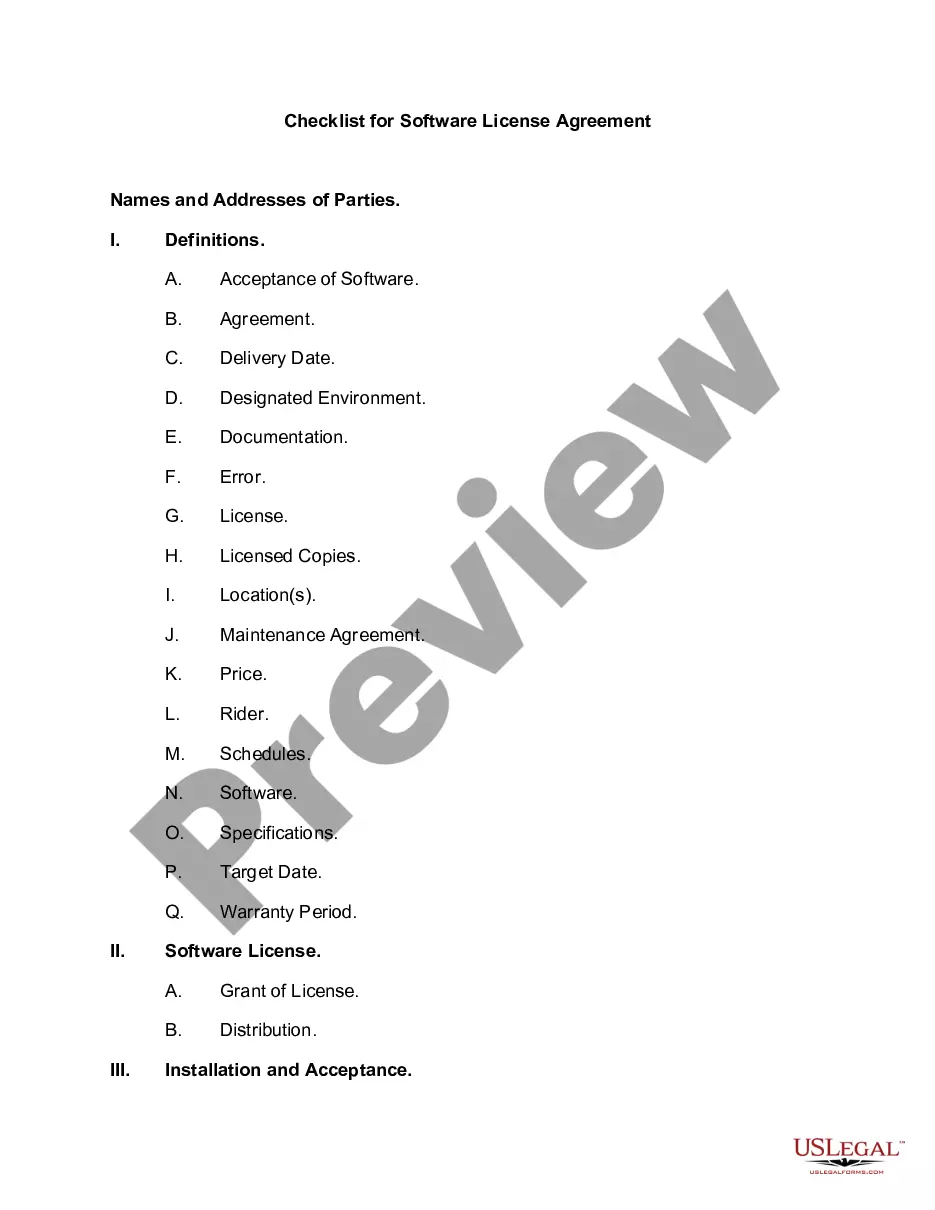
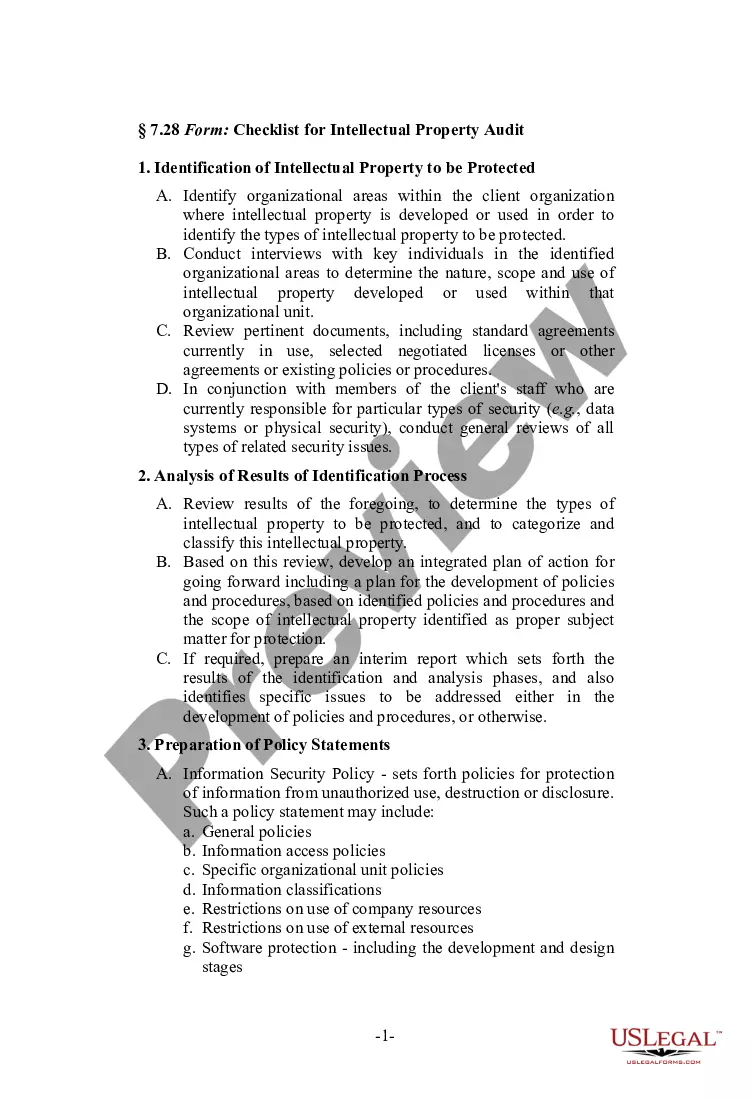
Situations where this form applies
This checklist should be used when you're considering applying for a patent or have questions about the patent process. It's helpful in situations such as: - Evaluating whether your invention qualifies for a patent. - Understanding the duration and maintenance of your patent. - Seeking guidance before filing a patent application. - Navigating the complexities of patent rights and infringement issues.
Intended users of this form
This form is intended for:
- Inventors looking to protect their inventions.
- Individuals or businesses considering patenting their ideas.
- Those needing clarification on patent laws and rights.
- Entrepreneurs interested in understanding the patent process to enhance their innovative products.
Instructions for completing this form
- Review the definitions and key concepts of patents provided in the checklist.
- Identify the type of patent relevant to your inventionâutility, design, or plant.
- Determine the eligibility of your invention and whether it meets the patentability criteria.
- Understand the process for filing a patent and the timeline involved.
- Familiarize yourself with patent maintenance fees and their implications for long-term protection.
Notarization guidance
This form does not typically require notarization unless specified by local law. It serves as a guideline for understanding patent-related questions and is intended for informational purposes.
Get your form ready online
Our built-in tools help you complete, sign, share, and store your documents in one place.
Make edits, fill in missing information, and update formatting in US Legal Forms—just like you would in MS Word.
Download a copy, print it, send it by email, or mail it via USPS—whatever works best for your next step.
Sign and collect signatures with our SignNow integration. Send to multiple recipients, set reminders, and more. Go Premium to unlock E-Sign.
If this form requires notarization, complete it online through a secure video call—no need to meet a notary in person or wait for an appointment.
We protect your documents and personal data by following strict security and privacy standards.

Make edits, fill in missing information, and update formatting in US Legal Forms—just like you would in MS Word.

Download a copy, print it, send it by email, or mail it via USPS—whatever works best for your next step.

Sign and collect signatures with our SignNow integration. Send to multiple recipients, set reminders, and more. Go Premium to unlock E-Sign.

If this form requires notarization, complete it online through a secure video call—no need to meet a notary in person or wait for an appointment.

We protect your documents and personal data by following strict security and privacy standards.
Avoid these common issues
- Submitting a patent application without confirming the invention's novelty.
- Failing to file for a patent within one year of public disclosure or sale.
- Not understanding the difference between various patent types and their implications.
- Overlooking the requirement of maintenance fees which can affect patent validity.
Advantages of online completion
- Immediate access to essential patent information without the need for legal counsel.
- Conveniently downloadable for your records.
- Edit and customize based on specific needs with ease.
- Reliable source of information prepared by legal professionals.
Legal use & context
- This checklist does not constitute legal advice but serves to inform about the patent process.
- Understanding patents is essential for legally protecting your intellectual property.
- Intellectual property rights are enforceable under federal law, but state-specific rules may vary.
Looking for another form?

Form popularity
FAQ
The innovation is patentable subject matter. Patentable. The innovation is new (called 'novelty') The innovation is inventive. The innovation is useful (called 'utility') The innovation must not have prior use.
Search the United States Patent and Trademark Office. Find a patent attorney. Determine what type of patent you need. File a provisional patent application. Become a Registered eFiler. Gather information for your formal application. Complete and review your formal application.
TITLE OF INVENTION. The title of your invention doesn't need to be super fancy. INVENTORS' NAMES AND CONTACT INFORMATION. SIGNIFICANT DATES. DESCRIPTION OF THE INVENTION. PRIOR ART. PUBLIC DISCLOSURES OF THE INVENTION AND COMMERCIAL ACTIVITY. FUNDING SOURCES. WITNESSES.
The theory behind the poor man's patent is that, by describing your invention in writing and mailing that documentation to yourself in a sealed envelope via certified mail (or other proof-of-delivery mail), the sealed envelope and its contents could be used against others to establish the date that the invention was
Begin on a separate sheet of paper. Give the page a title such as "Abstract" or "Abstract of the description". Say what your invention is. Say what your invention is used for. Describe the main parts and how they work. Do not refer to any claims, drawings or other pieces of your application.
Step 1: File an application for patent with the United States Patent and Trademark Office (USPTO) Step 2: Examination of patent application. Step 3: Respond to any objections or rejections made by the examiner. Step 4: Patent grant.
An application form (paper or online form) a description of your invention. claims. an abstract. drawings if they illustrate your invention. an indication of a deposit if the application involves a deposit of biological material as referred to in section 8 a of the Finnish Patents Act.
An application form (paper or online form) a description of your invention. claims. an abstract. drawings if they illustrate your invention. an indication of a deposit if the application involves a deposit of biological material as referred to in section 8 a of the Finnish Patents Act.
A nonprovisional utility patent application must include a specification, including a description and a claim or claims; drawings, when necessary; an oath or declaration; and the prescribed filing, search, and examination fees.