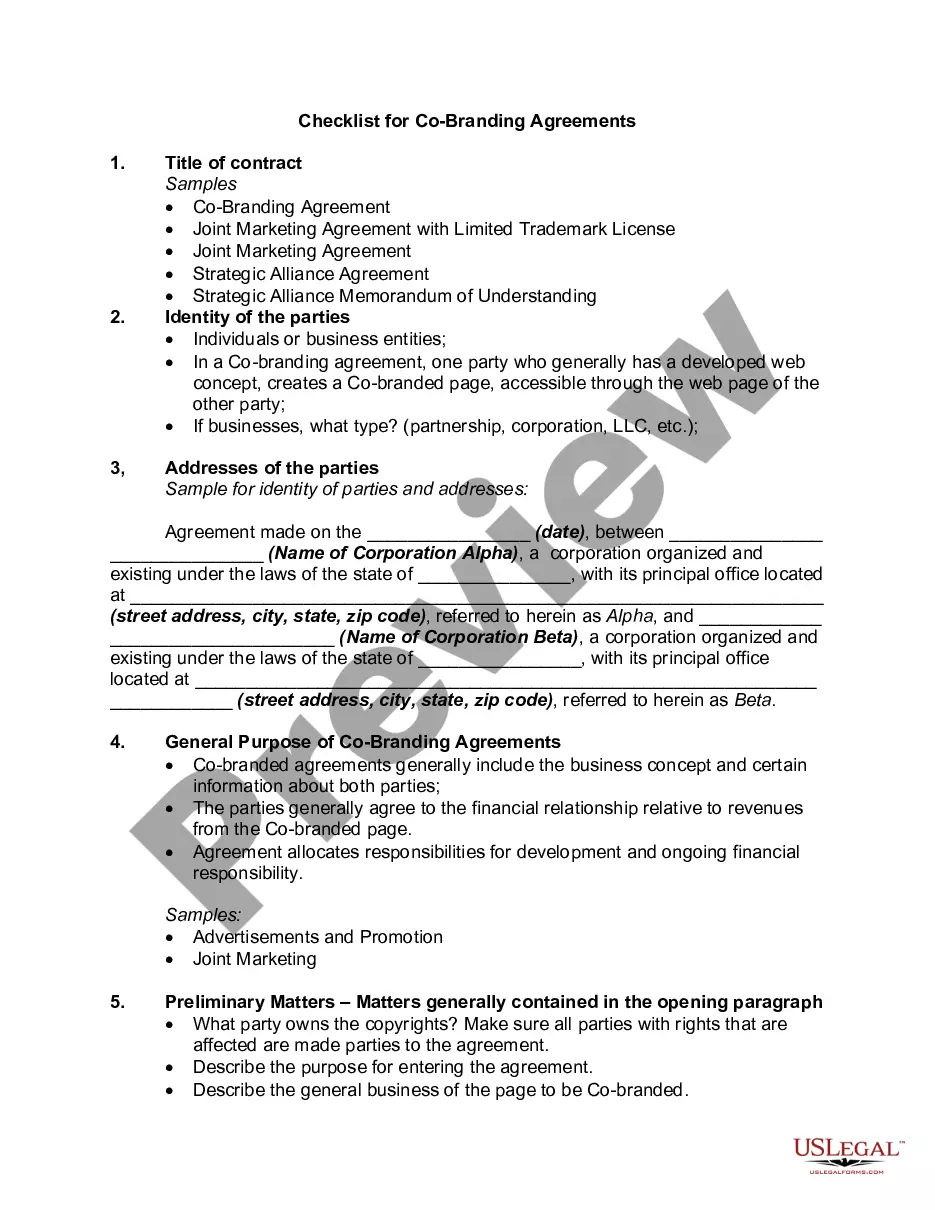
Checklist for Co-Branding Agreements
What is this form?
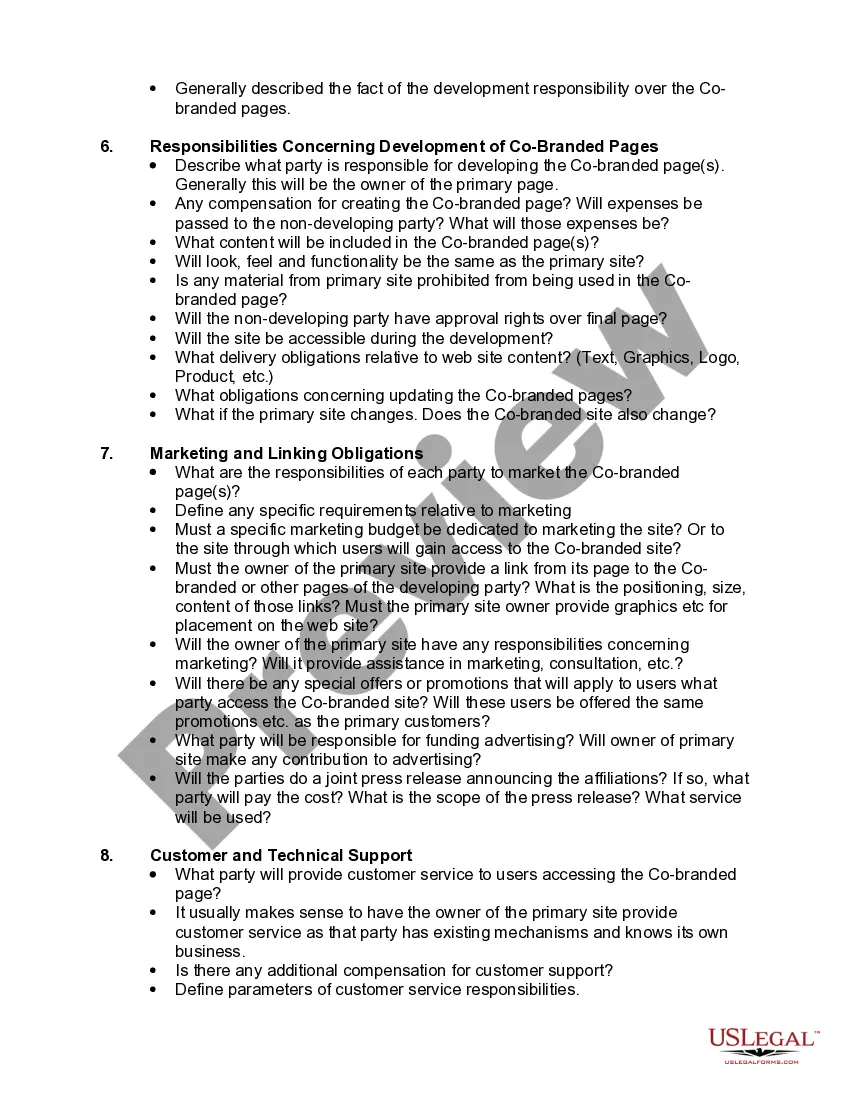
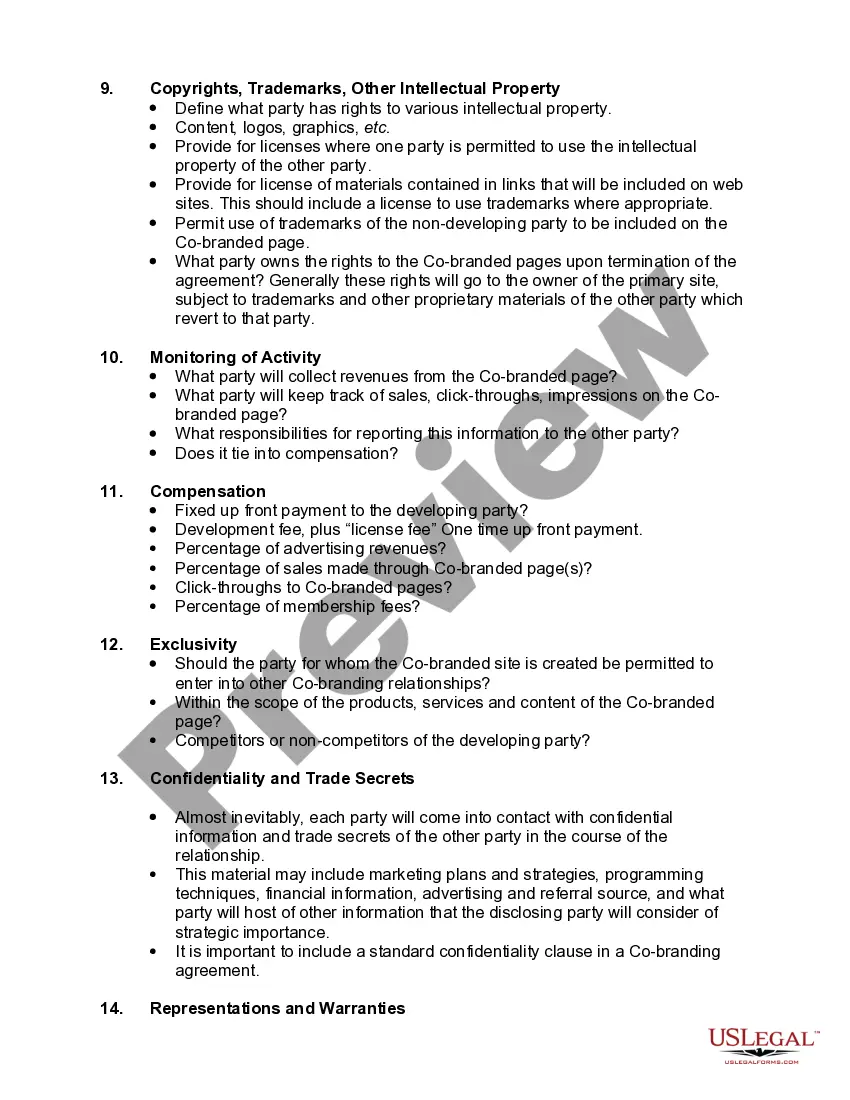
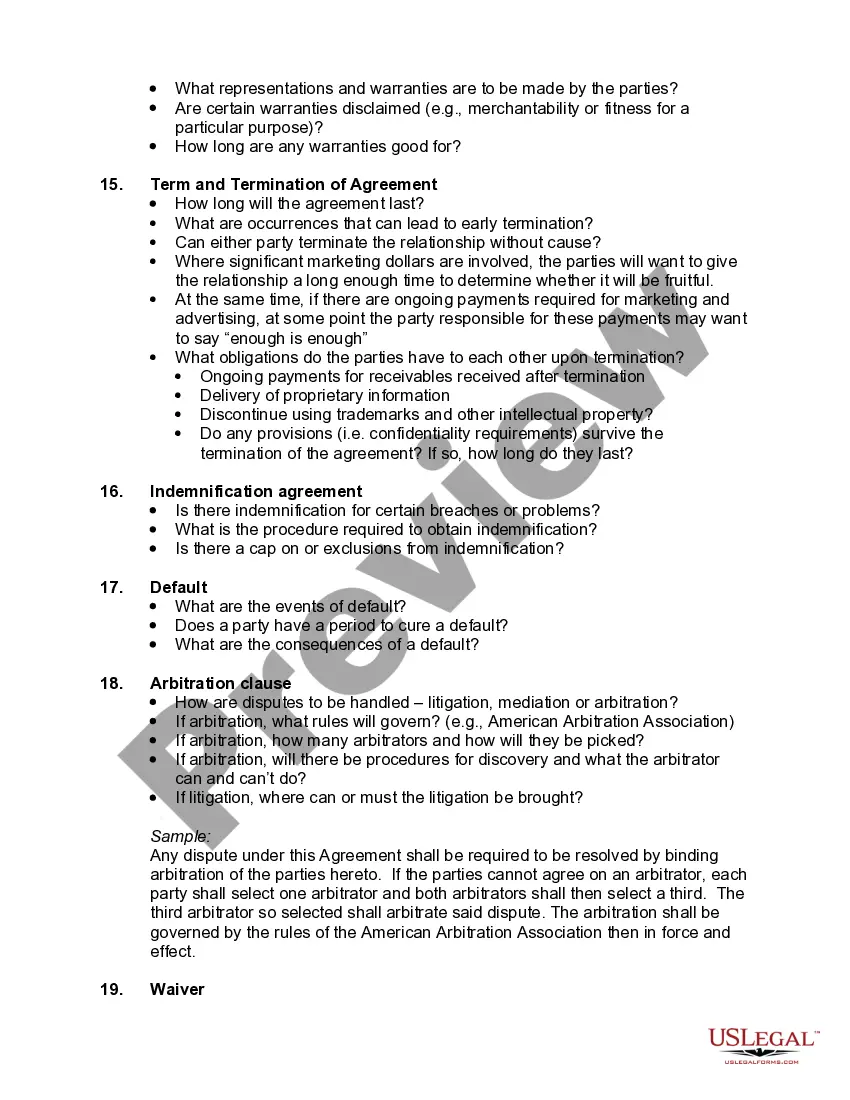
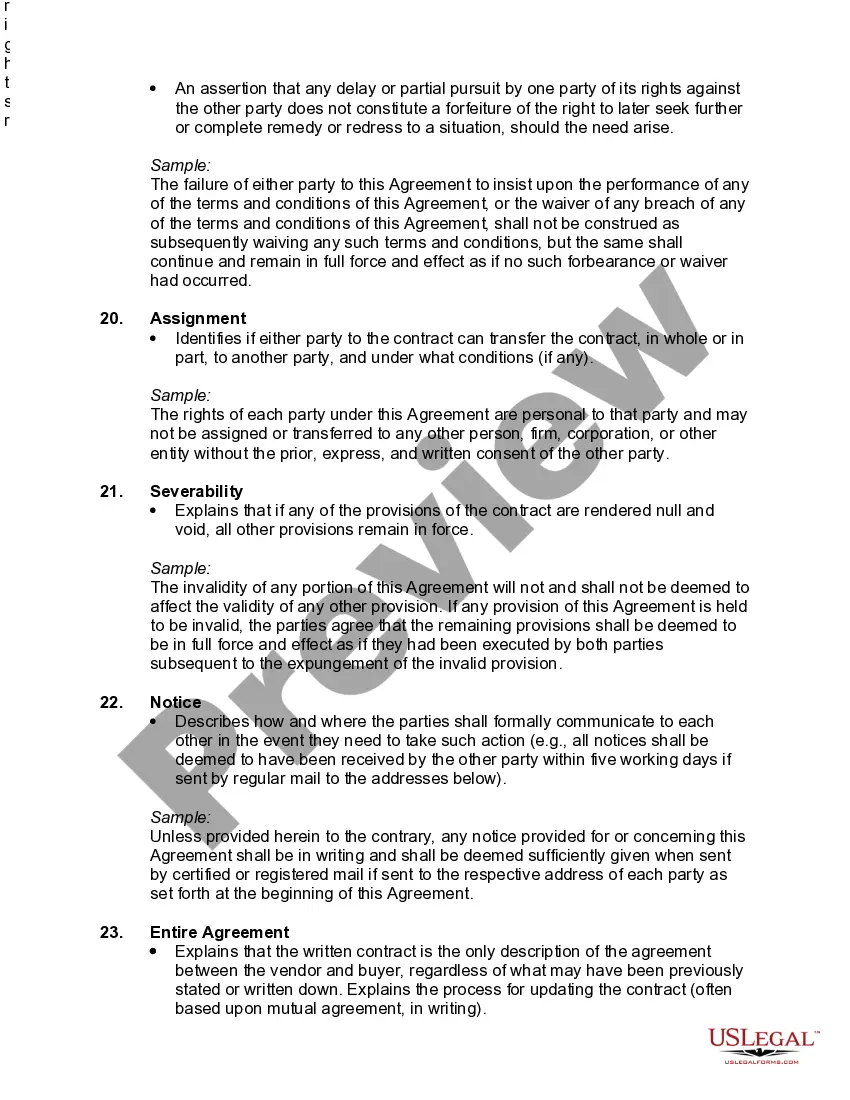
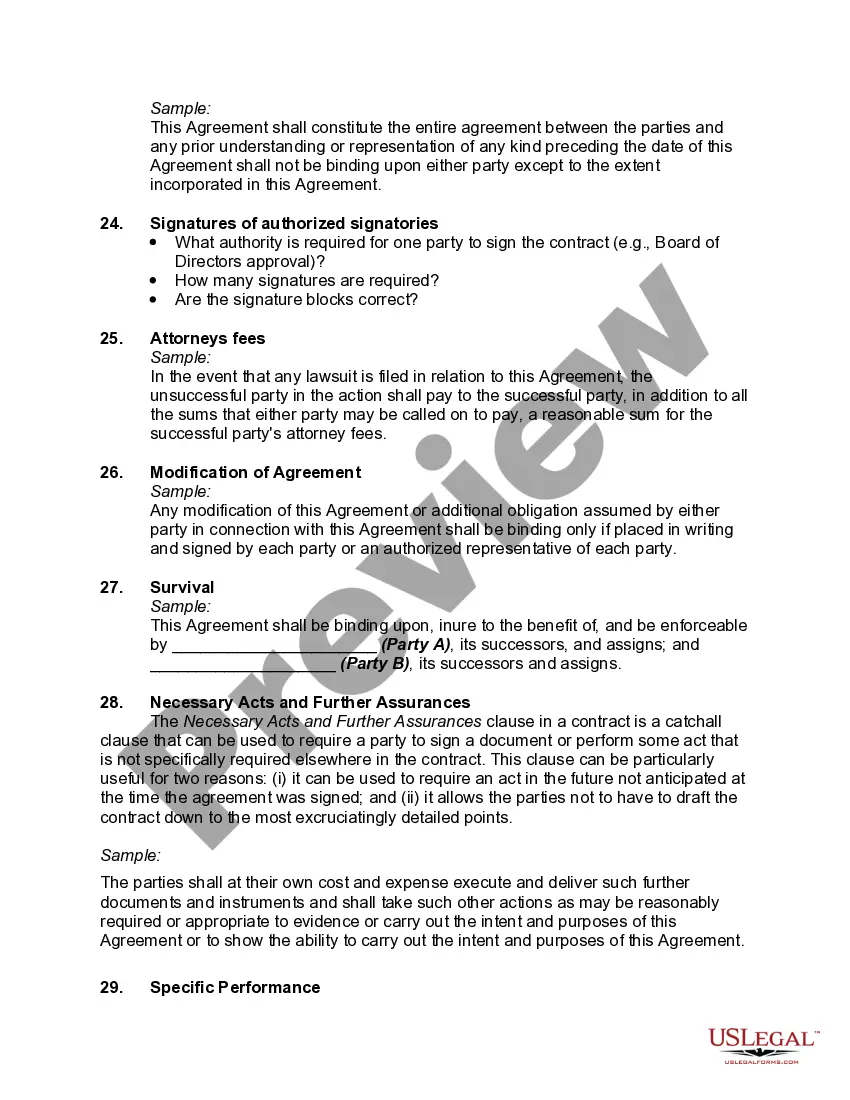
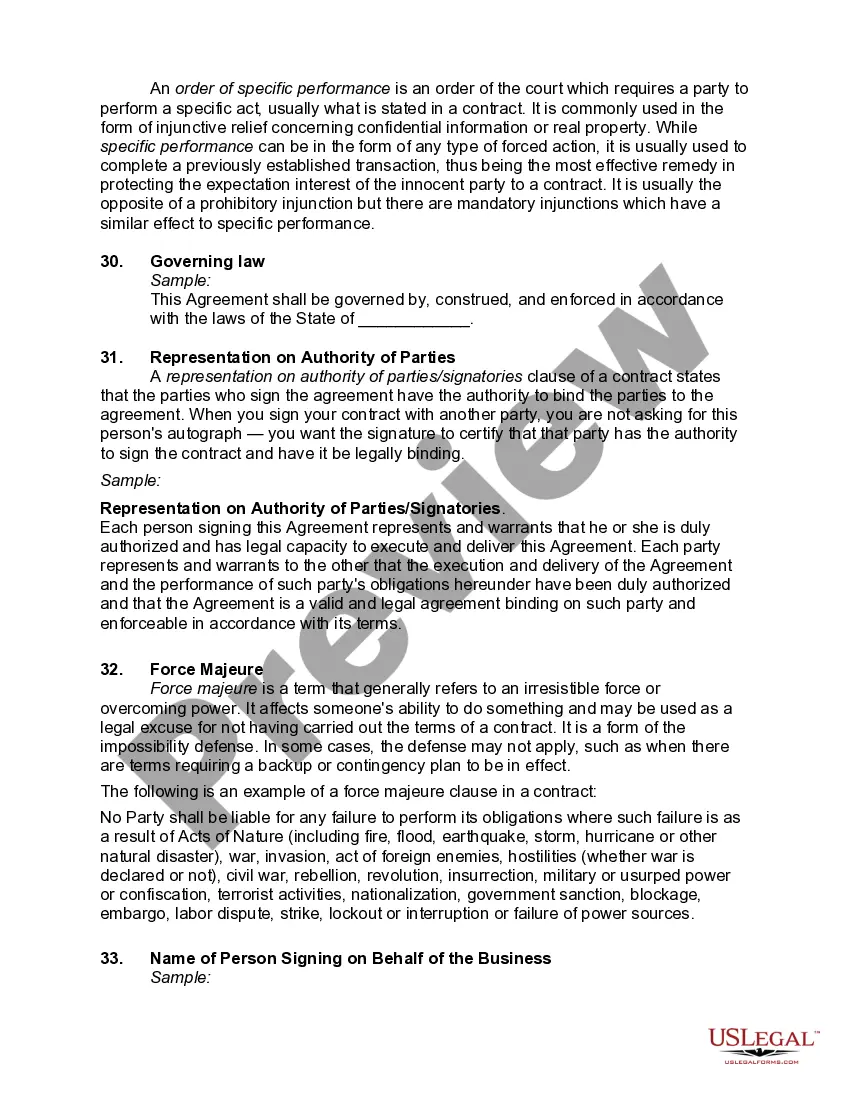
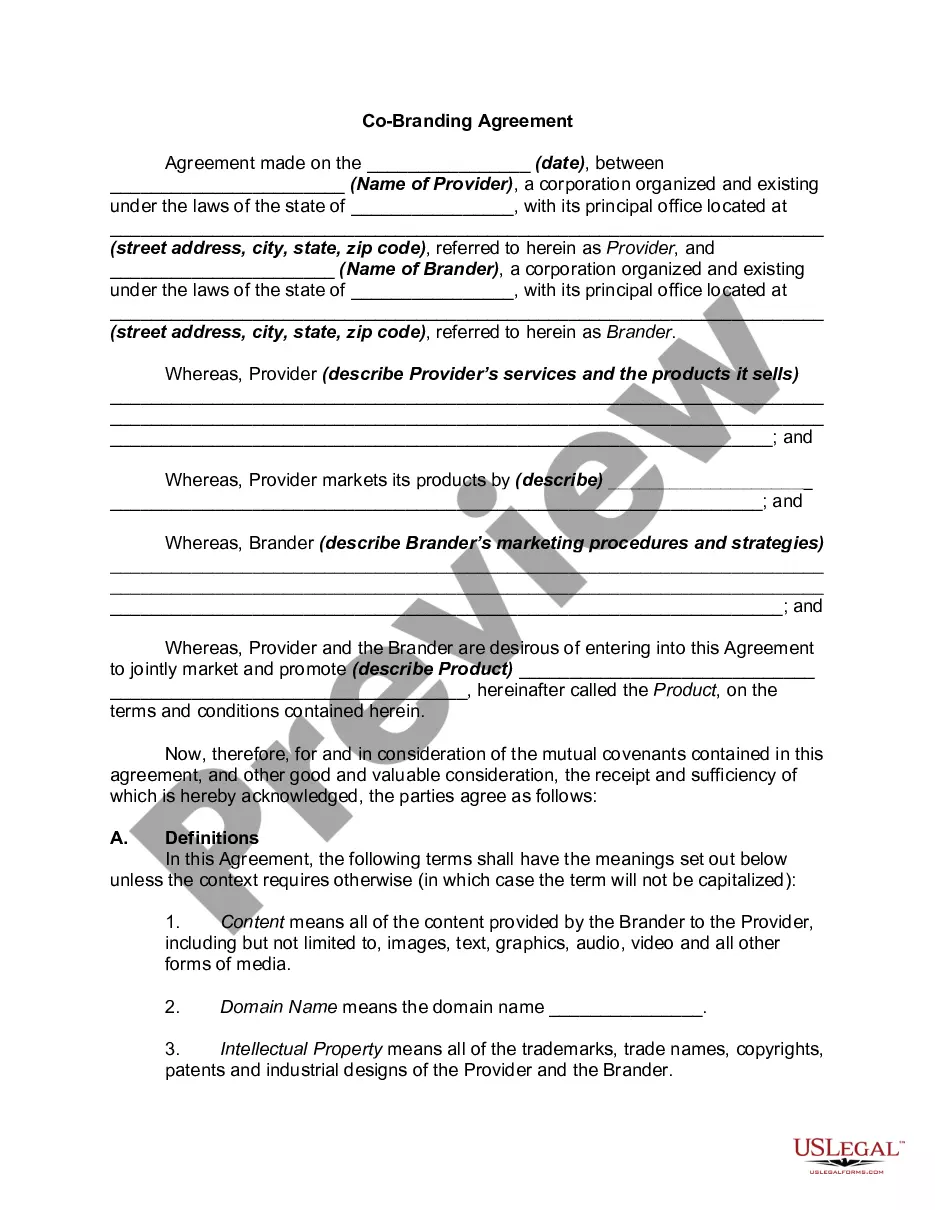
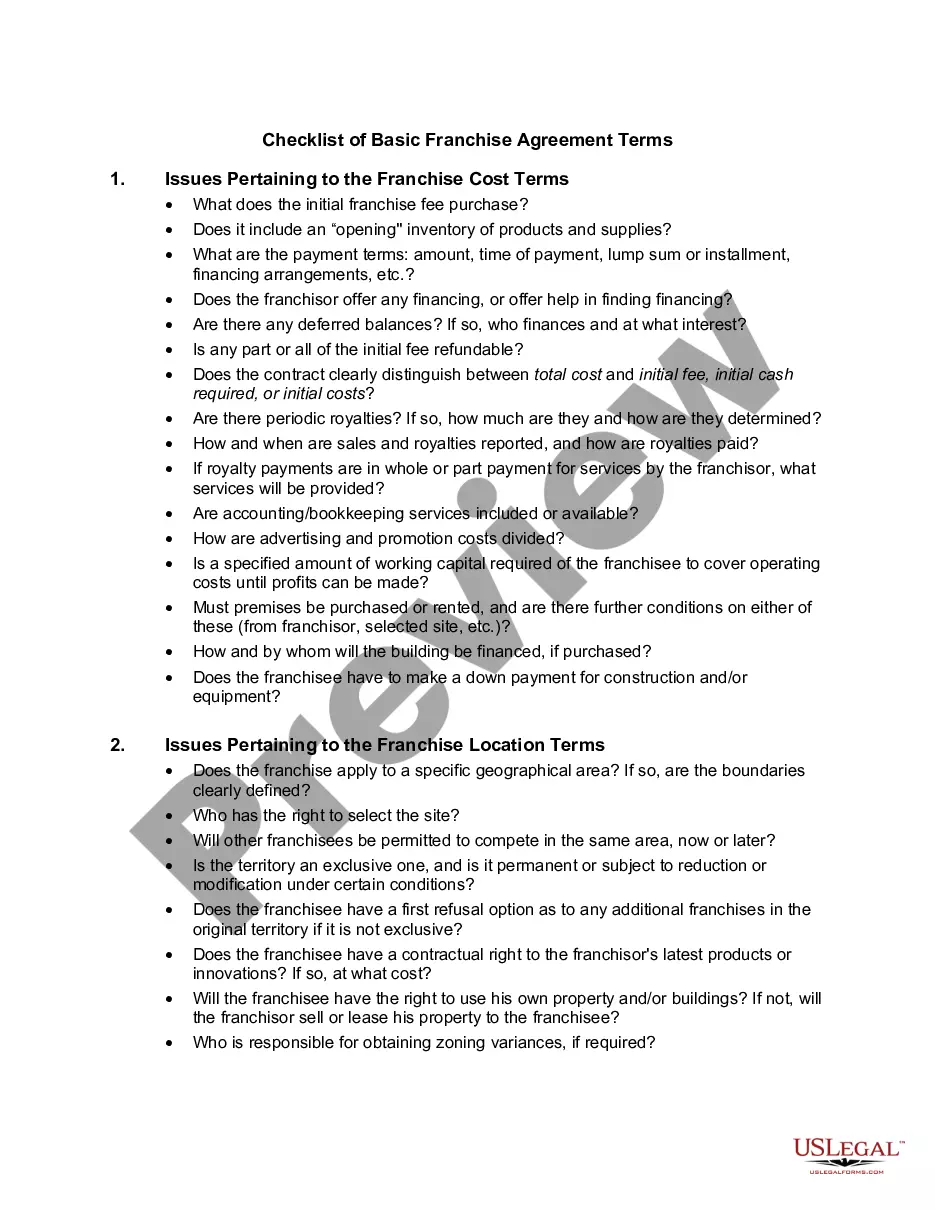
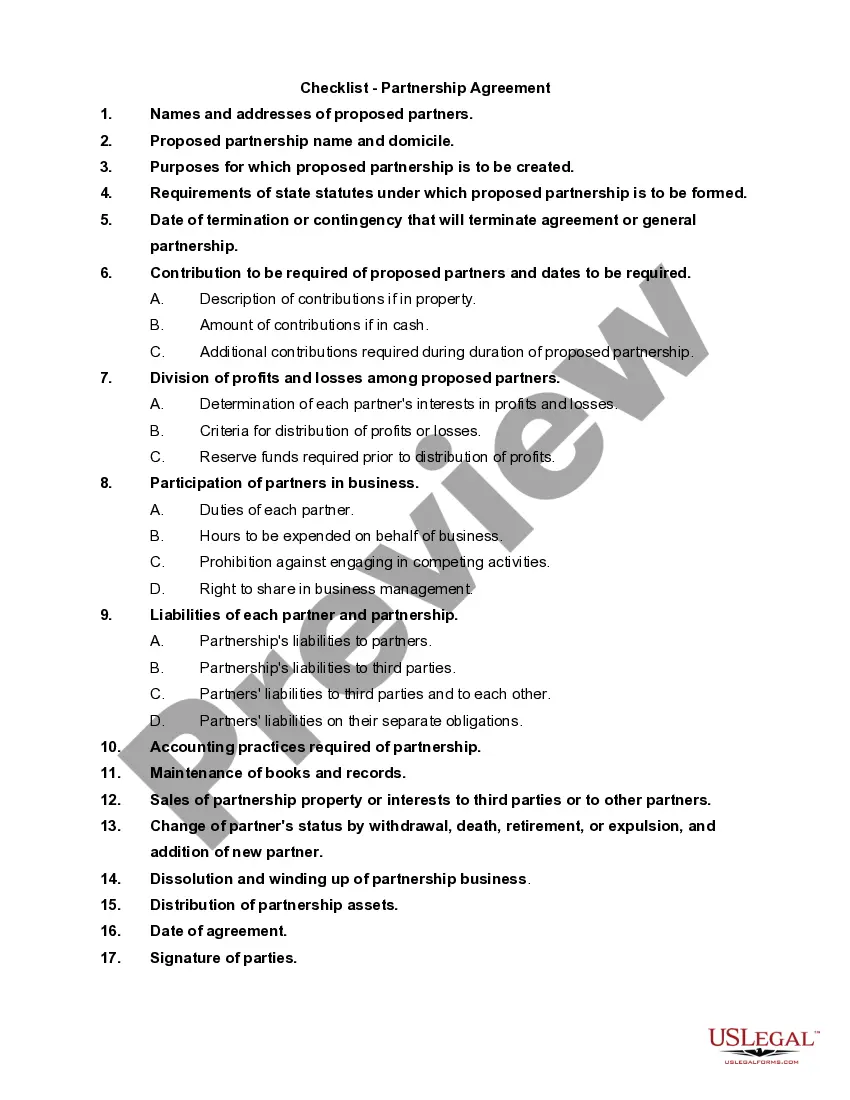
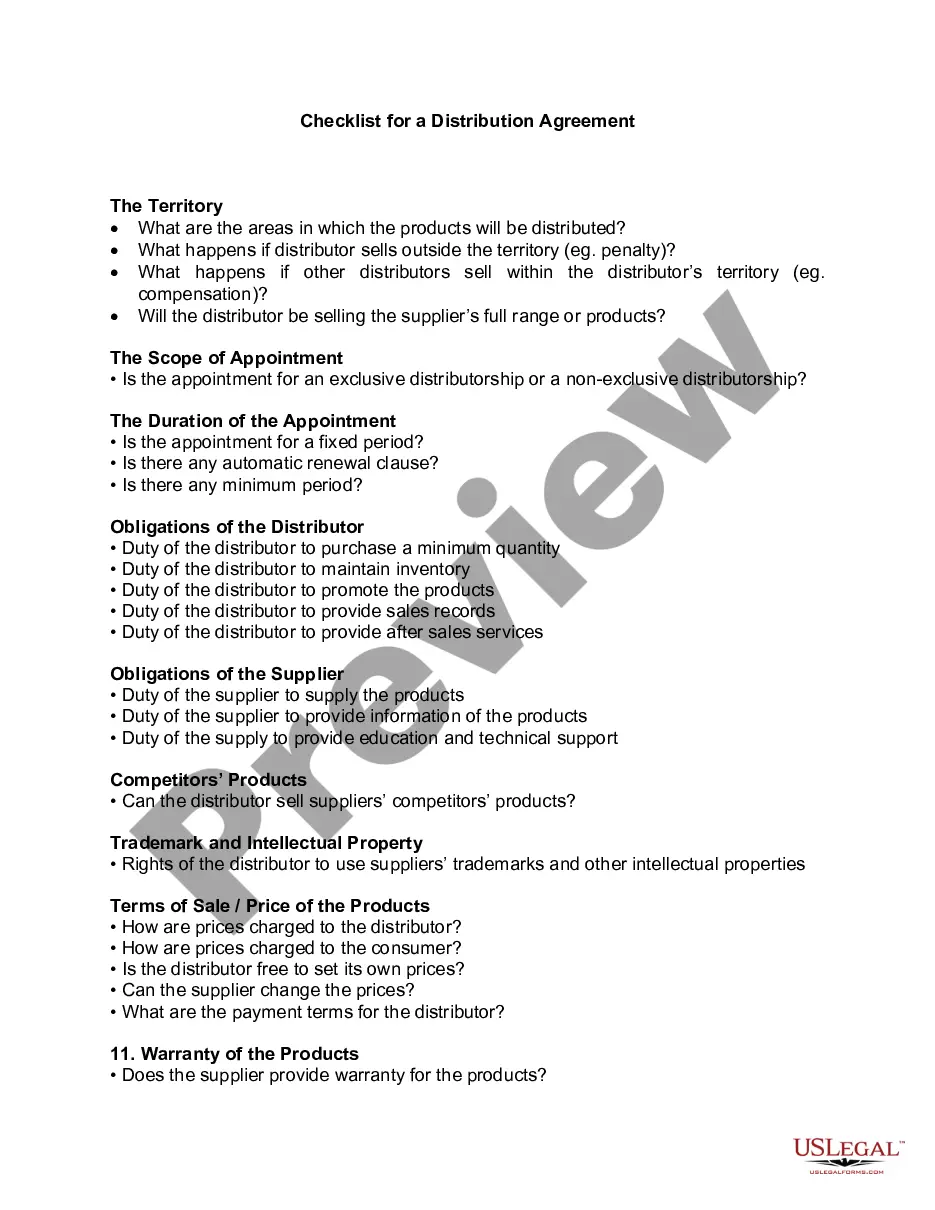
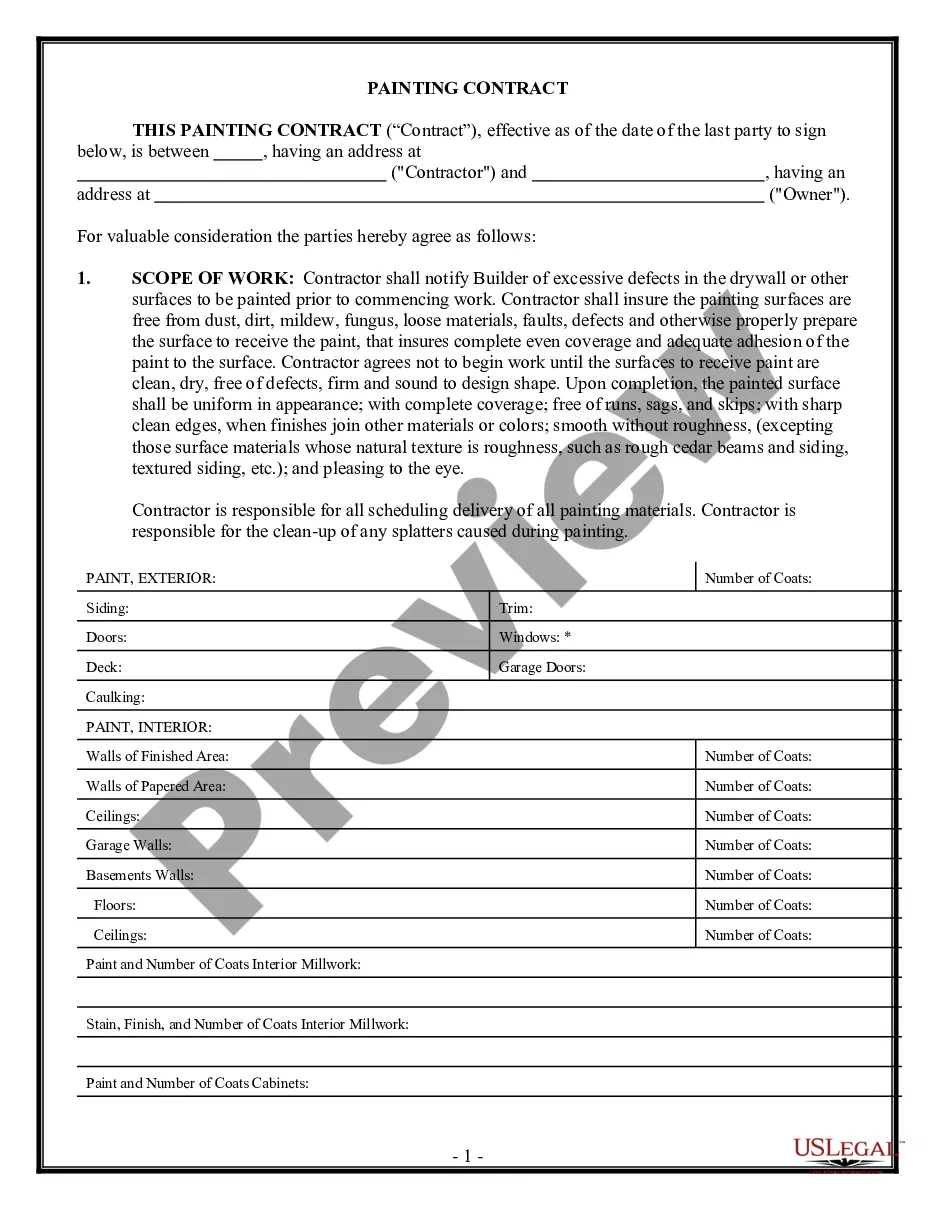
A Checklist for Co-Branding Agreements is a vital tool for businesses looking to collaborate under a co-branding initiative. This form serves to outline the responsibilities, expectations, and legal relationships between two parties promoting products or services together. It is distinct from other agreements as it emphasizes joint marketing strategies and the sharing of brand identities to enhance market reach and customer engagement.
Key components of this form
- Title of contract: Options for different types of co-branding agreements.
- Identity of the parties: Names and addresses of the entities involved.
- General purpose: Overview of the objectives and business concepts related to the co-branded product or page.
- Responsibilities: Detailed obligations regarding development, marketing, customer support, and intellectual property.
- Compensation: Payment structures including fixed fees and revenue sharing models.
- Term and termination: Duration of the agreement and conditions for termination.


When to use this form
This form is needed when businesses or individuals decide to enter a co-branding agreement to leverage shared resources for promotional purposes. Situations where this form is appropriate include launching a new product jointly, creating a co-branded online platform, or establishing a marketing alliance between companies to enhance visibility and sales.
Who needs this form
- Businesses seeking to collaborate on joint marketing efforts.
- Individuals representing brands that want to enter into strategic promotional partnerships.
- Marketing professionals looking to formalize co-branding strategies with other entities.
- Legal teams responsible for drafting and reviewing co-branding agreements.
Instructions for completing this form
- Identify the parties involved, including their legal names and addresses.
- Specify the purpose of the co-branding agreement clearly, highlighting the business concepts.
- Detail the responsibilities of each party concerning website development and content management.
- Outline the compensation model, including any revenue-sharing arrangements.
- Include an effective date for the agreement and obtain necessary signatures from authorized representatives.
Notarization guidance
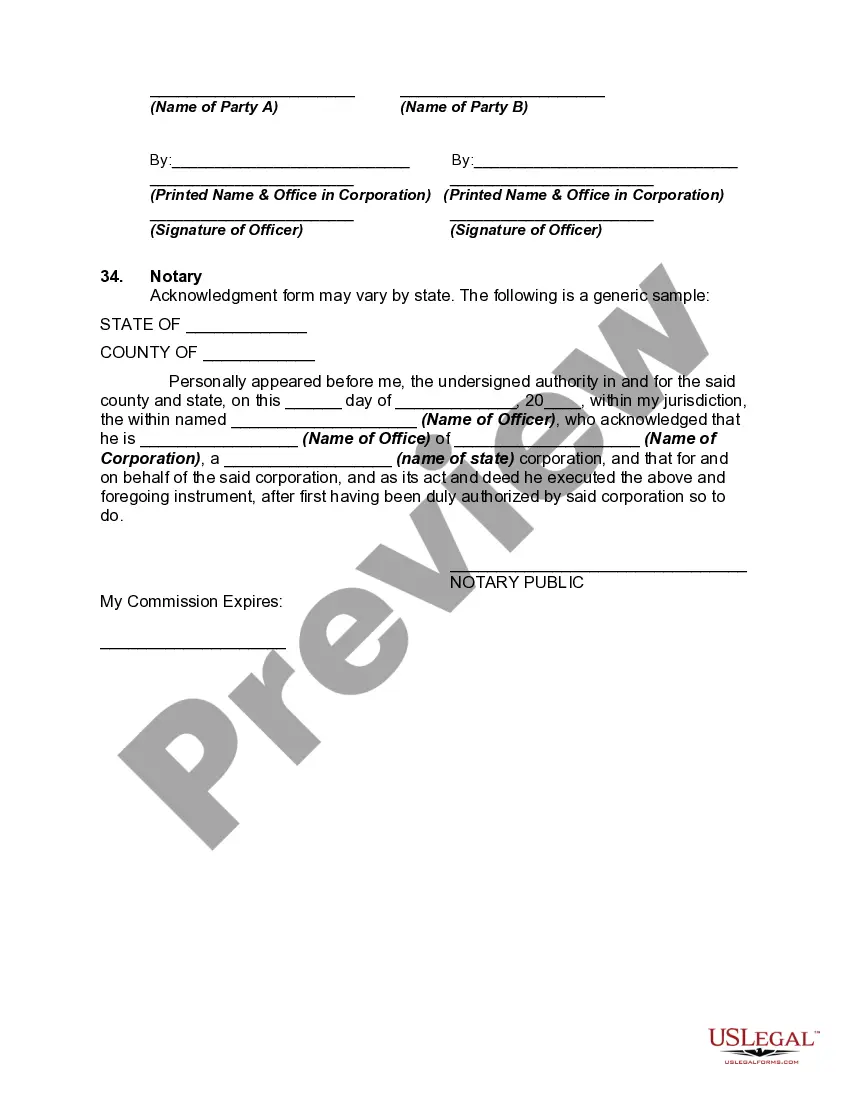
This form does not typically require notarization unless specified by local law. Always verify local regulations to ensure compliance.
Get your form ready online
Our built-in tools help you complete, sign, share, and store your documents in one place.
Make edits, fill in missing information, and update formatting in US Legal Forms—just like you would in MS Word.
Download a copy, print it, send it by email, or mail it via USPS—whatever works best for your next step.
Sign and collect signatures with our SignNow integration. Send to multiple recipients, set reminders, and more. Go Premium to unlock E-Sign.
If this form requires notarization, complete it online through a secure video call—no need to meet a notary in person or wait for an appointment.
We protect your documents and personal data by following strict security and privacy standards.

Make edits, fill in missing information, and update formatting in US Legal Forms—just like you would in MS Word.

Download a copy, print it, send it by email, or mail it via USPS—whatever works best for your next step.

Sign and collect signatures with our SignNow integration. Send to multiple recipients, set reminders, and more. Go Premium to unlock E-Sign.

If this form requires notarization, complete it online through a secure video call—no need to meet a notary in person or wait for an appointment.

We protect your documents and personal data by following strict security and privacy standards.
Typical mistakes to avoid
- Failing to clearly define the roles and responsibilities of each party.
- Omitting important clauses regarding intellectual property rights.
- Not specifying the financial arrangements accurately.
- Ignoring state-specific legal requirements related to co-branding.
Benefits of completing this form online
- Convenience: Download and fill out the form from anywhere at any time.
- Editability: Easily modify the content to suit specific business needs.
- Reliability: Access to forms drafted by licensed attorneys to ensure legal compliance.
Legal use & context
This form serves as a legal foundation for co-branding relationships, outlining how both parties will collaborate, share revenues, and promote products. It is enforceable in court if drafted and executed correctly.
What to keep in mind
- A co-branding agreement is essential for defining partnership roles in marketing initiatives.
- Important components include identification of parties, responsibilities, and financial terms.
- The checklist helps avoid common pitfalls in drafting co-branding agreements.
- Flexibility allows adaptation to meet specific state requirements.
Looking for another form?
Form popularity
FAQ
This Co-Marketing Agreement is a contract that specifies how two businesses will exchange materials, tools and training in order to market the each other's products or services. In this Agreement, marketing partners may host joint marketing events or run joint promotions or sales.
According to Chang, from the Journal of American Academy of Business, Cambridge, there are three levels of co-branding: market share, brand extension, and global branding.
A joint marketing agreement is a contract pursuant to which one or both of the parties will collaborate in order to promote the sale of product and service offerings of the other party.This article does not address the terms and conditions of sale of products and services to customers.
Brand partnership, or co-branding, is a popular marketing technique used to transfer the success of one brand to the partnered brands. With co-branding, one partner offers their branded product in conjunction with another company's branded product, such as a fast food restaurant offering a branded toy with a meal.
Co-branding has various advantages, such as - risk-sharing, generation of royalty income, more sales income, greater customer trust on the product, wide scope due to joint advertising, technological benefits, better product image by association with another renowned brand, and greater access to new sources of finance.
Co-branding is a marketing strategy that utilizes multiple brand names on a good or service as part of a strategic alliance. Also known as a brand partnership, co-branding (or "cobranding") encompasses several different types of branding collaborations, typically involving the brands of at least two companies.
The Taco Bell/Doritos partnership detailed below is a perfect example of co-branding. Or, for instance, when Nike partnered with Apple for Apple Watch Nike +. A common example is when your favorite brand or retailer partners with a credit card company for a co-branded credit card like Bloomingdale's American Express.