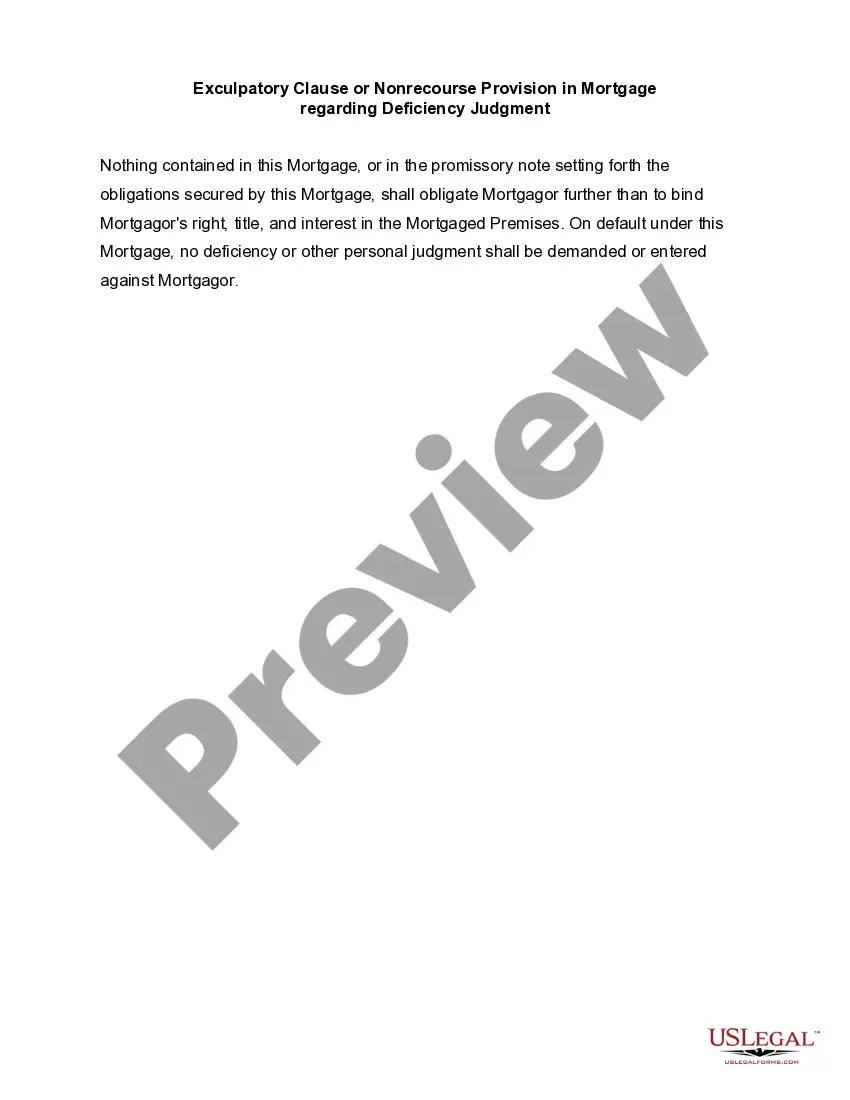
Exculpatory Clause or Nonrecourse Provision in Mortgage regarding Deficiency Judgment
What this document covers
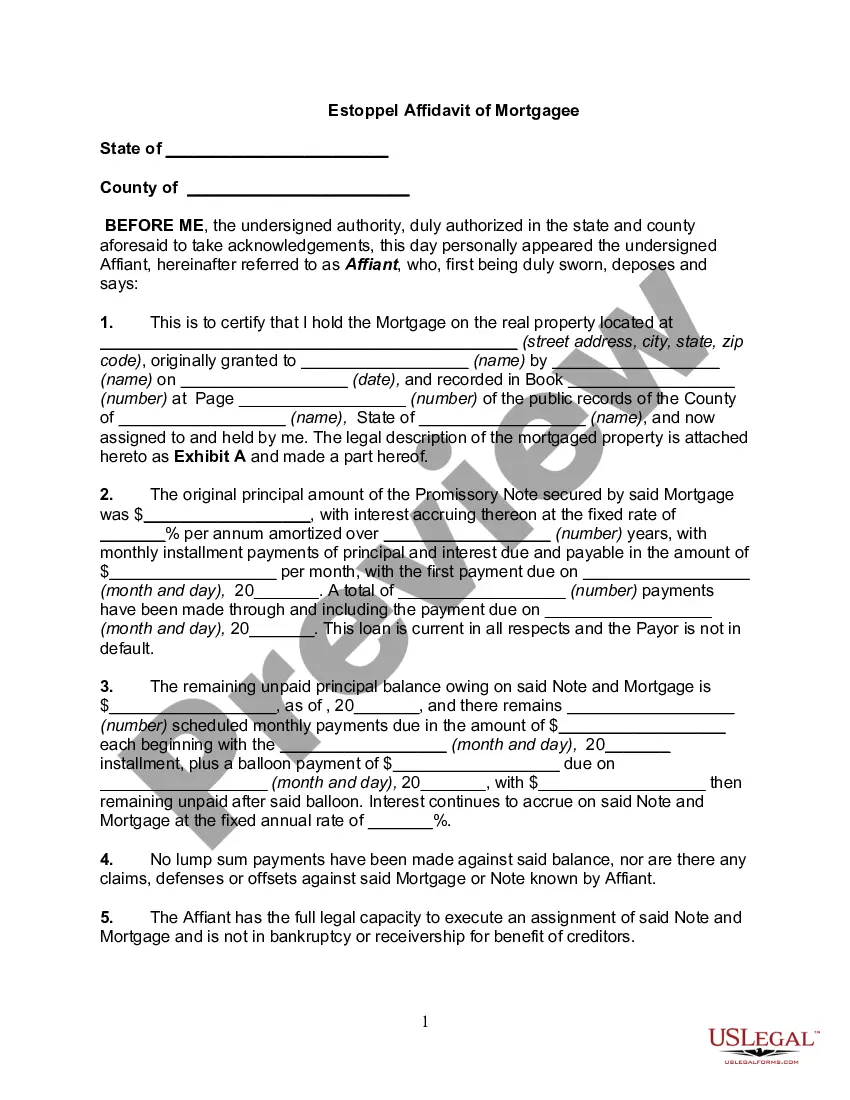
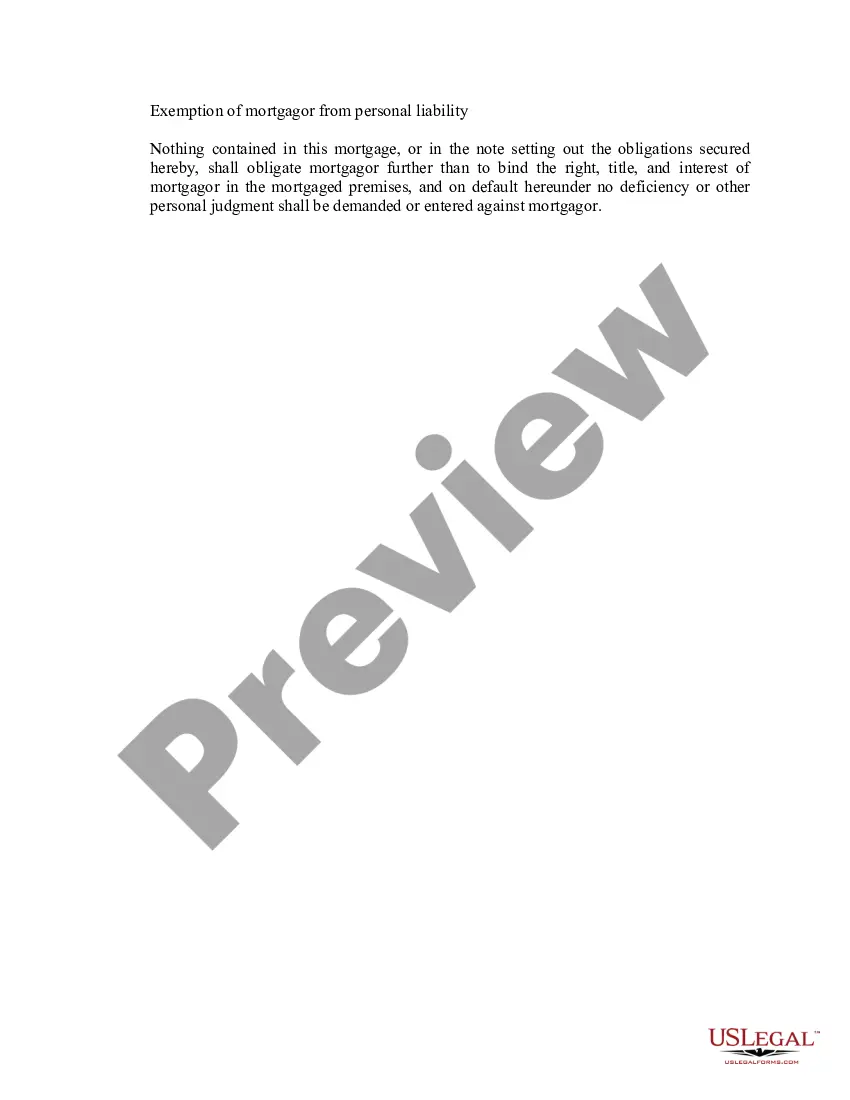
The exculpatory clause or nonrecourse provision in mortgage regarding deficiency judgment is a legal document that limits the liability of the borrower (mortgagor) in case of default. By incorporating this clause, the lender agrees that, in the event of a default, they cannot seek repayment from the borrower beyond the collateral specified in the mortgage. This form protects the mortgagor by ensuring that if the property is foreclosed, they cannot be held personally liable for any remaining loan balance.
Main sections of this form
- Definition of the collateral securing the mortgage.
- Statement that no personal judgment for deficiency amounts can be pursued against the mortgagor upon default.
- Clarification of the extent to which the mortgagor's liability is limited.
When to use this document
This form is typically used when a borrower seeks to protect themselves from potential financial liability beyond the collateral in a mortgage. It is useful in real estate transactions where the borrower wishes to ensure that in the case of property foreclosure, they will not be liable for any remaining debt. This is particularly important in economic downturns or for borrowers with less stable financial situations.
Who this form is for
- Borrowers seeking to secure a mortgage while limiting personal liability.
- Lenders who are offering nonrecourse loans under specific conditions.
- Real estate professionals advising clients during mortgage negotiations.
How to complete this form
- Identify the parties involved in the mortgage agreement (mortgagor and lender).
- Specify the property that is being mortgaged, including address and legal description.
- Include details regarding the loan amount and terms.
- Enter the date of the agreement.
- Ensure all parties sign and date the document as required.
Does this document require notarization?
This form does not typically require notarization unless specified by local law. It's advisable to check local regulations to ensure compliance.
Get your form ready online
Our built-in tools help you complete, sign, share, and store your documents in one place.
Make edits, fill in missing information, and update formatting in US Legal Forms—just like you would in MS Word.
Download a copy, print it, send it by email, or mail it via USPS—whatever works best for your next step.
Sign and collect signatures with our SignNow integration. Send to multiple recipients, set reminders, and more. Go Premium to unlock E-Sign.
If this form requires notarization, complete it online through a secure video call—no need to meet a notary in person or wait for an appointment.
We protect your documents and personal data by following strict security and privacy standards.

Make edits, fill in missing information, and update formatting in US Legal Forms—just like you would in MS Word.

Download a copy, print it, send it by email, or mail it via USPS—whatever works best for your next step.

Sign and collect signatures with our SignNow integration. Send to multiple recipients, set reminders, and more. Go Premium to unlock E-Sign.

If this form requires notarization, complete it online through a secure video call—no need to meet a notary in person or wait for an appointment.

We protect your documents and personal data by following strict security and privacy standards.
Common mistakes
- Failing to clearly identify the collateral property.
- Leaving out necessary signatures, which can invalidate the form.
- Not consulting legal advice to understand the implications of the clause fully.
Why use this form online
- Immediate access to a structured, professionally drafted legal form.
- Ability to customize the document to specific needs before downloading.
- Cost-effective solution for legal documentation without the need for lawyer consultations.
Legal use & context
- This form helps enforce the limitations set on the mortgagor's liability, making it an important tool in mortgage agreements.
- Understanding this clause is essential for borrowers wishing to manage their financial risk during property financing.
Main things to remember
- An exculpatory clause limits a mortgagor's liability to only the property secured by the mortgage.
- This form is essential for anyone wishing to protect themselves financially in real estate transactions.
- Always ensure compliance with local laws regarding notarization and execution.
Looking for another form?

Form popularity
FAQ
A provision in a lease that absolves the landlord in advance from responsibility for all damages, injuries, or losses occurring on the property, including those caused by the landlord's actions. Most states have laws that void exculpatory clauses in rental agreements, which means that a court will not enforce them.
How do I know if I have an existing recourse loan or nonrecourse loan? In most cases your original note and mortgage should indicate if the loan is recourse or nonrecourse, however, you can ask your lender to confirm the type of debt.
Reverse mortgages can use up the equity in your home, which means fewer assets for you and your heirs. Most reverse mortgages have something called a non-recourse clause. This means that you, or your estate, can't owe more than the value of your home when the loan becomes due and the home is sold.
Credit cards, auto loans and hard money loanstypically short-term real estate loans offered by non-bank lendersare common types of recourse loans.The lender can then attempt to recover its money by seizing the borrower's other assets. In all but 12 states, home mortgages are also considered recourse loans.
Few banks offer non-recourse loans, but home mortgages are treated as non-recourse loans in 12 non-recourse states. Non-recourse debt also has higher interest rates and more restrictive borrower qualifications than recourse because non-recourse debt is riskier for lenders.
(1) A clause in a mortgage that allows the borrower to surrender the property to a lender without any further personal liability for a deficiency. (2) A clause in a trust instrument or in a will excusing the trustee or executor from liability when powers are exercised in error but in good faith.
The general rule is that exculpatory clauses are enforceable if they are reasonable. They are not valid if they are unconscionable or unreasonable. Additionally, they cannot excuse liability from harm which is caused intentionally or recklessly.
Non-recourse states include Alaska, Arizona, Washington, Utah, Idaho, Minnesota, California, North Carolina, Connecticut, North Dakota, Texas and Oregon. These states only allow non-recourse loans. In other states, you may have either type of loan.
While exculpatory clauses are typically upheld, they can be challenged and overturned in court. The court can determine that the clause is unreasonable if both parties in the contract do not have equal bargaining power or if the clause eliminates liability for negligence.