Sample Letter for Request to Use Copyrighted Material
What this document covers
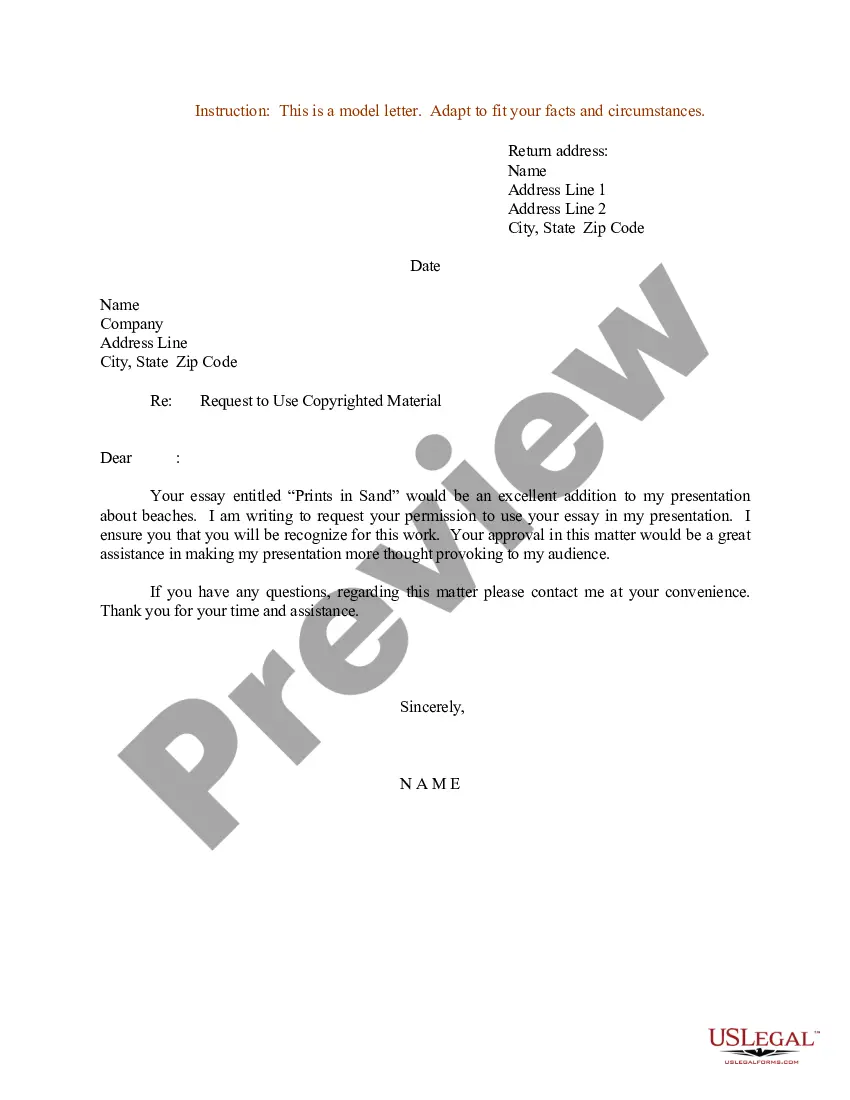
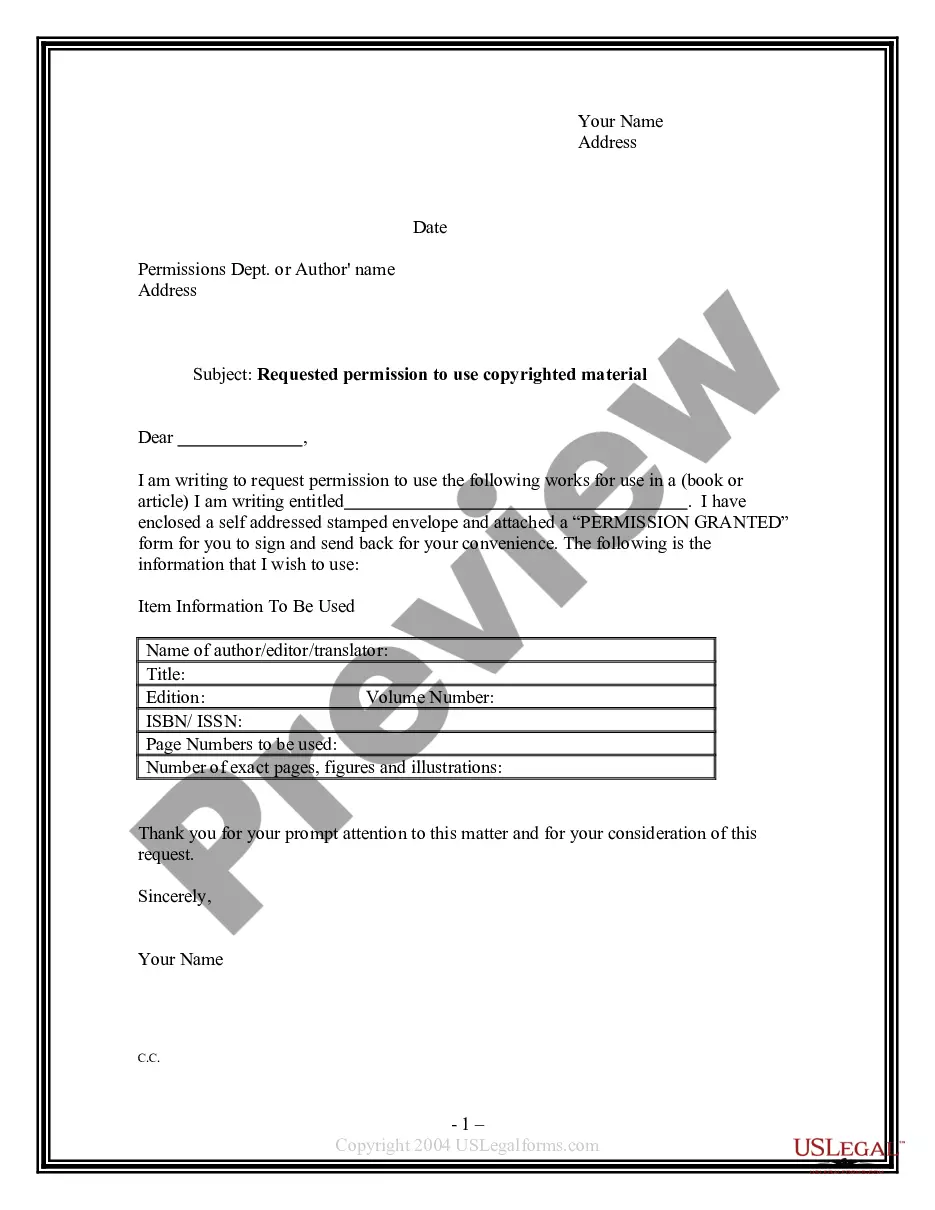
This Sample Letter for Request to Use Copyrighted Material is a formal request used to obtain permission to use copyrighted works. It is essential for individuals or businesses seeking to utilize content owned by others, differentiating it from other legal requests by specifically targeting copyright issues. This letter helps ensure that you are legally protected and respects the rights of the copyright holder.
What’s included in this form
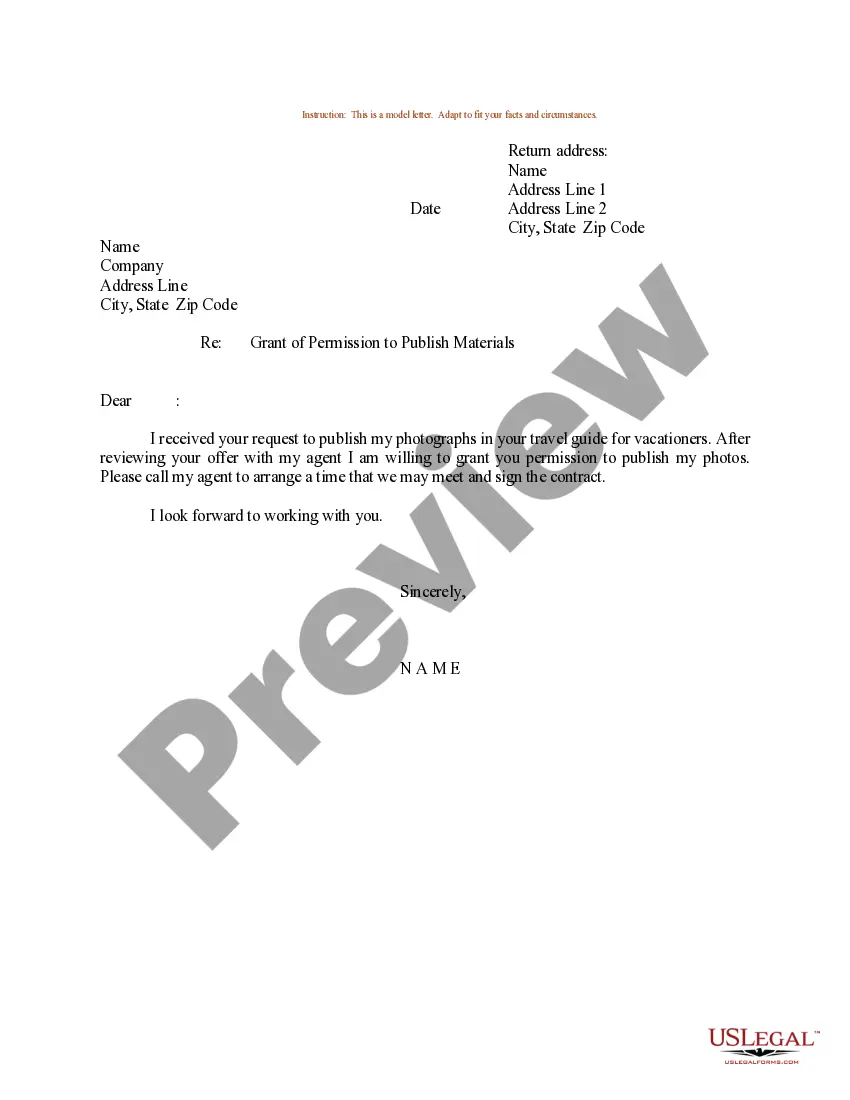
- Return address: Your name and contact details to identify the sender.
- Date: The date the letter is being sent.
- Recipient's address: The name and contact details of the copyright owner.
- Subject line: Clearly states the purpose of the letter.
- Polite closing: Expresses gratitude and provides contact information for follow-up.

When to use this form
This letter should be used whenever you want to request permission to use copyrighted material, such as text, images, music, or other creative works. It is particularly important in instances where you intend to publish, distribute, or adapt the material for your own projects, ensuring compliance with copyright law.
Who can use this document
Individuals or organizations that may find this form useful include:
- Authors seeking to quote another author's work.
- Educators wanting to use copyrighted materials in teaching.
- Businesses planning to incorporate third-party content in marketing materials.
- Artists wanting to use existing art pieces in their projects.
Instructions for completing this form
- Identify yourself by filling out the return address section with your name and contact information.
- Enter the date the letter is prepared and sent.
- Fill in the recipient's details, ensuring you have the correct name and address of the copyright holder.
- Clearly state the request in the subject line, specifying the copyrighted work you wish to use.
- Provide your contact information for any further inquiries.
- Sign the letter with your name before sending it out.
Is notarization required?
Notarization is generally not required for this form. However, certain states or situations might demand it. You can complete notarization online through US Legal Forms, powered by Notarize, using a verified video call available anytime.
Get your form ready online
Our built-in tools help you complete, sign, share, and store your documents in one place.
Make edits, fill in missing information, and update formatting in US Legal Forms—just like you would in MS Word.
Download a copy, print it, send it by email, or mail it via USPS—whatever works best for your next step.
Sign and collect signatures with our SignNow integration. Send to multiple recipients, set reminders, and more. Go Premium to unlock E-Sign.
If this form requires notarization, complete it online through a secure video call—no need to meet a notary in person or wait for an appointment.
We protect your documents and personal data by following strict security and privacy standards.

Make edits, fill in missing information, and update formatting in US Legal Forms—just like you would in MS Word.

Download a copy, print it, send it by email, or mail it via USPS—whatever works best for your next step.

Sign and collect signatures with our SignNow integration. Send to multiple recipients, set reminders, and more. Go Premium to unlock E-Sign.

If this form requires notarization, complete it online through a secure video call—no need to meet a notary in person or wait for an appointment.

We protect your documents and personal data by following strict security and privacy standards.
Avoid these common issues
- Failure to provide sufficient details about the work being used, which can lead to rejection of the request.
- Not including your contact information, making it difficult for the copyright owner to respond.
- Sending the letter without double-checking the recipient's information, which may cause delays.
Why complete this form online
- Convenience: Download and fill out the form at your own pace.
- Editability: Customize the template to fit your specific situation easily.
- Reliability: Ensures that you follow a professional format drafted by legal experts, reducing risks of errors.
Legal use & context
- Using copyrighted material without permission can lead to legal consequences.
- This form provides a clear record of your request for permission.
- Obtaining permission can mitigate risks and enable lawful use of content.
Main things to remember
- This letter is essential for legally requesting permission to use copyrighted materials.
- Correctly identifying all parties and including detailed information increases the likelihood of approval.
- Using an online form can simplify the process and ensure accuracy in your request.
Looking for another form?
Form popularity
FAQ
Declare the permission in Android Manifest file: In Android permissions are declared in AndroidManifest. Modify activity_main. Check whether permission is already granted or not.
Addresses: Write down the necessary addresses. Salutation: Here you offer some form of respectful greeting. Title: It should be centered, brief and informative. Body: This should be a maximum of 4 paragraphs. Sign out: Here you mention your name and offer your signature for authentication.
Explain precisely what your request is. Mention the reason for the request. Use polite language and a professional tone. Demonstrate respect and gratitude to the reader. The content of the letter should be official. You may provide contact information where you can be reached.
Fair use allows limited use of copyrighted material without permission from the copyright holder for purposes such as criticism, parody, news reporting, research and scholarship, and teaching. There are four factors to consider when determining whether your use is a fair one.
The Copyright Office cannot grant permission to use copyrighted works. In many situations, securing permission is the most certain way to ensure an intended use is not an infringement of the copyright owner's rights.
Explain precisely what your request is. Mention the reason for the request. Use polite language and a professional tone. Demonstrate respect and gratitude to the reader. The content of the letter should be official. You may provide contact information where you can be reached.
Determine if permission is needed. Identify the owner. Identify the rights needed. Contact the owner and negotiate whether payment is required. Get your permission agreement in writing.
Be sure to include your return address, telephone and fax numbers, and date at the top of your letter. Verify the exact name and address of the addressee. Clearly state the name of your university and your dissertation's title. Describe the proposed use of the copyrighted material.
You start the email or letter by explaining what you are writing about (the topic/subject) and what the email's purpose is (i.e. you want to ask them some questions or for something). Then in the next section, you ask them the questions or requests.