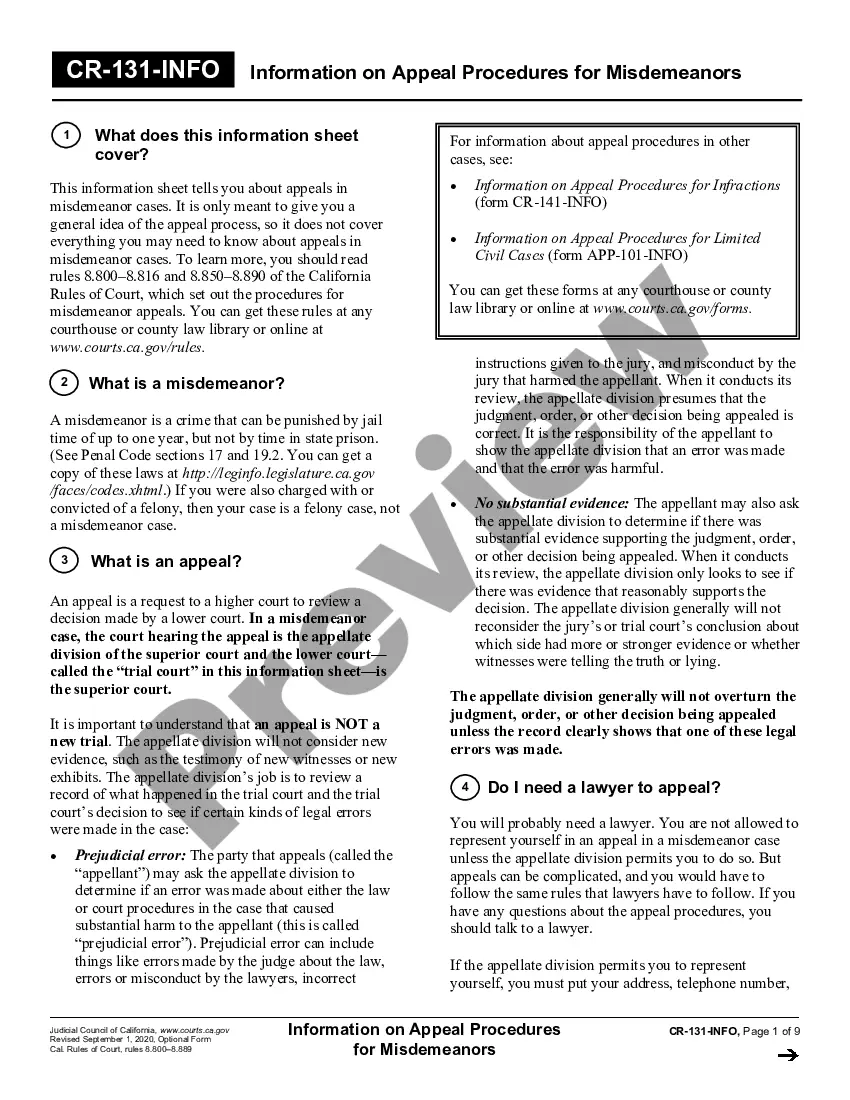
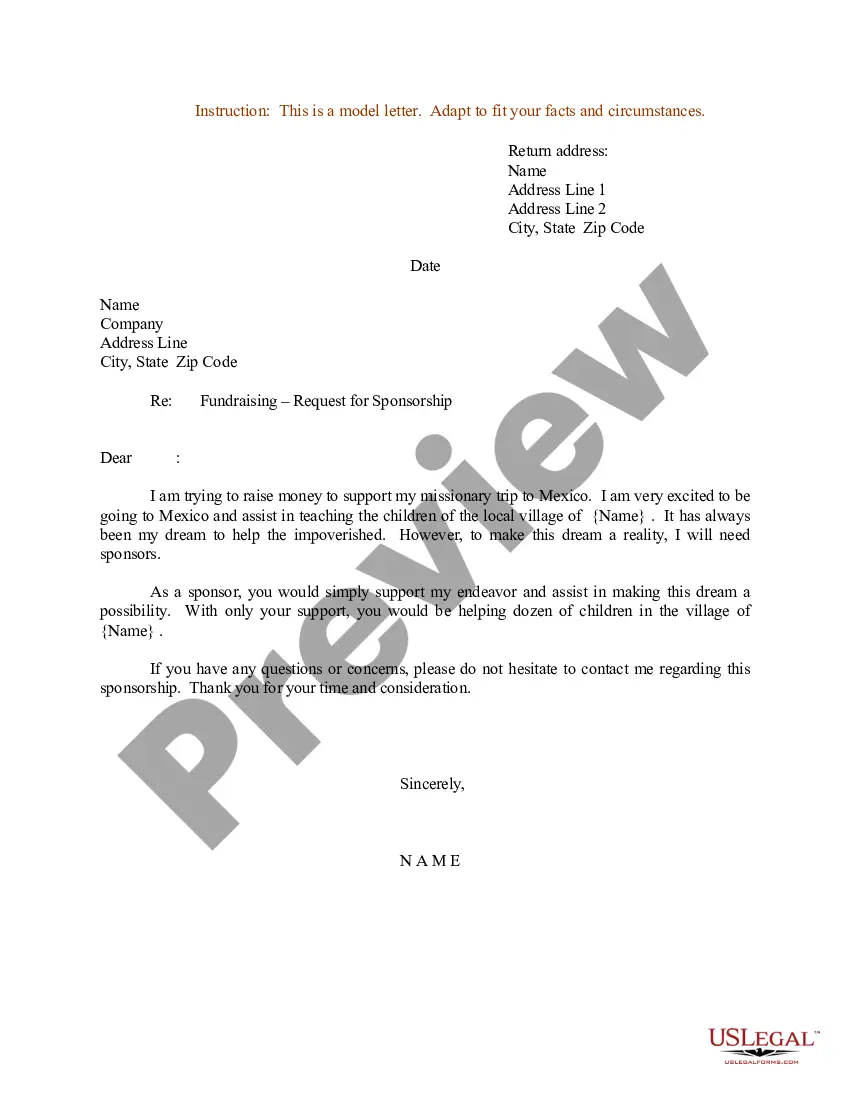
Sample Letter for Fundraising - Request for Sponsorship
Overview of this form
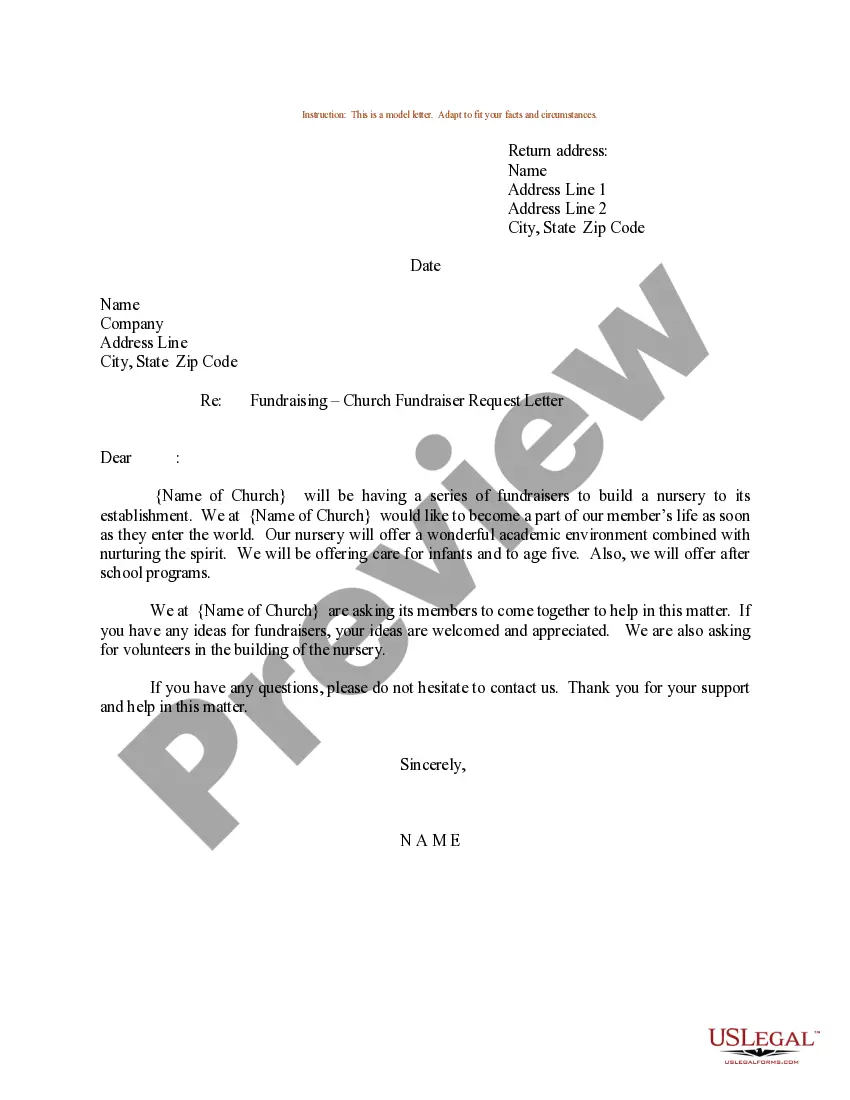
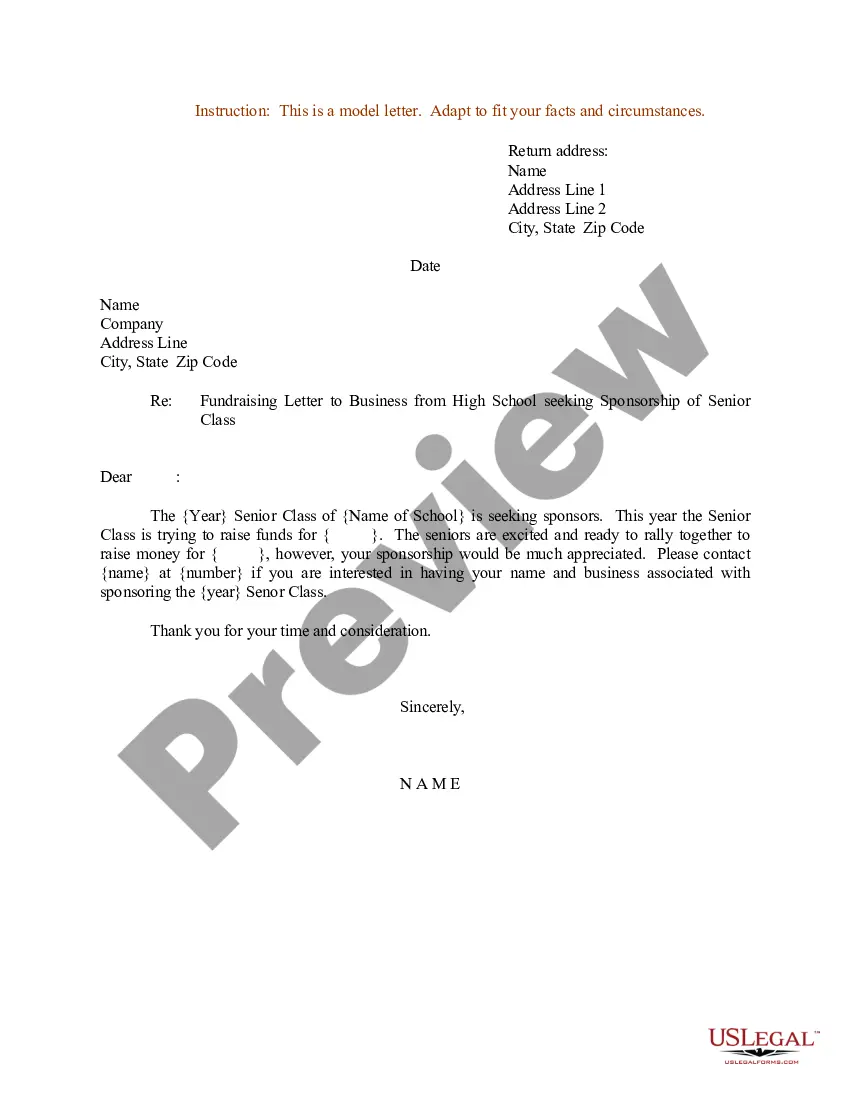
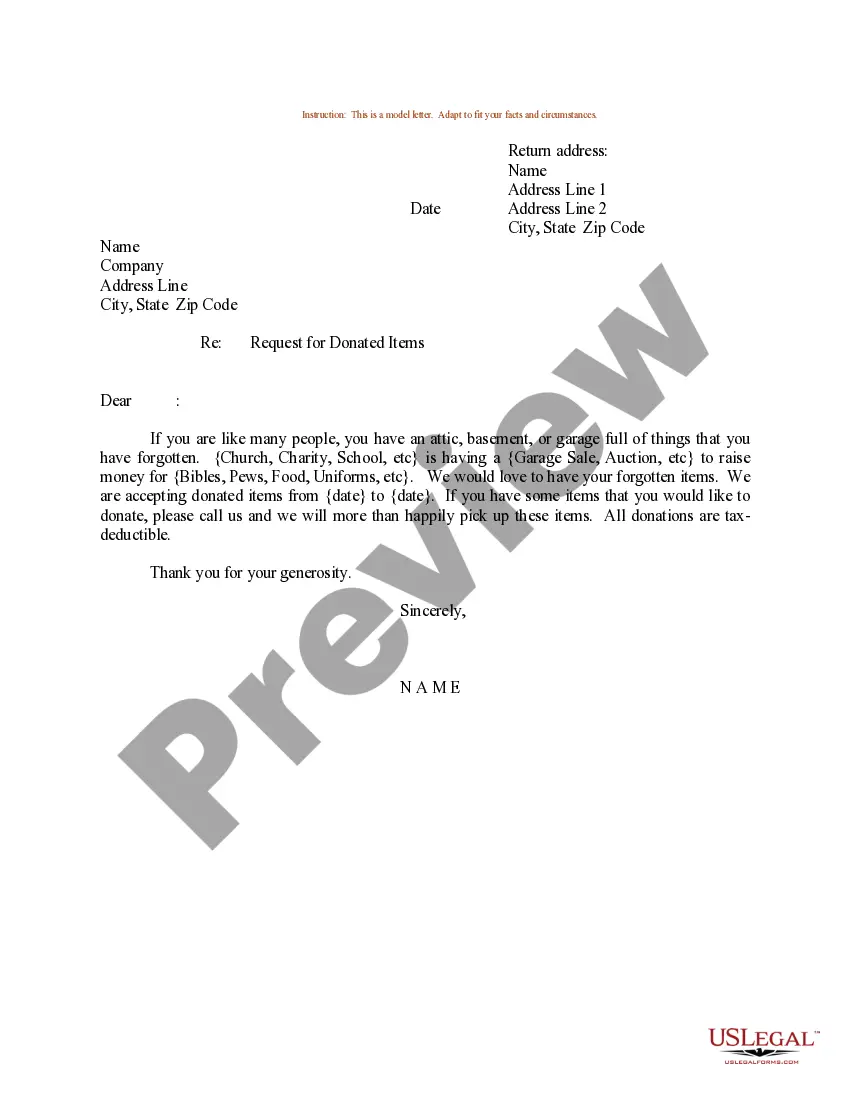
The Sample Letter for Fundraising - Request for Sponsorship is a template designed to help individuals or organizations solicit sponsorships for fundraising efforts. This form clarifies the sponsor's role and the impact of their support, making it distinct from general donation requests. It helps ensure potential sponsors understand their contribution's significance and builds a professional approach to fundraising.
Key parts of this document
- Return address: Includes the sender's name and address.
- Date: The date the letter is sent.
- Recipient's address: The name and address of the sponsor being approached.
- Salutation: A formal greeting to the recipient.
- Introduction: A brief explanation of the fundraising endeavor and its purpose.
- Contact information: A section inviting the sponsor to reach out with questions.
- Closing: A professional closing statement and signature line.
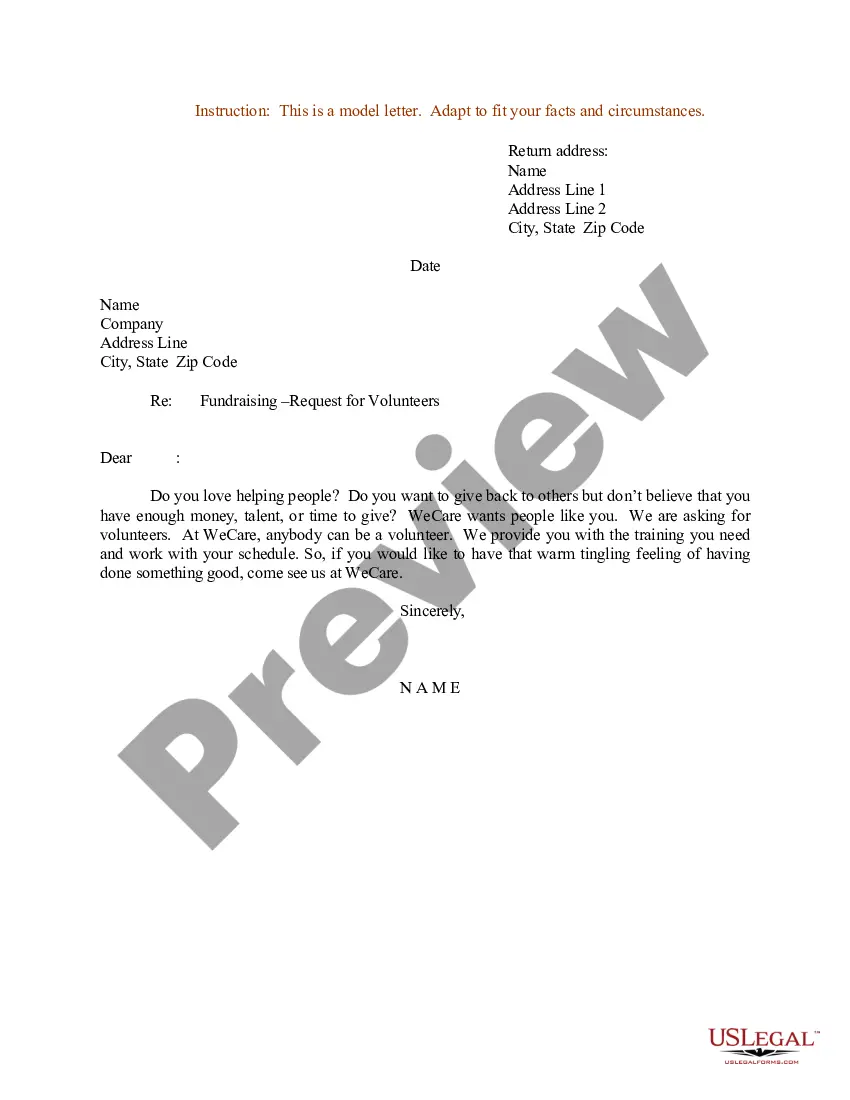
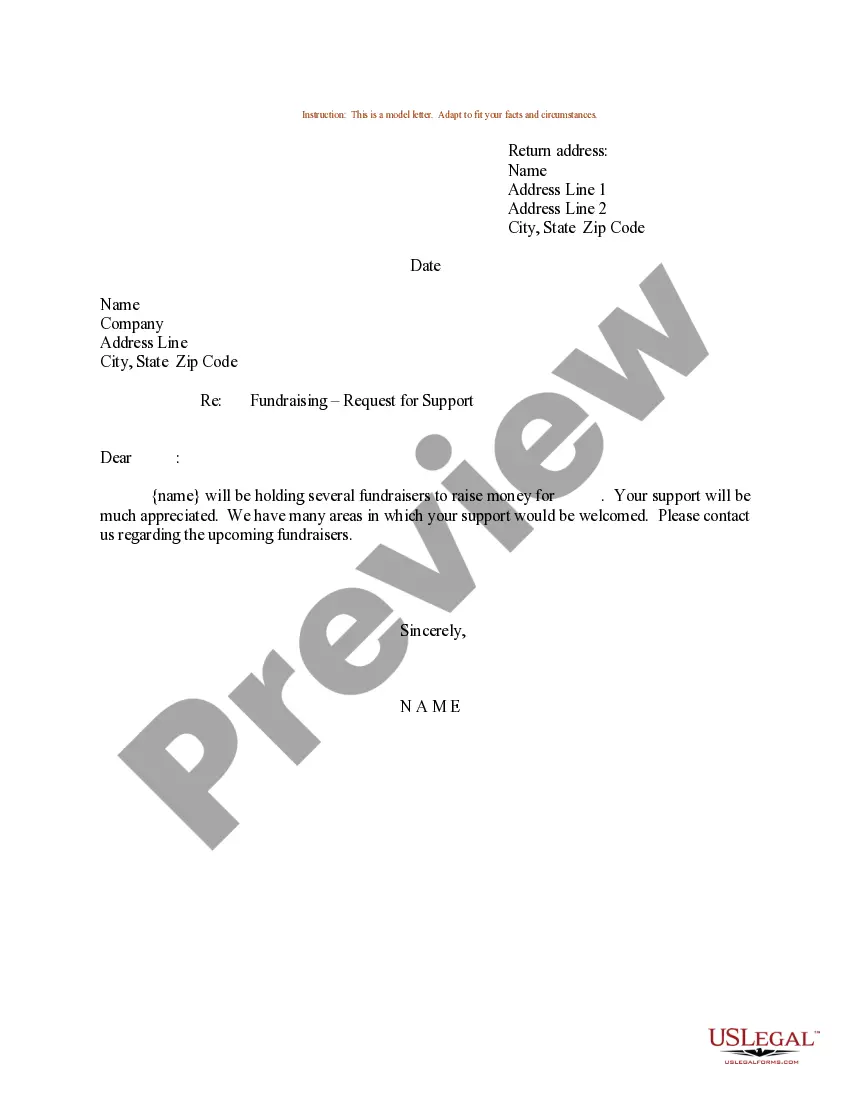
When to use this form
This form should be used when you need to ask for sponsorship for your fundraising event or initiative. It is applicable in scenarios where financial assistance or in-kind support is necessary to achieve a specific goal, such as helping children or supporting community projects. It is especially beneficial when approaching potential sponsors who may want to be associated with a good cause.
Who this form is for
This form is ideal for:
- Non-profit organizations seeking funding for projects.
- Schools or educational programs looking for sponsorships.
- Individuals planning events that require financial backing.
- Community groups aiming to enhance local services through fundraising.
Completing this form step by step
- Fill in your return address at the top of the letter.
- Add the date on which the letter is being sent.
- Include the recipient's name and address to personalize your request.
- Write a clear introduction stating the purpose of your fundraising effort.
- Invite the recipient to ask questions, providing your contact information.
- Close the letter with a polite and professional ending, followed by your name.
Is notarization required?
In most cases, this form does not require notarization. However, some jurisdictions or signing circumstances might. US Legal Forms offers online notarization powered by Notarize, accessible 24/7 for a quick, remote process.
Get your form ready online
Our built-in tools help you complete, sign, share, and store your documents in one place.
Make edits, fill in missing information, and update formatting in US Legal Forms—just like you would in MS Word.
Download a copy, print it, send it by email, or mail it via USPS—whatever works best for your next step.
Sign and collect signatures with our SignNow integration. Send to multiple recipients, set reminders, and more. Go Premium to unlock E-Sign.
If this form requires notarization, complete it online through a secure video call—no need to meet a notary in person or wait for an appointment.
We protect your documents and personal data by following strict security and privacy standards.

Make edits, fill in missing information, and update formatting in US Legal Forms—just like you would in MS Word.

Download a copy, print it, send it by email, or mail it via USPS—whatever works best for your next step.

Sign and collect signatures with our SignNow integration. Send to multiple recipients, set reminders, and more. Go Premium to unlock E-Sign.

If this form requires notarization, complete it online through a secure video call—no need to meet a notary in person or wait for an appointment.

We protect your documents and personal data by following strict security and privacy standards.
Common mistakes
- Neglecting to personalize the letter for the recipient.
- Failing to clearly state the purpose of the fundraising effort.
- Omitting contact information for follow-up questions.
- Using a casual tone instead of maintaining professionalism.
Benefits of completing this form online
- Convenience: Download and customize the template at your convenience.
- Editability: Tailor the template to fit your specific fundraising needs effortlessly.
- Reliability: Professionally drafted by licensed attorneys to ensure clarity and effectiveness.
What to keep in mind
- This Sample Letter for Fundraising is specifically designed for requesting sponsorship.
- Clearly outline the impact of potential sponsorship in your letter.
- Customize the template to suit your specific fundraising needs.
Looking for another form?
Form popularity
FAQ
Use "I" and "You", but Mostly "You" Talk About Benefits, Not Needs. Ask for Money, Not for Support. Write a Package, Not a Letter. Use Simple, Straight Forward Words. Make Your Letter Easy to Read. Give Readers a Reason to Send Money Now. Write as Much as You Need to Make Your Case.
Tell a story. Your fundraising letter should start with a story one that fully engages your current and potential supporters in your issue or the problem your organization is working to address. Define the problem. Present your goal. Ask for help. Be humble.
Start the letter with the date, and then the sponsor's name and address. Then, after a space, put the salutation: Dear (Name of the person) and a comma. Keep it short. Keep the sponsorship letter on one page. Send it snail mail.
Start with a story. It could be your story, or the story of someone whose life you changed. Describe what you do. This is your mission statement. Benefits. Describe your demographics. Create an advisory board. Ask for the money. Promise deliverables. Don't sell yourself short.
An Introduction to Yourself and Your Opportunity. The Reason You Got in Touch. Information about Your Audience. Your Activation and Sponsorship Opportunities. A Mention of When You Will Follow Up.
When you're ready to email your potential sponsor, keep this in mind: Be clear and concise: Your end goal is to start a conversation that will ultimately lead to a meeting to discuss the sponsorship opportunity. The email should focus on the value of your event, and what objectives and audience you share.
Start with a story. It could be your story, or the story of someone whose life you changed. Describe what you do. This is your mission statement. Benefits. Describe your demographics. Create an advisory board. Ask for the money. Promise deliverables. Don't sell yourself short.
Personalize your letter. Use first names if possible. Thank the donor for his or her past support. There's nothing worse than writing to a long-time donor as though he never gave before. Tell a story. Make the donor the hero. Write conversationally. Make a specific ask.
Introduce who or what are you are raising money for. An overview of what happened (or your cause). How the money will be spent. Why this cause means so much to you. Share your gratitude and appreciation that the reader is considering sharing or donating to your GoFundMe.