Motion for Summary Judgment by Plaintiff for Breach of Contract
Understanding this form
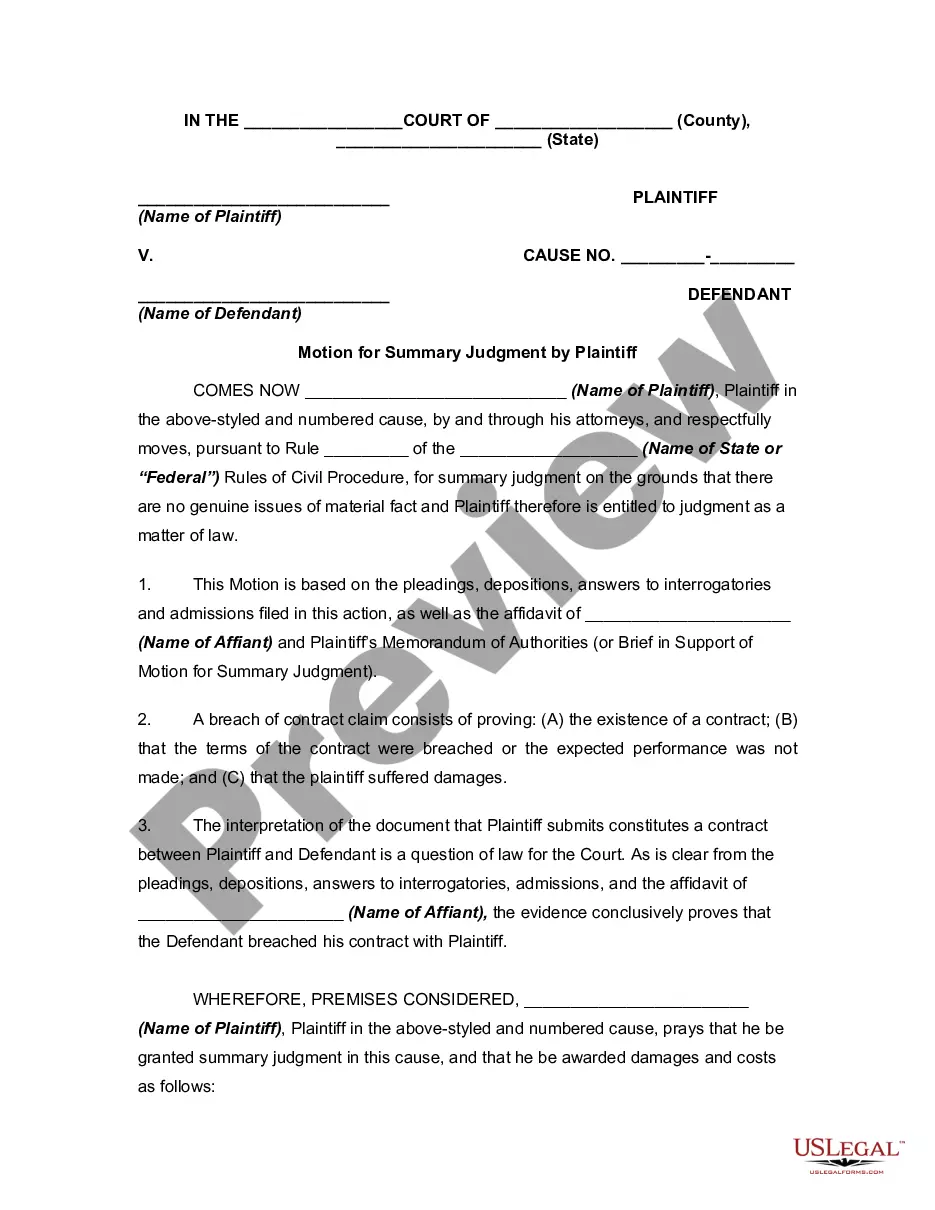
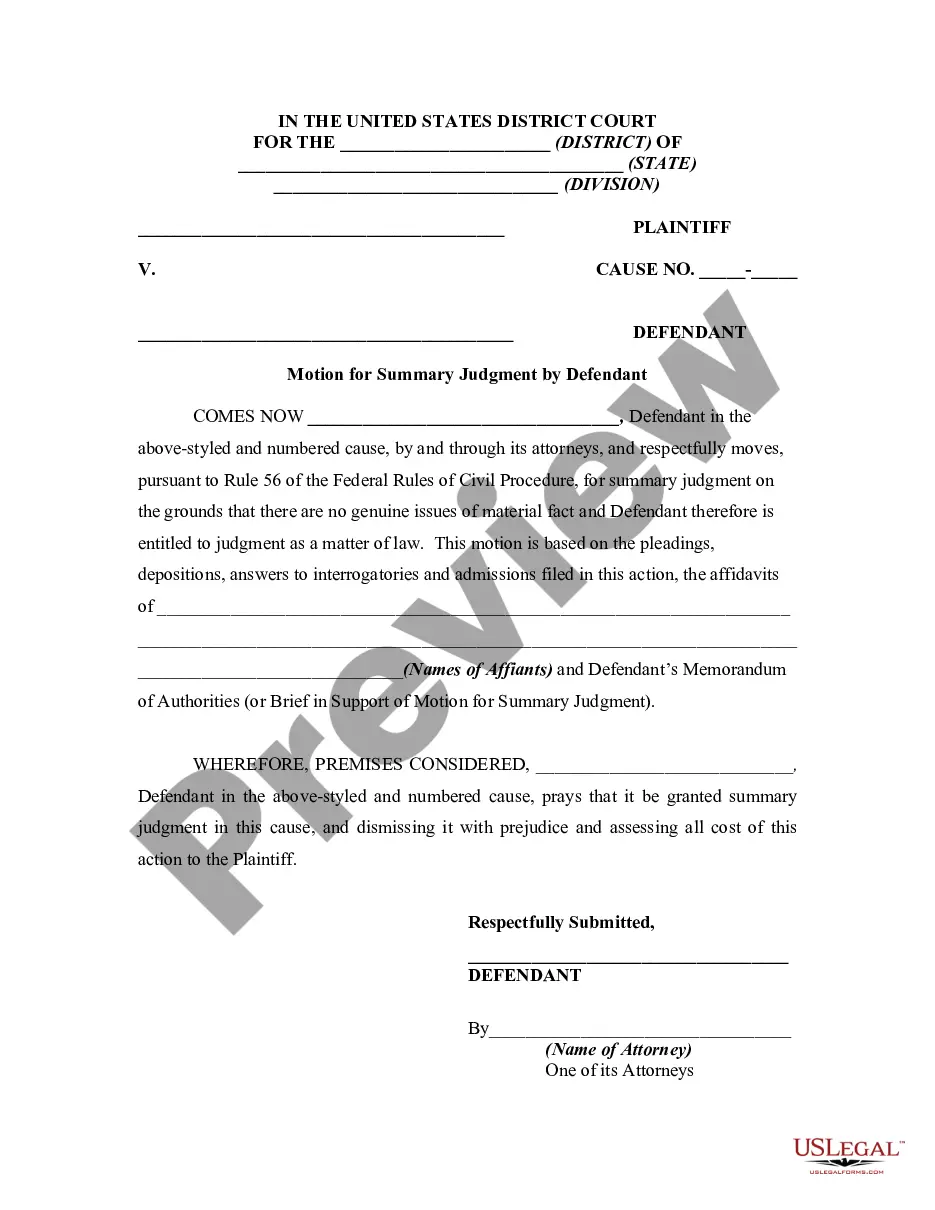
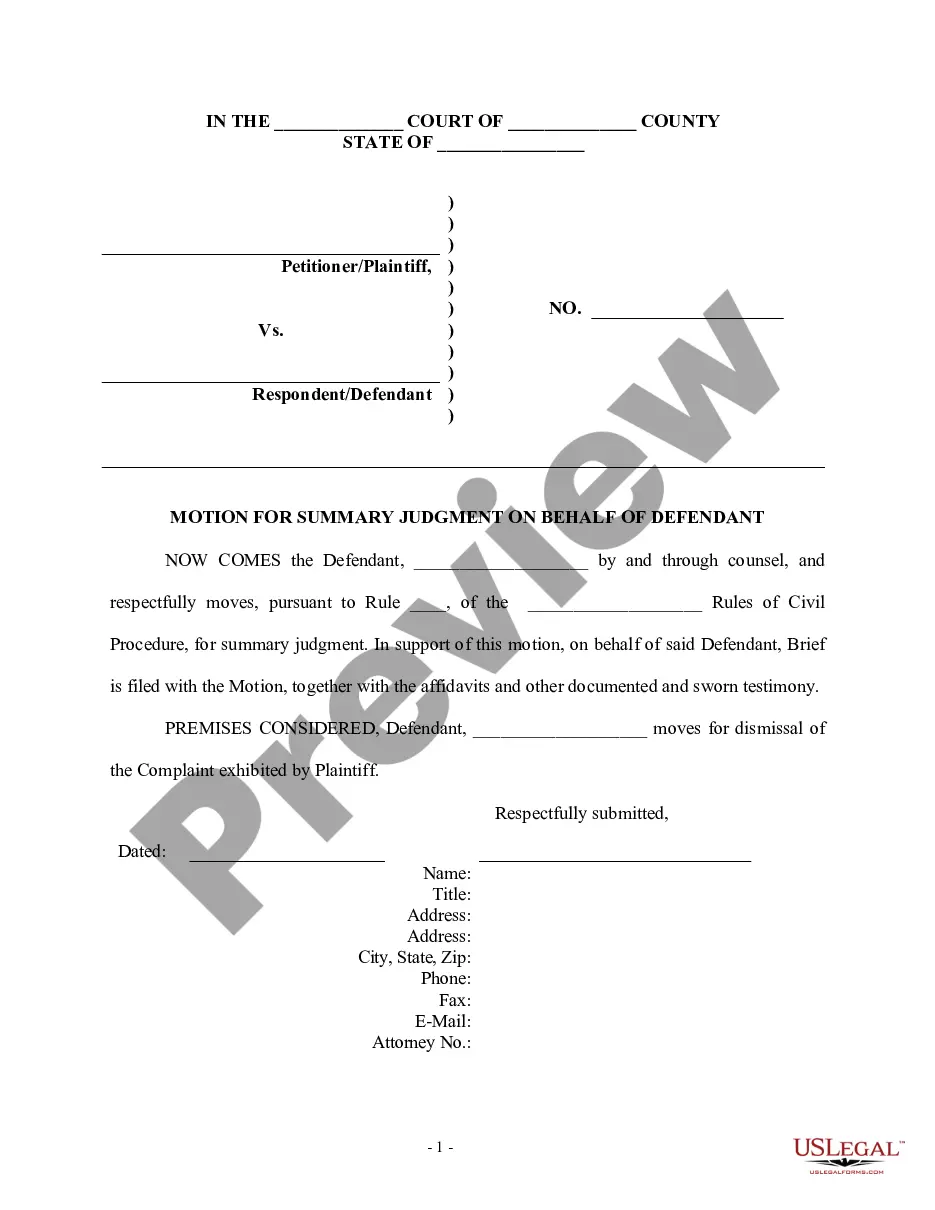
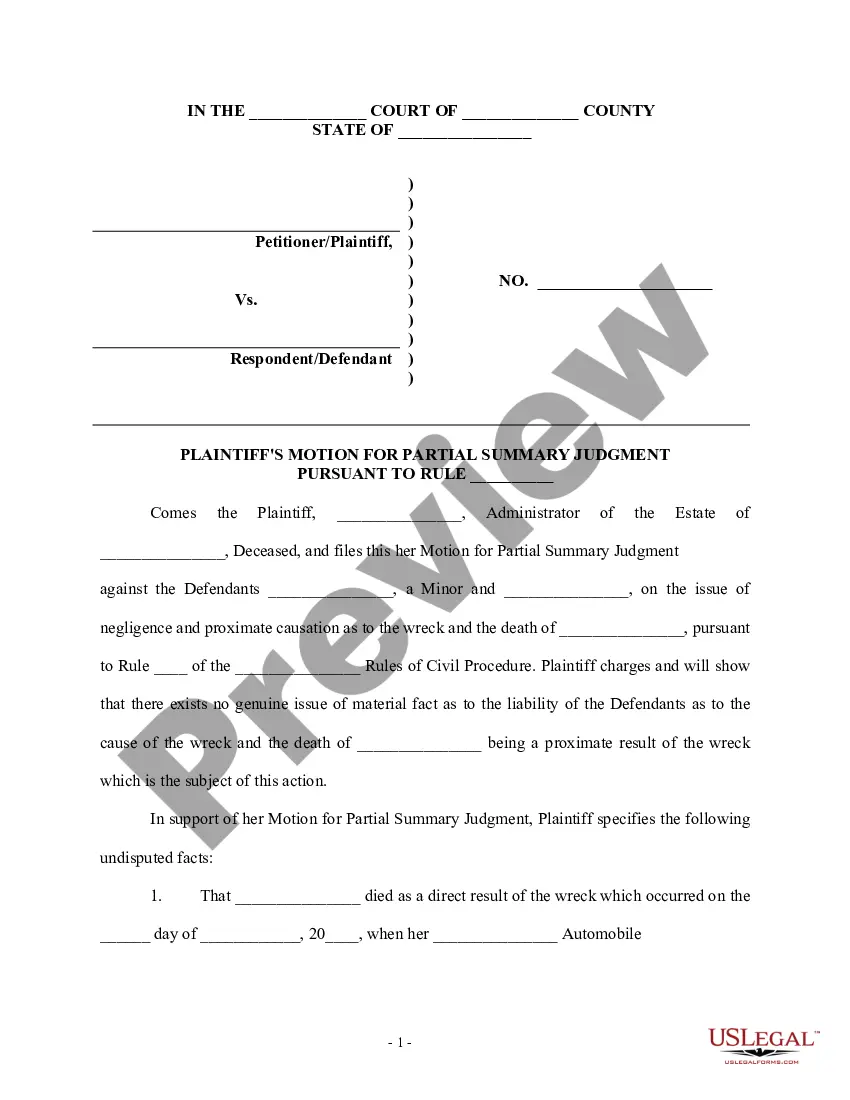
The Motion for Summary Judgment by Plaintiff for Breach of Contract is a legal document used to request a court judgment based on the argument that there are no significant factual disputes in the case. This type of motion allows a judge to rule on the application of the law to the undisputed facts, potentially resolving the case without the need for a full trial. Unlike other motions, this motion specifically addresses breach of contract cases where the essential facts are clear and undisputed.
Key parts of this document
- Identification of the parties involved in the case.
- A statement outlining the basis for the motion, including references to relevant legal rules.
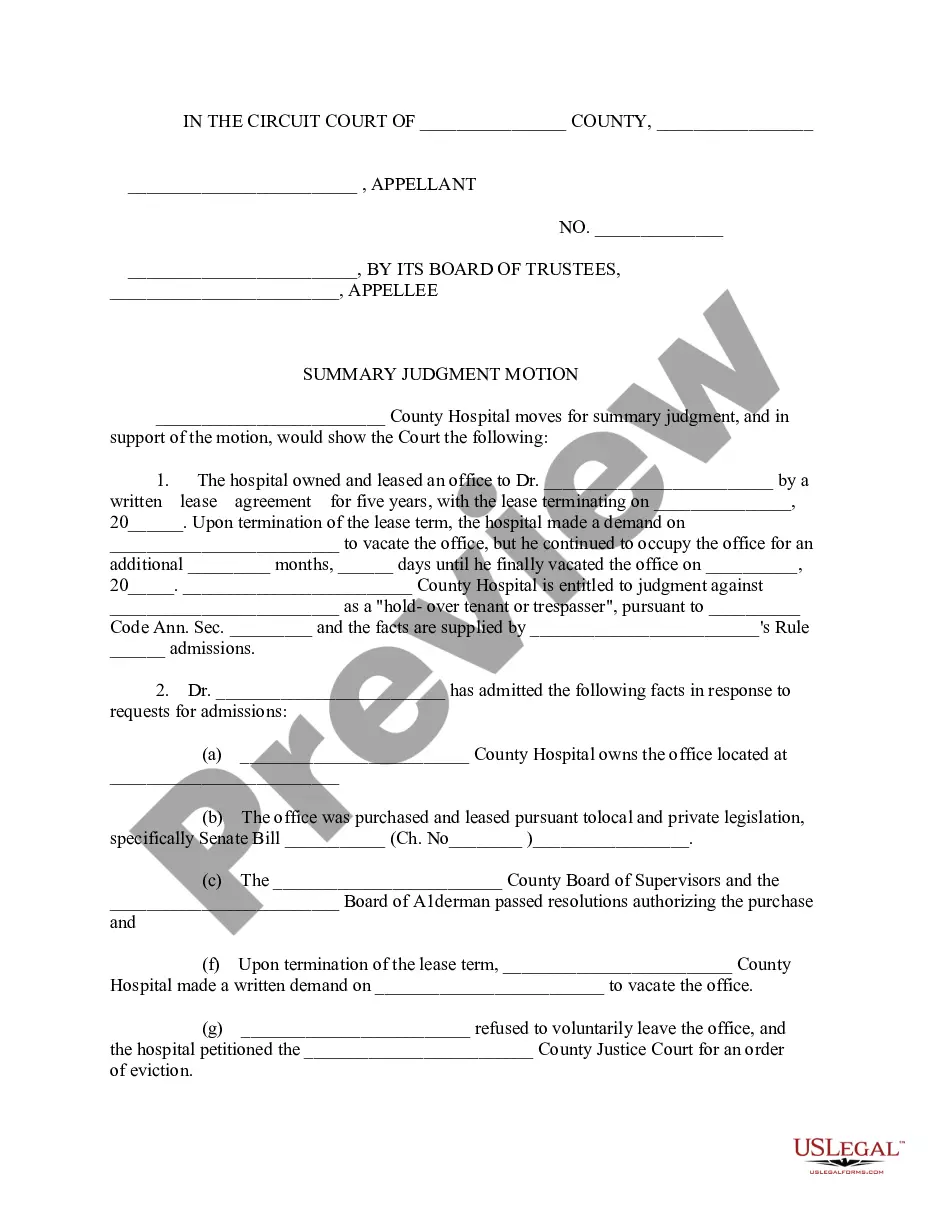
- Detailed allegations related to the breach of contract, including the existence of the contract and the damages suffered.
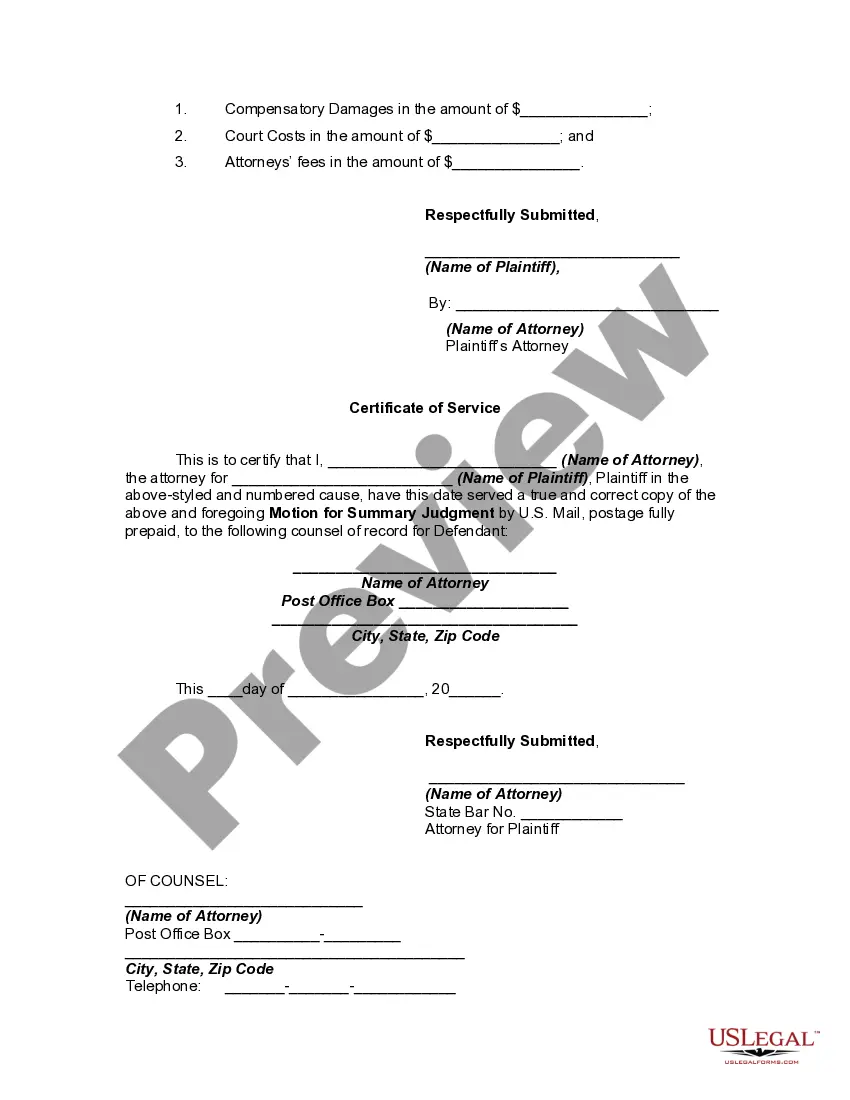
- A request for specific damages and costs, including compensatory damages, court costs, and attorney fees.
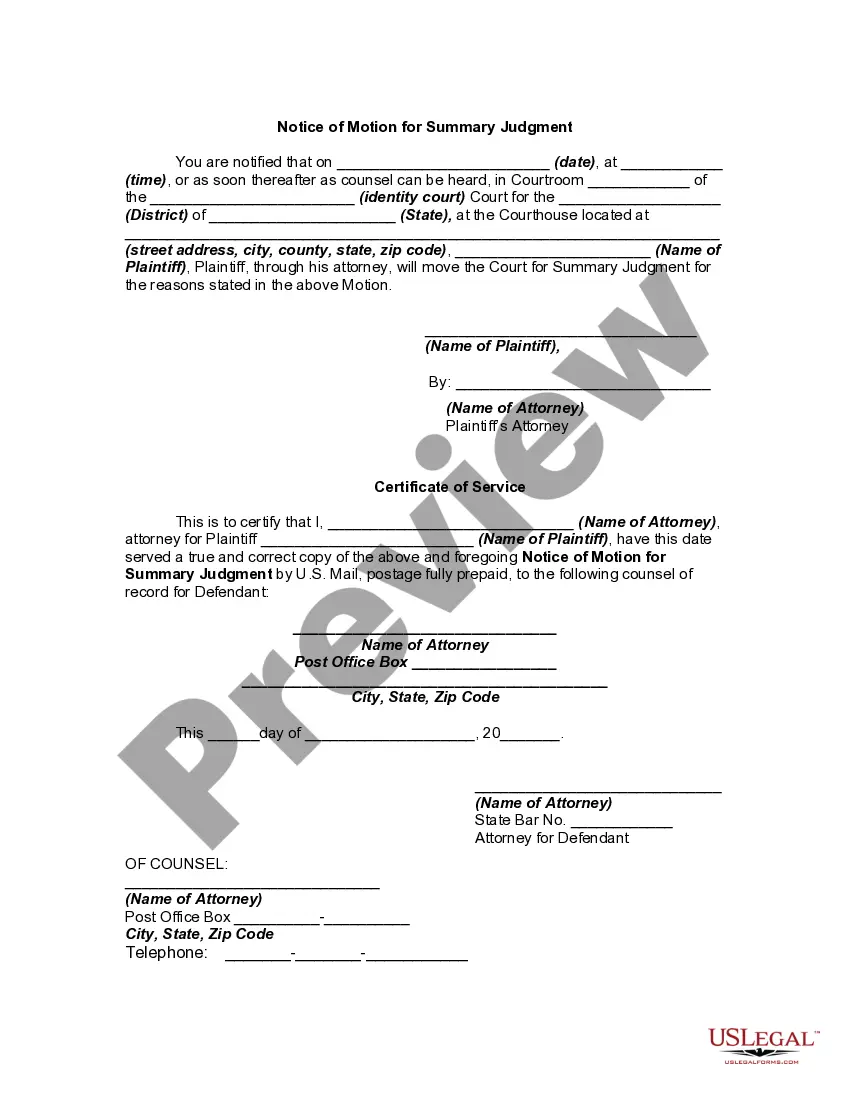
- Notification of the motion hearing date and time.
Situations where this form applies
This form should be used when a plaintiff believes that their breach of contract claim is strong and that there are no genuine disputes over material facts. It is typically filed after all discovery has been completed and the plaintiff is ready to seek a legal ruling from the judge, aiming to expedite the resolution of the case.
Who can use this document
This form is intended for:
- Individuals or businesses who are plaintiffs in a breach of contract lawsuit.
- Legal professionals representing plaintiffs in contracts disputes.
- Parties who have completed all necessary depositions and discovery related to the case.
Completing this form step by step
- Fill in the names of the plaintiff and defendant at the top of the motion.
- State the specific rule under which the motion is filed and the court's name.
- Outline the pertinent facts and legal arguments supporting the claim of breach of contract.
- Specify the amount of damages claimed, including compensatory damages, court costs, and attorney fees.
- Provide the hearing date and time details for the motion.
Does this form need to be notarized?
Notarization is not commonly needed for this form. However, certain documents or local rules may make it necessary. Our notarization service, powered by Notarize, allows you to finalize it securely online anytime, day or night.
Get your form ready online
Our built-in tools help you complete, sign, share, and store your documents in one place.
Make edits, fill in missing information, and update formatting in US Legal Forms—just like you would in MS Word.
Download a copy, print it, send it by email, or mail it via USPS—whatever works best for your next step.
Sign and collect signatures with our SignNow integration. Send to multiple recipients, set reminders, and more. Go Premium to unlock E-Sign.
If this form requires notarization, complete it online through a secure video call—no need to meet a notary in person or wait for an appointment.
We protect your documents and personal data by following strict security and privacy standards.

Make edits, fill in missing information, and update formatting in US Legal Forms—just like you would in MS Word.

Download a copy, print it, send it by email, or mail it via USPS—whatever works best for your next step.

Sign and collect signatures with our SignNow integration. Send to multiple recipients, set reminders, and more. Go Premium to unlock E-Sign.

If this form requires notarization, complete it online through a secure video call—no need to meet a notary in person or wait for an appointment.

We protect your documents and personal data by following strict security and privacy standards.
Common mistakes
- Failing to complete all discovery before filing the motion.
- Not clearly articulating the undisputed facts of the case.
- Omitting the specific legal grounds for the motion or relevant court rules.
- Neglecting to notify the defendant properly about the motion hearing.
Benefits of completing this form online
- Convenience of filling out the form at your own pace.
- Editable templates that allow for customization according to your case specifics.
- Reliable access to legal forms drafted by licensed attorneys.
Looking for another form?
Form popularity
FAQ
Completely resolve a case (e.g., entry of judgment for plaintiff or defendants) Completely resolve a claim. Completely determine the status of a particular party. Resolve a particular claim's application to a particular party. Establish a fact or ruling applicable to the case as it is further adjudicated.
When it comes to summary judgment, plaintiff lawyers are often guilty of forgetting the fact that either party can file one. If you have solid evidence that can't be disputed, you may very well be able to prove your claim without going to trial.
(b) (1) A party may move for judgment on the pleadings.(A) If the moving party is a plaintiff, that the complaint states facts sufficient to constitute a cause or causes of action against the defendant and the answer does not state facts sufficient to constitute a defense to the complaint.
Instead the party who believes that the undisputed facts compel a ruling in his or her favor will file a motion for summary judgment. The motion asks the court to consider the undisputed facts and apply the law to them, and argues that the law requires a judgment for the party bringing the motion.
2006) (The elements of a breach of contract claim are: (1) the existence of a valid contract; (2) the plaintiff's performance or tendered performance; (3) the defendant's breach of the contract; and (4) damages as a result of the breach.)
When a motion for summary judgment is denied, the nonmoving party achieves a form of premium that enables a case to settle for an additional amount. Put simply, the settlement value of a case increases when a motion for summary judgment is denied.
Rule 56 of the Federal Rules of Civil Procedure governs summary judgment for federal courts. Under Rule 56, in order to succeed in a motion for summary judgment, a movant must show 1) that there is no genuine dispute as to any material fact, and 2) that the movant is entitled to judgment as a matter of law.
A response must be in writing and include the same supporting documents as a motion for summary judgment. The opposition to the motion for summary judgment should also include a statement of facts showing the dispute and supporting documents.