Motion to Modify or Amend Divorce Decree to Provide for Reduction in Alimony Due to Involuntary Termination of Job or Employment
Understanding this form
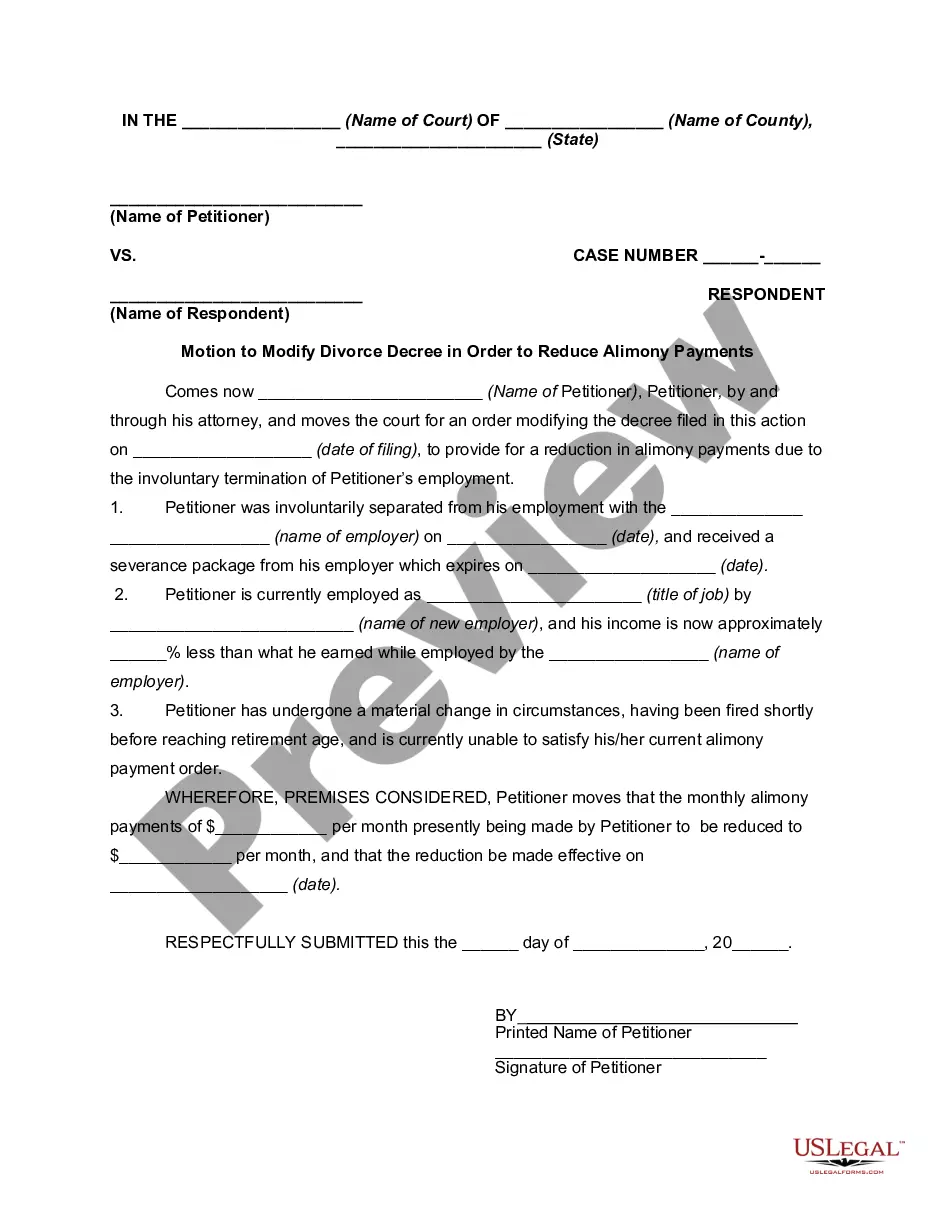
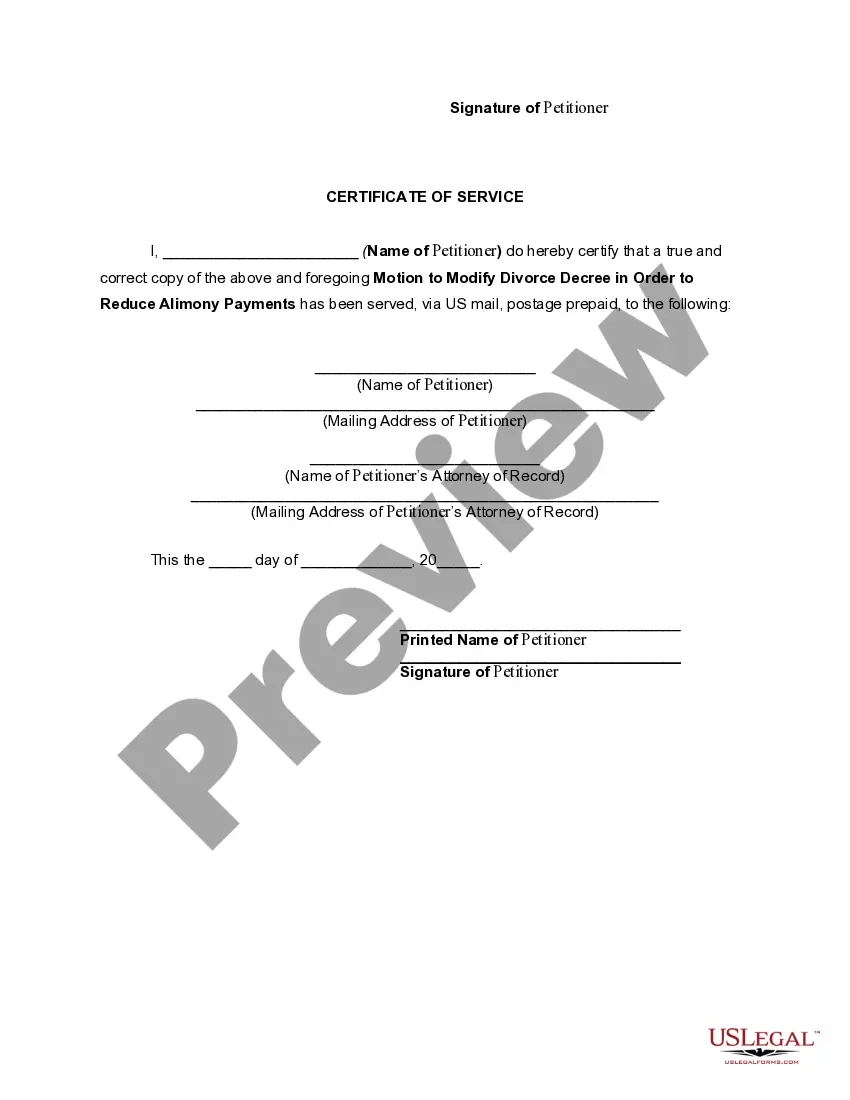
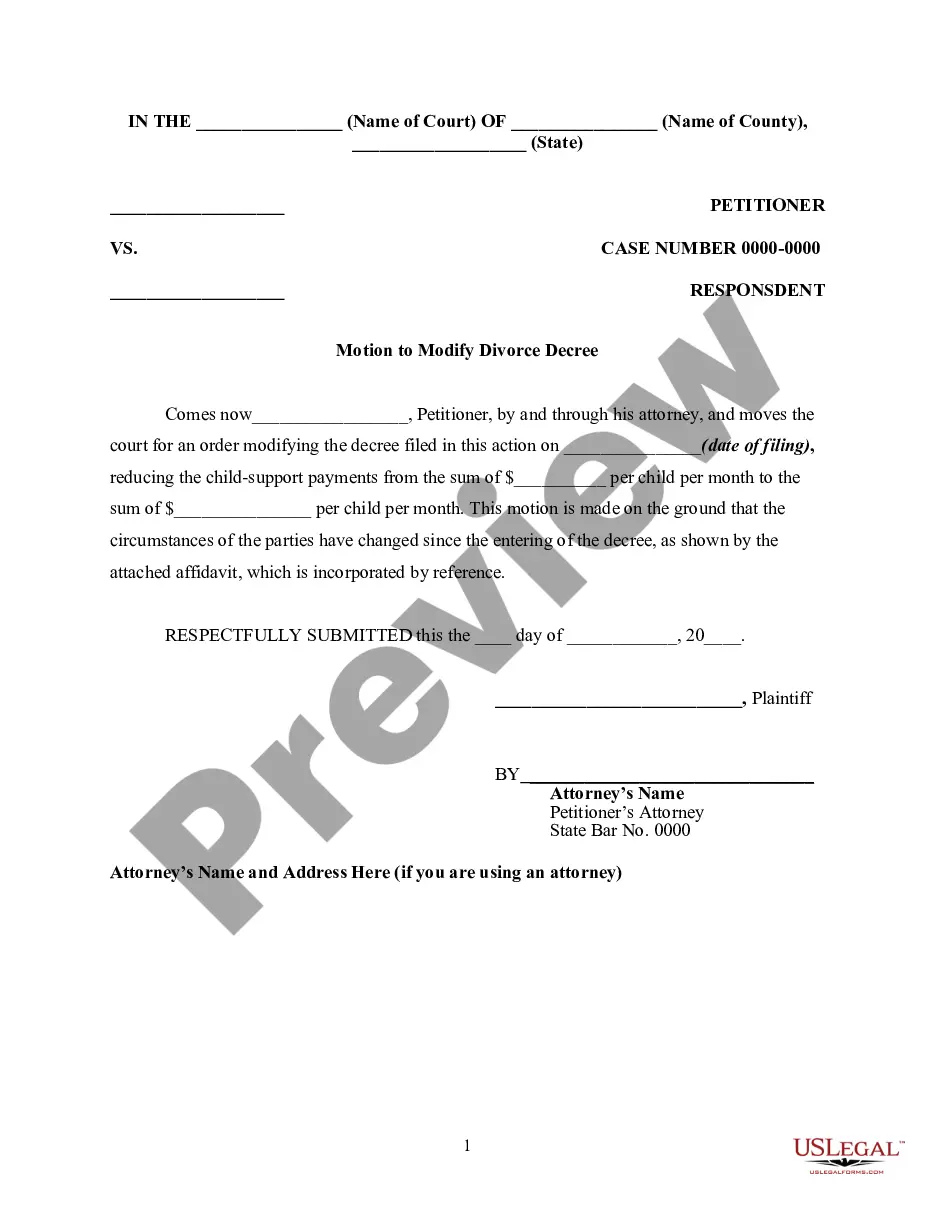
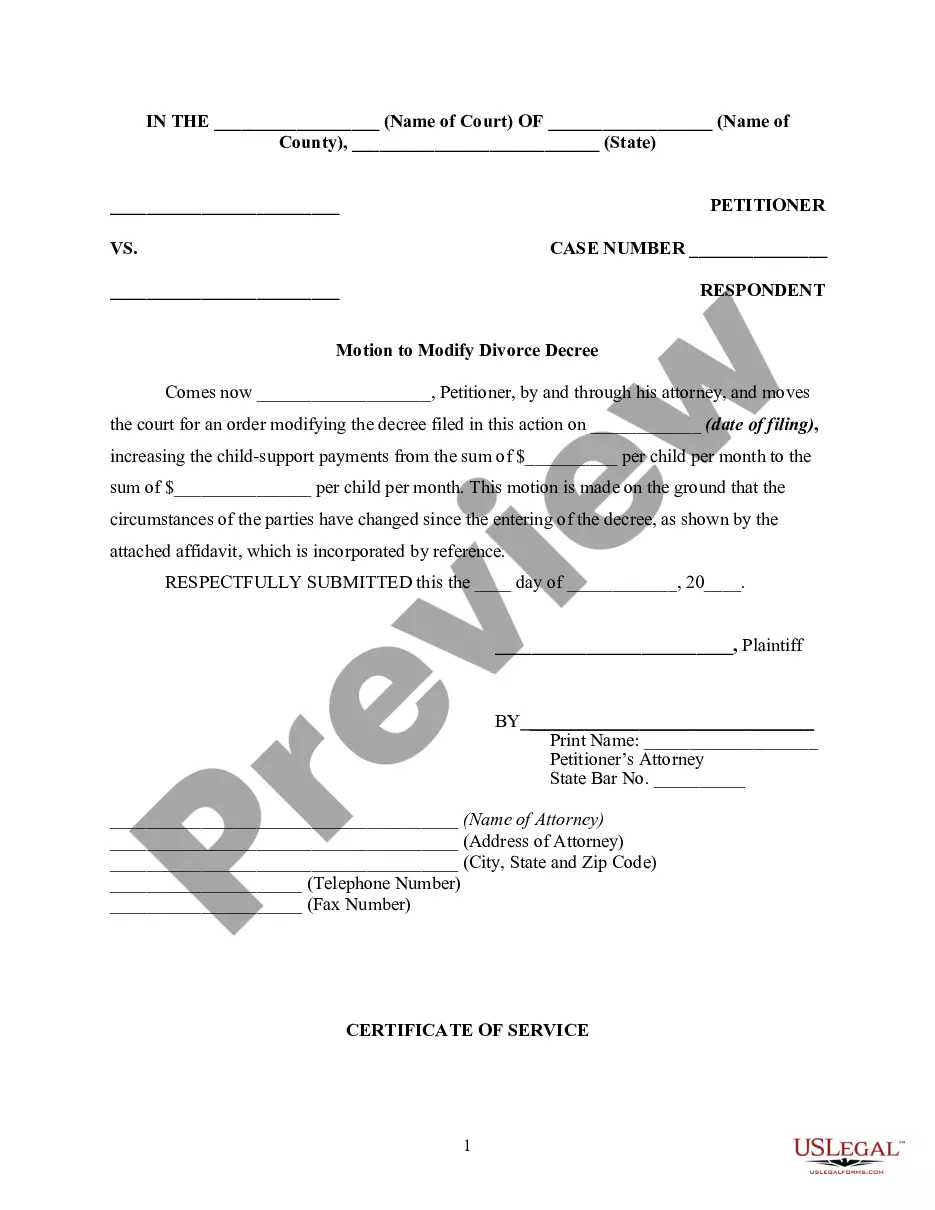
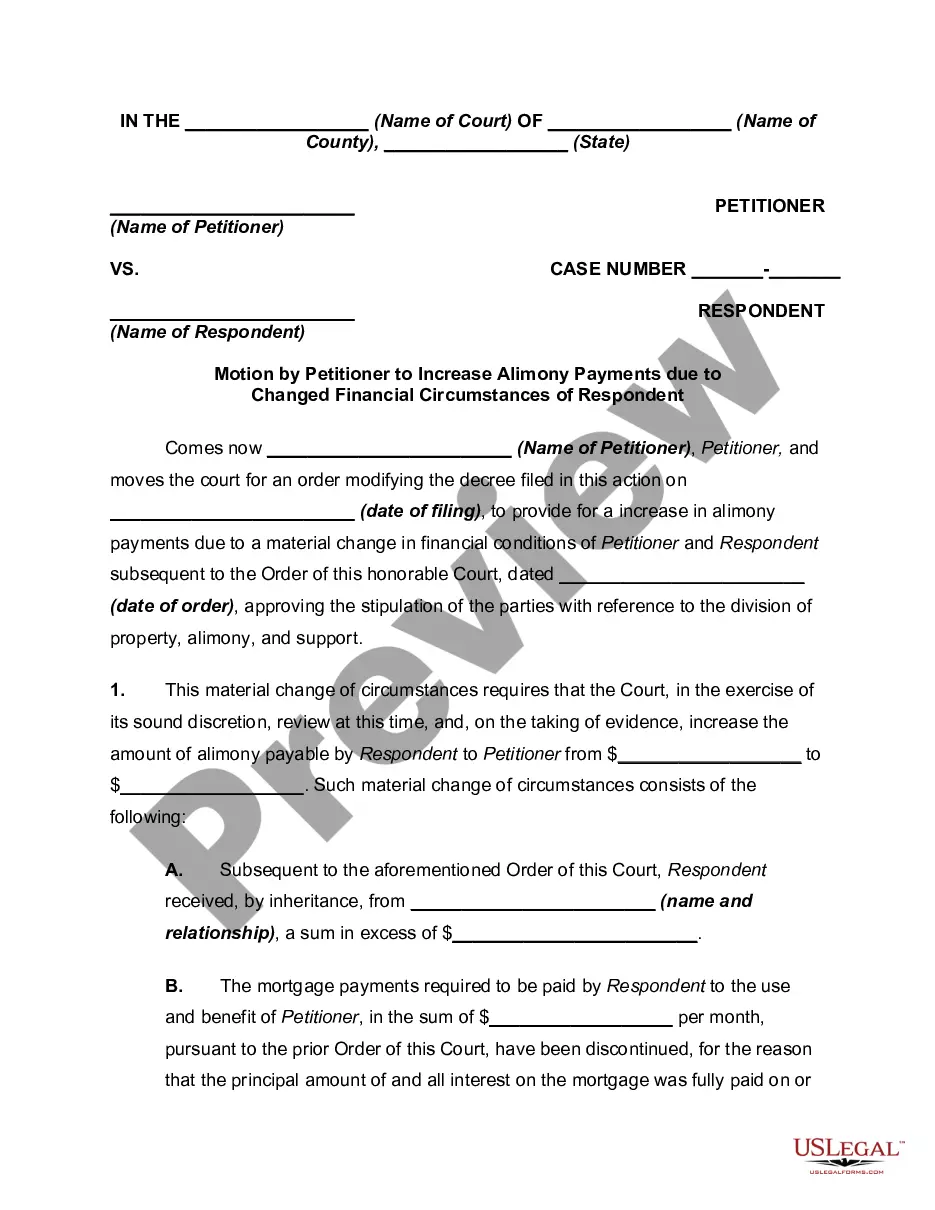
This Motion to Modify or Amend Divorce Decree to Provide for Reduction in Alimony Due to Involuntary Termination of Job or Employment is a legal document that requests a court to change an existing alimony order. The motion is used when there has been a significant change in circumstances, such as losing a job involuntarily, impacting the ability to pay alimony. This form is distinctive in that it specifically addresses the need for a modification related to unemployment, emphasizing the legal principle of res judicata, which prevents the same facts from being re-litigated.
Key components of this form
- Name of the petitioner and respondent.
- Case number linked to the original divorce decree.
- Date when alimony modification is being requested.
- Details surrounding the involuntary job termination.
- New employment information, including reduced income.
- Requested new alimony amount along with effective date.
When to use this document
This form should be used when a person cannot meet their alimony obligations due to an involuntary job loss. It is necessary when there has been a material change in financial circumstances since the original alimony order was issued. This situation often arises during economic downturns, company layoffs, or other unforeseen employment disruptions.
Intended users of this form
This form is suitable for:
- The party currently paying alimony who has lost their job involuntarily.
- Individuals seeking a legal adjustment to their financial obligations due to changed circumstances.
- Both plaintiffs and respondents involved in ongoing alimony arrangements.
Instructions for completing this form
- Identify the names of the petitioner and the respondent at the beginning of the form.
- Enter the case number associated with the original divorce decree.
- Fill in the date of filing and details regarding the involuntary job loss.
- Provide information about the new employment and any income changes.
- Request the specific new alimony amount and the desired effective date for the change.
- Sign and date the form to validate your motion.
Notarization requirements for this form
In most cases, this form does not require notarization. However, some jurisdictions or signing circumstances might. US Legal Forms offers online notarization powered by Notarize, accessible 24/7 for a quick, remote process.
Get your form ready online
Our built-in tools help you complete, sign, share, and store your documents in one place.
Make edits, fill in missing information, and update formatting in US Legal Forms—just like you would in MS Word.
Download a copy, print it, send it by email, or mail it via USPS—whatever works best for your next step.
Sign and collect signatures with our SignNow integration. Send to multiple recipients, set reminders, and more. Go Premium to unlock E-Sign.
If this form requires notarization, complete it online through a secure video call—no need to meet a notary in person or wait for an appointment.
We protect your documents and personal data by following strict security and privacy standards.

Make edits, fill in missing information, and update formatting in US Legal Forms—just like you would in MS Word.

Download a copy, print it, send it by email, or mail it via USPS—whatever works best for your next step.

Sign and collect signatures with our SignNow integration. Send to multiple recipients, set reminders, and more. Go Premium to unlock E-Sign.

If this form requires notarization, complete it online through a secure video call—no need to meet a notary in person or wait for an appointment.

We protect your documents and personal data by following strict security and privacy standards.
Avoid these common issues
- Not clearly stating the reason for the modification.
- Failing to provide supporting documentation of income changes.
- Omitting required signatures or dates.
Why use this form online
- Convenient access to the form anytime without needing to visit a legal office.
- Editable fields allow for personalization to fit specific situations.
- Reliable templates reduce the risk of errors compared to handwritten forms.
What to keep in mind
- This form is crucial for those needing to adjust alimony payments due to job loss.
- Providing documentation of changed financial circumstances is essential for a successful motion.
- Be aware of state-specific guidelines that may affect the filing process.
Looking for another form?


Form popularity
FAQ
In the State of New Jersey, if you wish to modify or reduce alimony payments, you will need to prove that you have experienced a substantial financial change in circumstances that renders you unable to continue making your alimony payments as presently required.
Things You Cannot Change in a Divorce Settlement Agreement In particular, California courts will not reconsider the original property or debt division. However, the parties can agree between themselves to change the terms of the property or debt division by stipulation and order to modify an earlier judgment.
Typically, an agreement for spousal support awarded to either party is subject to subsequent modification or termination by court order.Non-modifiable spousal support, on the other hand, means the spousal support award will not be subject to modification or termination.
The guideline states that the paying spouse's support be presumptively 40% of his or her net monthly income, reduced by one-half of the receiving spouse's net monthly income. If child support is an issue, spousal support is calculated after child support is calculated.
There Are Two Ways to Adjust Your Divorce Settlement. Don't panic yet your divorce settlement can be changed if you successfully prove that it should be. To change a part of your divorce decree, you'll have to either file an appeal arguing that the judge made a mistake, or request a post-divorce modification.
If you're negotiating a spousal support agreement, you can state spousal support is "non-modifiable," which means the amount cannot be changed at all, no matter what happens. The paying spouse might agree to this if the likelihood of a downward reduction seems slim (as where employment is secure or assets are high).
Study the Law. Take the time to learn all of the ins and outs of the laws in your state and how they apply to alimony payments. Manage Your Expectations. Think Twice Before Waiving Alimony. Keep Emotion Out of It.
Termination or Modification of Alimony in California If you're paying alimony and your ex-spouse is living with someone else or has increased income, you should ask your ex-spouse to agree to lower or end alimony. You can sign a formal agreement and file it with your divorce court to modify or terminate alimony.
Risk factors are either modifiable, meaning you can take measures to change them, or non-modifiable, which means they cannot be changed.