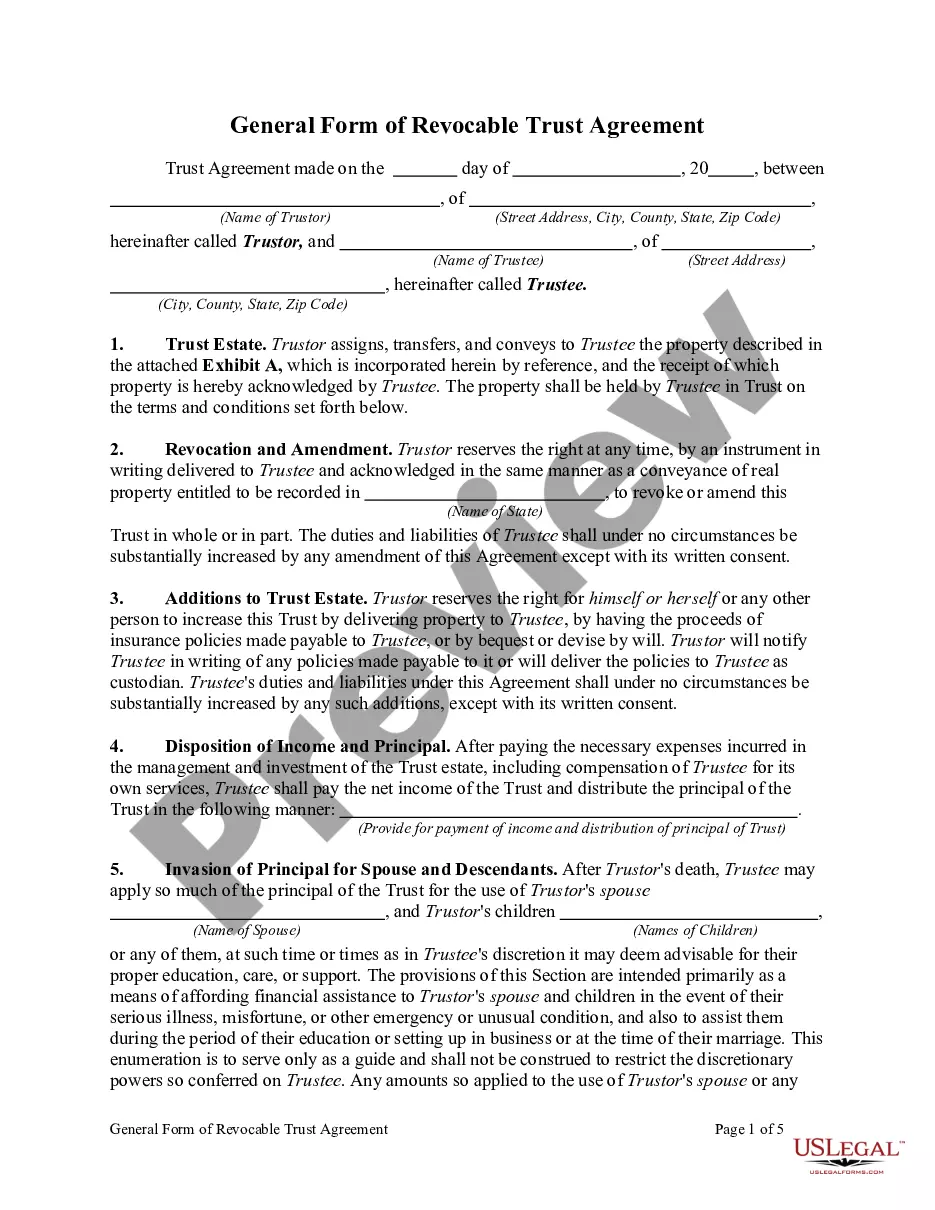
General Form of Revocable Trust Agreement
Overview of this form
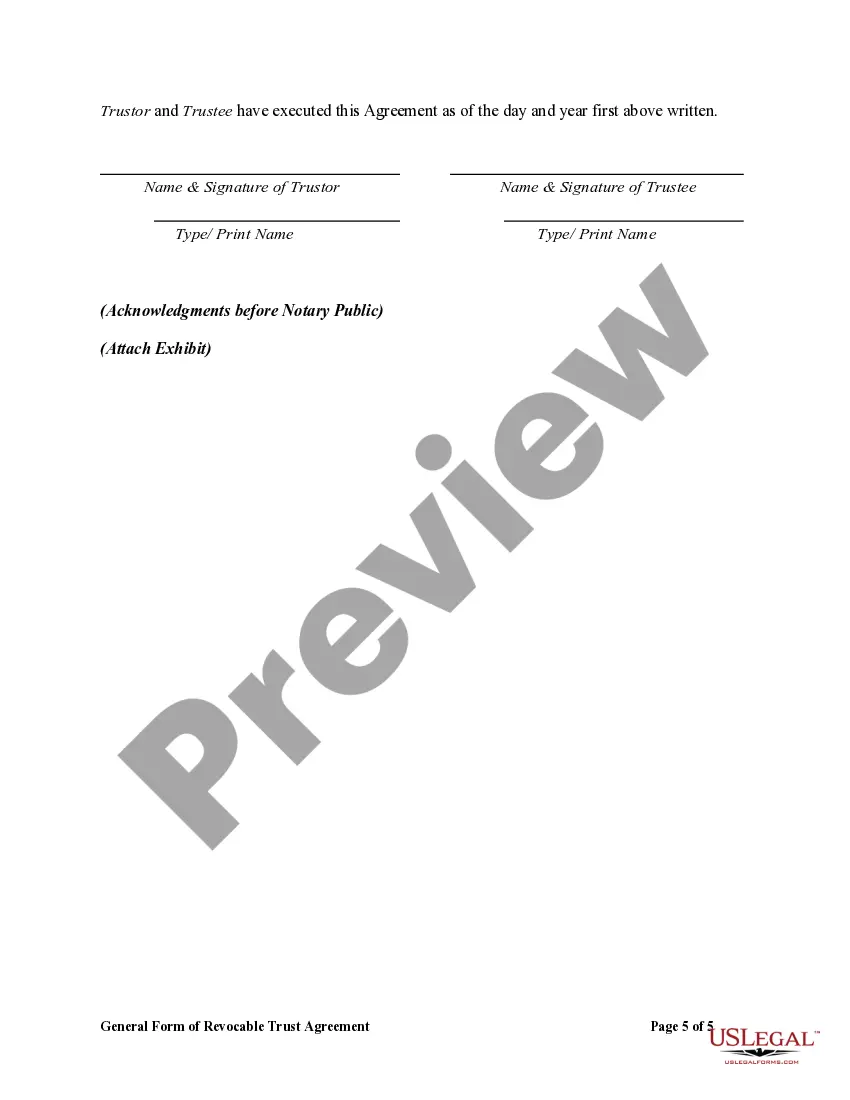
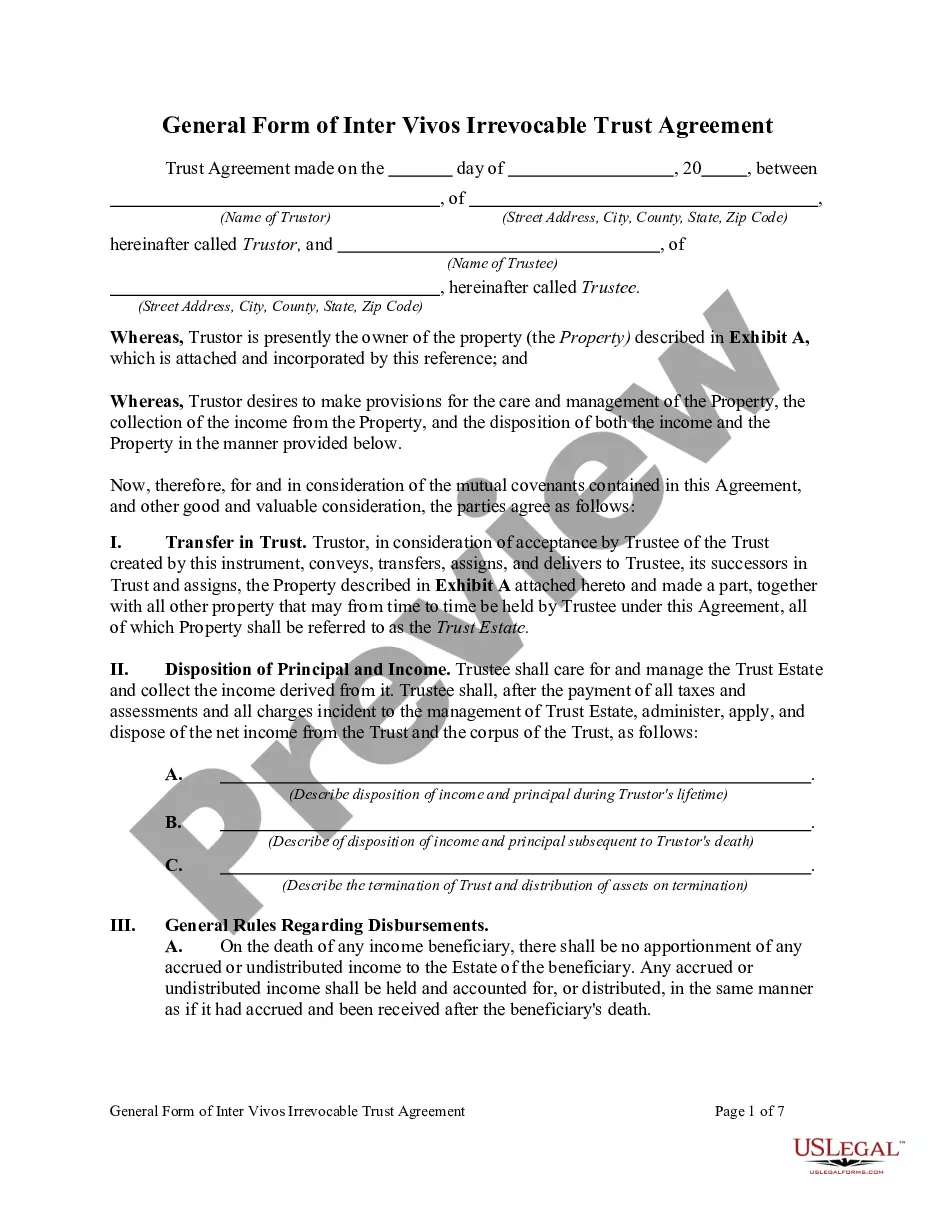
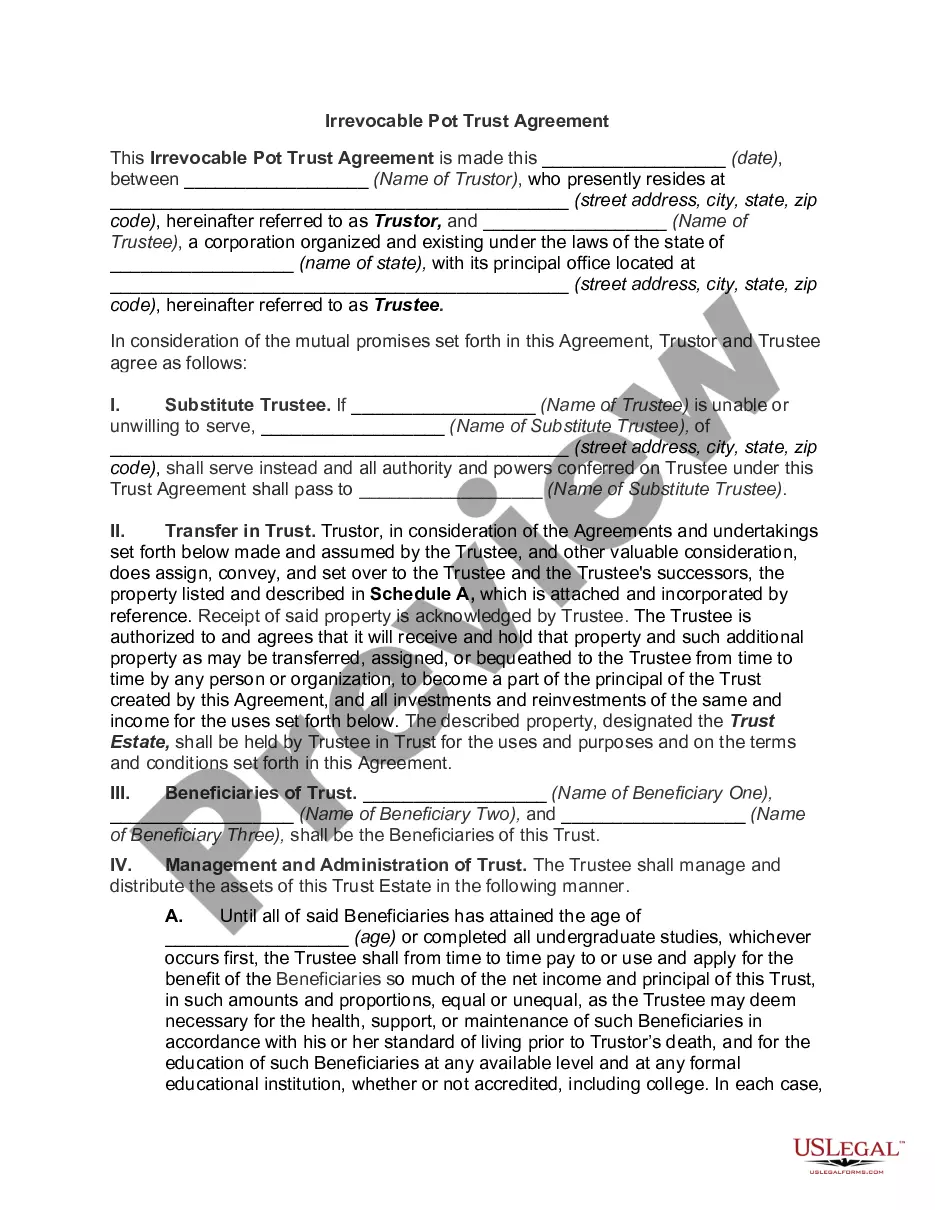
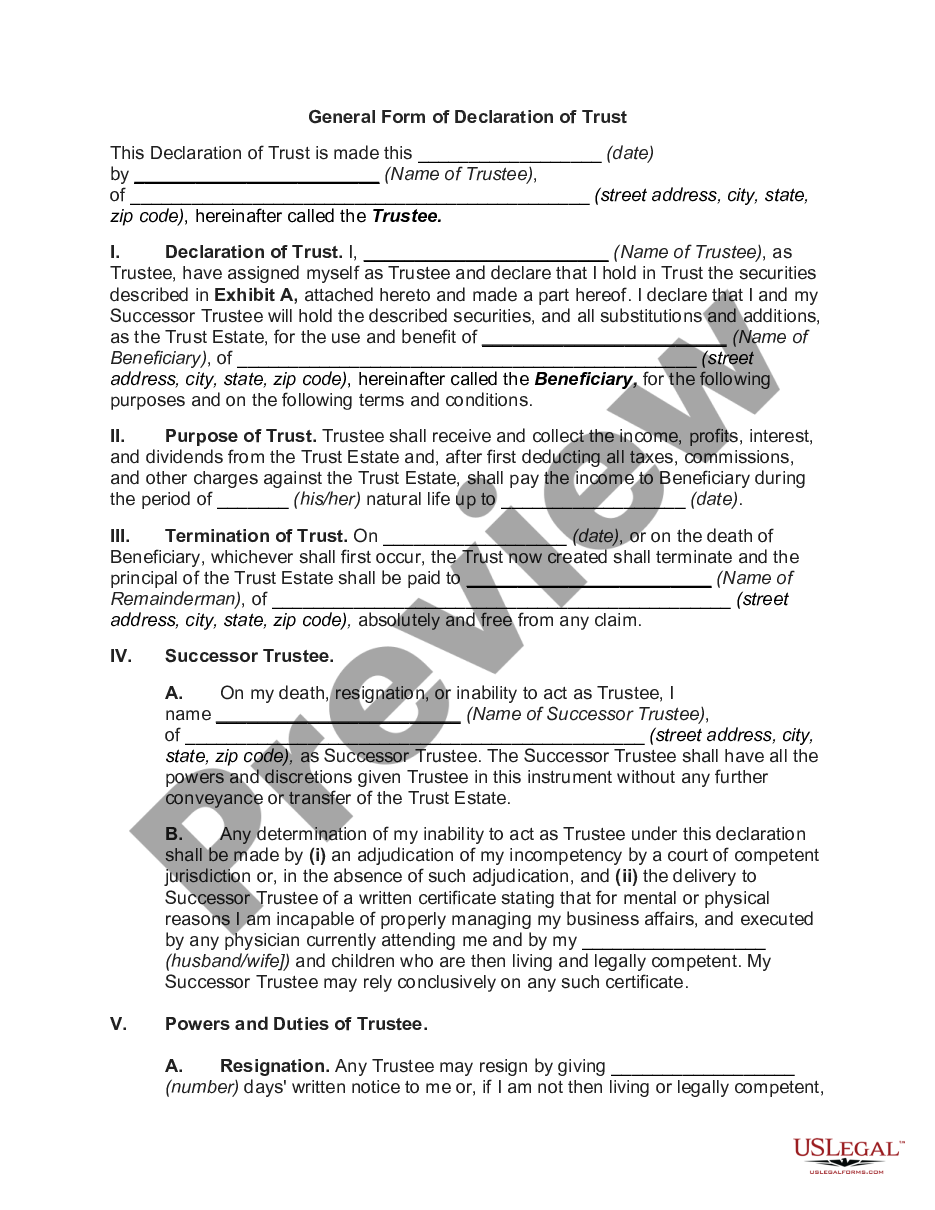
The General Form of Revocable Trust Agreement is a legal document that establishes a trust which can be amended or revoked by the trustor at any time. Unlike an irrevocable trust, which cannot be modified, this revocable trust allows individuals to maintain control over their assets. The trustor typically transfers property into the trust, appoints themselves as the trustee, and identifies themselves as the beneficiary to manage and receive income from the trust during their lifetime.
Key parts of this document
- Additions to Trust Estate: Provisions for increasing the trust by transferring additional property.
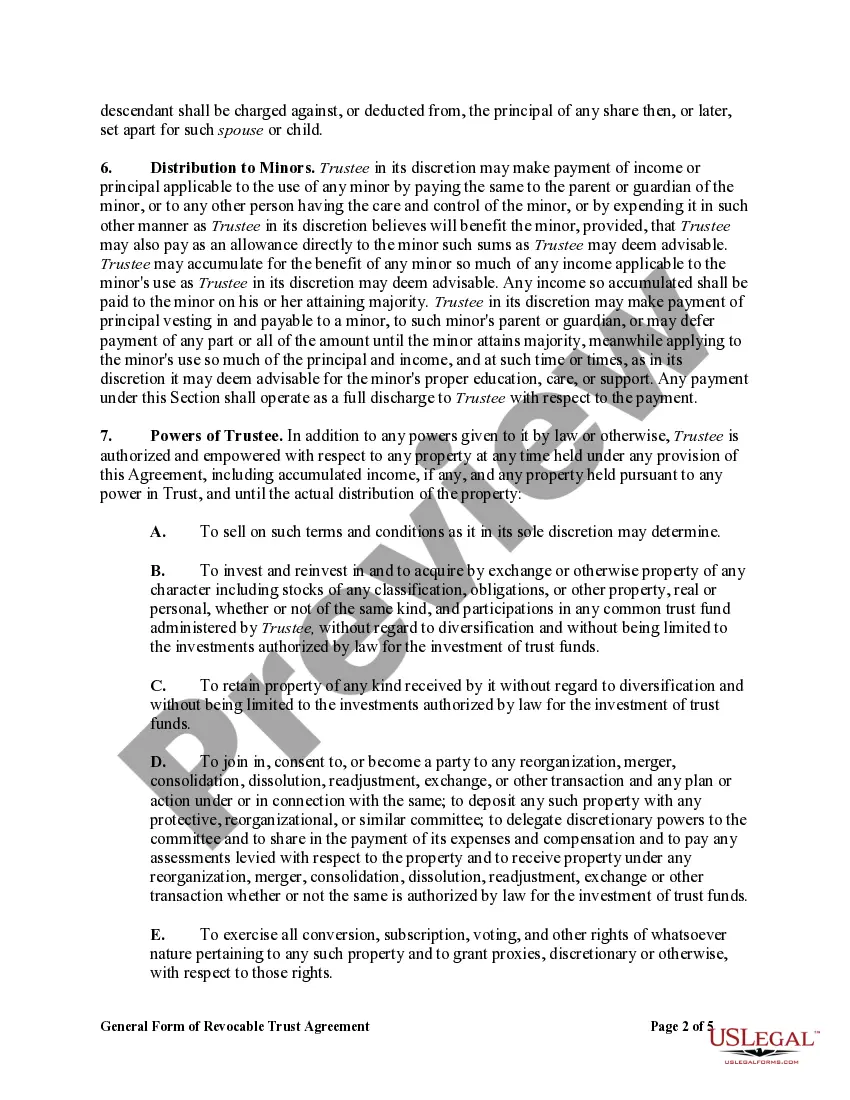
- Distribution to Minors: Guidelines for managing trust distributions benefiting minor beneficiaries.
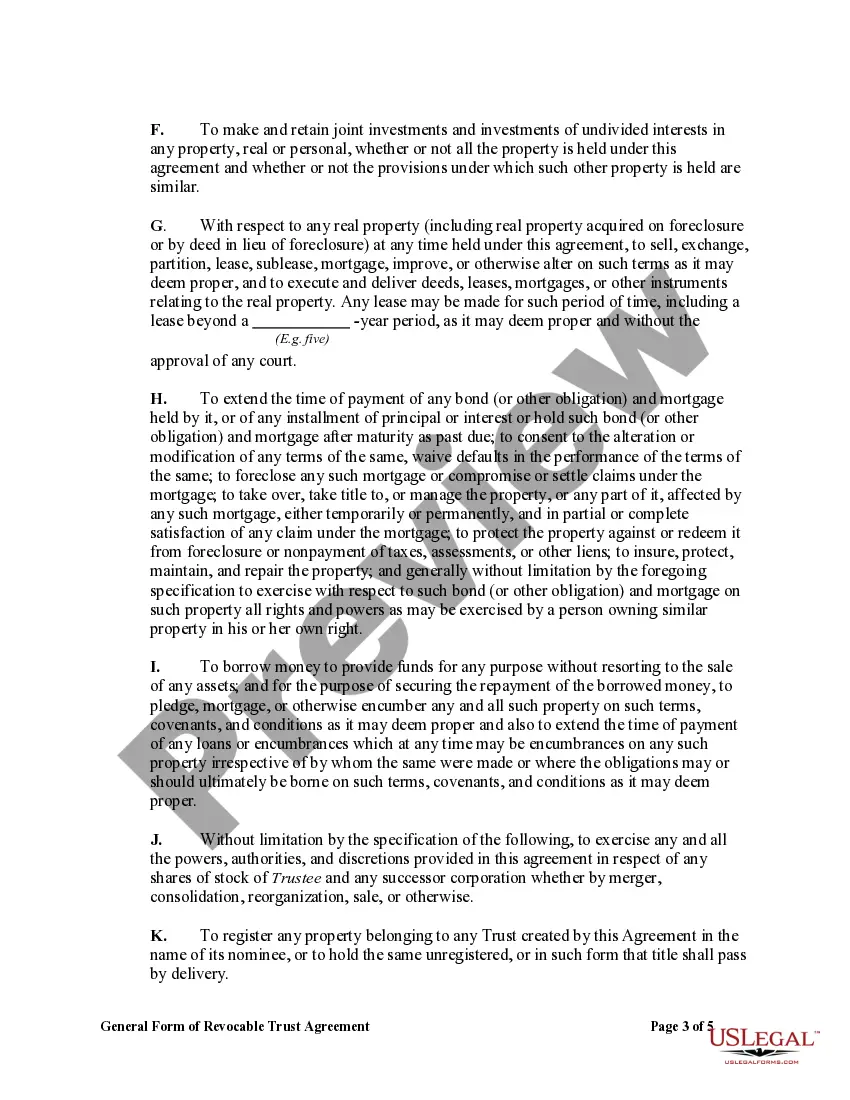
- Powers of Trustee: Detailed powers granted to the trustee, including investment decisions and property sales.
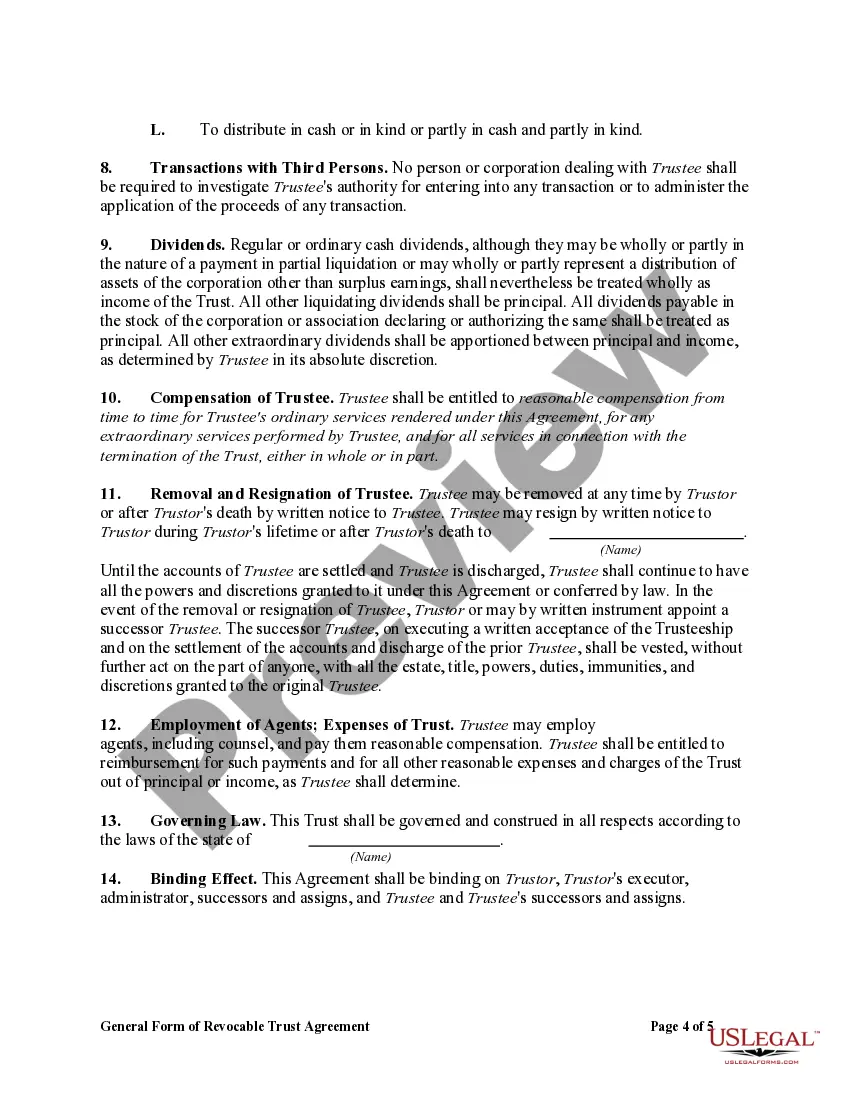
- Compensation of Trustee: Information regarding the trustee's right to compensation for their services.
- Dividends: Rules for treating various types of dividends received by the trust.
When this form is needed
This form is useful for individuals who want to create a flexible estate plan that allows for control over their assets during their lifetime. It is appropriate when the trustor desires to make arrangements for managing their assets, plan for potential incapacity, or provide for beneficiaries, especially minors, in a controlled manner. It should also be used when the trustor wishes to avoid probate upon their death.
Who this form is for
- Individuals looking to establish a trust for estate planning purposes.
- Parents or guardians wanting to provide for minor children through a trust.
- Anyone wishing to retain control over their assets while also planning for potential incapacity.
- Individuals interested in avoiding probate and simplifying the distribution of their estate.
Instructions for completing this form
- Identify the parties involved, including the trustor, trustee, and beneficiaries.
- Specify the property to be included in the trust and any additional property that may be added later.
- Outline the powers of the trustee to manage and control the trust assets.
- Detail the distributions to minors and how their needs will be met.
- Include provisions for the compensation of the trustee.
Does this form need to be notarized?
This form does not typically require notarization unless specified by local law.
Get your form ready online
Our built-in tools help you complete, sign, share, and store your documents in one place.
Make edits, fill in missing information, and update formatting in US Legal Forms—just like you would in MS Word.
Download a copy, print it, send it by email, or mail it via USPS—whatever works best for your next step.
Sign and collect signatures with our SignNow integration. Send to multiple recipients, set reminders, and more. Go Premium to unlock E-Sign.
If this form requires notarization, complete it online through a secure video call—no need to meet a notary in person or wait for an appointment.
We protect your documents and personal data by following strict security and privacy standards.

Make edits, fill in missing information, and update formatting in US Legal Forms—just like you would in MS Word.

Download a copy, print it, send it by email, or mail it via USPS—whatever works best for your next step.

Sign and collect signatures with our SignNow integration. Send to multiple recipients, set reminders, and more. Go Premium to unlock E-Sign.

If this form requires notarization, complete it online through a secure video call—no need to meet a notary in person or wait for an appointment.

We protect your documents and personal data by following strict security and privacy standards.
Common mistakes to avoid
- Failing to specify all assets intended to be placed in the trust.
- Not clearly identifying the powers and responsibilities of the trustee.
- Overlooking the inclusion of beneficiaries or improper designation of guardians for minors.
- Neglecting to update the trust as circumstances change, such as changes in asset ownership or family status.
Benefits of completing this form online
- Convenience: Complete and access the form anytime from anywhere.
- Editability: Easily make changes as your circumstances evolve.
- Guidance: Step-by-step instructions help ensure proper completion.
- Reliability: Professionally drafted forms tailored for your needs.
Legal use & context
- This trust agreement is legally enforceable and provides flexibility for asset management.
- It is essential to ensure the trust complies with specific state laws to be valid.
- Revocable trusts do not remove assets from the trustor's estate for tax purposes until the trustor passes away.
Main things to remember
- A revocable trust provides flexibility and control over your assets during your lifetime.
- It allows for straightforward changes and additions to the trust as needed.
- The trust can help in avoiding probate and easing the transfer of assets after death.
Looking for another form?
Form popularity
FAQ
If we wanted to write an equation with a positive value first, we could write 4x - 3y = - 24. To graph an equation in general linear form, compute the x-intercept (a, 0) and the y-intercept (0, b): a = and b = . Then connect the intercepts with a straight line and extend the line on both sides.
Lesson Summary The standard form of a linear equation is Ax + By = C. When we want to find the slope of the line represented by this equation, we have two options. We can put the equation in slope-intercept form and identify the slope that way, or we can use the formula m = -A/B.
Suggested clip Changing Slope-Intercept Form to General Form - YouTubeYouTubeStart of suggested clipEnd of suggested clip Changing Slope-Intercept Form to General Form - YouTube
Step 1: Develop the slope-point form for the line. Given two points (x1,y1) and (x2,y2) the slope between the points is. m=y22212y1x22212x1. and. Step 2: convert the slope point form into standard form. Note that the standard form is. Ax+Bx=C. with integer values for A,B,C and A22650. Starting from the slope-point form.
Suggested clip General Form of a Line - YouTubeYouTubeStart of suggested clipEnd of suggested clip General Form of a Line - YouTube
The graph of a quadratic function is a parabola. The general form of a quadratic function is f(x)=ax2+bx+c where a, b, and c are real numbers and a22600. The standard form of a quadratic function is f(x)=a(x2212h)2+k.
General form will typically be in the form y=mx+b. M is the slope of the graph, x is the unknown, and b is the y-Intercept. this means that the product of a number and x added to b will equal y. Standard form will always be x+y= a number value. so, let's get some practice.
Suggested clip Write Standard Form (when given point and slope) - YouTubeYouTubeStart of suggested clipEnd of suggested clip Write Standard Form (when given point and slope) - YouTube
The equation of a circle comes in two forms: 1) The standard form: (x - h)2 + (y-k)2 = r2. 2) The general form : x2 + y2 + Dx + Ey + F = 0, where D, E, F are constants. If the equation of a circle is in the standard form, we can easily identify the center of the circle, (h, k), and the radius, r .
Step 1: Develop the slope-point form for the line. Given two points (x1,y1) and (x2,y2) the slope between the points is. m=y22212y1x22212x1. and. Step 2: convert the slope point form into standard form. Note that the standard form is. Ax+Bx=C. with integer values for A,B,C and A22650. Starting from the slope-point form.