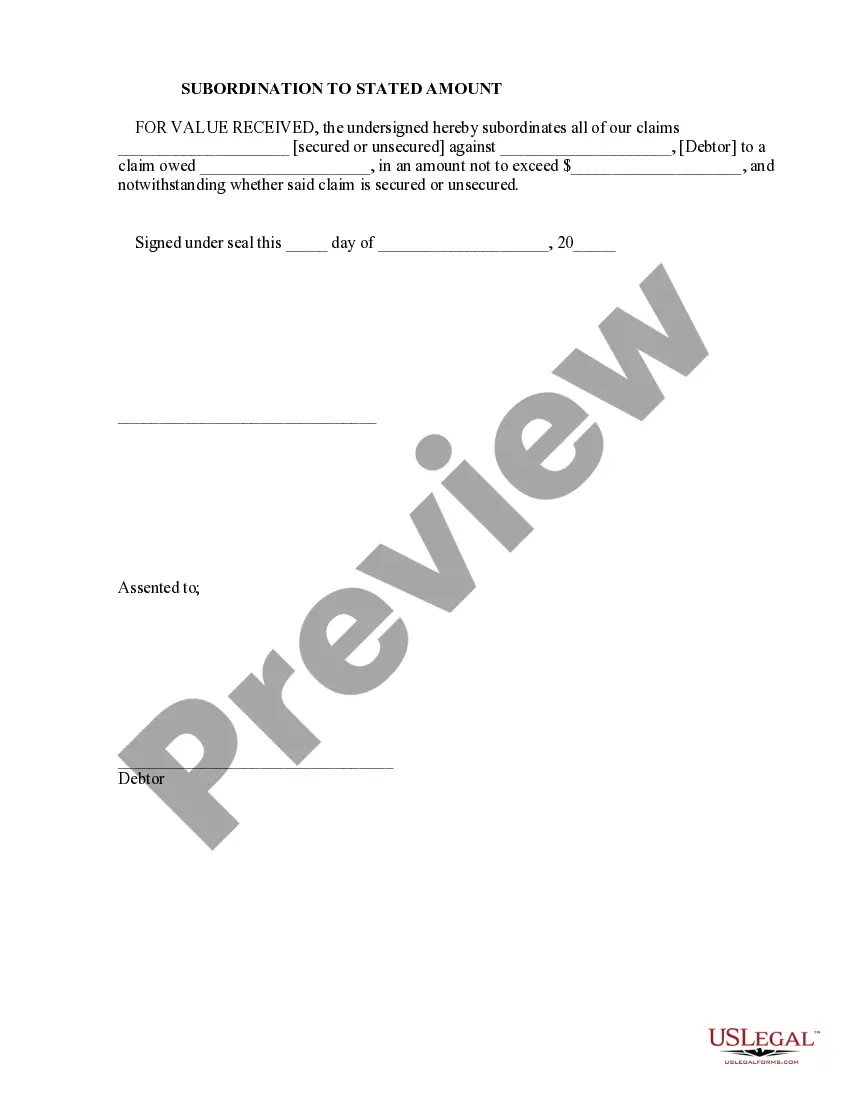
Subordination to Stated Amount
What is this form?
The Subordination to Stated Amount form is a legal document used to prioritize one party's claim over another in a financial agreement. This form allows a creditor to agree that their claims will be subordinate to those of another creditor, specifically in relation to a stated amount. It helps clarify the priority of claims and ensures that creditors understand their rights and responsibilities during a debtor's insolvency or bankruptcy. It differs from other forms, such as security agreements, by specifically addressing the subordination of claims rather than the creation of a security interest.
Key parts of this document
- Party identification: Names of the parties involved, including the debtor and subordinate creditor.
- Claim details: Description of the claims being subordinated, whether secured or unsecured.
- Stated amount: The maximum dollar amount up to which the claims will be subordinated.
- Date: The day the agreement is executed, which is necessary for legal records.
- Signature lines: Spaces for the parties to sign and date the document, validating the agreement.
When to use this document
This form should be used when a creditor needs to allow another creditor's claim to take precedence in a financial arrangement. This situation often arises in bankruptcy cases, loan restructurings, or when multiple lenders are involved with a debtor. It is particularly relevant when creditors need a clear understanding of their position in relation to specific debts or claims against a debtor's assets.
Who this form is for
- Creditors looking to subordinate their claims in favor of other creditors.
- Debtors needing to clarify creditor priorities during financial negotiations.
- Legal professionals assisting clients in structuring agreements among multiple creditors.
How to complete this form
- Identify the parties: Fill in the names and addresses of the creditor granting subordination and the debtor.
- Detail the claims: Describe the nature of the claims being subordinated, indicating if they are secured or unsecured.
- Specify the stated amount: Enter the maximum amount to which the claims will be subordinated.
- Date the document: Write the date on which the form is being executed.
- Signature: Have all parties sign the form to confirm their agreement and intentions.
Does this document require notarization?
This form does not typically require notarization to be legally valid. However, some jurisdictions or document types may still require it. US Legal Forms provides secure online notarization powered by Notarize, available 24/7 for added convenience.
Get your form ready online
Our built-in tools help you complete, sign, share, and store your documents in one place.
Make edits, fill in missing information, and update formatting in US Legal Forms—just like you would in MS Word.
Download a copy, print it, send it by email, or mail it via USPS—whatever works best for your next step.
Sign and collect signatures with our SignNow integration. Send to multiple recipients, set reminders, and more. Go Premium to unlock E-Sign.
If this form requires notarization, complete it online through a secure video call—no need to meet a notary in person or wait for an appointment.
We protect your documents and personal data by following strict security and privacy standards.

Make edits, fill in missing information, and update formatting in US Legal Forms—just like you would in MS Word.

Download a copy, print it, send it by email, or mail it via USPS—whatever works best for your next step.

Sign and collect signatures with our SignNow integration. Send to multiple recipients, set reminders, and more. Go Premium to unlock E-Sign.

If this form requires notarization, complete it online through a secure video call—no need to meet a notary in person or wait for an appointment.

We protect your documents and personal data by following strict security and privacy standards.
Common mistakes
- Failing to properly identify all parties involved.
- Omitting the stated amount, which can lead to disputes later.
- Not having the required signatures from all involved parties.
- Incorrectly indicating the nature of the claims (secured vs. unsecured).
Why complete this form online
- Accessibility: Downloadable for immediate use, saving time compared to traditional methods.
- Editability: Forms can be customized easily to suit specific details required for your situation.
- Clarity: Professionally drafted templates ensure that all necessary legal language is included.
Legal use & context
- This form is legally binding once executed and should comply with the relevant laws governing subordinate agreements.
- Subordination agreements can affect the enforceability of claims during insolvency proceedings.
- Make sure to consult legal counsel to ensure that the subordination is valid and enforceable in your jurisdiction.
Quick recap
- The Subordination to Stated Amount form clarifies creditor priorities in a financial agreement.
- It is essential for creditors to understand their rights and obligations when subordination occurs.
- Completing the form requires essential details about the parties, claims, and execution date.
Looking for another form?
Form popularity
FAQ
Subordination Statement means a statement from the relevant creditor to the Bond Trustee (in form and substance satisfactory to the Bond Trustee) to be entered into in respect of any Subordinated Loan and any intra-group loan granted by any Group Company to an Obligor.
Subordinate financing is debt financing that is ranked behind that held by secured lenders in terms of the order in which the debt is repaid. "Subordinate" financing implies that the debt ranks behind the first secured lender, and means that the secured lenders will be paid back before subordinate debt holders.
Example of a Subordination Agreement A standard subordination agreement covers property owners that take a second mortgage against a property. One loan becomes the subordinated debt, and the other becomes (or remains) the senior debt. Senior debt has higher claim priority than junior debt.
What is subordination? Subordination is the process of ranking home loans (mortgage, HELOC or home equity loan) by order of importance. When you have a home equity line of credit, for example, you actually have two loans ? your mortgage and HELOC. Both are secured by the collateral in your home at the same time.
Payment subordination is where the subordinated lender agrees (subject to carve-outs noted in the agreement) to fully subordinate the payment of the subordinated obligations to the prior repayment in full of the senior obligations.
Subordination in itself is the act of placing something in a lower-ranking position. Mortgage subordination boils down to a ranking system on the liens secured by your home. A lien is a legal agreement that grants the lender a right to repossess the property if you default on the loan.
A mortgage subordination refers to the order the outstanding liens on your property get repaid if you stop making your mortgage payments. For example, your first home loan (primary mortgage) is repaid first, with any remaining funds paying off additional liens, including second mortgages, HELOCs and home equity loans.
A subordination agreement prioritizes debts, ranking one behind another for purposes of collecting repayment from a debtor in the event of foreclosure or bankruptcy. A second-in-line creditor collects only when and if the priority creditor has been fully paid.