Nonqualified Deferred Compensation Trust for the Benefit of Executive Employees - a Rabbi Trust
Understanding this form
The Nonqualified Deferred Compensation Trust for the Benefit of Executive Employees, commonly known as a Rabbi Trust, is a legal instrument designed to defer compensation for executives. Unlike qualified plans, this trust allows employers to set aside funds that may still be subject to claims from creditors, ensuring that executive compensation can be distributed in the future without compromising the financial integrity of the organization.
Key parts of this document
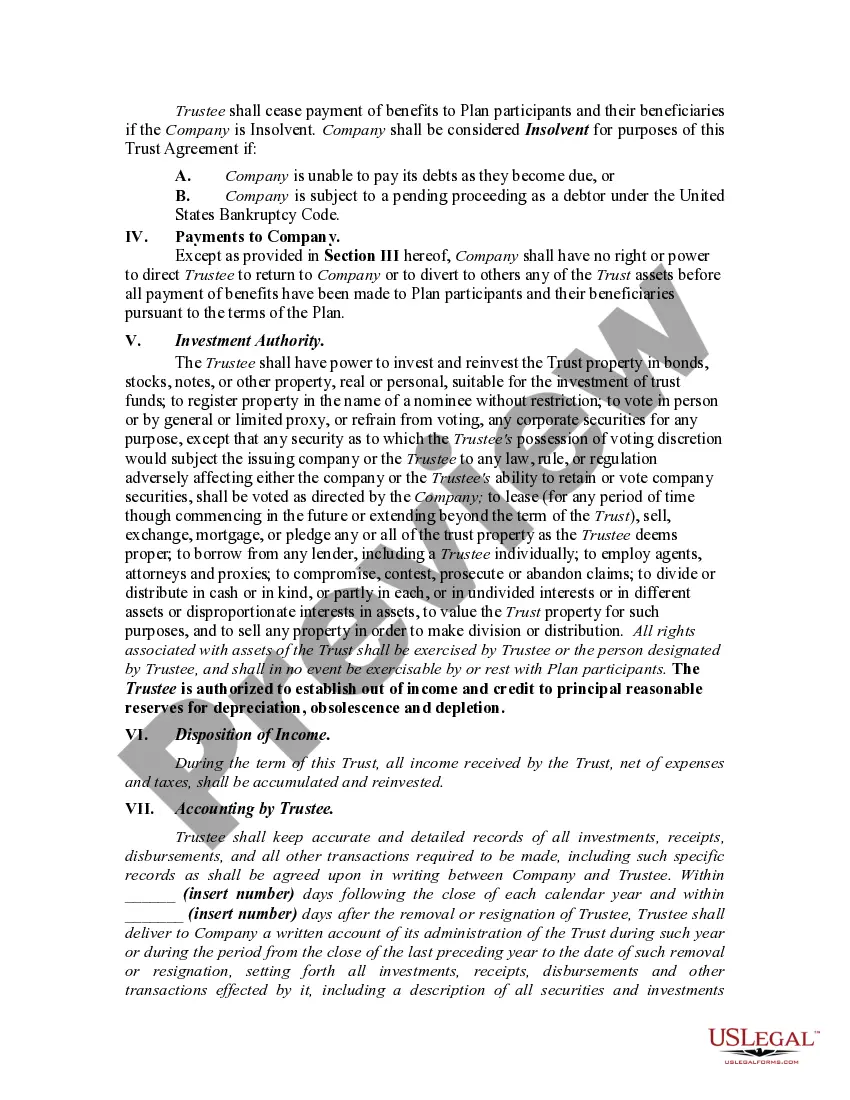
- Establishment of the Trust, detailing the parties involved and their responsibilities.
- Deposits made to the Trust, including definitions of the principal and additional contributions.
- Payment process to Plan participants and their beneficiaries, including tax obligations.
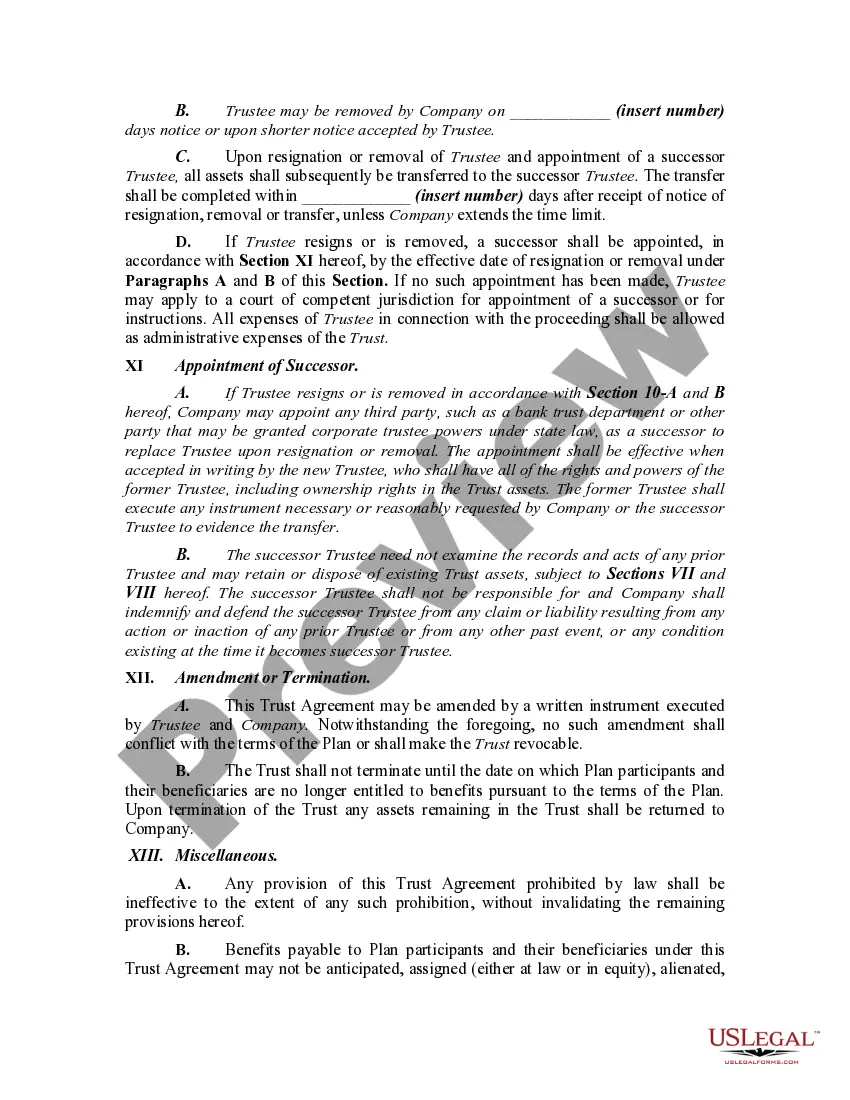
- Trustee responsibilities, including investment authority and handling disputes.
- Amendment and termination provisions for the Trust Agreement.










When to use this document
This form is typically used when a company wants to establish a deferred compensation plan for its executives while retaining control over the funds. It is suitable for organizations looking to provide incentives for executives without immediate tax consequences. Additionally, it is beneficial in scenarios where companies seek to enhance their executive compensation packages but must comply with certain IRS regulations.
Intended users of this form
- Companies seeking to create a deferred compensation plan for their executive employees.
- Business leaders and HR professionals responsible for employee compensation packages.
- Executives participating in a deferred compensation plan looking for clarity on their benefits.
Instructions for completing this form
- Identify the name of the Plan that the trust is associated with.
- Complete the date and the names of the Employer and Trustee, along with their addresses.
- Specify the amount deposited into the Trust to establish the principal.
- Outline the payment schedule for Plan participants and their beneficiaries.
- Ensure all parties sign the document, and consider notarization if required.
Does this form need to be notarized?
This form must be notarized to be legally valid. US Legal Forms provides secure online notarization powered by Notarize, allowing you to complete the process through a verified video call.
Get your form ready online
Our built-in tools help you complete, sign, share, and store your documents in one place.
Make edits, fill in missing information, and update formatting in US Legal Forms—just like you would in MS Word.
Download a copy, print it, send it by email, or mail it via USPS—whatever works best for your next step.
Sign and collect signatures with our SignNow integration. Send to multiple recipients, set reminders, and more. Go Premium to unlock E-Sign.
If this form requires notarization, complete it online through a secure video call—no need to meet a notary in person or wait for an appointment.
We protect your documents and personal data by following strict security and privacy standards.

Make edits, fill in missing information, and update formatting in US Legal Forms—just like you would in MS Word.

Download a copy, print it, send it by email, or mail it via USPS—whatever works best for your next step.

Sign and collect signatures with our SignNow integration. Send to multiple recipients, set reminders, and more. Go Premium to unlock E-Sign.

If this form requires notarization, complete it online through a secure video call—no need to meet a notary in person or wait for an appointment.

We protect your documents and personal data by following strict security and privacy standards.
Avoid these common issues
- Failing to accurately define the amount to be deposited into the Trust.
- Not ensuring that the form is signed by all relevant parties.
- Overlooking state-specific legal requirements that may impact the trust.
Advantages of online completion
- Convenience of downloading and completing the form at your own pace.
- Ability to easily make updates and amendments to the form as needed.
- Access to state-specific guidelines and legal updates that enhance compliance.
Legal use & context
- The trust is an unfunded arrangement and does not create secured interests for participants.
- Funds held in the trust are subject to the claims of creditors in case of company insolvency.
- The trust is structured to comply with IRS guidelines regarding nonqualified deferred compensation.
Summary of main points
- The Rabbi Trust allows deferred compensation for executives with certain protective measures.
- Proper completion of the form is essential for legal and financial security.
- Understanding your obligations as both an employer and trustee is crucial.
Looking for another form?


Form popularity
FAQ
The rabbi trust is usually irrevocable, although it can be designed to be revocable until the happening of certain events such as a change in control.
Taxation of Rabbi Trusts A rabbi trust is considered a grantor trust for income tax purposes, resulting in trust income taxed to the employer. The trustee is required to file a fiduciary tax return. Contributions to the trust are not tax deductible by the employer.
Rabbi trusts allow employees' assets to grow without them having to pay tax on any gains until they withdraw their money. In this sense, a rabbi trust is similar to a qualified retirement plan. A rabbi trust does not provide any tax benefits for companies that make its use limited compared to other types of trusts.
Rabbi trust is a grantor trust Because the assets of a rabbi trust are subject to an employer's creditors, the trust will be treated as a grantor trust.6 This means that the assets of the trust are treated as assets of the employer for tax purposes.
A rabbi trust is so called because the first such trust was established by a Jewish congregation for its rabbi. The congregation applied for and obtained a private letter ruling (PLR) from the Internal Revenue Service (IRS) which clarified the tax consequences of the establishment of the trust to the rabbi.
A rabbi trust is exempt from most of the Employee Retirement Income Security Act of 1974 (ERISA) as long as it is a top hat plan, which, according to section 201 of ERISA, is an unfunded plan maintained by an employer to provide deferred compensation to a select group of management or highly compensated employees.
A rabbi trust is a grantor trust established by an employer to hold assets to be used in connection with a deferred compensation arrangement. It can be established as a revocable trust or an irrevocable trust.
A rabbi trust protects employees from a company that is experiencing financial hardship and wants to remove some of the trust's assets to meet its other obligations. For example, an employer cannot withdraw $50,000 from a rabbi trust to pay employee wages.
Rabbi trusts allow employees' assets to grow without them having to pay tax on any gains until they withdraw their money. In this sense, a rabbi trust is similar to a qualified retirement plan. A rabbi trust does not provide any tax benefits for companies that make its use limited compared to other types of trusts.