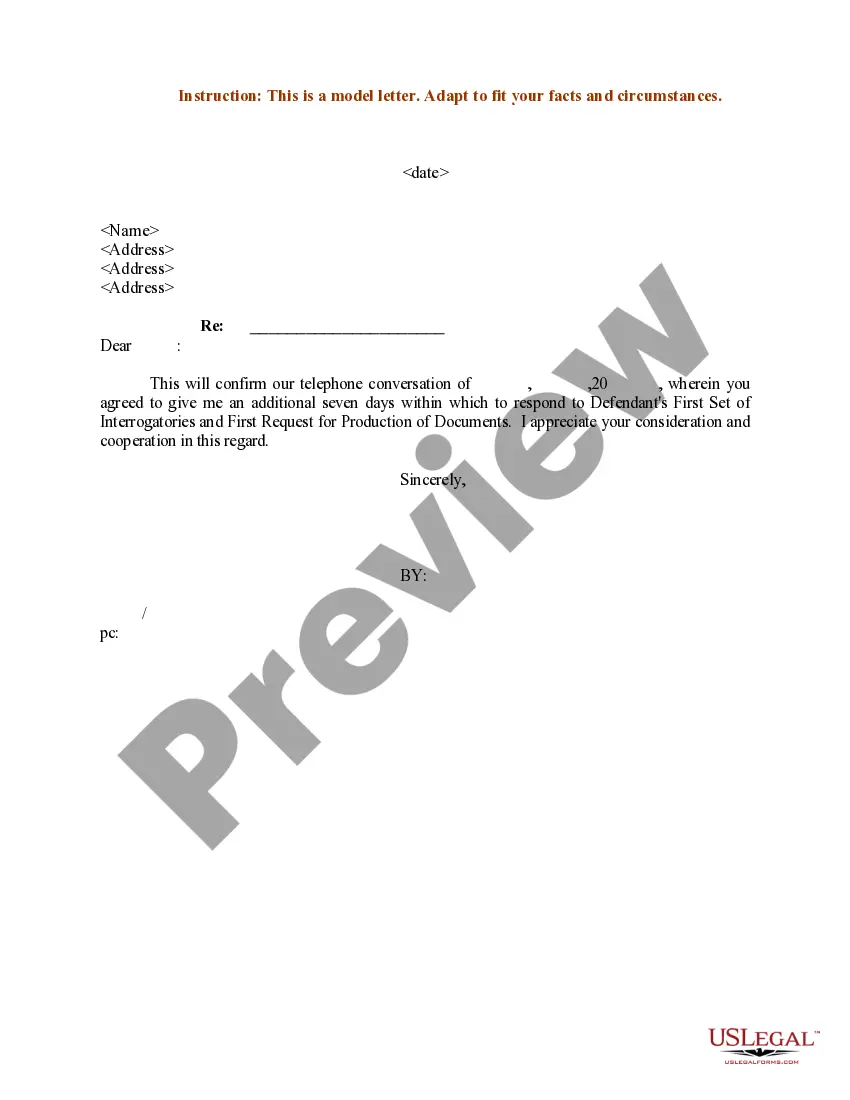
Sample Letter Confirming Additional Time to Respond to Defendant's First Set of Interrogatories and First Request for Production of Documents
About this form
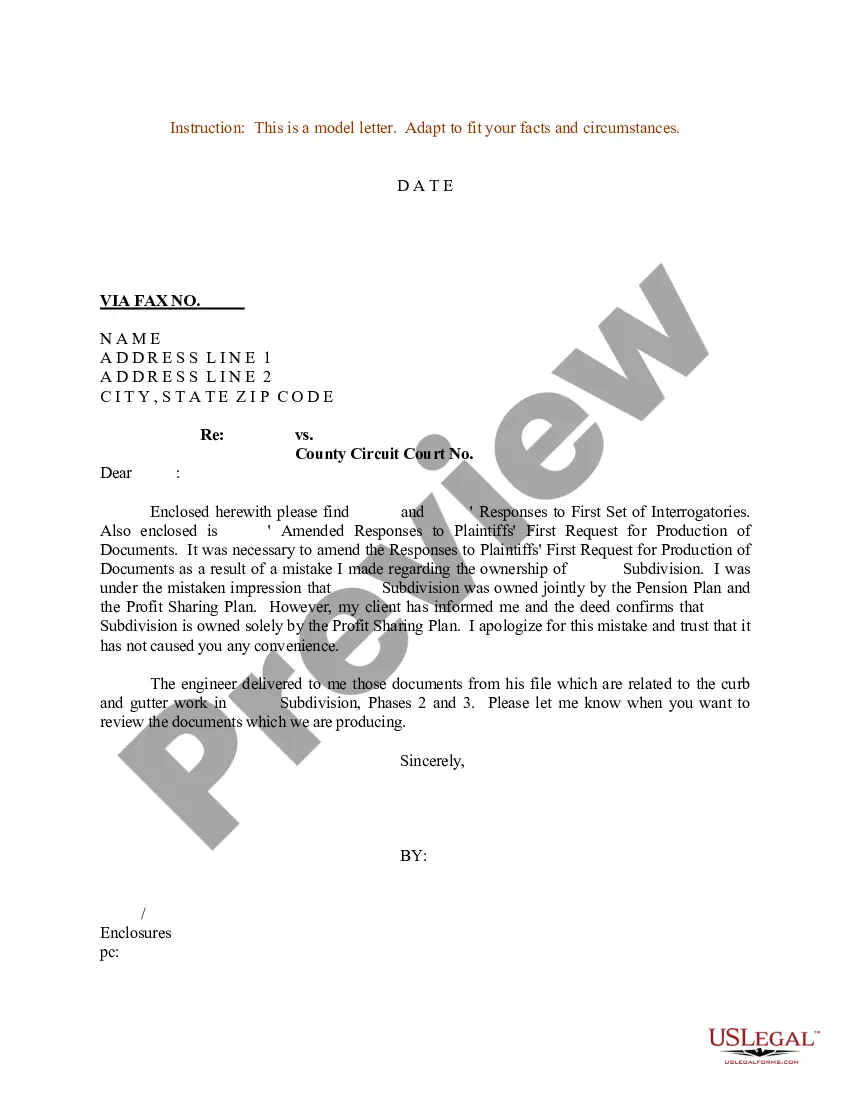
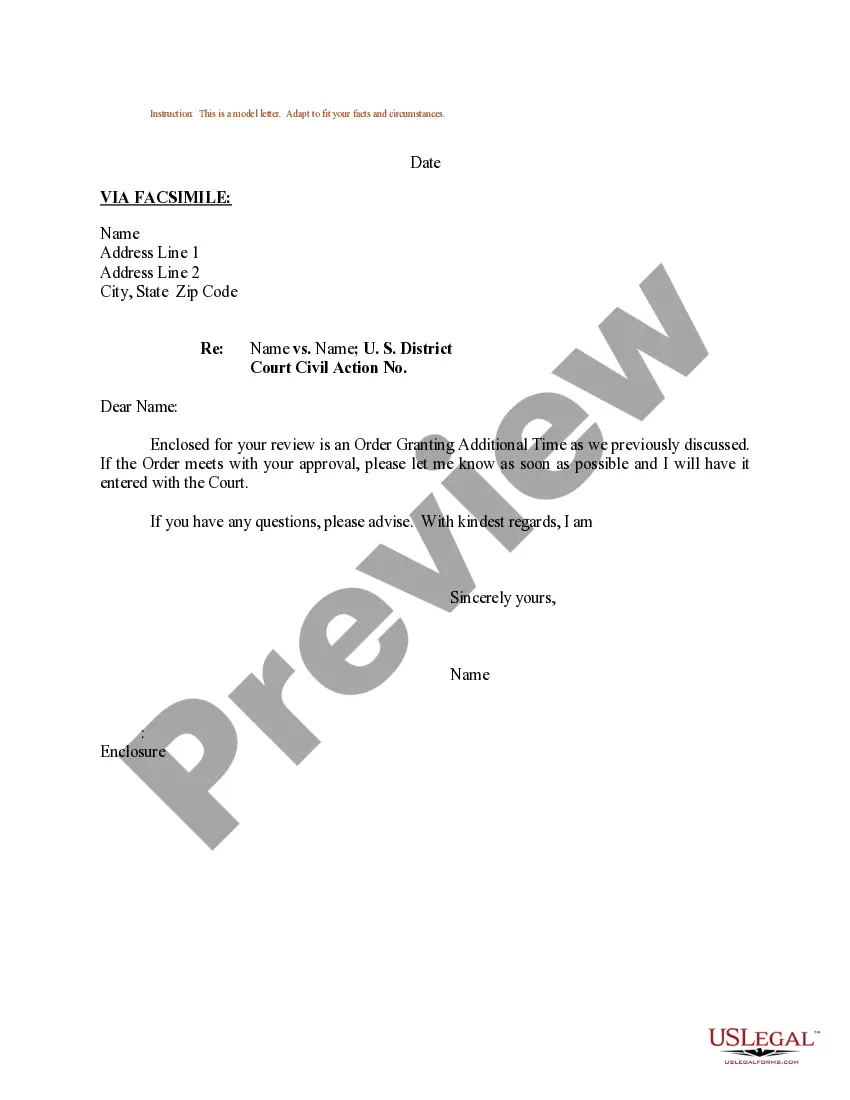
This is a Sample Letter Confirming Additional Time to Respond to Defendant's First Set of Interrogatories and First Request for Production of Documents. This form serves to formally notify the other party that you need extra time to respond to specific legal questions and document requests. It is essential for ensuring that you comply with legal procedures while also protecting your rights during a legal proceeding.
Main sections of this form
- Date of the letter
- Sender's name and address
- Recipient's name and address
- Subject line indicating the nature of the correspondence
- Details regarding the request for additional response time
- Signature line for the sender

When to use this document
This form is useful when you, as a defendant, have received interrogatories and requests for the production of documents and find that you need more time to gather the necessary information or documents. You may use it to request an extension to ensure that your responses are accurate and comprehensive, allowing you to present your case effectively.
Who should use this form
- Defendants involved in a civil lawsuit
- Individuals or entities responding to interrogatories and document requests
- Parties who require additional time for legal compliance
How to complete this form
- Enter the date at the top of the letter.
- Fill in the names and addresses of both the sender and the recipient.
- State the subject plainly to reflect the content of the letter.
- Clearly outline your request for additional time, including the reasons for the extension.
- Sign the letter and include your printed name.
Is notarization required?
In most cases, this form does not require notarization. However, some jurisdictions or signing circumstances might. US Legal Forms offers online notarization powered by Notarize, accessible 24/7 for a quick, remote process.
Get your form ready online
Our built-in tools help you complete, sign, share, and store your documents in one place.
Make edits, fill in missing information, and update formatting in US Legal Forms—just like you would in MS Word.
Download a copy, print it, send it by email, or mail it via USPS—whatever works best for your next step.
Sign and collect signatures with our SignNow integration. Send to multiple recipients, set reminders, and more. Go Premium to unlock E-Sign.
If this form requires notarization, complete it online through a secure video call—no need to meet a notary in person or wait for an appointment.
We protect your documents and personal data by following strict security and privacy standards.

Make edits, fill in missing information, and update formatting in US Legal Forms—just like you would in MS Word.

Download a copy, print it, send it by email, or mail it via USPS—whatever works best for your next step.

Sign and collect signatures with our SignNow integration. Send to multiple recipients, set reminders, and more. Go Premium to unlock E-Sign.

If this form requires notarization, complete it online through a secure video call—no need to meet a notary in person or wait for an appointment.

We protect your documents and personal data by following strict security and privacy standards.
Mistakes to watch out for
- Failing to provide a valid reason for the extension request.
- Overlooking to sign the letter.
- Not including the date, which can lead to confusion about the timeline.
- Sending the letter too close to the original response deadline.
Advantages of online completion
- Convenience of immediate access to legal document templates.
- Editability to customize the letter to your specific situation.
- Reliability, as forms are drafted by licensed attorneys.
Legal use & context
- This form is designed to assist in managing deadlines and procedural rules in litigation.
- Using the form correctly can help prevent disputes over timing and compliance with discovery rules.
- Failure to submit timely responses can result in legal penalties or unfavorable outcomes in a case.
Key takeaways
- This form is essential for defendants needing additional time to respond to legal inquiries.
- Clearly state your reasons for requesting an extension.
- Ensure all required information is correctly completed before sending.
Looking for another form?

Form popularity
FAQ
You must answer each interrogatory separately and fully in writing under oath, unless you object to it. You must explain why you object. You must sign your answers and objections.
You have 30 days after the form or special interrogatories were served to you (35 days if served by mail from within California) to serve your responses to the interrogatories. Sometimes, rather than answering the interrogatory, you may wish to object to the request on legal grounds.
Your answers to the interrogatories should usually be short, clear, and direct and should answer only the question that is being asked. This is not the time to set out your entire case or defense to the other side. Take the time to make sure your answers are correct and truthful.
You can object to an interrogatory if the information sought is known by the requesting party or available to both parties equally. For example, you should raise this objection if the answers are publicly available or in a third-party's custody or control.
Motions to Compel If a party doesn't respond to interrogatories or requests for production, then the party seeking those answers must file a motion to compel with the court. If the court grants the motion to compel, then the party who objected or failed to answer must then do so.
So, can you refuse to answer interrogatories? The answer is, no, you may not.That answer must either permit inspection of the requested information or object to the production of the information for a specific reason.
The plaintiff must respond to your requests for discovery. The plaintiff must respond by the deadline. There are different ways to make sure you get each kind of discovery if the plaintiff does not give it to you by the deadline.
Responding to Form InterrogatoriesAnswer each question, being careful to answer each subpart, if one exists. Read the question carefully, and answer only what it asks. You may attach exhibits, if necessary. The response must be verified, meaning you must swear that the responses given are true.
When you respond to a discovery request, you should make sure to do it within the timeframe listed in the discovery request or in the scheduling order if the judge issued one. In some cases, the judge will hold a court conference to establish a timeframe for discovery, motions, and the trial.