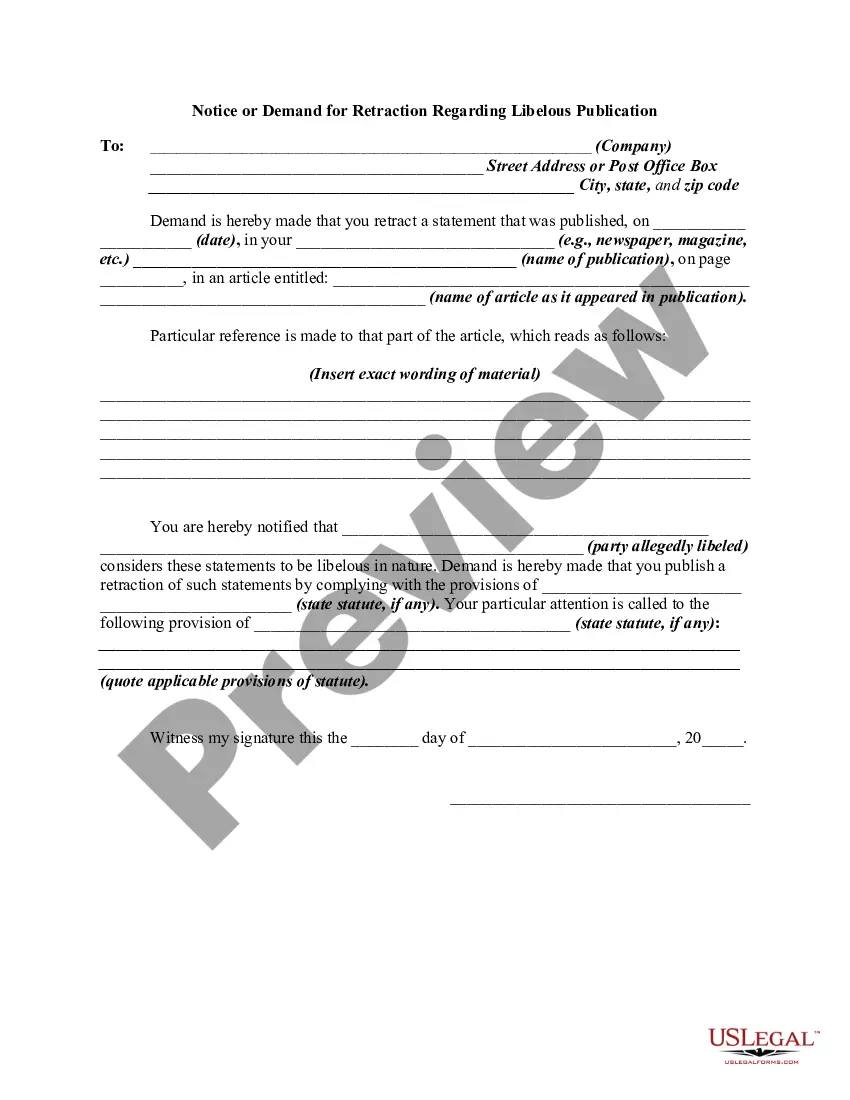
Notice or Demand for Retraction Regarding Libelous Publication - Defamation of Character
What is this form?
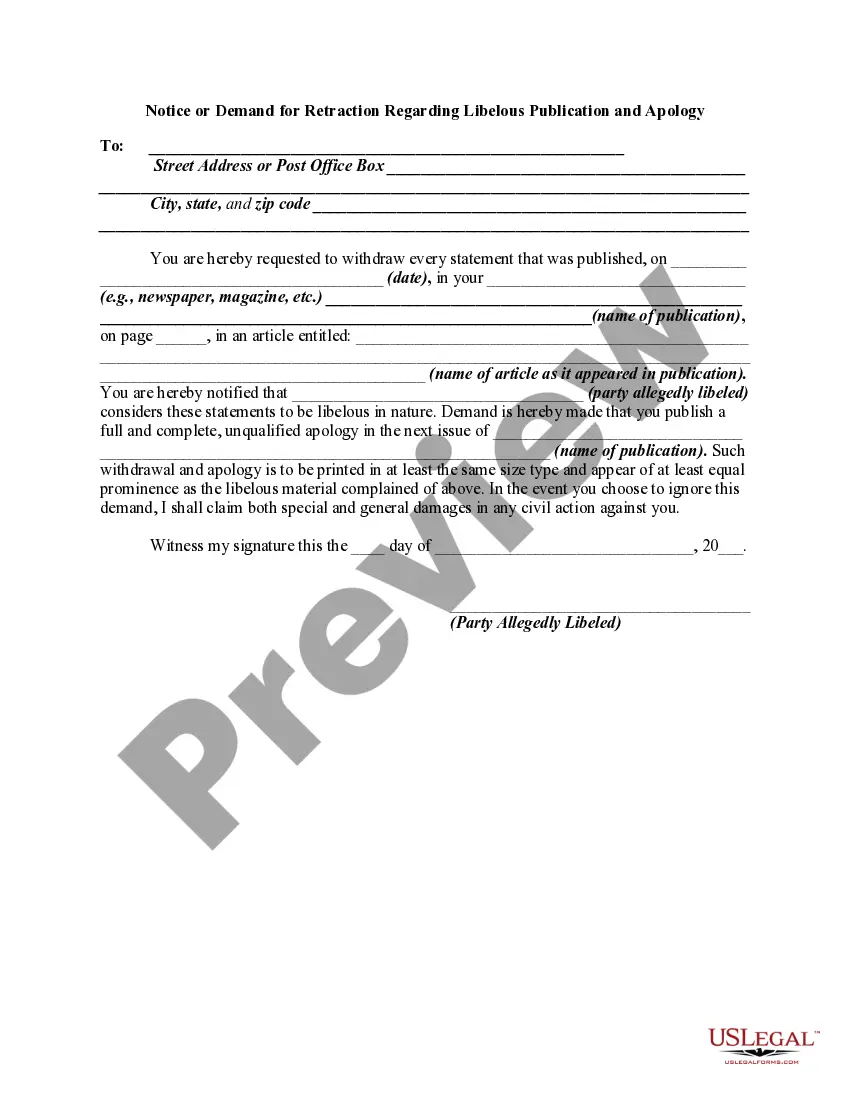
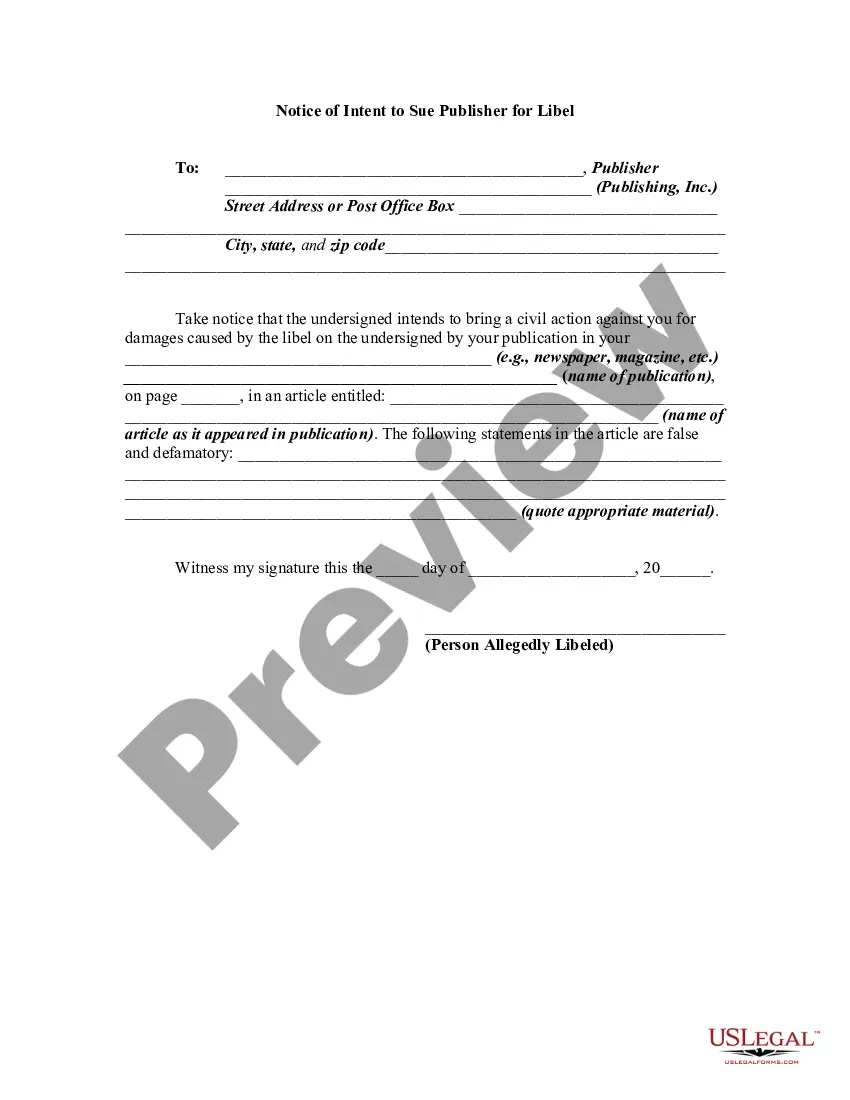
The Notice or Demand for Retraction Regarding Libelous Publication is a legal document used to formally request the retraction of defamatory statements that have been published. This form allows an individual or entity to notify a publisher of the alleged libelous content and provides an opportunity for them to withdraw the statements. Unlike other legal forms, this one specifically addresses issues of defamation and outlines the requirements for retraction under applicable law.
Key components of this form
- Party details: Information about the company or entity to which the demand is directed.
- Date of publication: The specific date when the defamatory statement was published.
- Publication details: Name and type of the publication where the statement appeared.
- Content reference: Exact wording of the statements considered defamatory.
- Notification of libel: A declaration identifying the harmed party and the nature of the statements.
- Statutory reference: Citation of relevant state statute regarding retraction requirements.

Situations where this form applies
This form should be used when an individual or organization believes they have been defamed by a published statement. You may need to use this form if you have discovered untrue statements about yourself or your business in a newspaper, magazine, or online publication. It is particularly important to act promptly in sending a retraction notice after the defamatory content has been published.
Who this form is for
- Individuals who feel they have been falsely represented in a publication.
- Businesses that have suffered reputational damage due to defamatory statements.
- Legal representatives acting on behalf of a harmed party.
- Anyone who wishes to address potential libelous content under state law.
Steps to complete this form
- Identify the company or publisher to which the notice is addressed.
- Enter the street address or post office box of the publisher.
- Specify the exact date when the defamatory publication occurred.
- Fill in the name of the publication and the title of the article containing the defamatory statements.
- Clearly cite the defamatory content as it appears in the publication.
- Sign and date the form at the end to validate the notice.
Does this form need to be notarized?
In most cases, this form does not require notarization. However, some jurisdictions or signing circumstances might. US Legal Forms offers online notarization powered by Notarize, accessible 24/7 for a quick, remote process.
Get your form ready online
Our built-in tools help you complete, sign, share, and store your documents in one place.
Make edits, fill in missing information, and update formatting in US Legal Forms—just like you would in MS Word.
Download a copy, print it, send it by email, or mail it via USPS—whatever works best for your next step.
Sign and collect signatures with our SignNow integration. Send to multiple recipients, set reminders, and more. Go Premium to unlock E-Sign.
If this form requires notarization, complete it online through a secure video call—no need to meet a notary in person or wait for an appointment.
We protect your documents and personal data by following strict security and privacy standards.

Make edits, fill in missing information, and update formatting in US Legal Forms—just like you would in MS Word.

Download a copy, print it, send it by email, or mail it via USPS—whatever works best for your next step.

Sign and collect signatures with our SignNow integration. Send to multiple recipients, set reminders, and more. Go Premium to unlock E-Sign.

If this form requires notarization, complete it online through a secure video call—no need to meet a notary in person or wait for an appointment.

We protect your documents and personal data by following strict security and privacy standards.
Common mistakes
- Failing to provide the exact wording of the defamatory statement.
- Not specifying the date of publication clearly.
- Neglecting to reference the relevant state statute.
- Inadequately identifying the party allegedly libeled.
- Overlooking the need for a signature or date at the end.
Benefits of using this form online
- Accessible: Easily download and complete the form at your convenience.
- Editability: Customizable to reflect your specific situation and requirements.
- Reliability: Prepared by licensed attorneys to ensure legal validity and compliance.
Legal use & context
- Retraction notices serve as a preliminary step before further legal action may be pursued.
- Successful retraction can mitigate damages by allowing the publisher to correct the information.
- This form is used as evidence of an attempt to resolve a defamation claim amicably.
Looking for another form?

Form popularity
FAQ
To prove prima facie defamation, a plaintiff must show four things: 1) a false statement purporting to be fact; 2) publication or communication of that statement to a third person; 3) fault amounting to at least negligence; and 4) damages, or some harm caused to the person or entity who is the subject of the statement.
Truth. the allegedly defamatory statement was merely a statement of opinion. consent to the publication of the allegedly defamatory statement. absolute privilege. qualified privilege. retraction of the allegedly defamatory statement.
To prove prima facie defamation, a plaintiff must show four things: 1) a false statement purporting to be fact; 2) publication or communication of that statement to a third person; 3) fault amounting to at least negligence; and 4) damages, or some harm caused to the person or entity who is the subject of the statement.
Name, description, and place of residence of the recipient of the notice. Name, description, and place of residence of the sender of the notice. Details of the cause of action. The relief claimed by the sender of the notice. The detailed description of the incident which raised the cause of action.
The statement must be proved false. Truth is an absolute defense to defamation. There must be communication. The statement is opinion, not fact. There must be harm. Consent has been given. Privilege or immunity can be claimed.
Truth is an absolute defense to libel claims, because one of the elements that must be proven in a defamation suit is falsity of the statement. If a statement is true, it cannot be false, and therefore, there is no prima facie case of defamation.
Some of the most major defenses to defamation are:Retraction: in cases involving publication of a libel in a newspaper or of a slander by radio broadcast, if a defamer retracts the allegedly defamatory statement that often will serve as a defense to any defamation lawsuit, especially if the defamer also apologizes.
Unlike the traditional meaning of the word "published," a defamatory statement does not need to be printed. Rather, a statement heard over the television or seen scrawled on someone's door is considered to be published.Falsity - Defamation law will only consider statements defamatory if they are, in fact, false.
The tone of the letter should be friendly but firm. Explain that the author of the defamatory content has made a mistake in their statement. Provide them with correct information and explain that the continued publication of the inaccurate comments will hurt you financially.