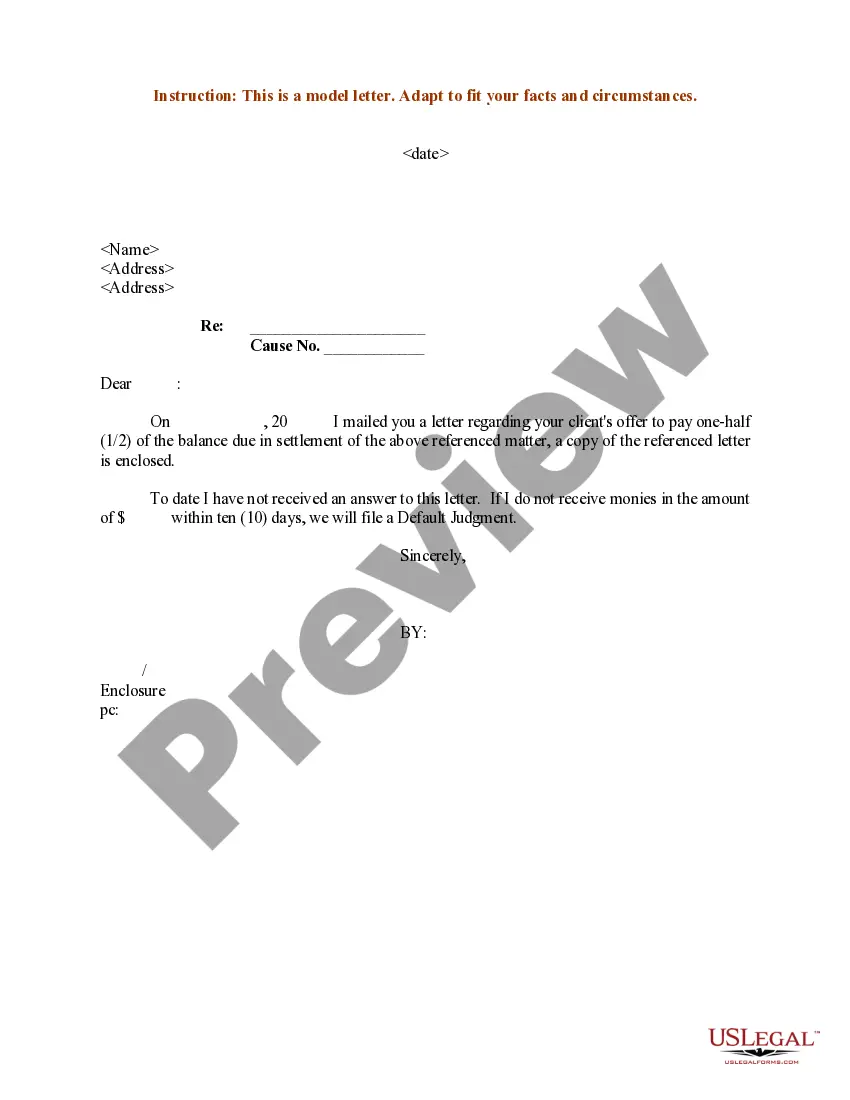
Sample Letter Purveying Settlement Offer and threatening filing for Default Judgment
What is this form?
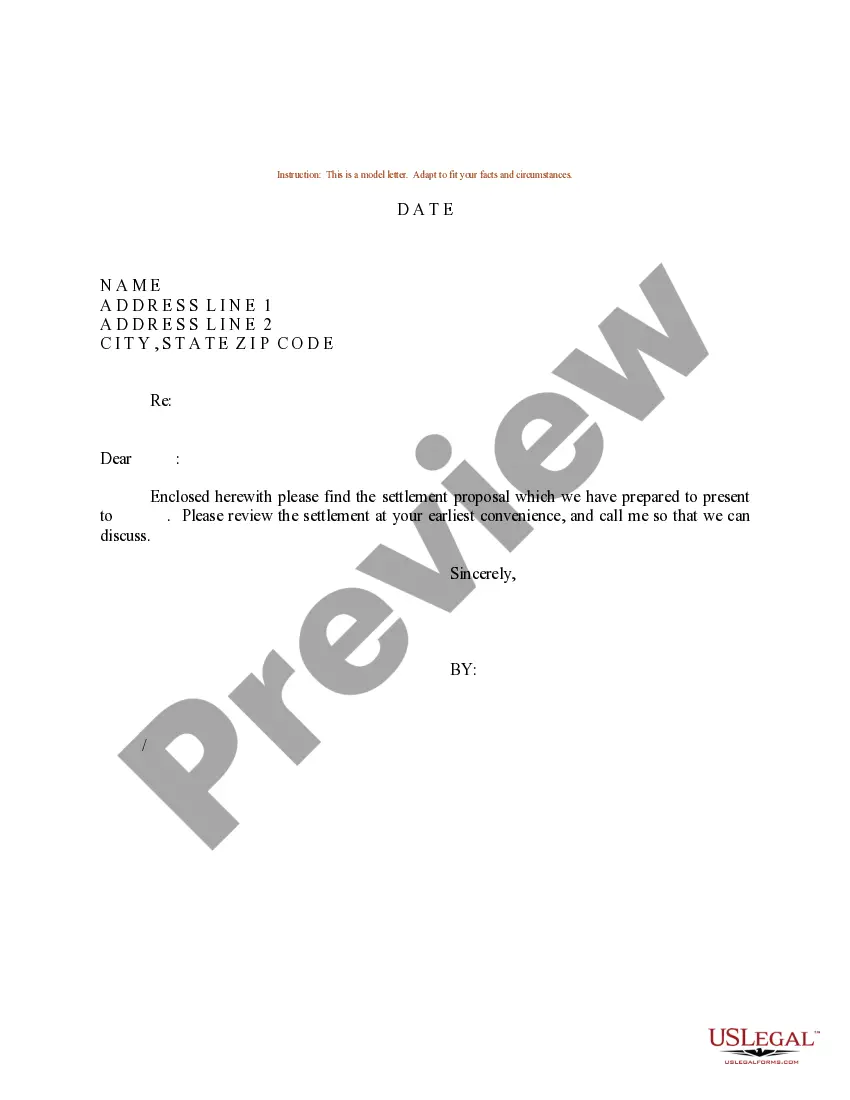
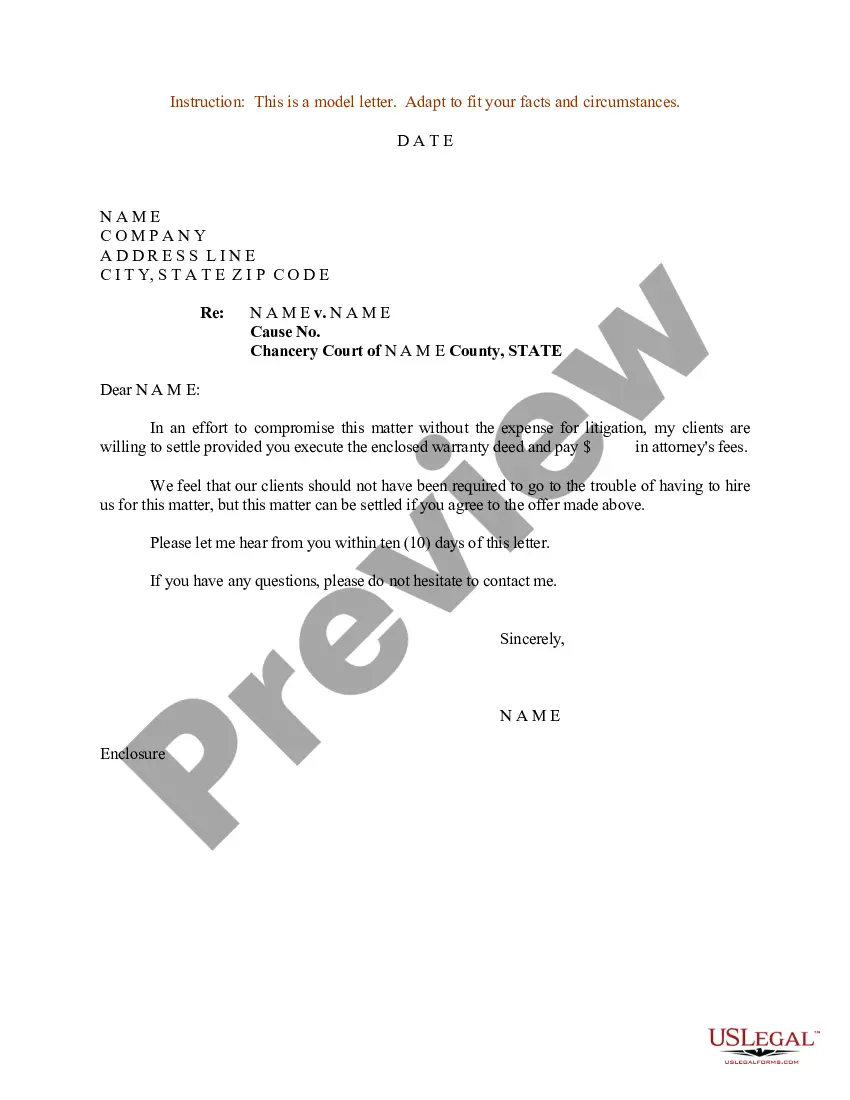
This form is a sample letter purveying a settlement offer and threatening the filing for a default judgment. It is designed to communicate to the other party the intention to move forward with legal action unless a settlement is reached. This is distinct from other legal letters, as it specifically incorporates both a proposal for settlement and a warning about potential court action, providing a clear path for resolution before proceeding to litigation.
Form components explained
- Date: The date the letter is written.
- Addressee details: Name and address of the recipient.
- Subject line: Clearly states the purpose of the letter.
- Case number: Important for identifying the related legal matter.
- Settlement offer details: Specific terms of the offer are outlined.
- Notice of default judgment risk: Alerts the recipient to potential filing of a default judgment.

When this form is needed
Who should use this form
- Individuals involved in a legal dispute who are considering a settlement.
- Lawyers crafting letters on behalf of their clients.
- Businesses seeking to resolve disputes before engaging in lengthy litigation.
How to prepare this document
- Enter the date at the top of the letter.
- Add the name and address of the recipient.
- Clearly state the subject of the letter.
- Include the relevant case number.
- Detail your settlement offer in a clear and concise manner.
- Include a warning regarding the potential for filing a default judgment if no action is taken.
Notarization requirements for this form
This form does not typically require notarization to be legally valid. However, some jurisdictions or document types may still require it. US Legal Forms provides secure online notarization powered by Notarize, available 24/7 for added convenience.
Get your form ready online
Our built-in tools help you complete, sign, share, and store your documents in one place.
Make edits, fill in missing information, and update formatting in US Legal Forms—just like you would in MS Word.
Download a copy, print it, send it by email, or mail it via USPS—whatever works best for your next step.
Sign and collect signatures with our SignNow integration. Send to multiple recipients, set reminders, and more. Go Premium to unlock E-Sign.
If this form requires notarization, complete it online through a secure video call—no need to meet a notary in person or wait for an appointment.
We protect your documents and personal data by following strict security and privacy standards.

Make edits, fill in missing information, and update formatting in US Legal Forms—just like you would in MS Word.

Download a copy, print it, send it by email, or mail it via USPS—whatever works best for your next step.

Sign and collect signatures with our SignNow integration. Send to multiple recipients, set reminders, and more. Go Premium to unlock E-Sign.

If this form requires notarization, complete it online through a secure video call—no need to meet a notary in person or wait for an appointment.

We protect your documents and personal data by following strict security and privacy standards.
Typical mistakes to avoid
- Failing to include key details such as the case number.
- Not providing sufficient context for the settlement offer.
- Using vague language instead of specific terms.
- Neglecting to sign or date the letter.
Benefits of using this form online
- Access legal forms anytime, from anywhere.
- Editable Word format allows for easy customization.
- Drafted by licensed attorneys to ensure legal accuracy.
- Convenient downloading saves time compared to traditional legal consultations.
What to keep in mind
- This form is crucial for communicating a settlement offer and the risk of legal action.
- Completing the letter correctly can prevent misunderstandings and expedite resolution.
- Always check state-specific rules related to legal correspondence.
Looking for another form?

Form popularity
FAQ
The danger of allowing a default judgment against you is once this occurs the debt buyer can garnish your wages and your bank accounts.If you don't submit a written answer to the lawsuit the court can enter a default judgment giving the debt buyer everything they are asking for.
Entry of default refers to the process where the person making a claim in a case makes a request before a court of law stating that the party against whom they have made a claim have failed to furnish any meaningful response to the claimant's pleadings within the time allowed for that.
If granted, the default judgment will be vacated and a new trial will be scheduled on the matter. In a county or district court in Texas, the deadline for a request for a new trial is 30 days from entry of the default judgment.
A simple default doesn't mean you legally owe a certain amount of money. A default judgment identifies the amount you owe the plaintiff. You don't want this to happen because a default judgment makes you a judgment debtor. Plaintiff may use all sorts of legal procedures to legally take your money and property.
First, you can ask the court to set aside the default judgment and give you an opportunity to contest it. Next, you can settle the debt with the debt buyer for an amount less than what the default judgment is for. And finally you can eliminate the default judgment completely by filing for bankruptcy.
A simple default doesn't mean you legally owe a certain amount of money. A default judgment identifies the amount you owe the plaintiff. You don't want this to happen because a default judgment makes you a judgment debtor. Plaintiff may use all sorts of legal procedures to legally take your money and property.
A very important fact you should keep in mind is that California courts do impose a timeline for seeking entry of a default judgment. Specifically, a request for entry of default must be filed within 10 days following a defendant's failure to timely file and serve a responsive pleading. (See Cal.
A default judgment occurs when the defendant in a legal case fails to respond to a court summons or does not appear in court. If this occurs, a court may rule in favor of the plaintiff by default.
A default judgment means that the court has decided that you owe money. This a result of the person suing you in small claims court and you failed to appear at the hearing.