Release and Indemnification Agreement Given by Registered Guest at Hotel or Motel Regarding Unregistered Occupants or Visitors in Guest's Room
About this form
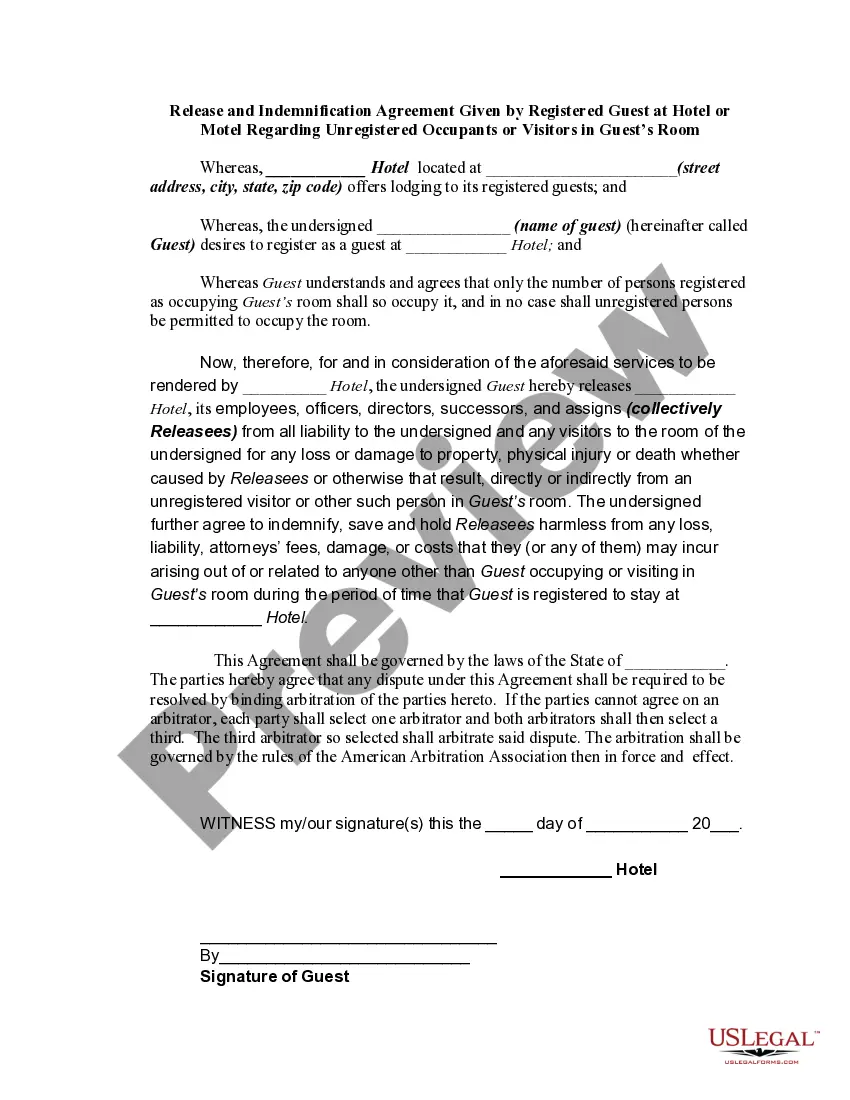
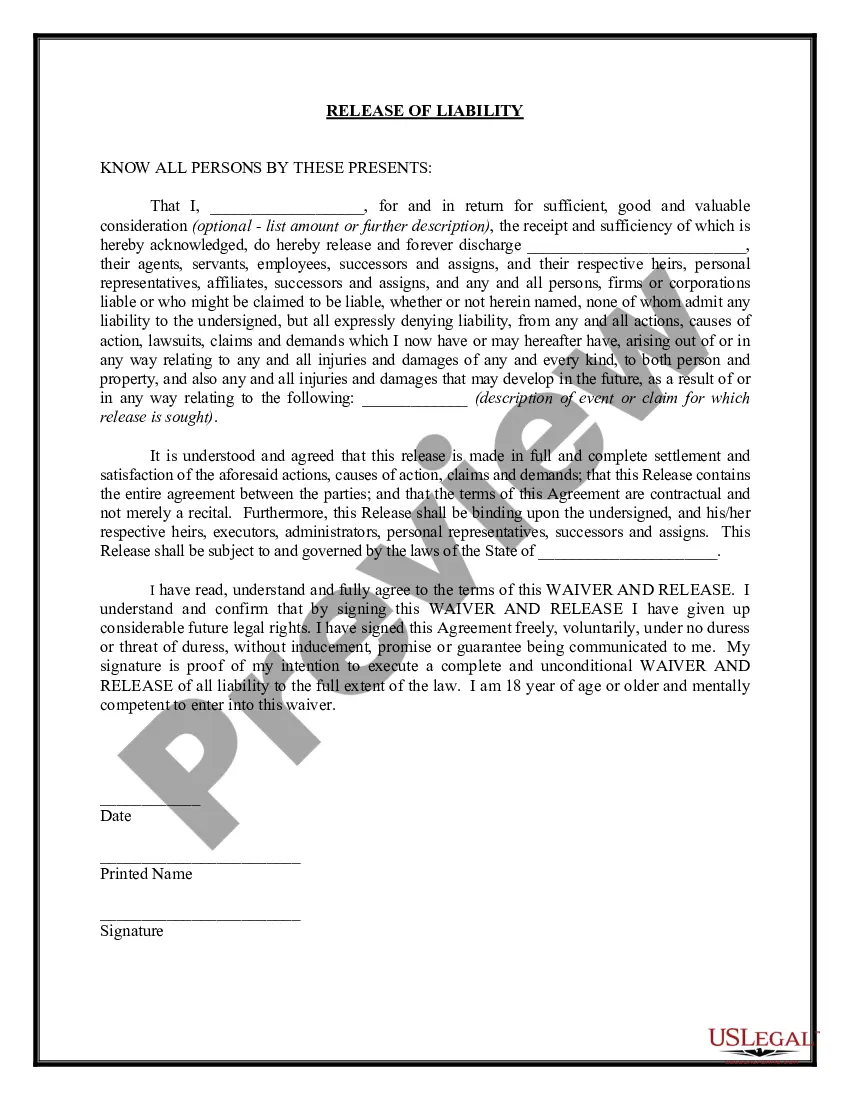
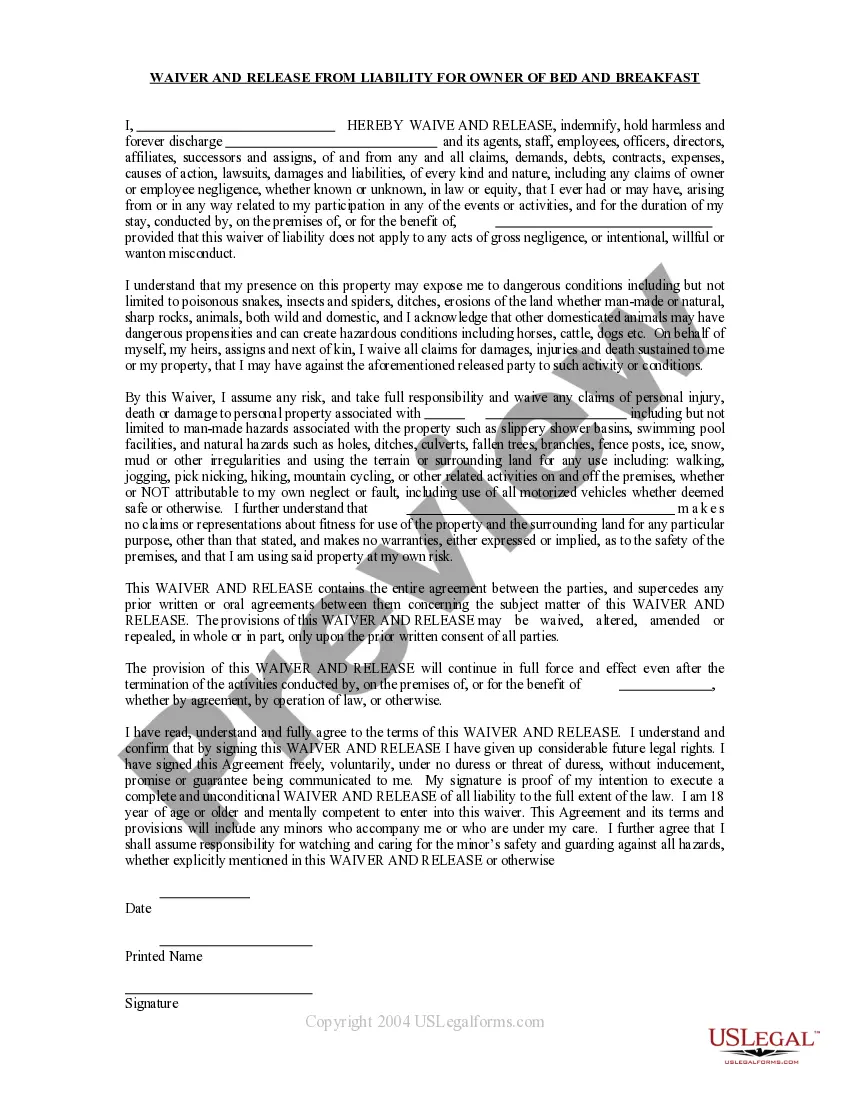
The Release and Indemnification Agreement is a legal document used by hotel guests to waive their rights to sue the hotel for any injuries or damages that occur as a result of unregistered occupants or visitors in their hotel room. This form is important for both the guest and the hotel, as it clarifies each party's responsibilities and liabilities regarding unauthorized visitors. Unlike a standard guest registration form, this agreement specifically addresses the issue of unregistered guests, providing additional legal protection for the hotel and limiting liability for guests who allow others to stay in their room without prior registration.
Key components of this form
- Identification of the hotel, guest, and the number of registered occupants.
- A release of liability for the hotel from any claims related to unregistered occupants.
- Indemnification clause, requiring the guest to cover any costs incurred by the hotel due to unregistered visitors.
- Governing law clause specifying the state law that applies to the agreement.
- Arbitration clause for dispute resolution, detailing the process if disagreements arise.

When this form is needed
This form is typically used when a guest registers at a hotel or motel and intends to allow additional visitors who are not registered. It protects the hotel from legal claims that may arise from any incidents involving those unregistered visitors. Guests should complete this form when they check in and before any visitors enter their room to ensure clarity on liabilities and responsibilities.
Who needs this form
- Any registered guest at a hotel or motel who plans to have visitors in their room.
- Hotels looking to establish clear liability and legal protections regarding their guests.
- Hotel management teams that need to protect against potential legal claims from accidents involving unregistered visitors.
Completing this form step by step
- Enter the name of the hotel and its complete address.
- Fill in the guest's name and details of registered occupants in the room.
- Specify any additional visitors who will be in the room during the stay.
- Read the release and indemnification clauses carefully before signing.
- Sign and date the form to make it legally binding.
Notarization guidance
This form does not typically require notarization to be legally valid. However, some jurisdictions or document types may still require it. US Legal Forms provides secure online notarization powered by Notarize, available 24/7 for added convenience.
Get your form ready online
Our built-in tools help you complete, sign, share, and store your documents in one place.
Make edits, fill in missing information, and update formatting in US Legal Forms—just like you would in MS Word.
Download a copy, print it, send it by email, or mail it via USPS—whatever works best for your next step.
Sign and collect signatures with our SignNow integration. Send to multiple recipients, set reminders, and more. Go Premium to unlock E-Sign.
If this form requires notarization, complete it online through a secure video call—no need to meet a notary in person or wait for an appointment.
We protect your documents and personal data by following strict security and privacy standards.

Make edits, fill in missing information, and update formatting in US Legal Forms—just like you would in MS Word.

Download a copy, print it, send it by email, or mail it via USPS—whatever works best for your next step.

Sign and collect signatures with our SignNow integration. Send to multiple recipients, set reminders, and more. Go Premium to unlock E-Sign.

If this form requires notarization, complete it online through a secure video call—no need to meet a notary in person or wait for an appointment.

We protect your documents and personal data by following strict security and privacy standards.
Avoid these common issues
- Failing to disclose all visitors who will be in the room.
- Not fully understanding the implications of the release of liability.
- Neglecting to check the governing law section before signing.
- Signing without reading the terms of indemnification.
Why use this form online
- Convenient and immediate access to the form, allowing guests to complete it at check-in.
- Easily editable to fit specific situations and needs.
- Prepared by licensed attorneys, ensuring the legality and relevance of the content.
Legal use & context
- This agreement is intended to protect hotels from liability associated with unregistered guests.
- It may not hold up in cases of gross negligence or intentional misconduct by hotel staff.
- Some courts may not enforce releases involving minors, thereby limiting liability in those situations.
Summary of main points
- The Release and Indemnification Agreement offers legal protection for both guests and hotels.
- Guests must be aware of their responsibilities regarding unregistered visitors.
- Completing this form can prevent misunderstandings about liability during a hotel stay.
Looking for another form?


Form popularity
FAQ
: a claim to a privilege (as entertainment or protection) to which a guest is entitled usually for a brief period by custom or law also : the right to make such a claim on the basis of blood or other relationship.
Yes , you can ask to connect to a guest but any other details like their phone number, or if they are staying in the hotel or their room number will not be given to you.It is a matter of privacy concern and no one can tell to anyone who is staying in the hotel or not.
In California, a guest automatically becomes a tenant once he/she has stayed for more than 30 consecutive days. However, the hotel has the power to prevent a guest from staying longer than 30 days and accruing tenant's rights, which happens automatically on the 31st day.
A hotel is generally not liable for loss of luggage or other personal items belonging to guests of the hotel and lost in areas other than the guest's private room, unless the hotel or its employees are at fault.
Can a hotel legally kick you out? Yes. All hotelsluxury or budget accommodationshave rules to maintain the peace and safety of guests and staff. The law protects innkeepers from people that may harm them and cause damage to their property.
Can a hotel legally kick you out? Yes. All hotelsluxury or budget accommodationshave rules to maintain the peace and safety of guests and staff. The law protects innkeepers from people that may harm them and cause damage to their property.
A guest has a right to remain in the hotel for a reasonable time. Upon the expiration of the rental period, a hotel guest has no right to use the room. S/he also loses any privacy interest associated with the room.In order to remain in the hotel a guest must behave properly. A guest must pay the amount charged.
If a hotel is your primary place of living, it is your residence. There is no time period to establish residency in a state. Many people mistakenly believe that you need to live in a state for a certain length of time to establish residency, but that is not true.