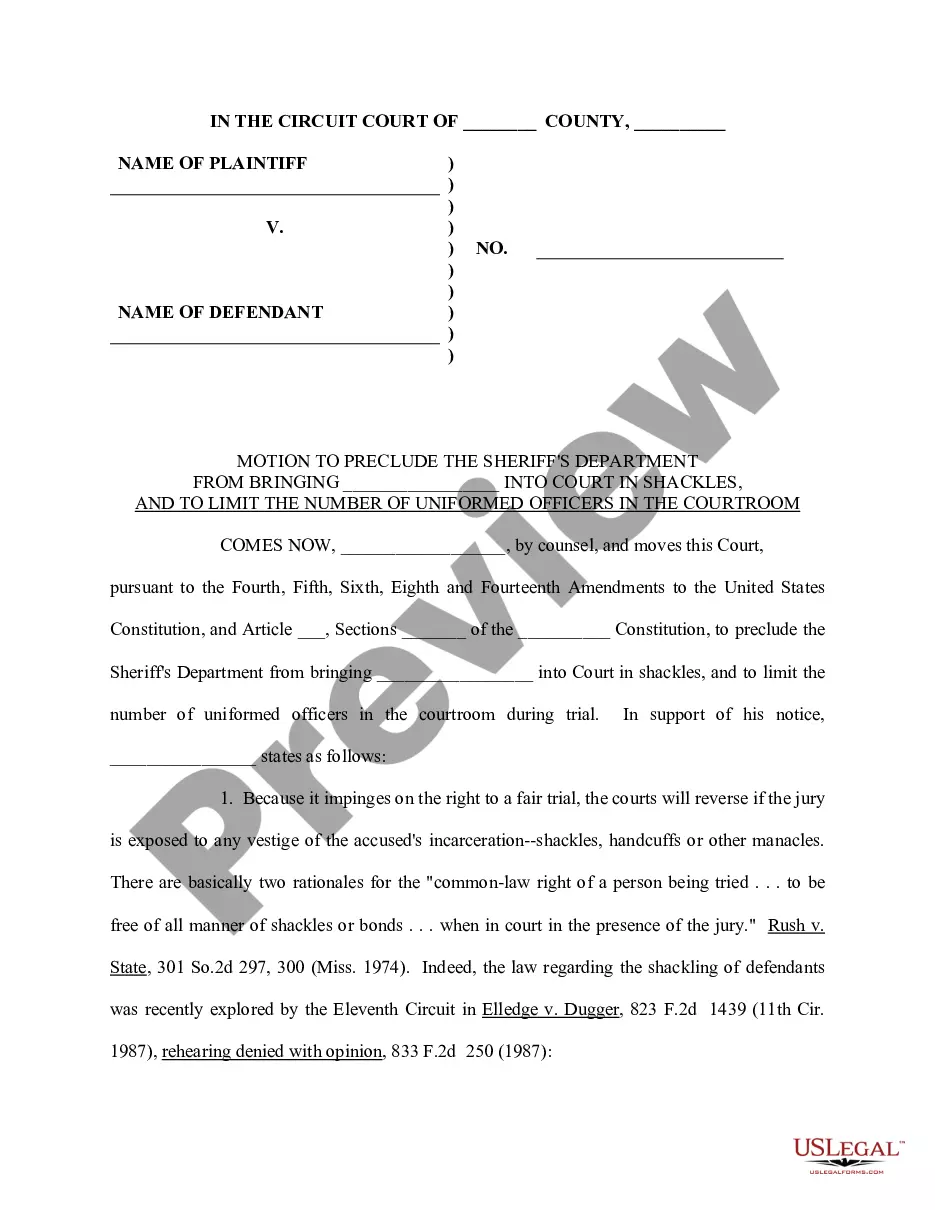
Motion to Preclude the Sheriff's Department from Bringing Defendant Into Court in Shackles, and to Limit Number of Uniformed Officers in Courtroom
What this document covers
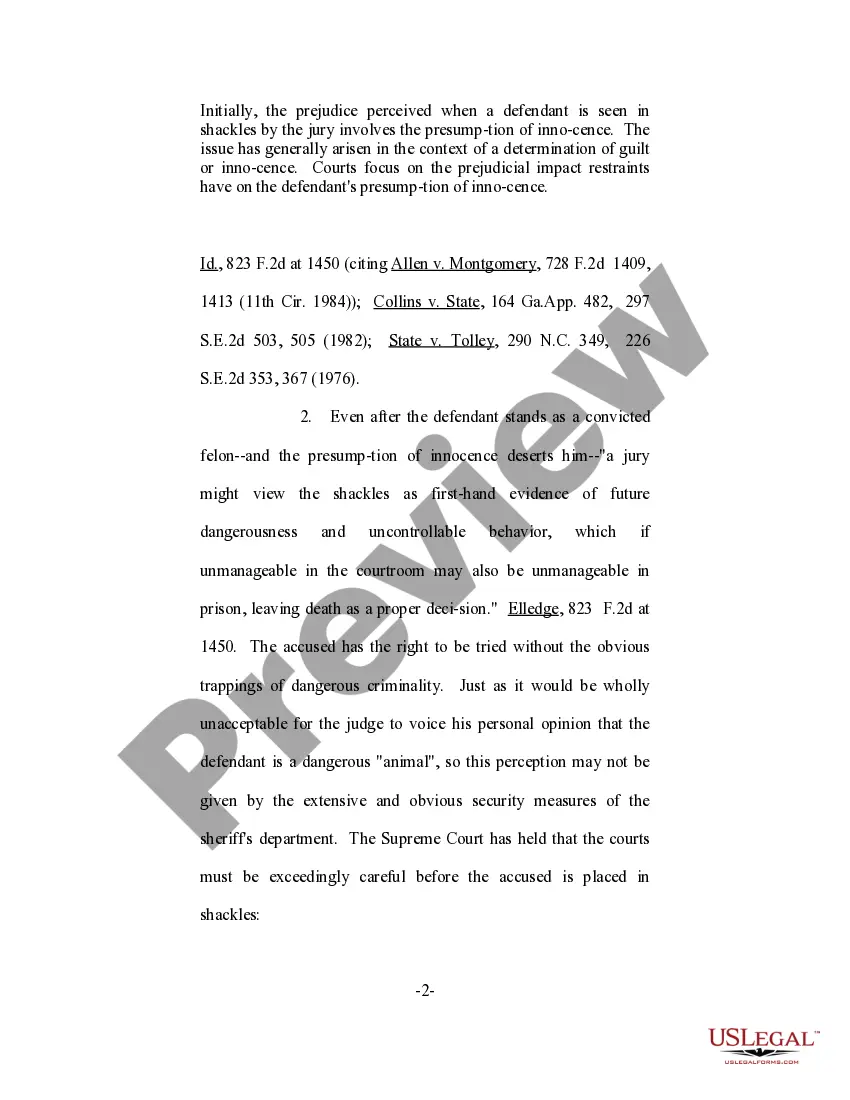
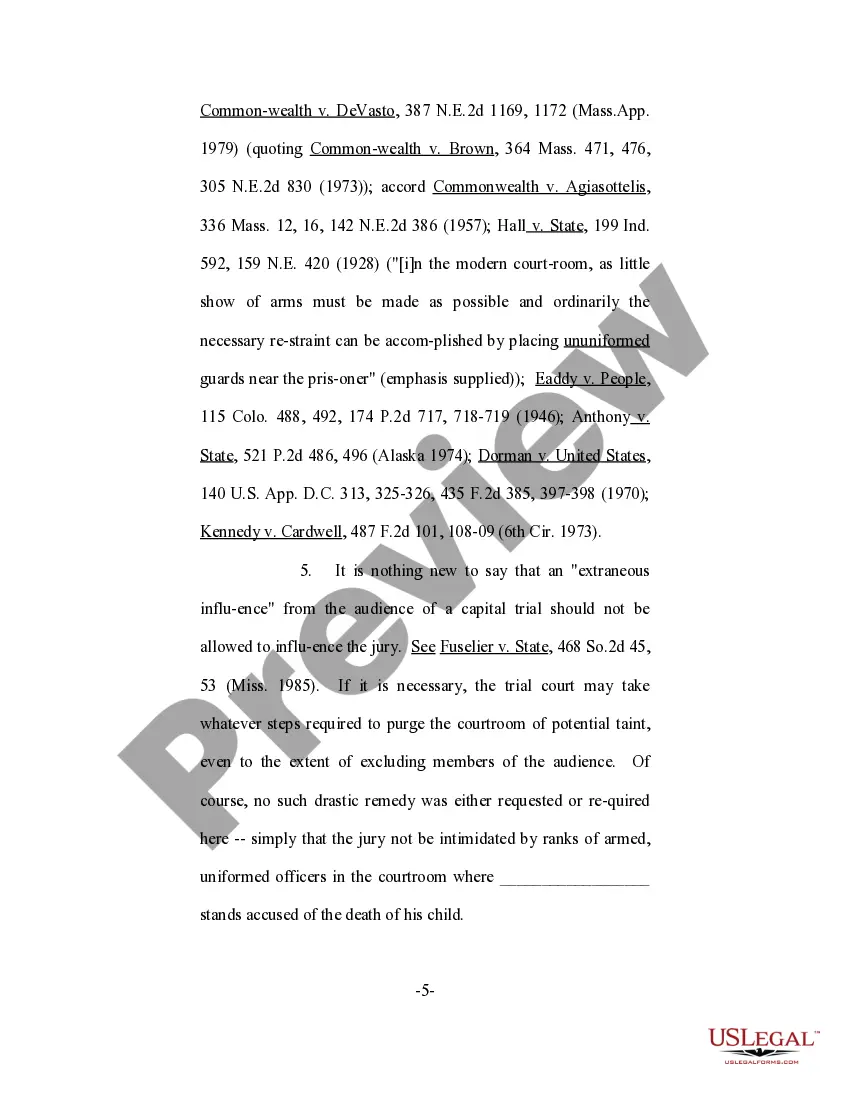
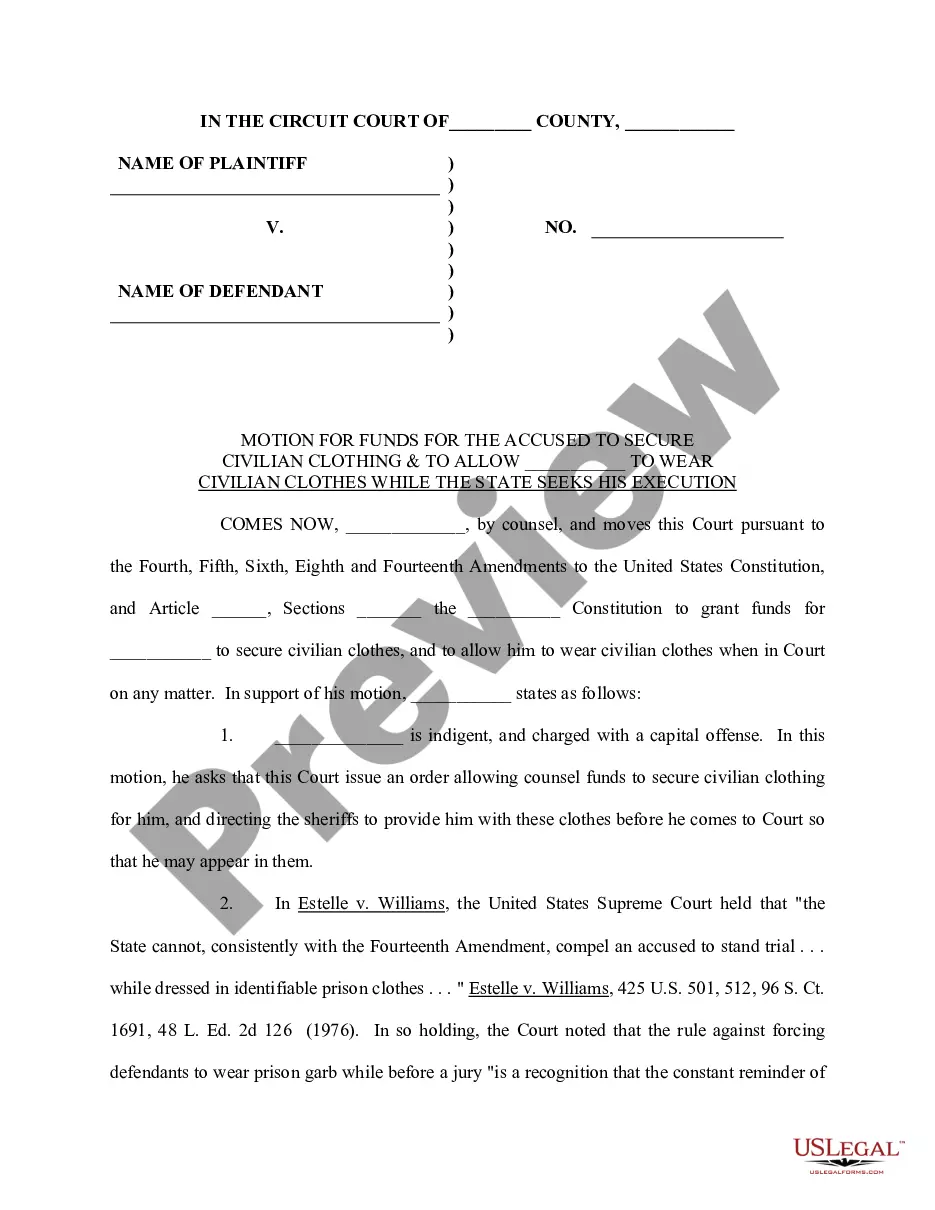
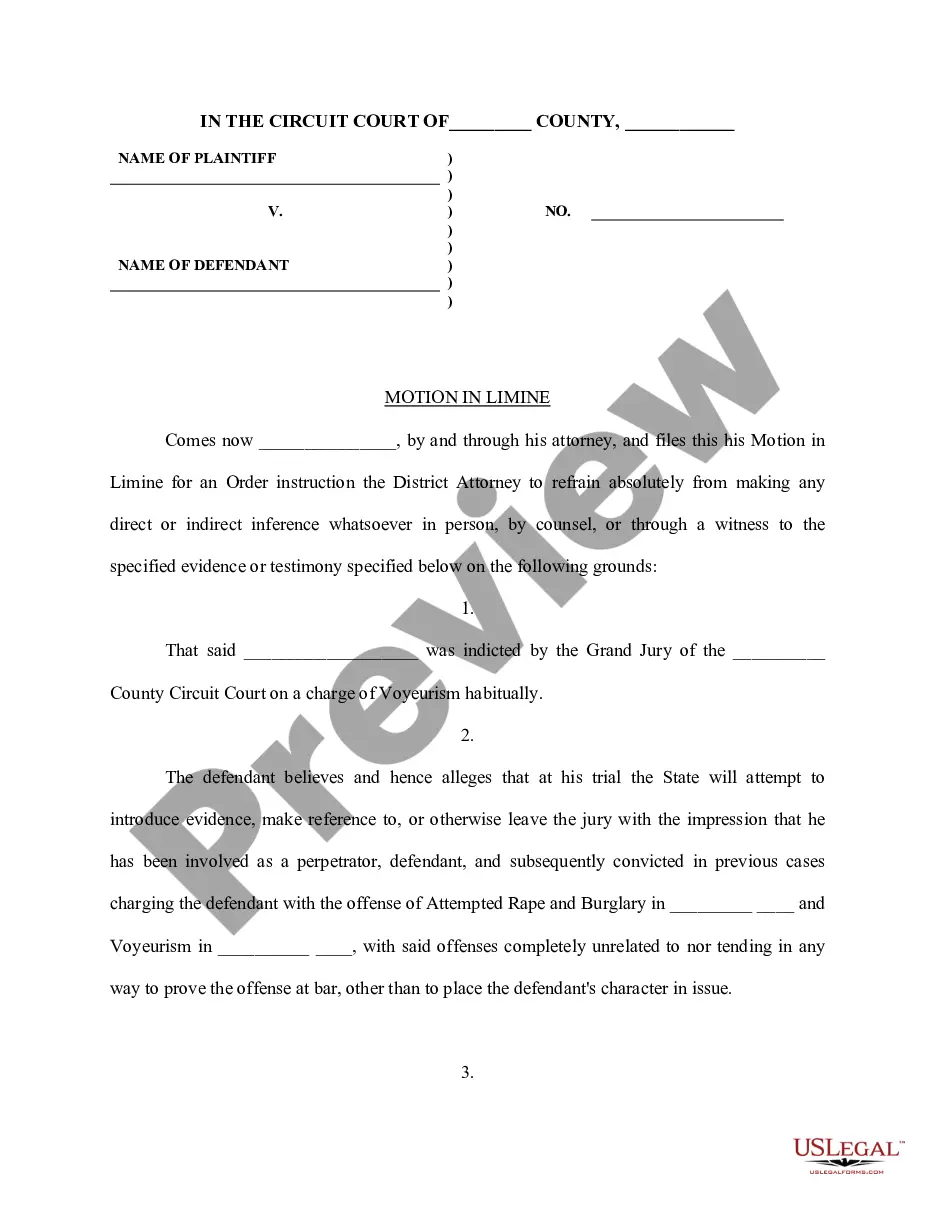
This Motion to Preclude the Sheriff's Department from Bringing Defendant Into Court in Shackles, and to Limit Number of Uniformed Officers in Courtroom is a legal document used to request that a defendant not be brought into the courtroom in restraints, such as shackles or handcuffs. It also seeks to limit the presence of uniformed officers to avoid prejudicing the juryâs perception of the defendant. This form is crucial in ensuring that a defendant's right to a fair trial is upheld and that the presumption of innocence is maintained in the eyes of the jury.
Key parts of this document
- Identification of the defendant and the court where the motion is filed.
- Recognition of constitutional rights relevant to fair trial standards.
- Specific requests regarding shackling and limiting security presence.
- Statement of support referencing legal precedents.
- Signature of the attorney representing the defendant.
Common use cases
This motion should be utilized in criminal trials where the defendant's appearance in court may be prejudicial due to the use of restraints or an excessive number of law enforcement officials in the courtroom. It is applicable during any phase of the trial where the defendant is present, particularly when jury selection or jury trials are underway.
Who should use this form
- Defendants seeking to protect their rights during a criminal proceeding.
- Defense attorneys representing clients in court who wish to ensure a fair trial.
- Individuals involved in cases sensitive to jury perception who may be impacted by the visibility of restraints or security personnel.
Instructions for completing this form
- Identify the parties involved by filling in the defendant's name and other relevant case details.
- Outline the constitutional arguments supporting the motion clearly and concisely.
- State the specific requests for preclusion of shackles and limiting officers present in the courtroom.
- Provide citations of relevant legal cases that support the motion.
- Sign the motion and include your attorney information as applicable.
Does this form need to be notarized?
This form does not typically require notarization unless specified by local law. Ensure to check your jurisdiction's requirements before submitting the motion.
Get your form ready online
Our built-in tools help you complete, sign, share, and store your documents in one place.
Make edits, fill in missing information, and update formatting in US Legal Forms—just like you would in MS Word.
Download a copy, print it, send it by email, or mail it via USPS—whatever works best for your next step.
Sign and collect signatures with our SignNow integration. Send to multiple recipients, set reminders, and more. Go Premium to unlock E-Sign.
If this form requires notarization, complete it online through a secure video call—no need to meet a notary in person or wait for an appointment.
We protect your documents and personal data by following strict security and privacy standards.

Make edits, fill in missing information, and update formatting in US Legal Forms—just like you would in MS Word.

Download a copy, print it, send it by email, or mail it via USPS—whatever works best for your next step.

Sign and collect signatures with our SignNow integration. Send to multiple recipients, set reminders, and more. Go Premium to unlock E-Sign.

If this form requires notarization, complete it online through a secure video call—no need to meet a notary in person or wait for an appointment.

We protect your documents and personal data by following strict security and privacy standards.
Mistakes to watch out for
- Failing to cite relevant legal precedents that could strengthen the motion.
- Not clearly specifying the number of officers to be limited in the courtroom.
- Omitting necessary signatures or contact information of the attorney.
- Using legal jargon that may not be clearly understood by all parties involved in the trial.
Why complete this form online
- Convenient access to legal forms designed by licensed attorneys.
- Edit and customize the document as needed for your specific case.
- Downloadable format allows for easy printing and submission.
- Fast and efficient process, saving time compared to traditional methods.
Legal use & context
- Prevention of jury bias due to the visual implications of restraints.
- Reinforcement of a defendant's presumption of innocence until proven guilty.
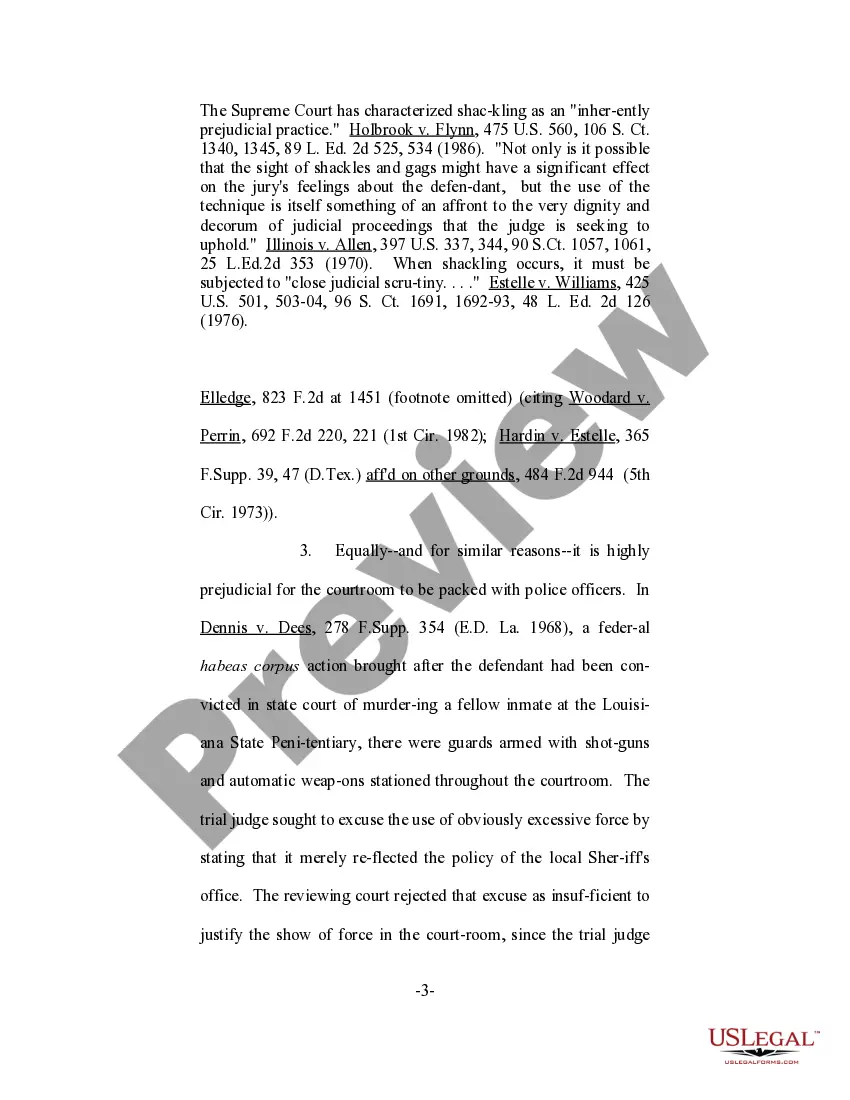
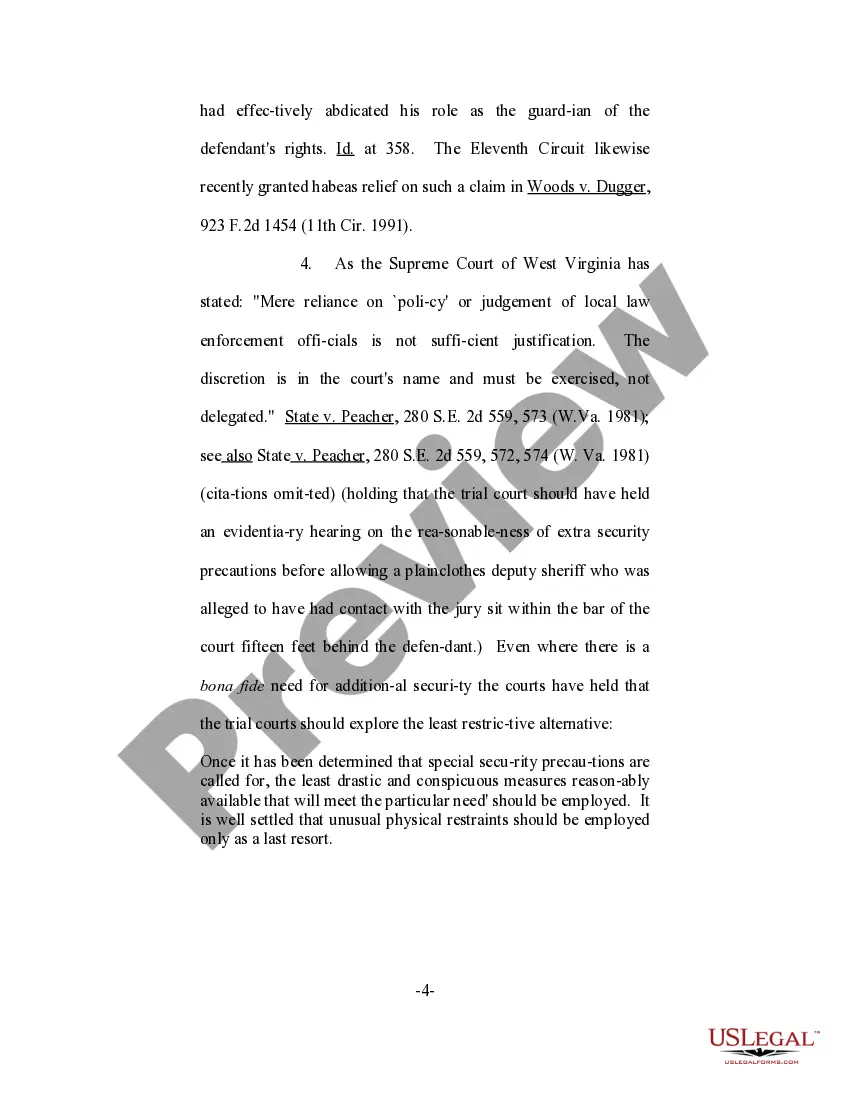
- Relevant case laws underscore the need for courts to handle shackling with careful consideration.
What to keep in mind
- This motion is essential for maintaining a fair trial environment for the defendant.
- Understanding and correctly filling out this form is critical to avoid common pitfalls.
- Always verify state-specific requirements for legal documents.
Looking for another form?


Form popularity
FAQ
No person shall be held to answer for a capital, or otherwise infamous crime, unless on a presentment or indictment of a Grand Jury, except in cases arising in the land or naval forces, or in the Militia, when in actual service in time of War or public danger; nor shall any person be subject for the same offence to be
Equality. The system must not discriminate procedurally between parties.Economy. The cost of access to the system must not be a barrier to its use or operate to the disadvantage of one or the other parties.Expedition.Evidence.Equity.
Due process rights are basically the guarantee that a person has the right to the fair application of the law before they can be imprisoned, executed, or have their property seized. This concept is responsible for all the procedures that guarantee a fair trial no matter who you are.
Initiation of the Prosecution. Clarity in Criminal Statutes: The Void-for-Vagueness Doctrine. Entrapment. Criminal Identification Process. Fair Trial. Prosecutorial Misconduct. Proof, Burden of Proof, and Presumptions. The Problem of the Incompetent or Insane Defendant.
Scholars consider the Fifth Amendment as capable of breaking down into the following five distinct constitutional rights: 1) right to indictment by the grand jury before any criminal charges for felonious crimes, 2) a prohibition on double jeopardy, 3) a right against forced self-incrimination, 4) a guarantee that all
First Amendment: Freedom of religion, freedom of speech and the press, the right to assemble, the right to petition government. Second Amendment: The right to form a militia and to keep and bear arms.
Suppose, for example, state law gives students a right to a public education, but doesn't say anything about discipline. Before the state could take that right away from a student, by expelling her for misbehavior, it would have to provide fair procedures, i.e. due process.
For example, a mere expectation of continued employment by a terminable-at-will public employee is not a property interest because there is no legitimate claim of entitlement. In contrast, if that public employee has a contract and is terminated in the middle of that contract period without any kind of a hearing,
635 (1940), enumerated the following cardinal primary requirements of procedural due process in administrative proceedings: (1) The right to a hearing, which includes the right to present one's case and submit evidence in support thereof; (2) The tribunal must consider the evidence presented; (3) The decision must