Option to Purchase Stock - Long Form
What is this form?
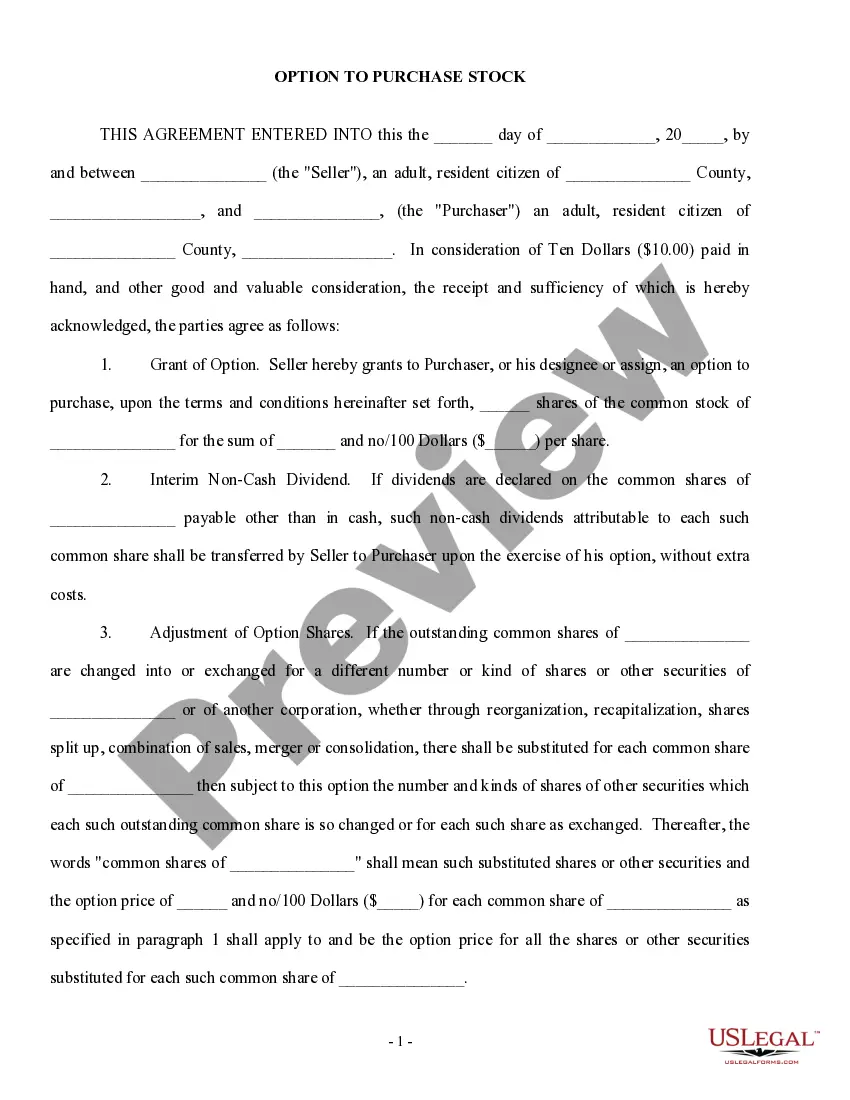
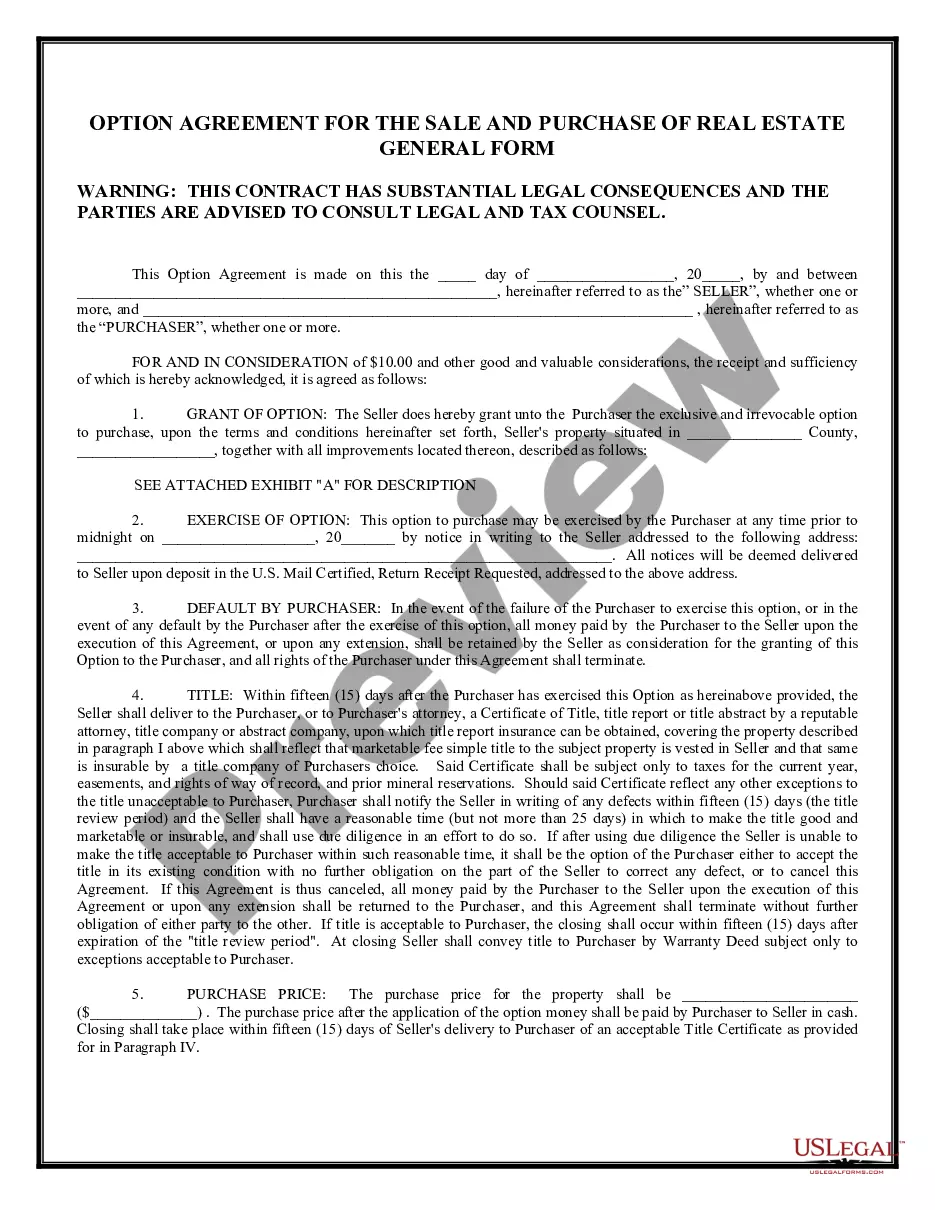
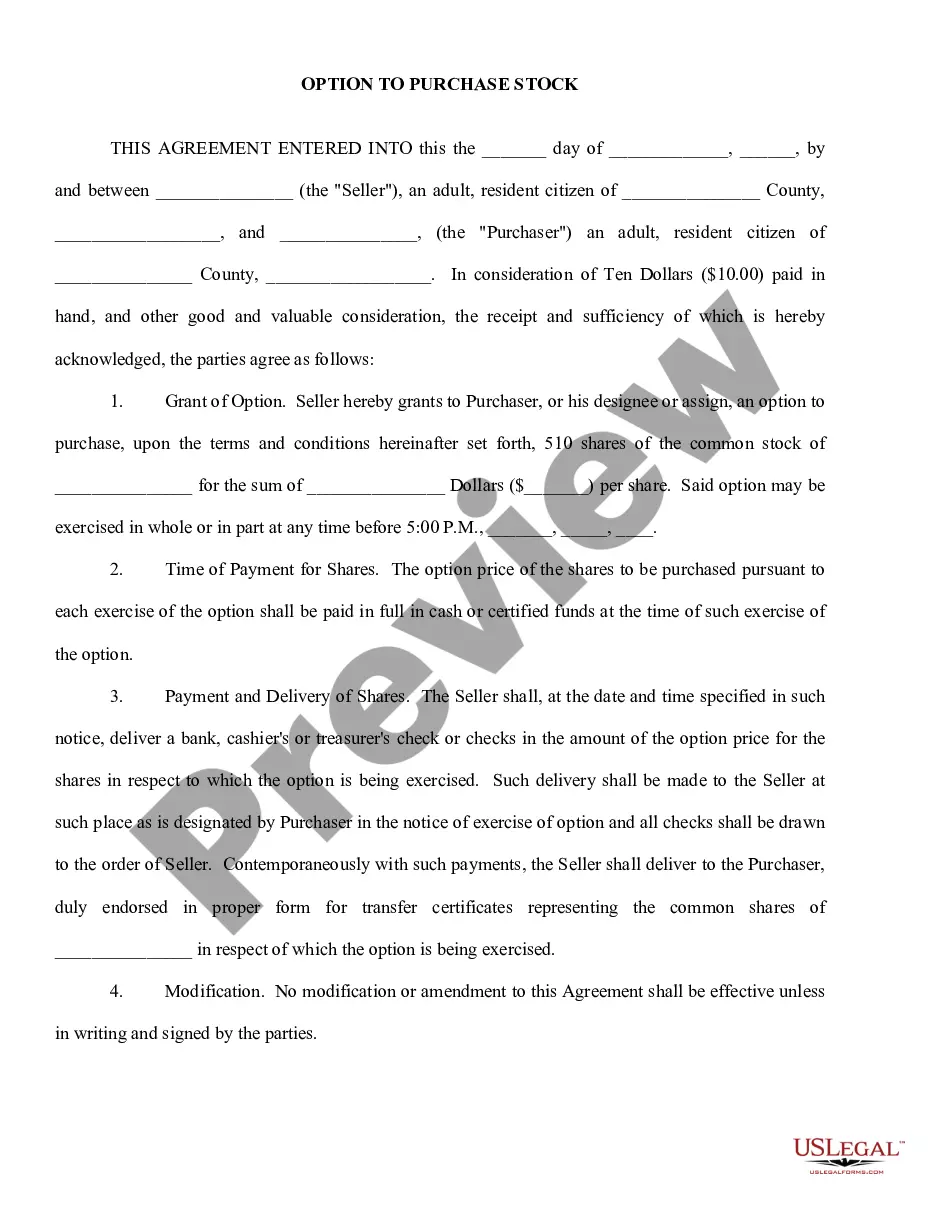
The Option to Purchase Stock - Long Form is a legal agreement that allows the purchaser to buy shares of common stock from the seller at a predetermined price. This document ensures that both parties understand the terms of the stock purchase and highlights the rights and obligations associated with the option. Unlike simpler forms, this long form offers detailed clauses addressing dividends, adjustments, and exercise methods, which are crucial for comprehensive legal protection.
Form components explained
- Grant of Option: Details the number of shares available for purchase and the purchase price per share.
- Interim Non-Cash Dividend: Addresses any non-cash dividends that may be transferred to the purchaser upon option exercise.
- Adjustment of Option Shares: Covers what happens if the common shares are changed or exchanged for different securities.
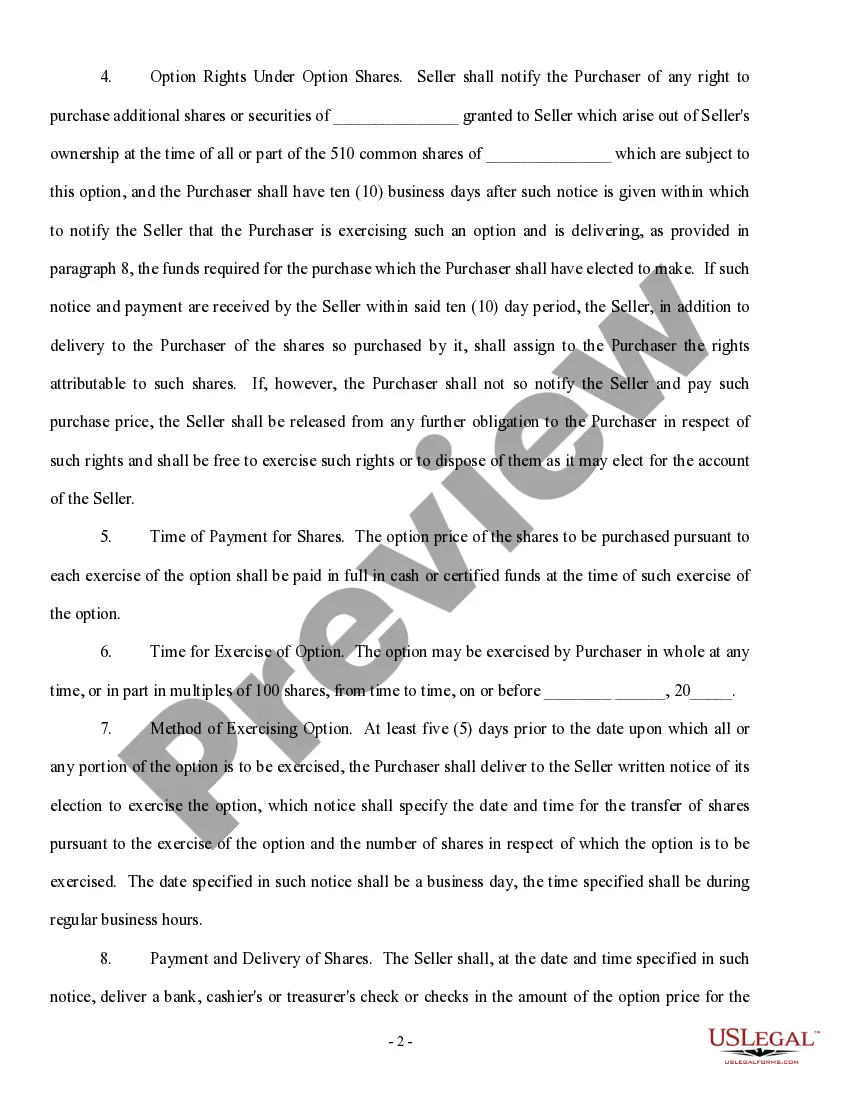
- Option Rights Under Option Shares: Specifies the notification process for additional shares or securities rights.
- Time of Payment for Shares: Outlines that payment must be made in full at the time of exercising the option.
- Time for Exercise of Option: Indicates the deadlines for exercising the option, whether in full or partial amounts.

Situations where this form applies
This form should be used when an individual or entity is interested in securing the option to buy shares of a companyâs stock at a specified price in the future. Examples include startup investors wanting to lock in stock prices, or employees offered stock options as part of a compensation package. If you anticipate future stock purchases, this form formalizes the agreement and protects both parties involved in the transaction.
Who needs this form
This form is intended for:
- Individuals seeking to invest in a company by purchasing stock options.
- Businesses or startups that wish to provide stock options to employees or investors.
- Investors looking for assurance regarding the future purchase of shares at a specified price.
Completing this form step by step
To complete this form, follow these steps:
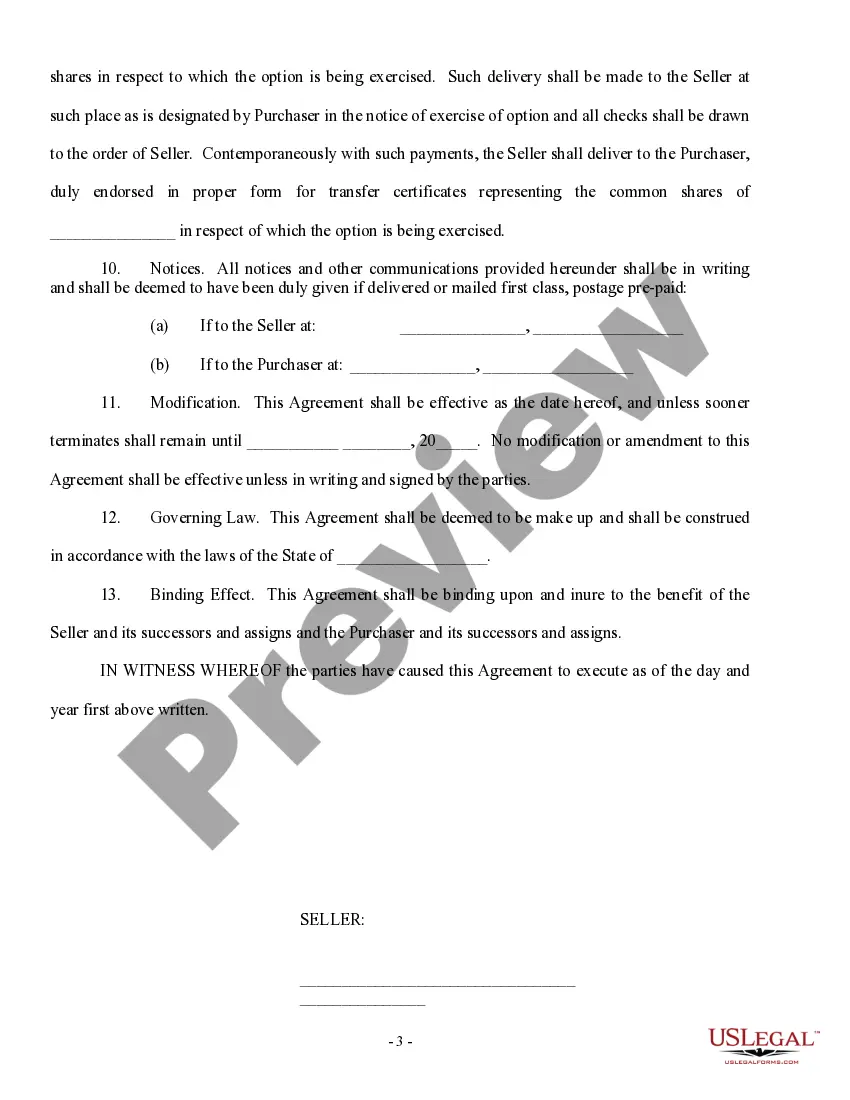
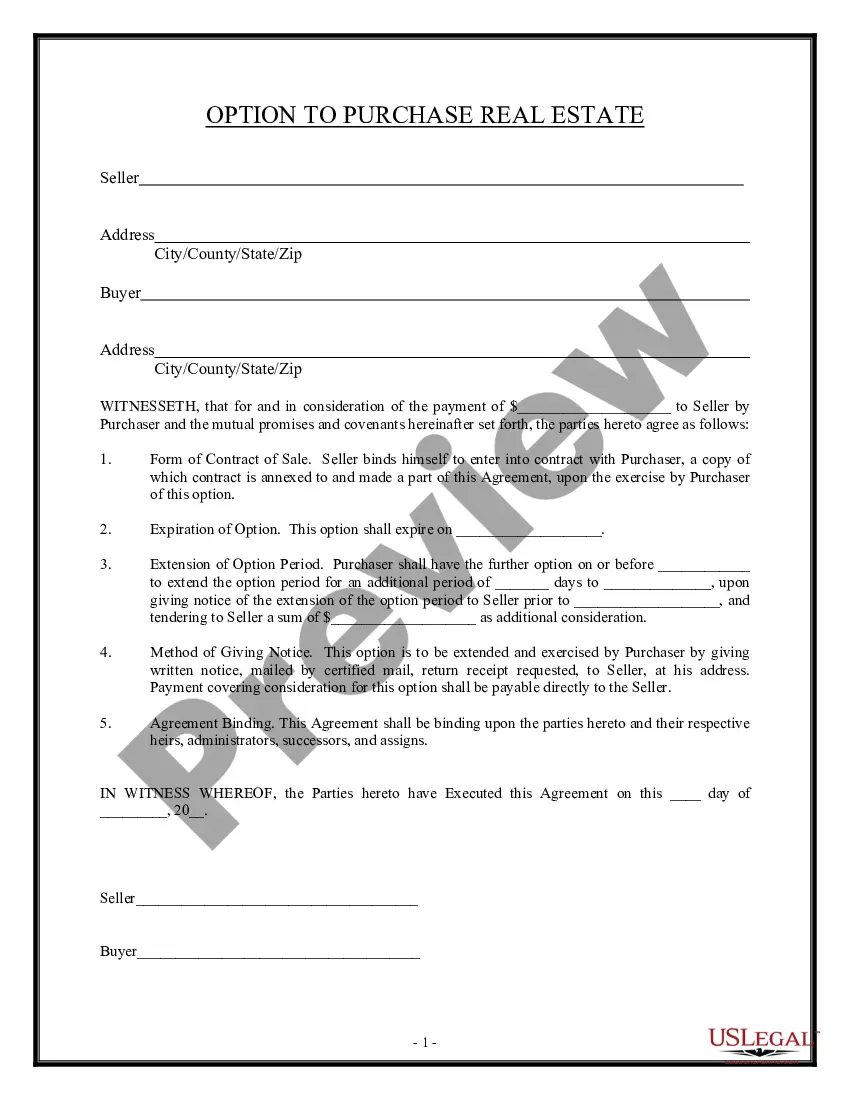
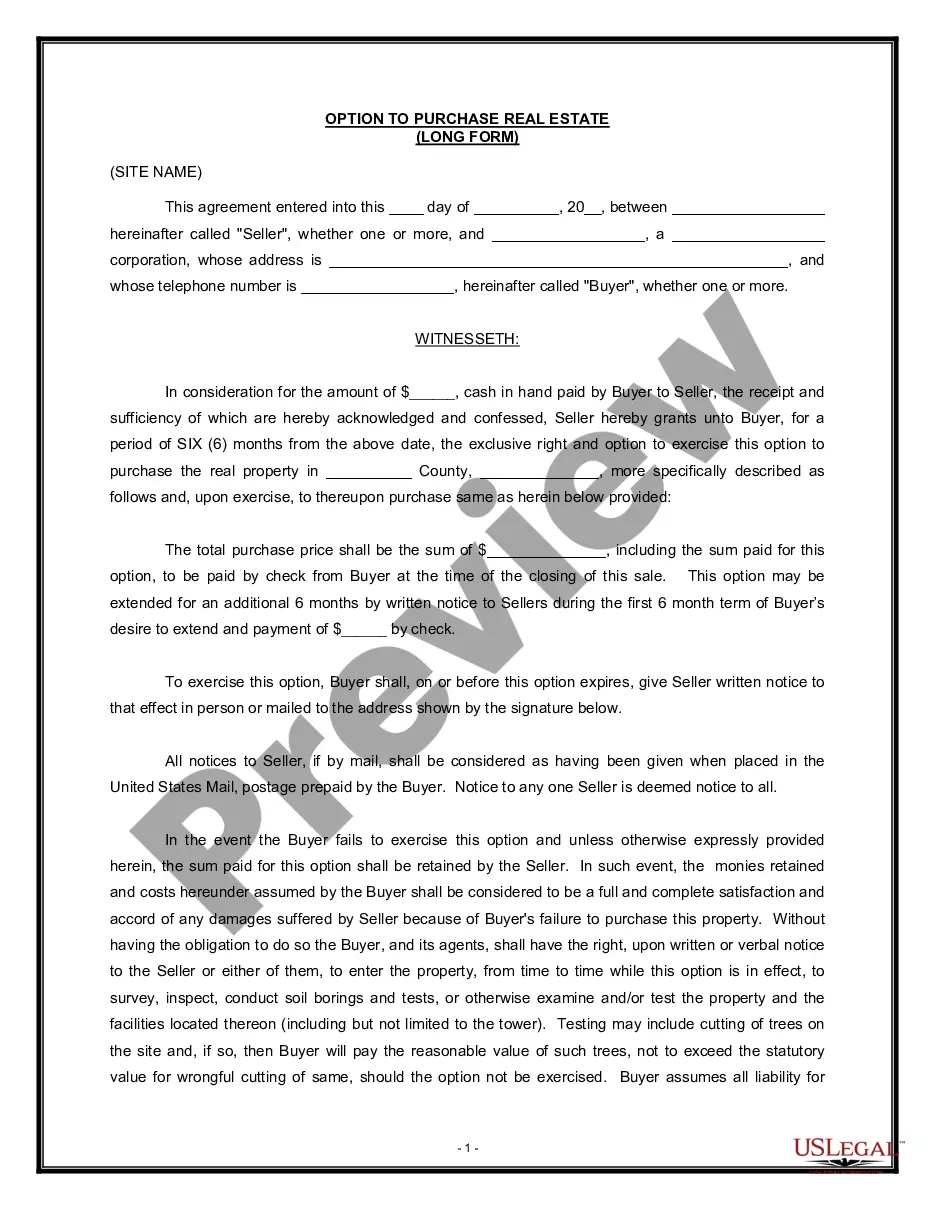
- Identify the parties: Enter the names and addresses of both the seller and purchaser in the designated areas.
- Specify the shares: Indicate the number of shares and the purchase price per share in the respective sections.
- Set the exercise date: Choose a date by which the purchaser must exercise the option and fill it out in the provided field.
- Complete payment details: State how payment will be made upon exercising the option.
- Sign the agreement: Ensure both parties sign and date the agreement to make it legally binding.
Is notarization required?
This form does not typically require notarization unless specified by local law. However, having the agreement notarized may add an extra layer of legitimacy and can be beneficial if disputes arise.
Get your form ready online
Our built-in tools help you complete, sign, share, and store your documents in one place.
Make edits, fill in missing information, and update formatting in US Legal Forms—just like you would in MS Word.
Download a copy, print it, send it by email, or mail it via USPS—whatever works best for your next step.
Sign and collect signatures with our SignNow integration. Send to multiple recipients, set reminders, and more. Go Premium to unlock E-Sign.
If this form requires notarization, complete it online through a secure video call—no need to meet a notary in person or wait for an appointment.
We protect your documents and personal data by following strict security and privacy standards.

Make edits, fill in missing information, and update formatting in US Legal Forms—just like you would in MS Word.

Download a copy, print it, send it by email, or mail it via USPS—whatever works best for your next step.

Sign and collect signatures with our SignNow integration. Send to multiple recipients, set reminders, and more. Go Premium to unlock E-Sign.

If this form requires notarization, complete it online through a secure video call—no need to meet a notary in person or wait for an appointment.

We protect your documents and personal data by following strict security and privacy standards.
Common mistakes
Common mistakes to avoid when using this form include:
- Failing to accurately complete all fields, particularly those regarding the number of shares and purchase price.
- Neglecting to specify the deadlines for exercising the option, which can lead to confusion.
- Forgetting to sign the document, rendering it unenforceable.
- Overlooking adjustments for non-cash dividends and changes in shares, which can affect the agreement's validity.
Why complete this form online
Benefits of using this form online include:
- Easy access: Downloadable at your convenience, allowing you to complete it anytime.
- Editability: The form can be modified to suit specific needs and circumstances.
- Reliability: Created by licensed attorneys to ensure compliance with legal standards.
Summary of main points
Key takeaways regarding the Option to Purchase Stock - Long Form:
- This form provides a structured agreement for purchasing stock options, detailing rights, obligations, and procedures.
- It is essential for both sellers and purchasers to complete all sections accurately to avoid potential disputes.
- Consulting legal counsel is advisable to ensure that the form complies with applicable laws in your jurisdiction.
Looking for another form?

Form popularity
FAQ
Having a long position in a security means that you own the security.A "short" position is generally the sale of a stock you do not own. Investors who sell short believe the price of the stock will decrease in value. If the price drops, you can buy the stock at the lower price and make a profit.
Long options are any options, calls or puts that you pay for in order to acquire. When you purchase an option, payment is called a debit and you're considered to be long, as opposed to short options which are those option positions that you sold, or wrote, and for which you received cash (and termed a credit).
A stock option is the right to buy a specific number of shares of company stock at a pre-set price, known as the exercise or strike price, for a fixed period of time, usually following a predetermined waiting period, called the vesting period. Most vesting periods span follow three to five years, with a certain
Statutory Stock Options You have taxable income or deductible loss when you sell the stock you bought by exercising the option. You generally treat this amount as a capital gain or loss. However, if you don't meet special holding period requirements, you'll have to treat income from the sale as ordinary income.
If you've held the stock or option for less than one year, your sale will result in a short-term gain or loss, which will either add to or reduce your ordinary income. Options sold after a one year or longer holding period are considered long-term capital gains or losses.
According to the stock option agreement, there is a particular time period, within which you should exercise your options or else they will expire (typically 10 years). If you leave the company for a new job, retire, or get laid off, then you typically have a window of 90 days to exercise your options.
One contract is equal to 100 shares of the underlying stock. Using the previous example, a trader decides to buy five call contracts.If the stock rises above $150 by the expiration date, the trader would have the option to exercise or buy 500 shares of IBM's stock at $150, regardless of the current stock price.
If you exercised nonqualified stock options (NQSOs) last year, you may mistakenly double-report income on your tax return if you do not realize that the income in Box 1 of your Form W-2 already includes the option exercise income.
If you've held the stock or option for less than one year, your sale will result in a short-term gain or loss, which will either add to or reduce your ordinary income. Options sold after a one year or longer holding period are considered long-term capital gains or losses.