Tooling Agreement
Overview of this form
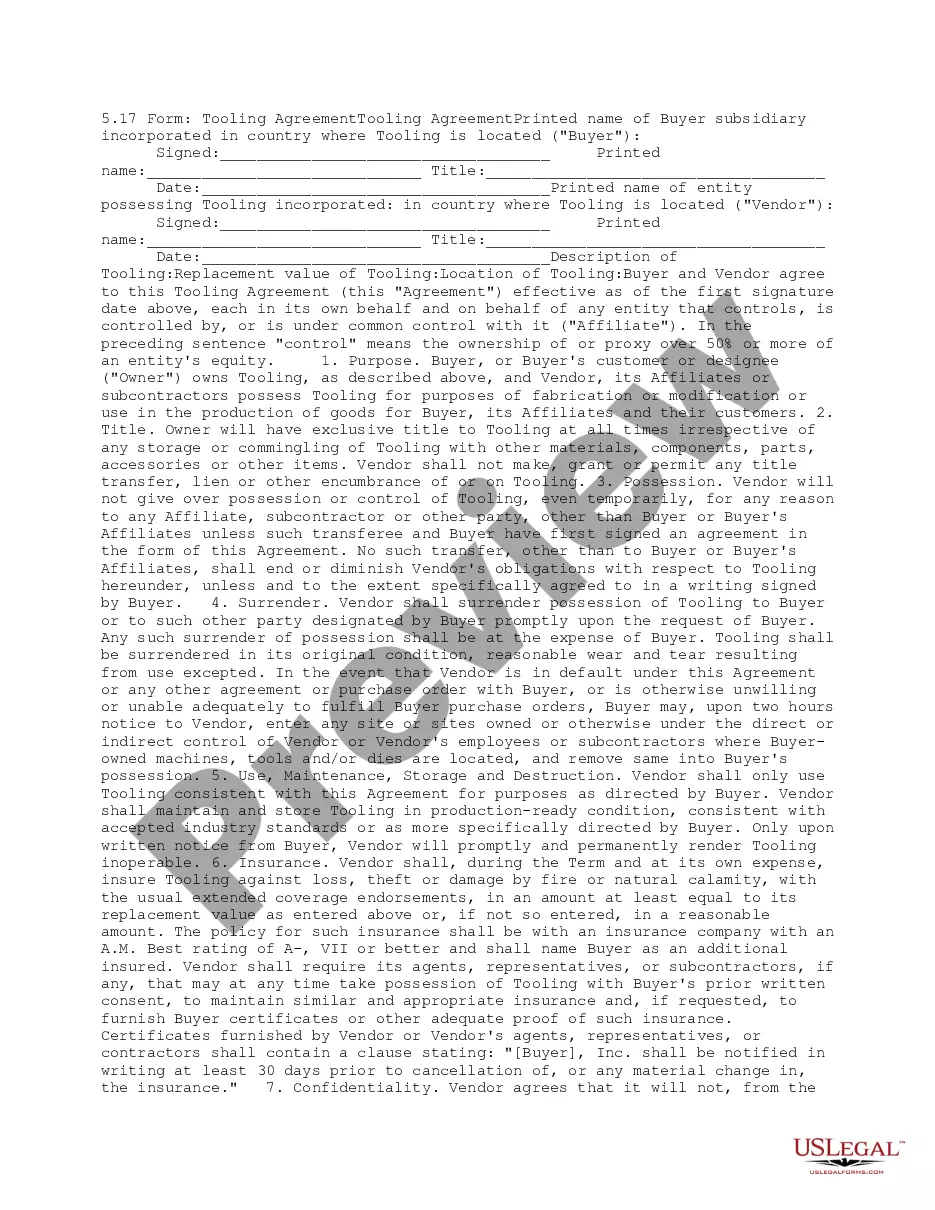
A tooling agreement is a legal document that outlines the relationship between a buyer and a vendor regarding the possession and use of tooling. This agreement details essential aspects such as the description of the tooling, its replacement value, and its location. Unlike other contracts, the tooling agreement focuses specifically on the terms of ownership and control of specialized tools required for manufacturing or production processes. It ensures that the buyer retains exclusive rights to the tooling while setting standards for its maintenance and use by the vendor.
Key components of this form
- Identification of Buyer and Vendor, including their printed names and titles.
- Description of the tooling along with its replacement value and location.
- Exclusive title clause indicating the buyer's ownership rights.
- Possession clause specifying that the vendor cannot transfer tooling to third parties.
- Maintenance obligations outlining how the vendor should care for the tooling.
- Insurance requirements for safeguarding the tooling against loss or damage.
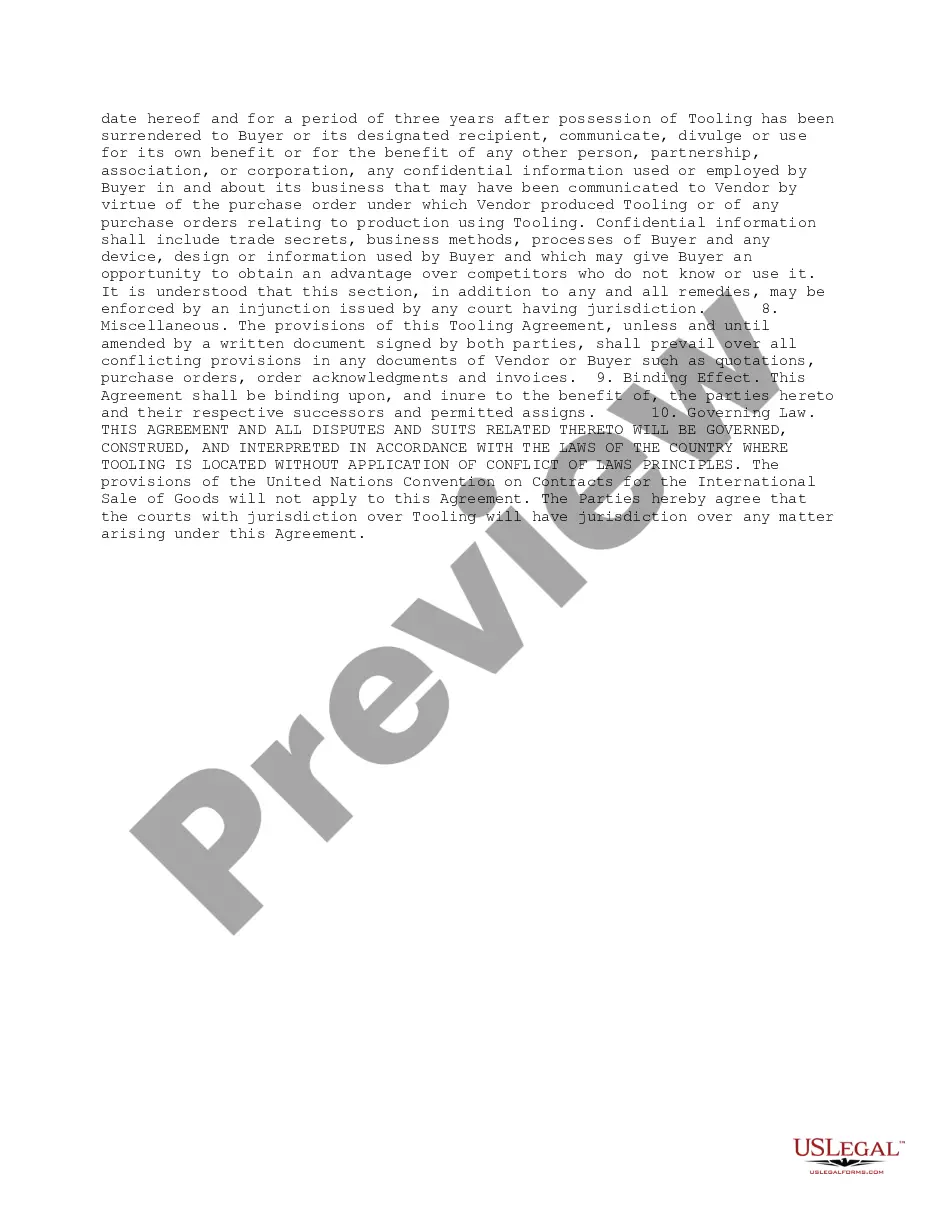
- Confidentiality agreement protecting sensitive information related to the tooling.
When this form is needed
This tooling agreement should be used when a buyer and a vendor engage in a business relationship involving the use of specialized tooling for production. It is particularly relevant when the buyer needs to ensure that the tooling they provide is maintained appropriately and used solely for their purposes. Common scenarios include manufacturing contracts, where tooling is necessary for creating goods, or when modifications to existing tooling are required.
Who can use this document
This form is suitable for:
- Manufacturers seeking to protect their investment in tooling.
- Vendors responsible for using or maintaining tooling provided by a buyer.
- Businesses involved in production processes that require precise oversight of tooling ownership and usage.
- Any party entering a contractual agreement where tooling will be involved in the fulfillment of orders or services.
How to prepare this document
- Identify the parties involved by entering the printed names and titles of the Buyer and Vendor.
- Provide a clear description of the tooling along with its replacement value and location.
- Ensure both parties sign and date the agreement to make it legally binding.
- Review and understand each clause regarding ownership, possession, and maintenance obligations.
- Discuss and agree on confidentiality terms to protect sensitive information shared during the partnership.
Notarization requirements for this form
This form usually doesn’t need to be notarized. However, local laws or specific transactions may require it. Our online notarization service, powered by Notarize, lets you complete it remotely through a secure video session, available 24/7.
Get your form ready online
Our built-in tools help you complete, sign, share, and store your documents in one place.
Make edits, fill in missing information, and update formatting in US Legal Forms—just like you would in MS Word.
Download a copy, print it, send it by email, or mail it via USPS—whatever works best for your next step.
Sign and collect signatures with our SignNow integration. Send to multiple recipients, set reminders, and more. Go Premium to unlock E-Sign.
If this form requires notarization, complete it online through a secure video call—no need to meet a notary in person or wait for an appointment.
We protect your documents and personal data by following strict security and privacy standards.

Make edits, fill in missing information, and update formatting in US Legal Forms—just like you would in MS Word.

Download a copy, print it, send it by email, or mail it via USPS—whatever works best for your next step.

Sign and collect signatures with our SignNow integration. Send to multiple recipients, set reminders, and more. Go Premium to unlock E-Sign.

If this form requires notarization, complete it online through a secure video call—no need to meet a notary in person or wait for an appointment.

We protect your documents and personal data by following strict security and privacy standards.
Mistakes to watch out for
- Failing to clearly identify all parties and their roles.
- Neglecting to include the tooling description or its replacement value.
- Not reviewing the maintenance and possession clauses thoroughly.
- Forgetting to sign and date the agreement.
- Overlooking confidentiality obligations that may affect operations in the future.
Advantages of online completion
- Convenient access to professionally drafted forms tailored for legal clarity.
- Editable templates that allow customization to fit specific business needs.
- Instant download and easy completion can save time and resources.
- Increased reliability and accuracy with legally vetted formats.
Looking for another form?
Form popularity
FAQ
A tolling agreement is a written agreement, signed by both sides to a potential lawsuit, that suspends the statute of limitations for an agreed amount of time.With the limitations period suspended, the parties can have the time they need to negotiate and settle the dispute.
A supply agreement states the terms and conditions under which one company will manufacture and supply goods to another. A supply contract may be exclusive or non-exclusive, include standards on product quality, and should state how product orders will be handled.
Tooling refers to building the different types of components and machinery needed for production, like molds, jigs, and fixtures. Effective tooling ensures that manufactured products function properly, extends the product lifecycle, and makes for a higher quality product overall.
A tooling agreement is very similar to a bailment or loan situation. Similar to a bailment you want: > You want the tool to be identified as your property. This is done to protect it in the event the supplier went bankrupt.
Noun. work done with a tool or tools; tooled ornamentation, as on wood, stone, or leather. Machinery. a number of tools, as in a particular factory.
Tooling preparations cost quoted by forgers generally includes the cost of designing and manufacturing the tools used to produce the forging. It also includes the cost of special gauges and fixtures. Tooling cost varies with a number of factors, the most important being the forging process.
Noun. work done with a tool or tools; tooled ornamentation, as on wood, stone, or leather. Machinery. a number of tools, as in a particular factory. the planning and arrangement of tools for a particular manufacturing process.
Tooling, also known as machine tooling, is the process of acquiring the manufacturing components and machines needed for production. The common categories of machine tooling include fixtures, jigs, gauges, molds, dies, cutting equipment and patterns.
To put it simply, tooling is the backbone of the physical production of a product.The term tooling refers to any number of implements required to produce a product.