Medicaid Myths
Understanding this form
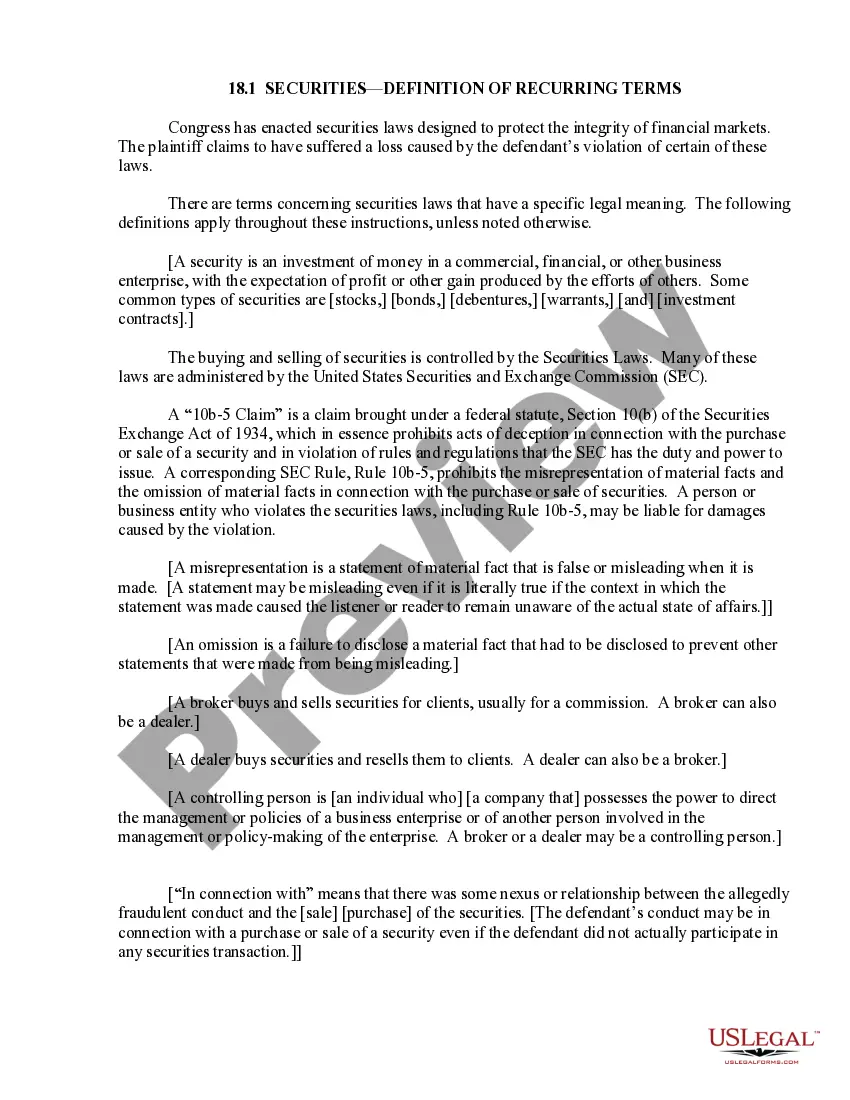
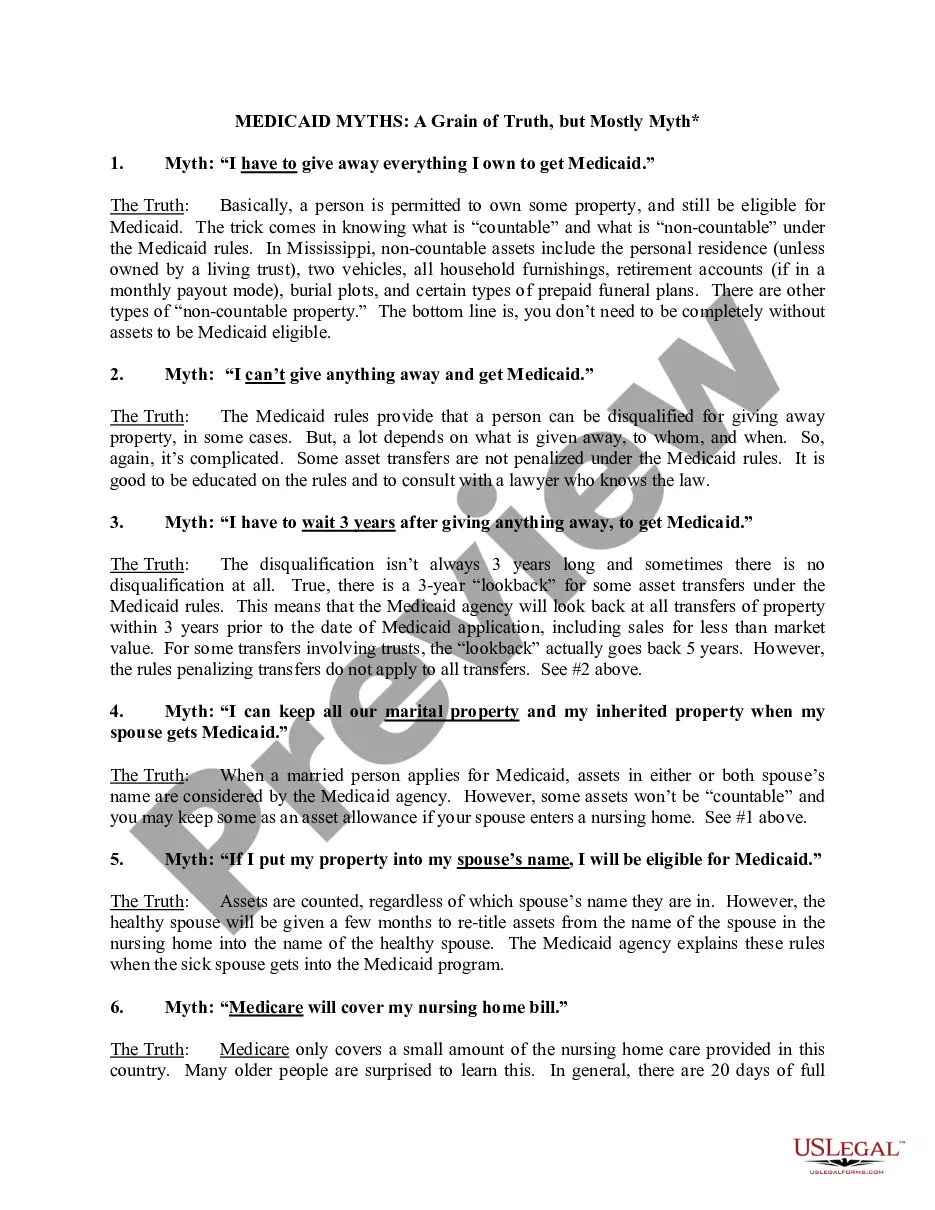
The Medicaid Myths form is an informational handout designed to explain and debunk common misconceptions about obtaining Medicaid benefits. This resource is essential for individuals seeking to understand the intricacies of Medicaid eligibility and the rules that govern asset ownership and transfer, making it distinct from other legal documents related to Medicaid applications or planning.
What’s included in this form
- Common myths surrounding Medicaid eligibility.
- Clarifications on asset ownership and transfers under Medicaid rules.
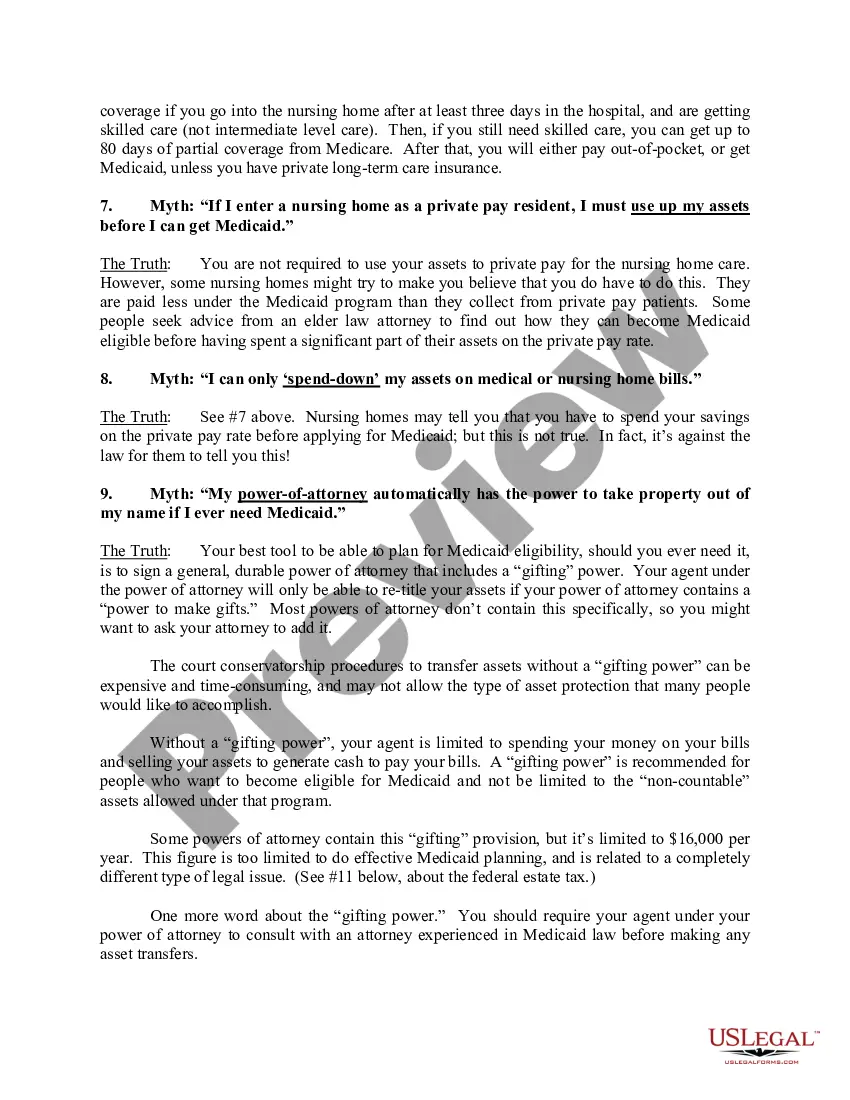
- Information on penalties associated with giving away property.
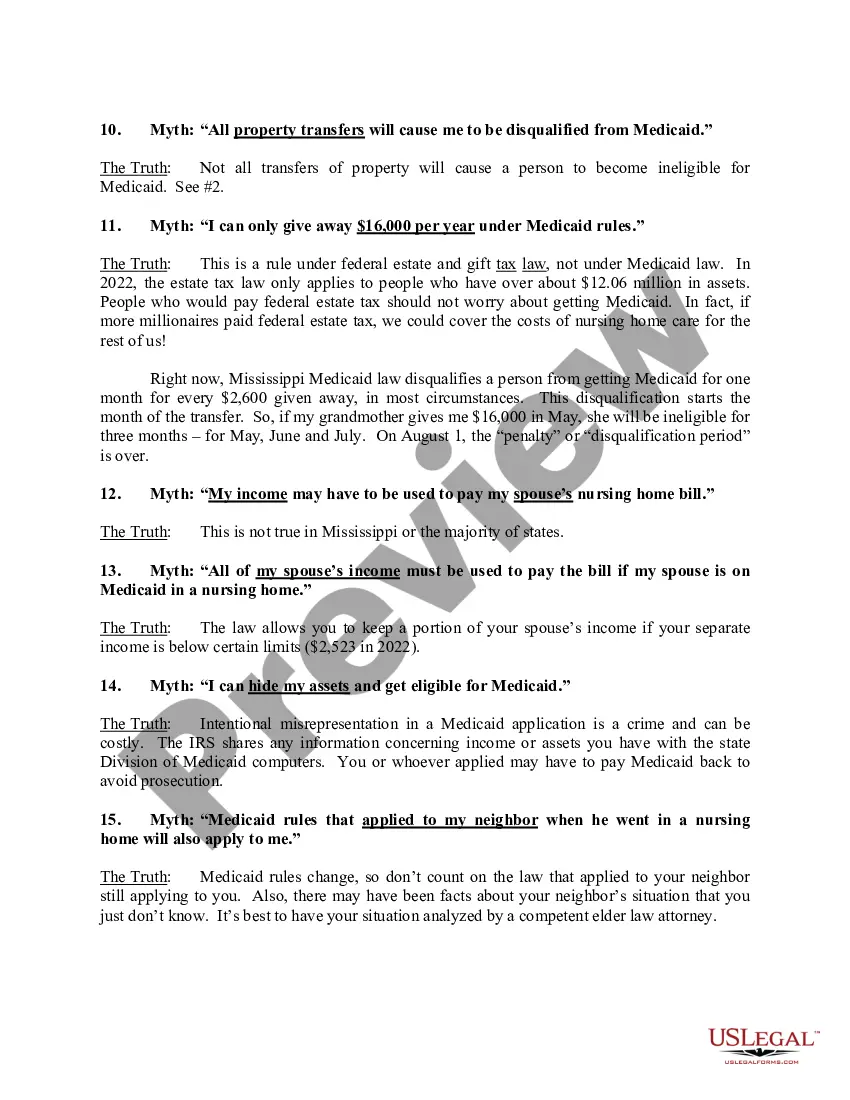
- Insights into spouse asset allowances and income regulations.
- Guidance on the necessity of a power of attorney for Medicaid planning.
When this form is needed
This form should be used by individuals or families who are considering applying for Medicaid benefits and want to ensure they have accurate information regarding the eligibility process. It is particularly useful when planning for long-term care, discussing asset transfers, or addressing misunderstandings about what can be retained during the Medicaid application process.
Intended users of this form
- Individuals aged 65 or older seeking long-term care.
- Caregivers or family members assisting someone applying for Medicaid.
- Anyone feeling confused about Medicaid eligibility rules and asset management.
- Those looking to consult with an elder law attorney for personalized advice.
Instructions for completing this form
- Review the myths presented and compare them against your current understanding of Medicaid rules.
- Identify which myths may apply to your situation by cross-referencing with your assets and income.
- Consult with a licensed attorney experienced in Medicaid law for any clarifications needed.
- Discuss potential asset transfers or planning with family or caregivers.
- Keep this document accessible for reference during the Medicaid application process.
Does this document require notarization?
This form does not typically require notarization to be legally valid. However, some jurisdictions or document types may still require it. US Legal Forms provides secure online notarization powered by Notarize, available 24/7 for added convenience.
Get your form ready online
Our built-in tools help you complete, sign, share, and store your documents in one place.
Make edits, fill in missing information, and update formatting in US Legal Forms—just like you would in MS Word.
Download a copy, print it, send it by email, or mail it via USPS—whatever works best for your next step.
Sign and collect signatures with our SignNow integration. Send to multiple recipients, set reminders, and more. Go Premium to unlock E-Sign.
If this form requires notarization, complete it online through a secure video call—no need to meet a notary in person or wait for an appointment.
We protect your documents and personal data by following strict security and privacy standards.

Make edits, fill in missing information, and update formatting in US Legal Forms—just like you would in MS Word.

Download a copy, print it, send it by email, or mail it via USPS—whatever works best for your next step.

Sign and collect signatures with our SignNow integration. Send to multiple recipients, set reminders, and more. Go Premium to unlock E-Sign.

If this form requires notarization, complete it online through a secure video call—no need to meet a notary in person or wait for an appointment.

We protect your documents and personal data by following strict security and privacy standards.
Common mistakes to avoid
- Assuming all assets must be given away to qualify for Medicaid.
- Not consulting with a qualified attorney before making asset transfers.
- Believing that all family income contributes to the nursing home's costs without understanding the allowances.
- Ignoring the rules' variations across different states.
Why use this form online
- Immediate access to vital information without the need for an appointment.
- Easy reference for future queries regarding Medicaid eligibility.
- Conveniently downloadable for personal review and planning sessions.
Legal use & context
This form provides crucial information that can assist individuals in navigating the complex Medicaid application process. While the myths clarified in this document hold significant value, they should not replace personalized legal advice tailored to individual circumstances.
Summary of main points
- Many misconceptions exist regarding Medicaid eligibility and asset management.
- Understanding the rules can help preserve assets while applying for benefits.
- Consulting with an expert helps clarify nuances specific to your situation.
- Medicaid rules can vary greatly between states; local legal advice is essential.
Definitions you should know
- Countable assets: Assets considered by Medicaid when determining eligibility.
- Non-countable assets: Assets not included in Medicaid eligibility calculations, such as a personal residence or certain retirement funds.
- Lookback period: The timeframe during which Medicaid reviews asset transfers to determine eligibility.
- Power of attorney (POA): A legal document allowing someone to act on anotherâs behalf, often including financial decision-making powers.
Looking for another form?
Form popularity
FAQ
Federal Poverty Level thresholds to qualify for Medicaid In 2023 these limits are: $14,580 for a single adult person, $30,000 for a family of four and $50,560 for a family of eight. To calculate for larger households, you need to add $5,140 for each additional person in families with nine or more members.
One study found that expansion was associated with an 18% increase in aggregate opioid admissions to specialty treatment facilities, nearly all of which was driven by a 113% increase in admissions from Medicaid beneficiaries.
Cons Members are responsible for copayments and deductibles. May require referrals to see a specialist. The provider network limits the choice of doctors/hospitals and doctors may not accept certain Medicare Advantage plans. Members are required to pay full price for services outside the provider network.
Disadvantages of Medicaid Lower reimbursements and reduced revenue. Every medical practice needs to make a profit to stay in business, but medical practices that have a large Medicaid patient base tend to be less profitable.Administrative overhead.Extensive patient base.Medicaid can help get new practices established.
Liberals view Medicaid as diverting the Nation's attention from the need for national health insurance. They are troubled by the fact that the program covers less than one-half the Nation's poor and that there are substantial variations in State Medicaid programs.
One challenge in aligning these programs is the inconsistent, and sometimes contradictory, payment strategies used in Medicare and Medicaid. State Medicaid programs are federally required to provide a broad range of services, including benefits not covered by Medicare, such as long-term services and supports.