Texas Codicil to Will Form for Amending Your Will - Will Changes or Amendments
Overview of this form
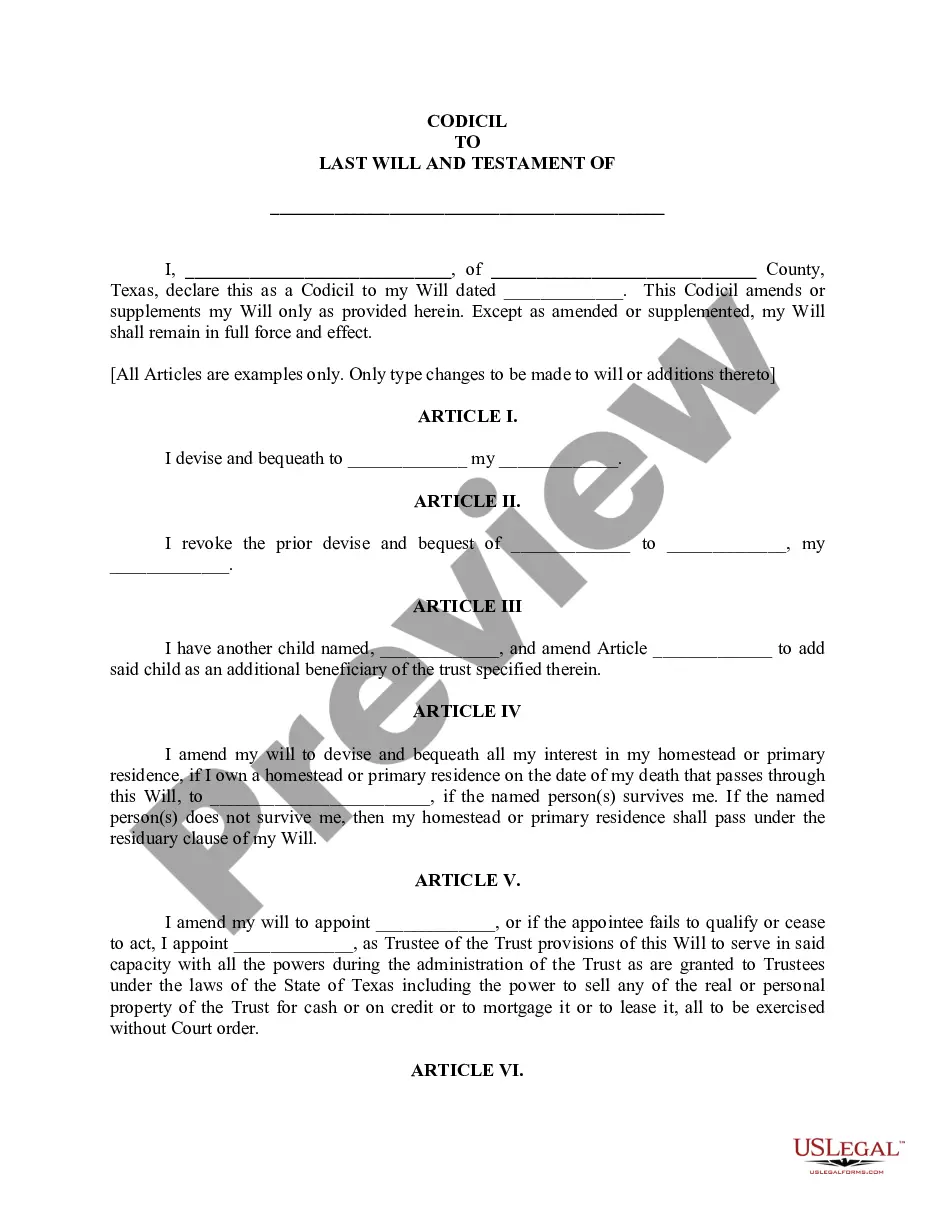
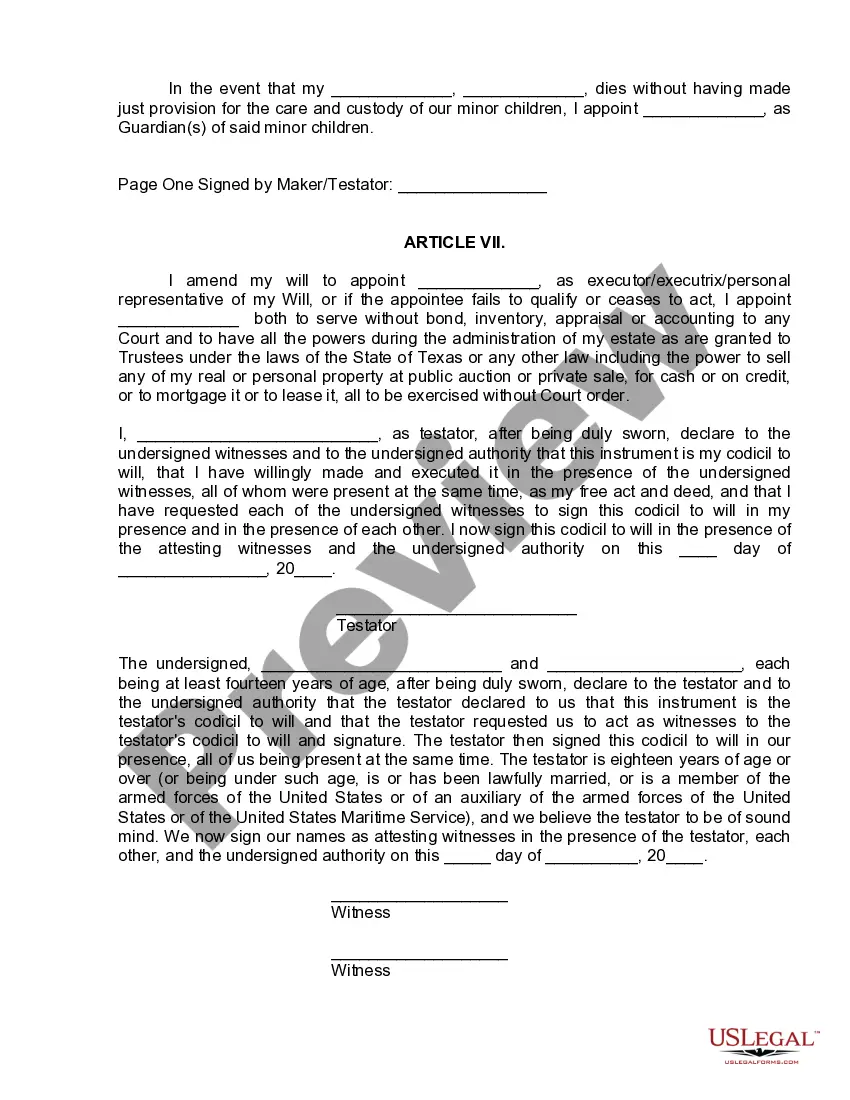
The Codicil to Will Form for Amending Your Will allows individuals to make specific changes to an existing will without needing to draft an entirely new document. This form serves as a legal amendment, ensuring that the original will remains valid except for the changes stated in the codicil. By using this form, individuals can easily update their estate plans in compliance with estate laws.
What’s included in this form
- Declaration of the codicil and the original will's date.
- Provisions for specific amendments, additions, or revocations to the existing will.
- Details regarding the beneficiaries and bequests.
- Appointment of guardians for minor children, if applicable.
- Signature lines for the testator and witnesses, ensuring legal compliance.

When to use this document
This form is applicable in various scenarios where an individual wishes to amend their will rather than creating a new one. For instance, if you wish to add a new beneficiary, change the executor, or update the guardianship provisions for minors, a codicil is a suitable option. It is a convenient choice for those who wish to make minor adjustments to their estate plan without the need to draft an entirely new will.
Who needs this form
This form is designed for:
- Individuals who have an existing will needing amendments.
- People looking to include new family members or adjust bequests.
- Anyone wanting to update their estate planning documents to reflect life changes.
How to prepare this document
To complete this form, follow these steps:
- Fill in your name and the county of residence at the beginning of the form.
- Specify the date of your original will.
- Clearly detail the changes you wish to make, including any new beneficiaries or revocations.
- Designate guardians for minor children if necessary.
- Ensure you and your witnesses sign and date the form in the appropriate sections.
Does this form need to be notarized?
This form does not typically require notarization unless specified by local law. Make sure to check local regulations to ensure compliance with specific requirements in your jurisdiction.
Get your form ready online
Our built-in tools help you complete, sign, share, and store your documents in one place.
Make edits, fill in missing information, and update formatting in US Legal Forms—just like you would in MS Word.
Download a copy, print it, send it by email, or mail it via USPS—whatever works best for your next step.
Sign and collect signatures with our SignNow integration. Send to multiple recipients, set reminders, and more. Go Premium to unlock E-Sign.
If this form requires notarization, complete it online through a secure video call—no need to meet a notary in person or wait for an appointment.
We protect your documents and personal data by following strict security and privacy standards.

Make edits, fill in missing information, and update formatting in US Legal Forms—just like you would in MS Word.

Download a copy, print it, send it by email, or mail it via USPS—whatever works best for your next step.

Sign and collect signatures with our SignNow integration. Send to multiple recipients, set reminders, and more. Go Premium to unlock E-Sign.

If this form requires notarization, complete it online through a secure video call—no need to meet a notary in person or wait for an appointment.

We protect your documents and personal data by following strict security and privacy standards.
Avoid these common issues
- Failing to clearly specify what amendments are being made to the original will.
- Not including all necessary signatures or witnesses.
- Neglecting to date the codicil properly.
Benefits of using this form online
- You can easily download and customize the form to suit your specific needs.
- This form ensures compliance with Texas laws, reducing the risk of legal issues.
- Using this codicil allows for quick and efficient amendments to your will.
Legal use & context
The Codicil to Will Form is legally binding and enforceable in Texas, provided it is executed properly. Adhering to state laws ensures that amendments to your will are valid and can be upheld in court, making it an essential tool for estate planning.
Key takeaways
- A codicil allows effective amendments to an existing will without drafting a new one.
- This form is specifically designed for Texas residents and incorporates state-specific legal requirements.
- Completing this form correctly can help prevent disputes and ensure your estate wishes are honored.
Looking for another form?


Form popularity
FAQ
The Texas Codicil to Will Form for Amending Your Will is a legal amendment that lets you make specific changes to an existing will without drafting a new one. It records the codicil and the original will’s date, lists the exact amendments, and includes signature lines for the testator and witnesses to keep the will valid with the stated changes. Use it to add beneficiaries, adjust bequests, or update guardians as life changes warrant.
Not required, but advisable if changes are complex. This form provides a standardized codicil structure—the declaration, the original will’s date, specific amendments, details on beneficiaries and bequests, and guardians for minors, plus witness signatures—so a straightforward update can be done without a lawyer. For complicated estates, consult an attorney to ensure the codicil aligns with the original will.
Yes. The Texas Codicil to Will Form for Amending Your Will is designed to be downloaded and used to amend an existing will. It consolidates the codicil declaration, the specific amendments, and witness signatures in one document, helping you update your estate plan without drafting a whole new will.
Not necessarily. The form requires the testator and witnesses to sign; notarization is not shown as required in the form components. In Texas, witnessed execution is typically sufficient for a codicil, though notarization or a self-proving affidavit may be helpful in some situations. Consider consulting an attorney for your circumstances.
Use the Texas Codicil to Will Form for Amending Your Will: complete the codicil declaration and reference the original will’s date, specify the changes to be made, confirm the intended beneficiaries or guardians, and sign with witnesses as required. The document amends the existing will without invalidating it.
This form amends only specific provisions in an existing will rather than drafting a brand-new document. It requires a codicil declaration, references the original will, lists exact amendments (additions, revocations, or changes), and includes signatures by the testator and witnesses, leaving the rest of the will unchanged.