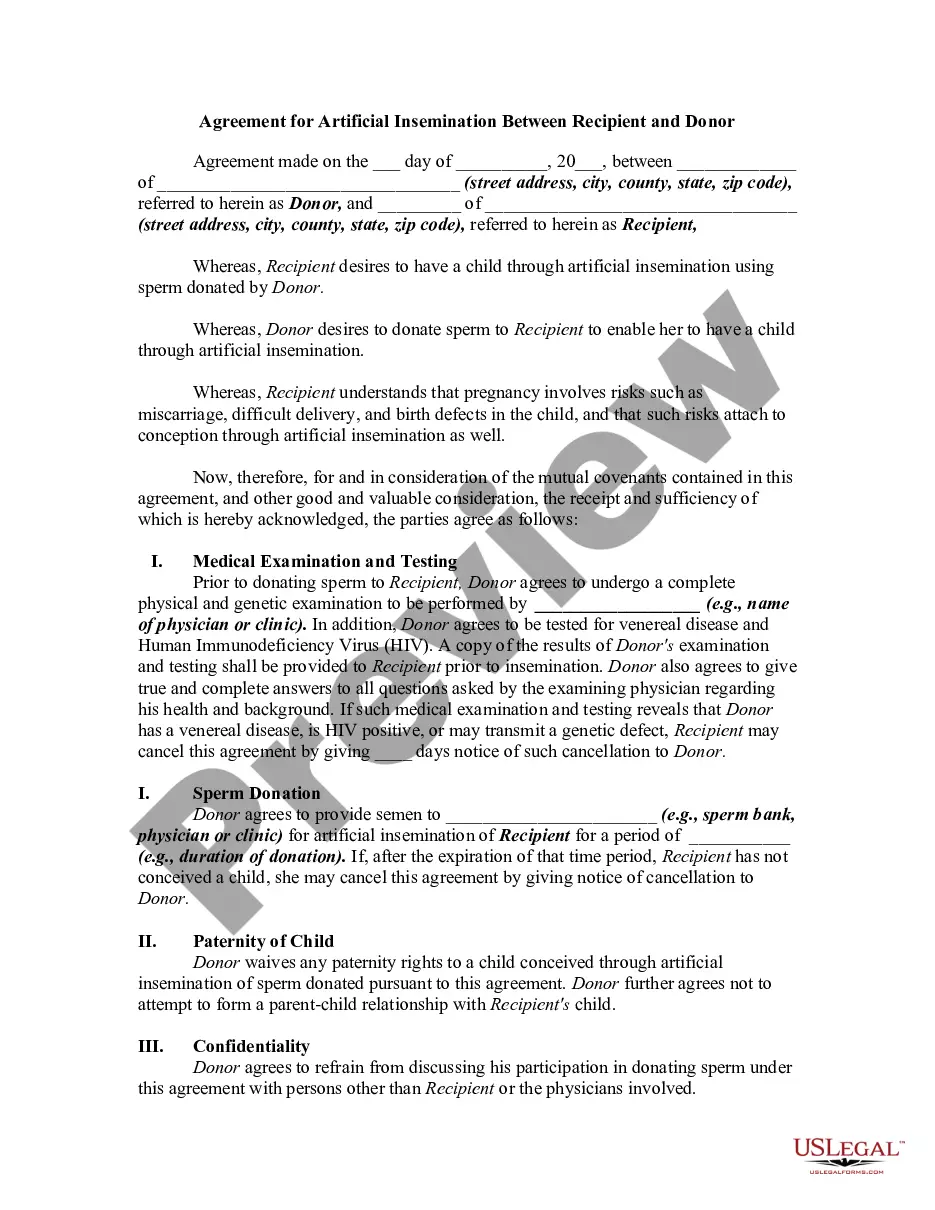
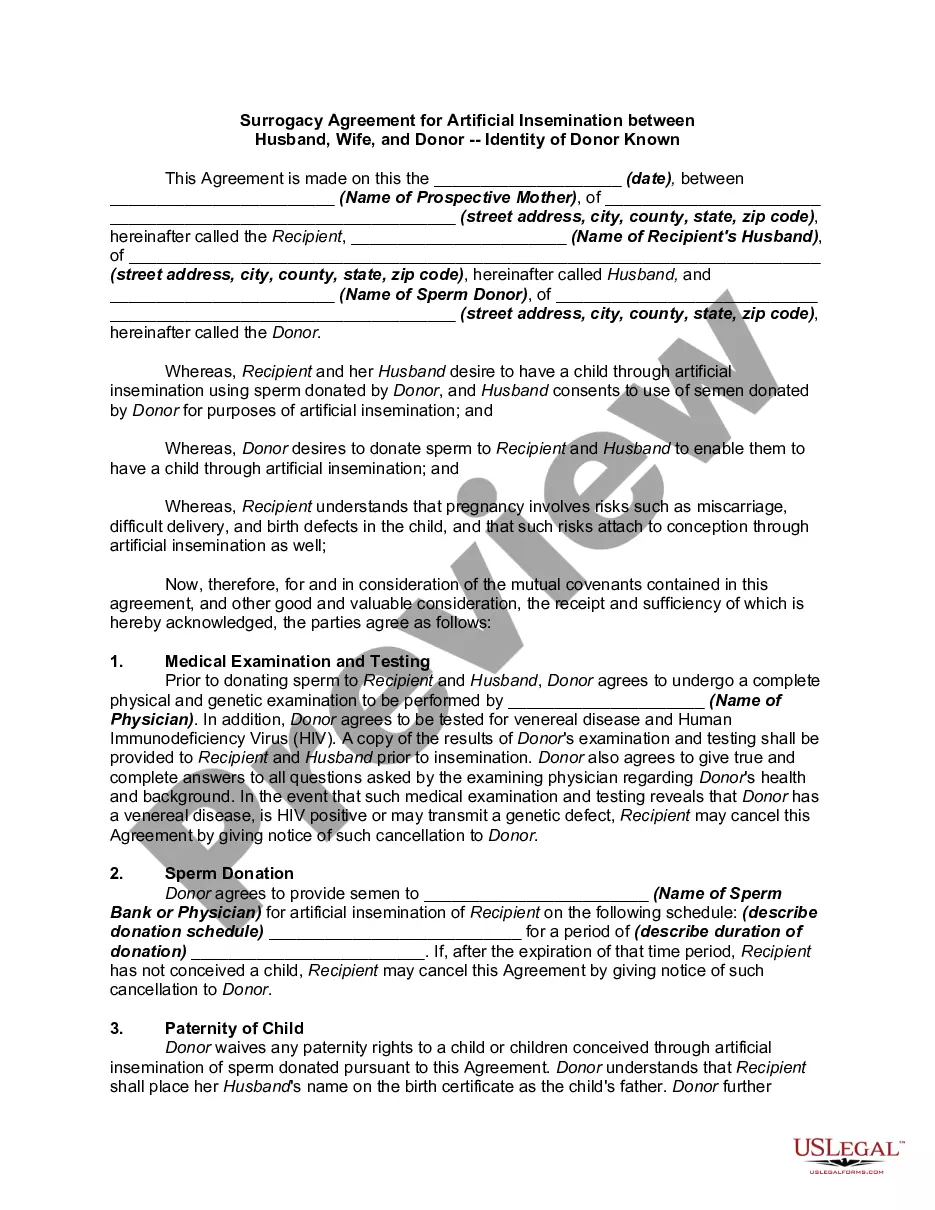
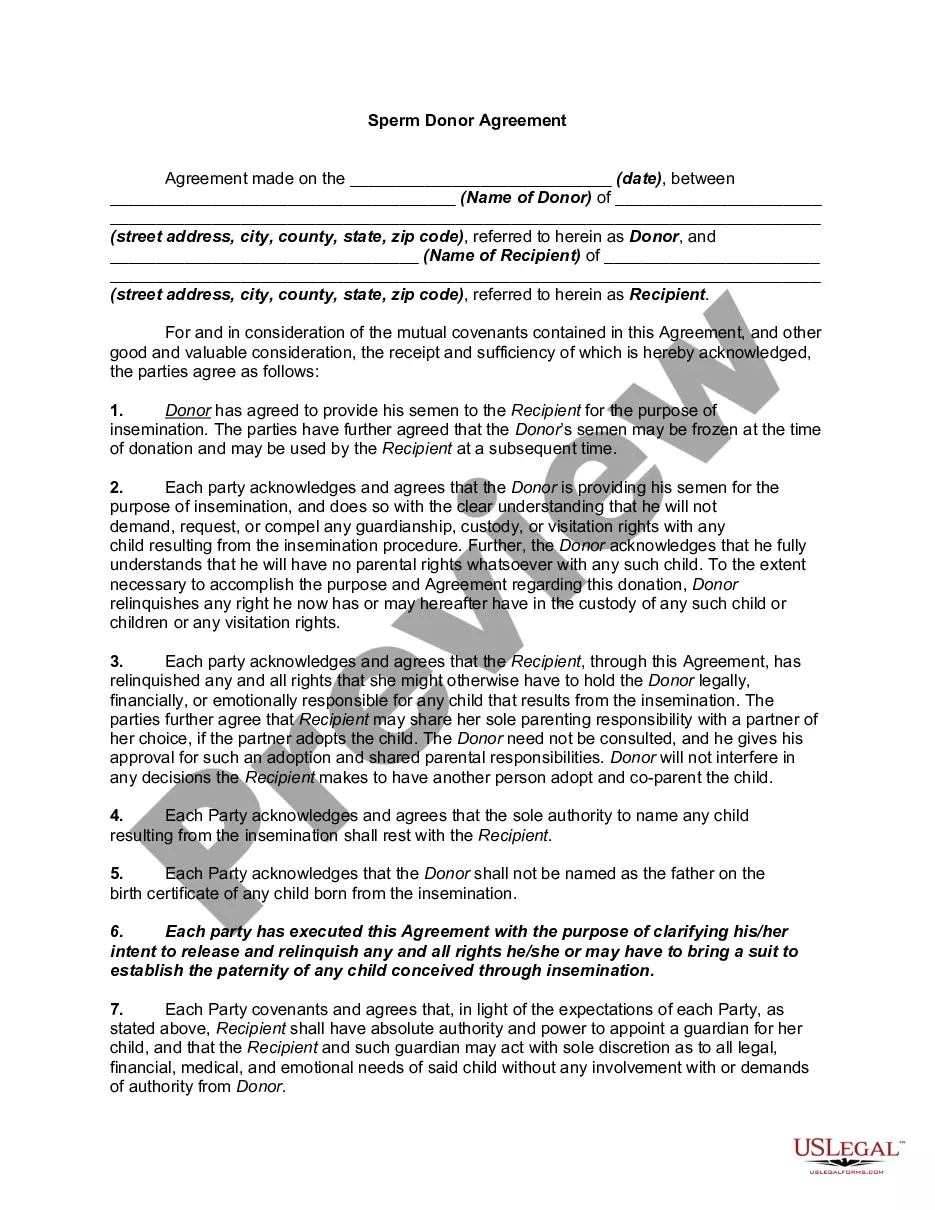
Texas Agreement for Artificial Insemination Between Recipient and Donor
Description
Get your form ready online
Our built-in tools help you complete, sign, share, and store your documents in one place.
Make edits, fill in missing information, and update formatting in US Legal Forms—just like you would in MS Word.
Download a copy, print it, send it by email, or mail it via USPS—whatever works best for your next step.
Sign and collect signatures with our SignNow integration. Send to multiple recipients, set reminders, and more. Go Premium to unlock E-Sign.
If this form requires notarization, complete it online through a secure video call—no need to meet a notary in person or wait for an appointment.
We protect your documents and personal data by following strict security and privacy standards.

Make edits, fill in missing information, and update formatting in US Legal Forms—just like you would in MS Word.

Download a copy, print it, send it by email, or mail it via USPS—whatever works best for your next step.

Sign and collect signatures with our SignNow integration. Send to multiple recipients, set reminders, and more. Go Premium to unlock E-Sign.

If this form requires notarization, complete it online through a secure video call—no need to meet a notary in person or wait for an appointment.

We protect your documents and personal data by following strict security and privacy standards.
Looking for another form?

How to fill out Agreement For Artificial Insemination Between Recipient And Donor?
Selecting the optimal authorized document template can be a challenge. Naturally, there is a multitude of templates available online, but how can you locate the legal form you need? Utilize the US Legal Forms website.
The service offers a vast array of templates, including the Texas Agreement for Artificial Insemination Between Recipient and Donor, which can be utilized for business and personal requirements. All the forms are vetted by experts and comply with federal and state regulations.
If you are currently registered, sign in to your account and click on the Download button to access the Texas Agreement for Artificial Insemination Between Recipient and Donor. Use your account to browse the legal forms you have previously acquired. Go to the My documents section of your account and download another copy of the document you need.
Choose the file format and download the legal document template to your device. Complete, edit, print, and sign the acquired Texas Agreement for Artificial Insemination Between Recipient and Donor. US Legal Forms is the largest repository of legal forms where you can find a variety of document templates. Use the service to download professionally crafted documents that meet state requirements.
- If you are a new user of US Legal Forms, here are some straightforward steps for you to follow.
- First, ensure that you have selected the correct form for your jurisdiction.
- You can review the form using the Preview button and read the form description to confirm it is suitable for your needs.
- If the form doesn't meet your requirements, use the Search field to find the appropriate form.
- Once you are confident that the form is right, click the Get now button to obtain the form.
- Select the pricing option you prefer and enter the necessary information. Create your account and place your order using your PayPal account or credit card.
Form popularity
FAQ
In the context of the Texas Agreement for Artificial Insemination Between Recipient and Donor, it is essential to establish clear terms regarding parental rights. Generally, donors do not have parental rights if the agreement is properly executed and complies with state laws. This document outlines the rights and responsibilities of each party involved, protecting the interests of both the recipient and the donor. By using a well-crafted Texas Agreement for Artificial Insemination Between Recipient and Donor, you can ensure that all parties understand their roles and obligations.
In Texas, the requirements to donate involve several key factors. Potential donors must be at least 18 years old and must undergo health screenings to ensure they are suitable candidates. Additionally, you will need to review and sign a Texas Agreement for Artificial Insemination Between Recipient and Donor, which outlines your rights and responsibilities. This agreement is essential to ensure all parties understand the process and expectations.
Yes, height is not a prohibitive factor for becoming a donor in Texas. The Texas Agreement for Artificial Insemination Between Recipient and Donor focuses more on health, genetics, and compatibility rather than specific physical traits. Therefore, if you meet the health criteria and have completed the necessary screenings, you can proceed with the donation process.
A known donor agreement in Texas refers to an arrangement between a donor and a recipient who are familiar with one another. This type of agreement, specified in the Texas Agreement for Artificial Insemination Between Recipient and Donor, outlines the rights and responsibilities of each party. By detailing these elements, the agreement helps to prevent potential disputes in the future.
The procedure for artificial insemination typically involves several key steps. First, both the recipient and the donor should sign the Texas Agreement for Artificial Insemination Between Recipient and Donor, establishing their rights and expectations. Following that, medical professionals perform screenings, after which the insemination process takes place, ensuring a systematic approach for all parties involved.
Donors in Texas must adhere to regulations that emphasize health screening and informed consent. The Texas Agreement for Artificial Insemination Between Recipient and Donor ensures that donors understand their obligations, including potential responsibilities towards any resulting children. By completing a thorough evaluation, both parties can approach the donation process with confidence.
In Texas, any individual wishing to be a donor must follow specific guidelines established by state law. According to the Texas Agreement for Artificial Insemination Between Recipient and Donor, donors must be aware of both medical screening and legal responsibilities. Additionally, proper documentation and consent forms are crucial to ensure the rights and responsibilities of all parties are clear.
Under the Texas Agreement for Artificial Insemination Between Recipient and Donor, donors typically do not carry child support obligations. This agreement legally establishes that the donor does not have parental rights or responsibilities towards the child conceived through artificial insemination. However, individual circumstances can vary, so it’s important to consult with a legal expert familiar with these agreements. Utilizing platforms like uslegalforms can help clarify these terms and create a robust document tailored to your needs.