Texas General Warranty Deed for Individual to Three (3) Individuals as Joint Tenants with Rights of Survivorship
About this form
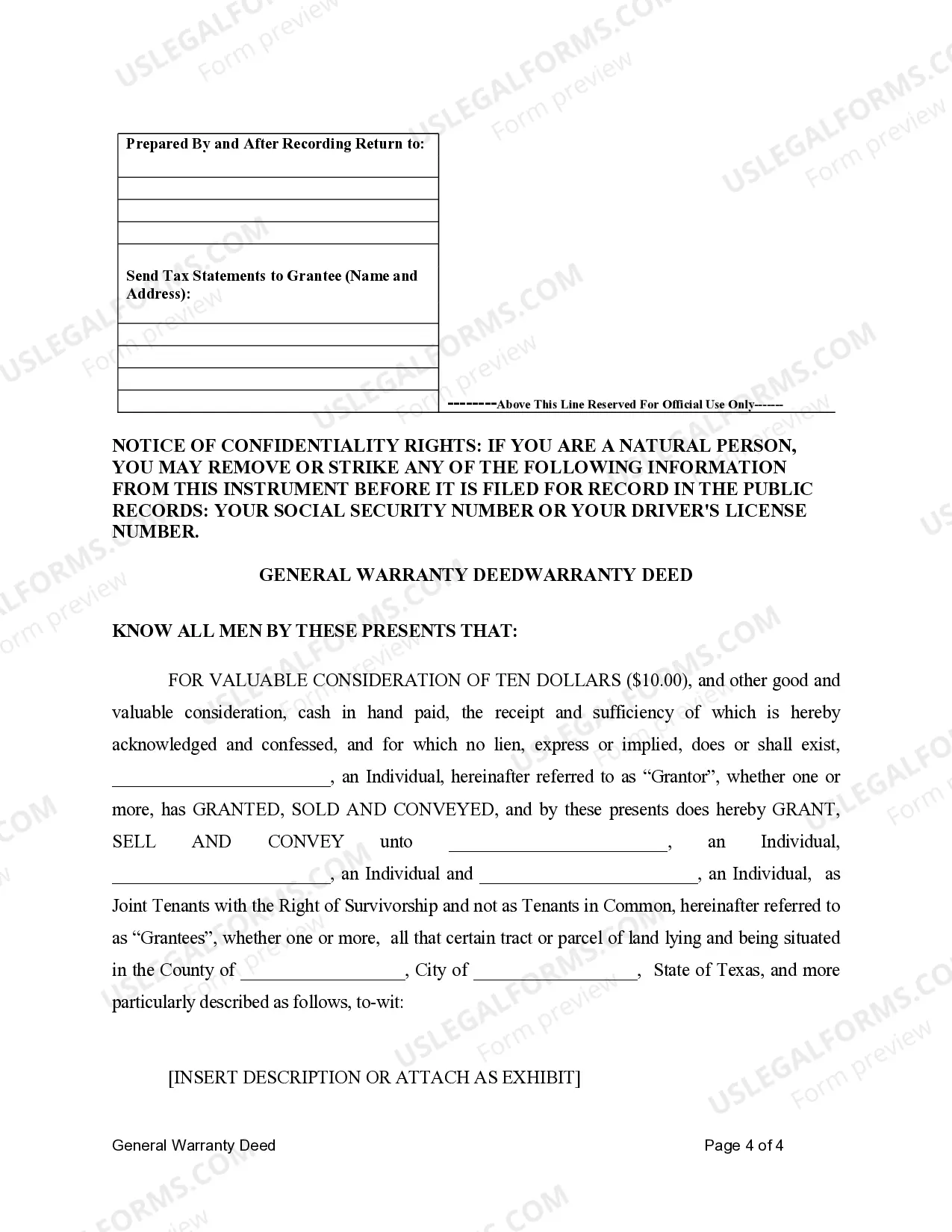
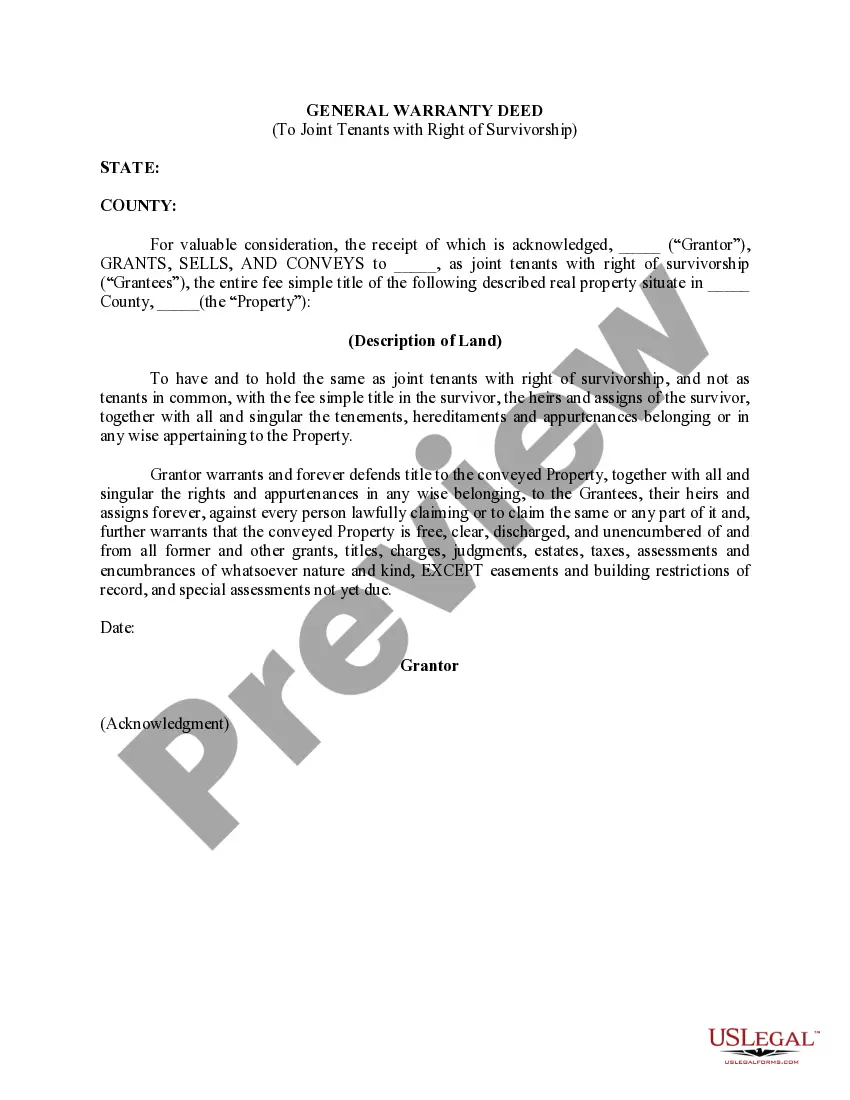
This General Warranty Deed is a legal document used to transfer property from one individual (the grantor) to three individuals (the grantees) who will hold the property as joint tenants with rights of survivorship. This means that if one grantee passes away, their share of the property automatically transfers to the surviving grantees. This form provides increased security for the property ownership compared to other deeds, as it includes warranties that the grantor has clear title to the property and the right to transfer it.
Form components explained
- Names of the grantor and grantees
- Legal description of the property being transferred
- Consideration amount paid for the property
- Declarations regarding the joint tenancy and rights of survivorship
- Signature of the grantor and acknowledgment of the deed




Common use cases
This form is ideal when an individual wishes to transfer ownership of real estate to three individuals who will own the property jointly. It is particularly useful in family situations or partnerships where the intent is for the property to pass automatically to the surviving owners without going through probate. Use this deed when establishing joint ownership with rights of survivorship to ensure that the property remains within the group of owners after an owner's death.
Intended users of this form
This General Warranty Deed is intended for:
- Individuals transferring property to multiple parties
- Families establishing joint ownership of real estate
- Partners looking to share ownership with survivorship rights
- Anyone wanting to avoid probate complications for the property after death
How to complete this form
- Identify the grantor (the individual transferring the property) and the grantees (the three individuals receiving the property).
- Provide a detailed legal description of the property being conveyed.
- Insert the consideration amount in the designated field.
- Sign and date the document in the presence of a notary (if required).
- Ensure all grantees are acknowledged and that their rights are clearly stated.
Notarization requirements for this form
Notarization is required for this form to take effect. Our online notarization service, powered by Notarize, lets you verify and sign documents remotely through an encrypted video session, available 24/7.
Get your form ready online
Our built-in tools help you complete, sign, share, and store your documents in one place.
Make edits, fill in missing information, and update formatting in US Legal Forms—just like you would in MS Word.
Download a copy, print it, send it by email, or mail it via USPS—whatever works best for your next step.
Sign and collect signatures with our SignNow integration. Send to multiple recipients, set reminders, and more. Go Premium to unlock E-Sign.
If this form requires notarization, complete it online through a secure video call—no need to meet a notary in person or wait for an appointment.
We protect your documents and personal data by following strict security and privacy standards.

Make edits, fill in missing information, and update formatting in US Legal Forms—just like you would in MS Word.

Download a copy, print it, send it by email, or mail it via USPS—whatever works best for your next step.

Sign and collect signatures with our SignNow integration. Send to multiple recipients, set reminders, and more. Go Premium to unlock E-Sign.

If this form requires notarization, complete it online through a secure video call—no need to meet a notary in person or wait for an appointment.

We protect your documents and personal data by following strict security and privacy standards.
Typical mistakes to avoid
- Not providing a complete legal description of the property.
- Failure to properly sign and date the document.
- Neglecting to acknowledge the joint tenancy with rights of survivorship.
- Leaving out the consideration amount or not properly documenting it.
Why use this form online
- Convenience of filling out the form from home at your own pace.
- Editability allows you to correct any errors before finalizing the document.
- Reliable templates drafted by licensed attorneys to ensure legal adherence.
Looking for another form?

Form popularity
FAQ
Property held in joint tenancy, tenancy by the entirety, or community property with right of survivorship automatically passes to the survivor when one of the original owners dies. Real estate, bank accounts, vehicles, and investments can all pass this way. No probate is necessary to transfer ownership of the property.
In Texas, two forms of joint ownership have the right of survivorship: Joint tenancy. Property owned in joint tenancy automatically passes to the surviving owners when one owner dies. (The survivor must, however, live at least 120 hours longer than the deceased co-owner.
Joint tenancy has what is called right of survivorship, where, if one owner dies, the surviving owner takes all of the property, immediately upon the other owner's death. No court action is necessary for the surviving owner to take the property.X gives property to A & B as joint tenants with right of survivorship.
Joint Tenancy With Right of Survivorship Property owned in joint tenancy automatically passes, without probate, to the surviving owner(s) when one owner dies.
Right of survivorship refers to the right of the surviving party (usually a husband or wife) to take over their deceased partner's interest in a property that they owned equal interest in without having to go through probate.An exception in a Survivorship Deed means anything that may limit the title of property.
Joint tenancy can only be created if the four people obtain their interest at the same time. In other words, if three people own a building, they cannot add a fourth person to the deed and create a joint tenancy.
Survivorship rights take precedence over any contrary terms in a person's will because property subject to rights of survivorship is not legally part of their estate at death and so cannot be distributed through a will.
Unlike most states Texas does not automatically recognize joint tenancies as having a right of survivorship. Instead the parties must agree, in writing, to include a right of survivorship.
As with the tenancy-in-common, a joint tenancy can exist in three or more people. Obviously, each party must have an interest that is equal to one divided by the total number of joint tenants. If one of the joint tenants dies, the others share his or her interest and they remain joint tenants with each other.