Texas General Warranty Deed for Trust to Individuals or Husband and Wife
About this form
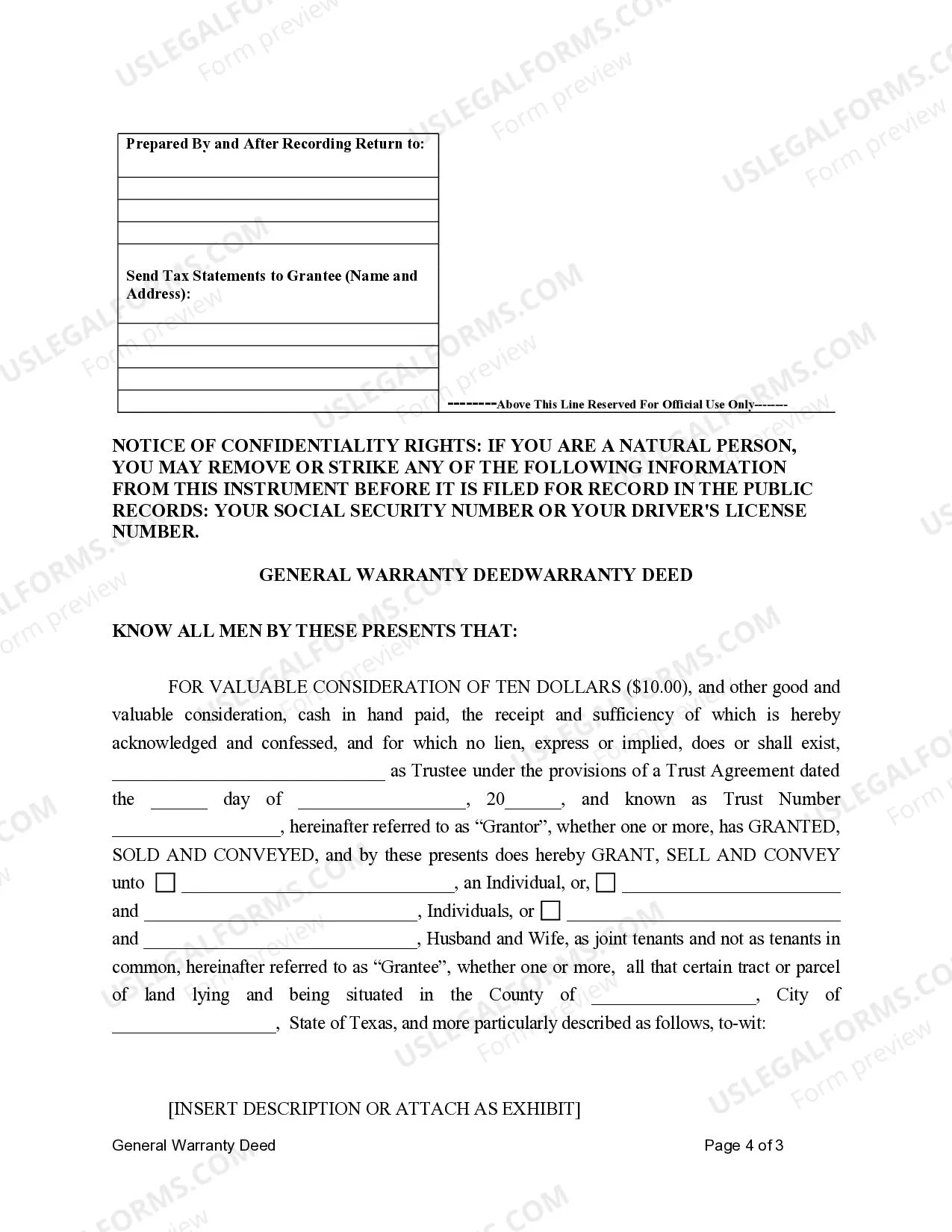
The General Warranty Deed for Trust to Individuals or Husband and Wife is a legal document that transfers ownership of property from a trust to individual(s) or a couple. This form provides a guarantee from the grantor (the trust) that the property title is clear of any encumbrances, ensuring a secure transfer. Unlike other deeds, such as quitclaim deeds, a general warranty deed offers the highest level of protection for the grantees by guaranteeing the propertyâs title against any claims.
Key components of this form
- Identification of the Grantor as the trustee of the trust.
- Identification of the Grantee, who can be individuals or a couple.
- A clear description of the property being transferred.
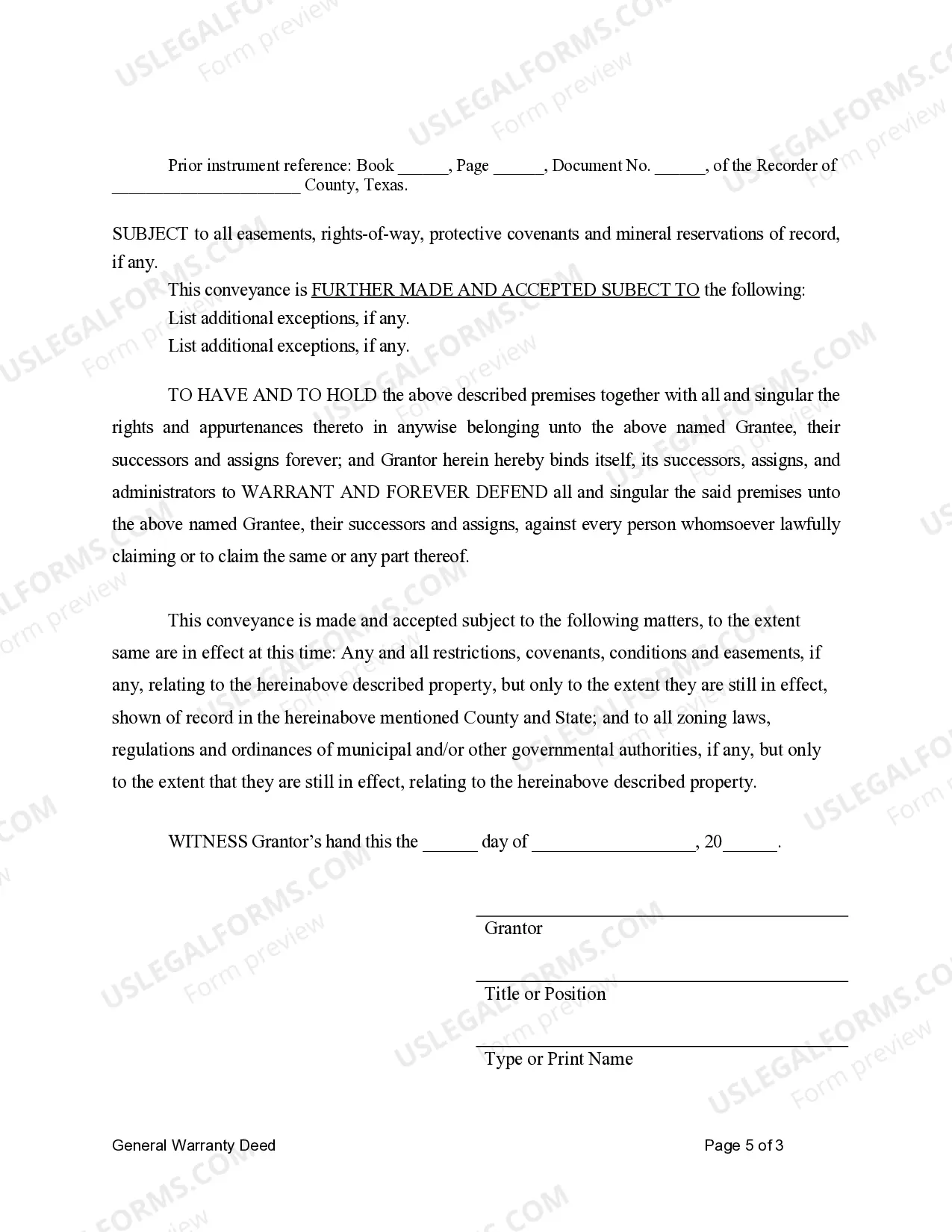
- Warranties and guarantees regarding the title to the property.
- Signatures of the Grantor and any necessary witnesses.

When to use this form
This form is commonly used when a trust owner wishes to transfer property to individuals or a married couple. It is necessary in situations such as a property sale, gift transfer, or estate planning, where the trust is distributing property to beneficiaries. Using this form ensures the grantees receive a full warranty of title.
Who needs this form
This form is suitable for:
- Trustees of a trust seeking to transfer property.
- Individuals or couples receiving property from a trust.
- Real estate professionals assisting with property transactions involving trusts.
- Estate planners managing asset distribution from a trust to heirs.
How to prepare this document
- Identify the parties: Enter the names and details of the Grantor (trust) and Grantee (individuals or couple).
- Specify the property: Include a detailed and precise description of the property being conveyed.
- Fill in the date: Record the date of the transaction.
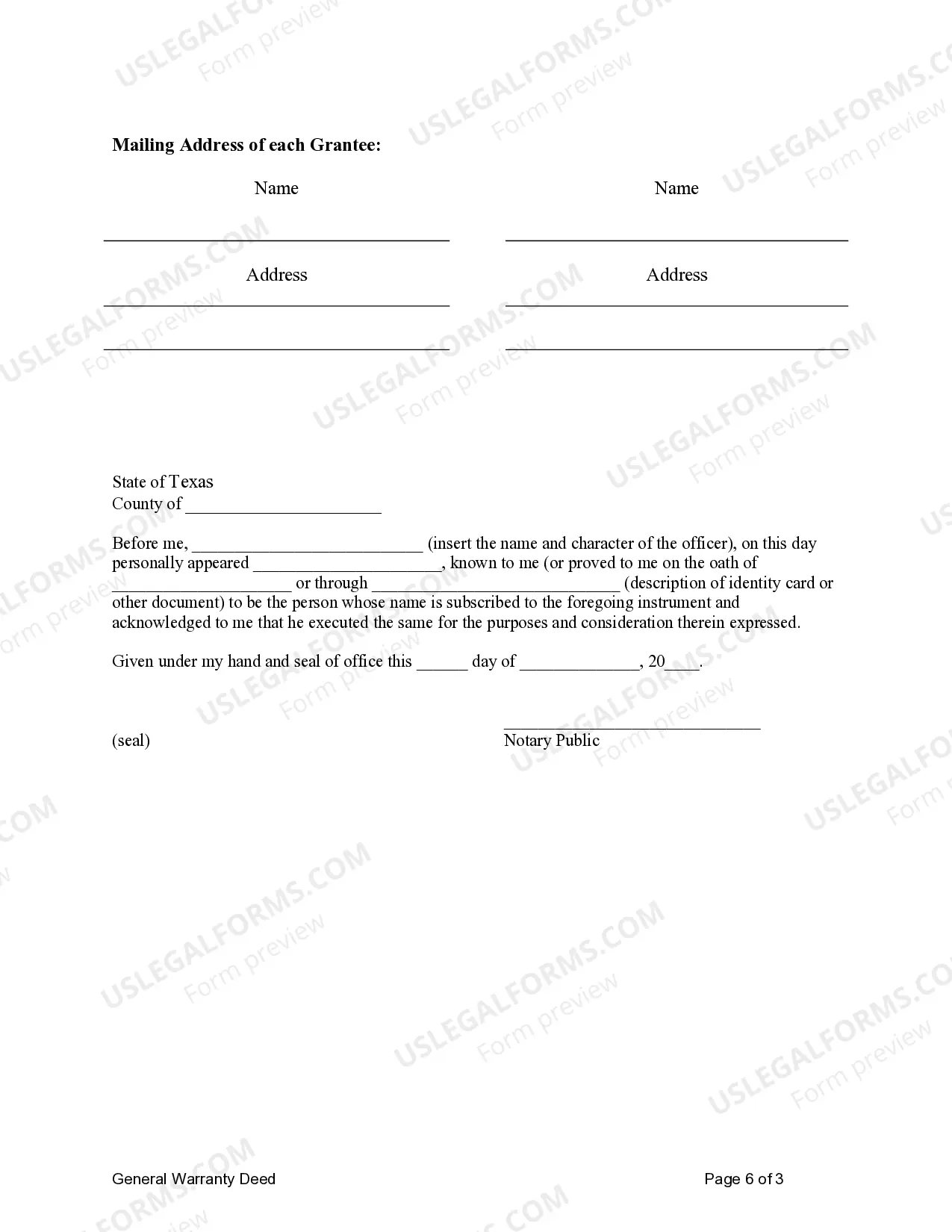
- Sign the deed: The Grantor must sign the deed, and if required, have it notarized.
- Record the deed: Submit the completed deed to the appropriate county office for recording.
Notarization guidance
Yes, this form must be notarized to be legally valid. Notarization adds a layer of verification and authenticity, ensuring that the signatures on the deed are genuine. U.S. Legal Forms offers integrated online notarization, which makes it easy to complete this step securely and efficiently via a video call.
Get your form ready online
Our built-in tools help you complete, sign, share, and store your documents in one place.
Make edits, fill in missing information, and update formatting in US Legal Forms—just like you would in MS Word.
Download a copy, print it, send it by email, or mail it via USPS—whatever works best for your next step.
Sign and collect signatures with our SignNow integration. Send to multiple recipients, set reminders, and more. Go Premium to unlock E-Sign.
If this form requires notarization, complete it online through a secure video call—no need to meet a notary in person or wait for an appointment.
We protect your documents and personal data by following strict security and privacy standards.

Make edits, fill in missing information, and update formatting in US Legal Forms—just like you would in MS Word.

Download a copy, print it, send it by email, or mail it via USPS—whatever works best for your next step.

Sign and collect signatures with our SignNow integration. Send to multiple recipients, set reminders, and more. Go Premium to unlock E-Sign.

If this form requires notarization, complete it online through a secure video call—no need to meet a notary in person or wait for an appointment.

We protect your documents and personal data by following strict security and privacy standards.
Mistakes to watch out for
- Failing to provide a complete description of the property.
- Not including all necessary signatures and notarization.
- Leaving out required dates or details which may affect the validity of the deed.
- Incorrectly identifying the Grantor or Grantee names.
Why use this form online
- Convenience of completing the form from anywhere at any time.
- Editable template that allows for customization based on individual needs.
- Access to reliable legal forms drafted by licensed attorneys.
- Streamlined process that includes electronic notarization options without requiring in-person visits.
Looking for another form?
Form popularity
FAQ
Because the Deed of Trust basically "shares" ownership between the borrower and the lender's trustee, and because Texas is a community property state, both the borrower and the spouse (even if they are not on the mortgage note) must be on the Deed of Trust.
If you've recently married and already own a home or other real estate, you may want to add your new spouse to the deed for your property so the two of you own it jointly. To add a spouse to a deed, all you have to do is literally fill out, sign and record a new deed in your county recorder's office.
Both a warranty deed and deed of trust are used to transfer the title of a property from one person to another. However, the difference between these two contracts is who is protected. As you now know, a deed of trust protects the beneficiary (lender). A warranty deed, on the other hand, protects the property owner.
A warranty deed guarantees that: The grantor is the rightful owner of the property and has the legal right to transfer the title.The title would withstand third-party claims to ownership of the property. The grantor will do anything to ensure the grantee's title to the property.
A deed conveys ownership; a deed of trust secures a loan.
A trustee deed offers no such warranties about the title.
It's important to note that a warranty deed does not actually prove the grantor has ownership (a title search is the best way to prove that), but it is a promise by the grantor that they are transferring ownership and if it turns out they don't actually own the property, the grantor will be responsible for compensating
In the context of a California mortgage transaction, a trust deed also transfer ownership. Only this time, the title is being placed in the hands of a third-party trustee, who holds the property on behalf of the lender and the homeowner-borrower until the mortgage is paid.
A deed conveys ownership; a deed of trust secures a loan.