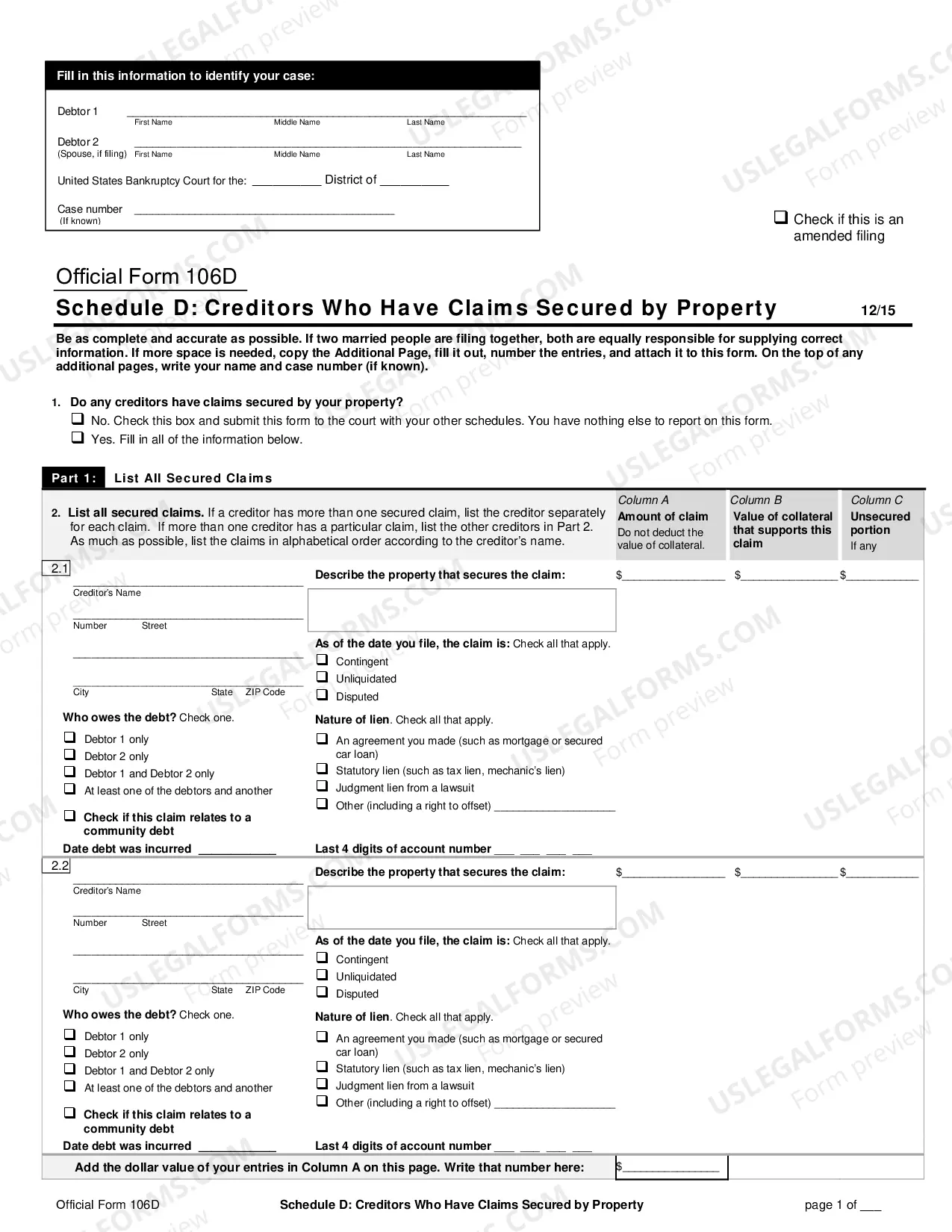
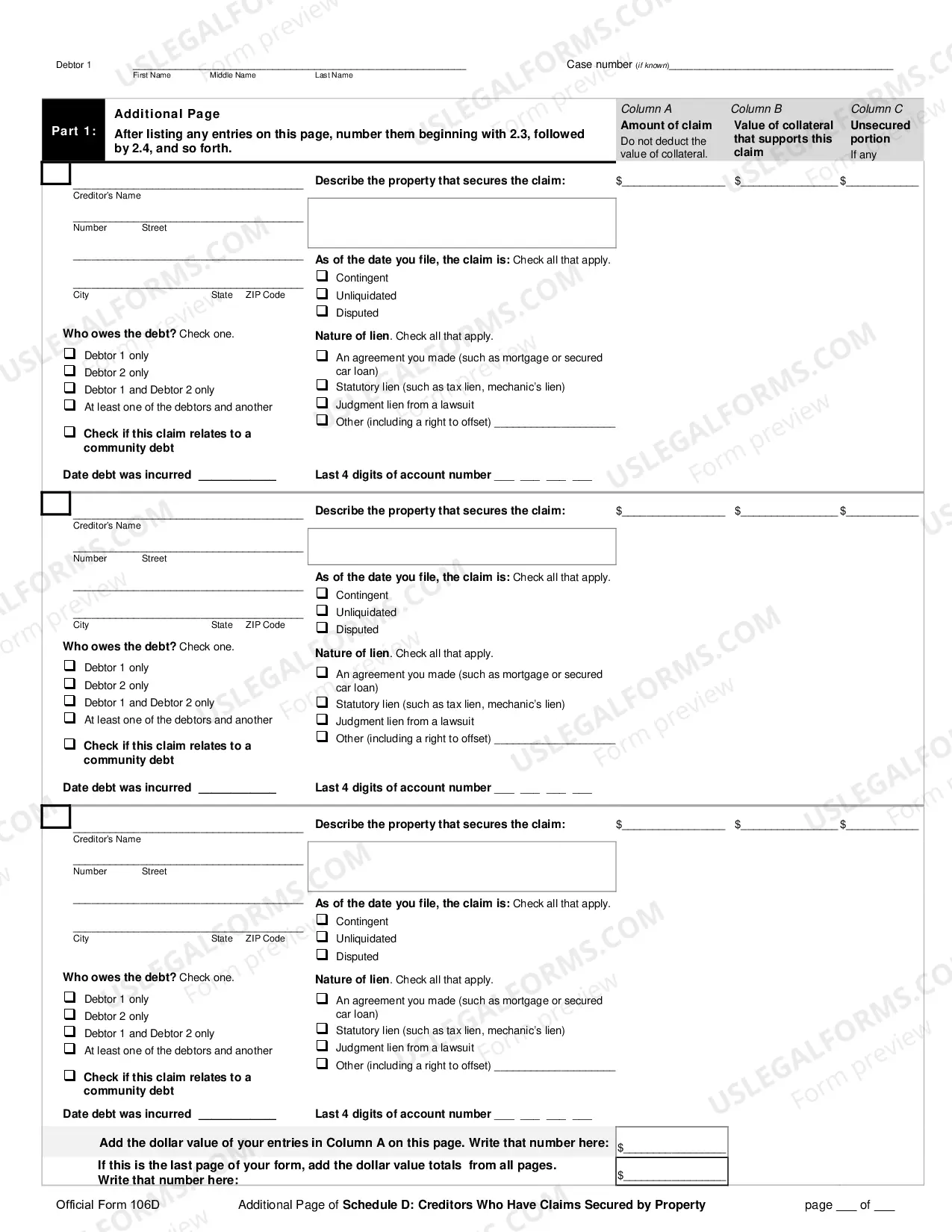
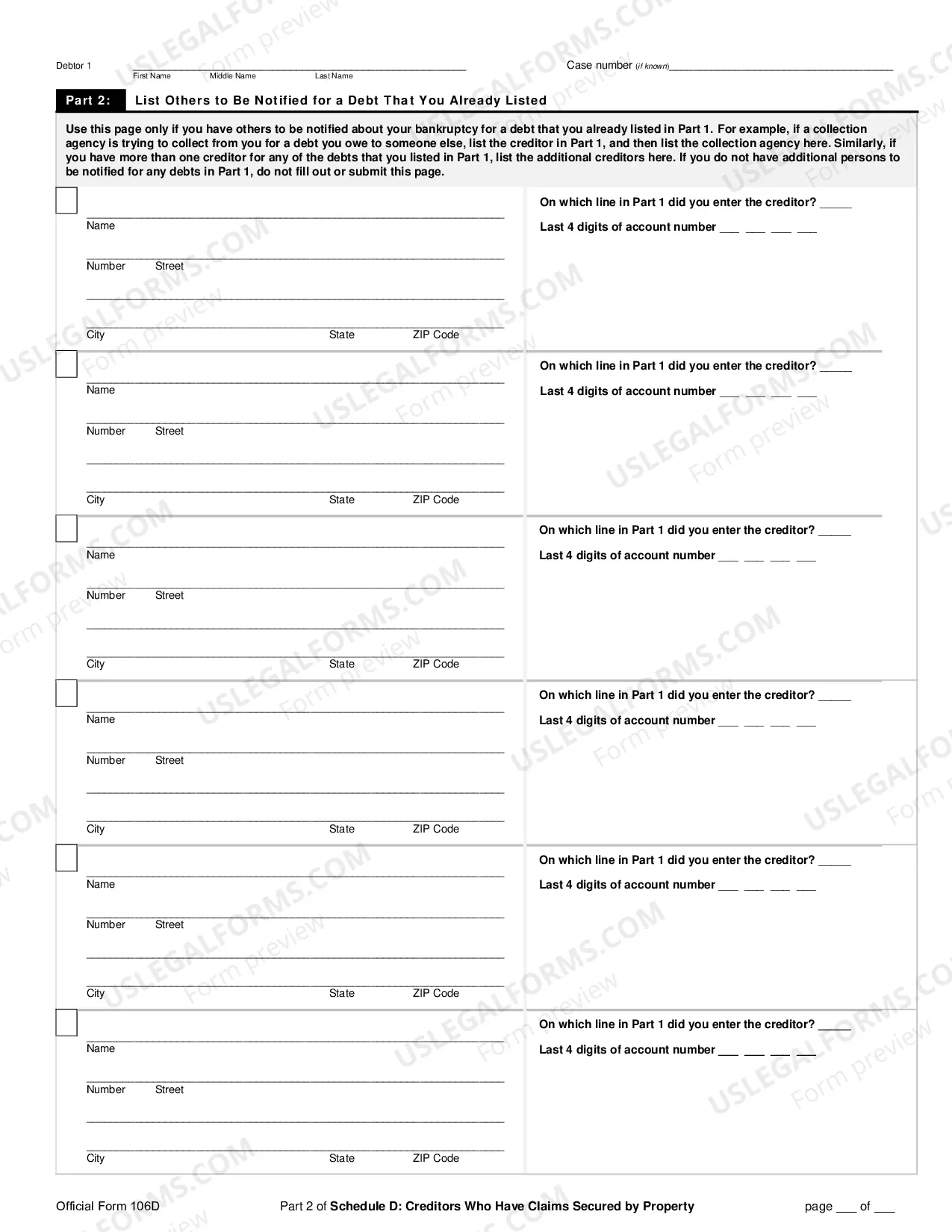
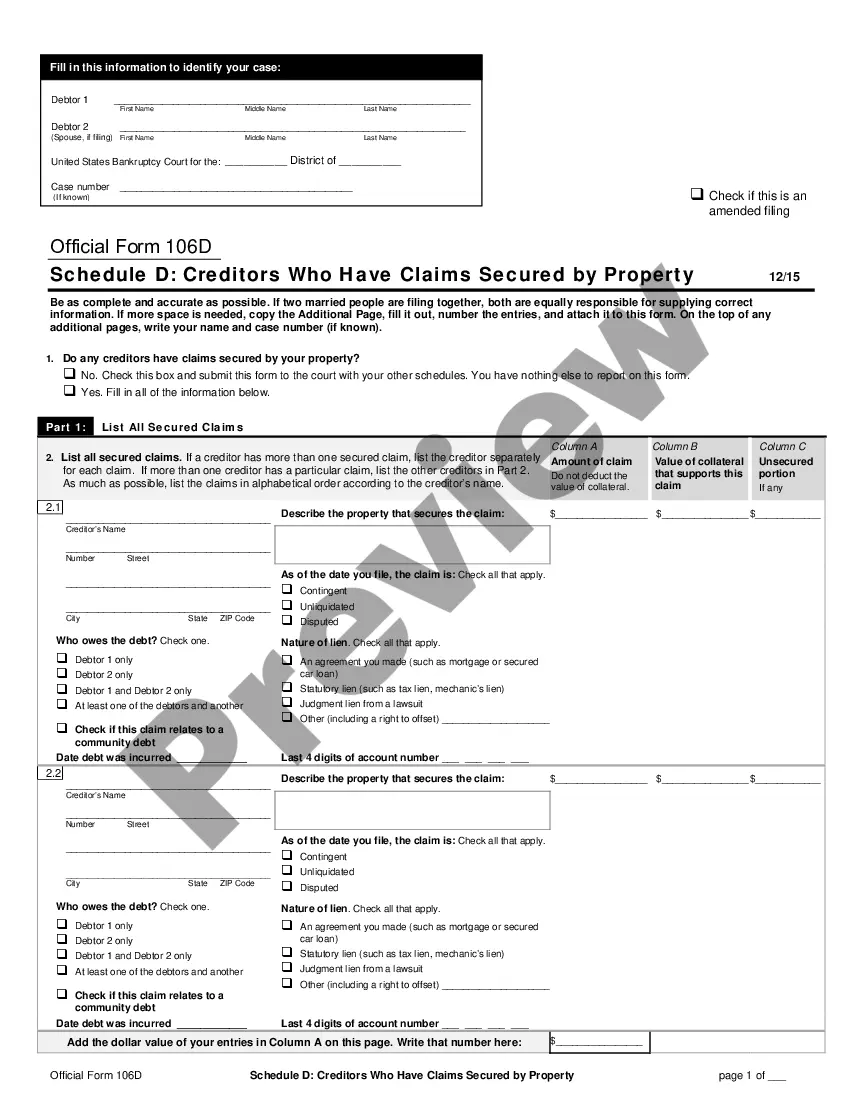
Texas Schedule D: Creditors Who Hold Claims Secured By Property (individuals)
Description
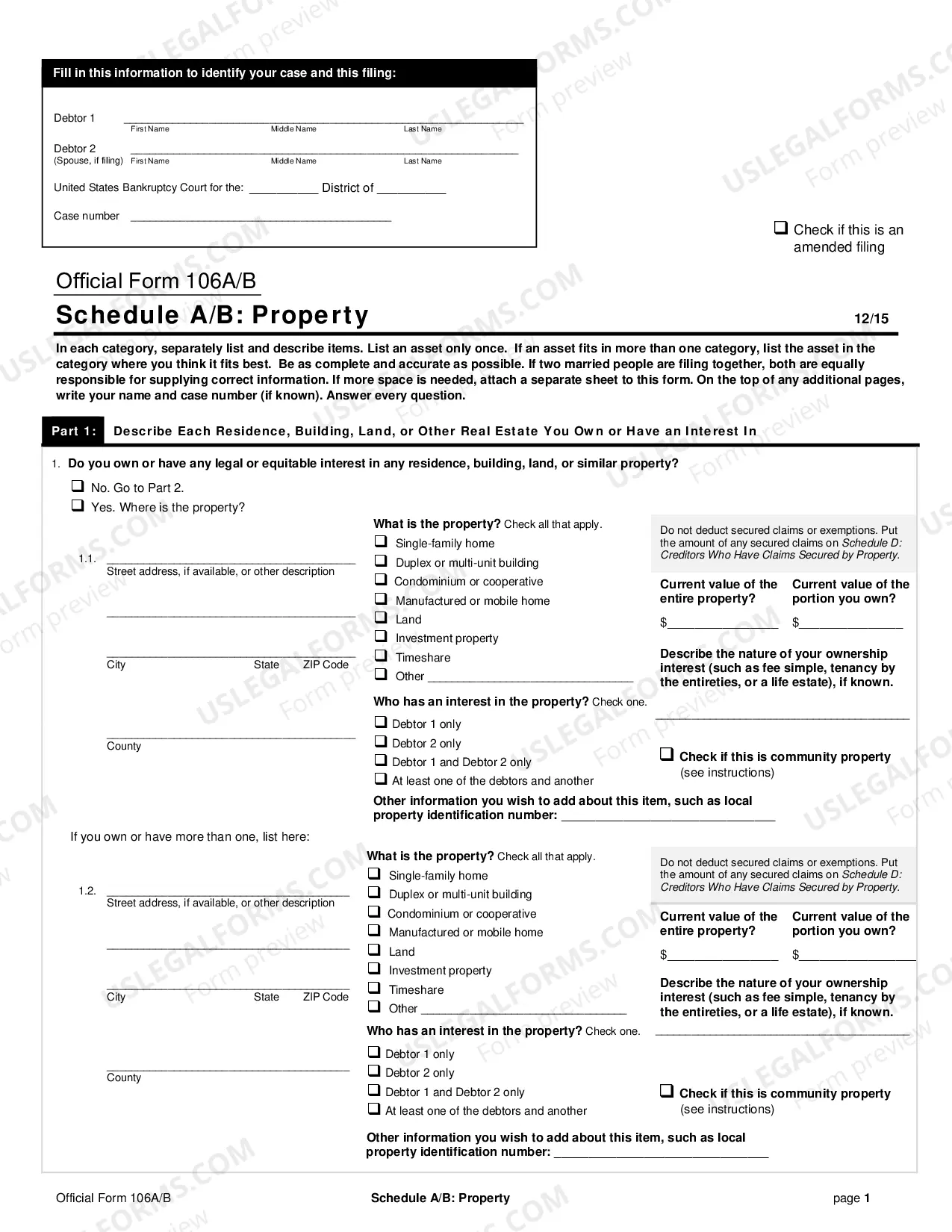
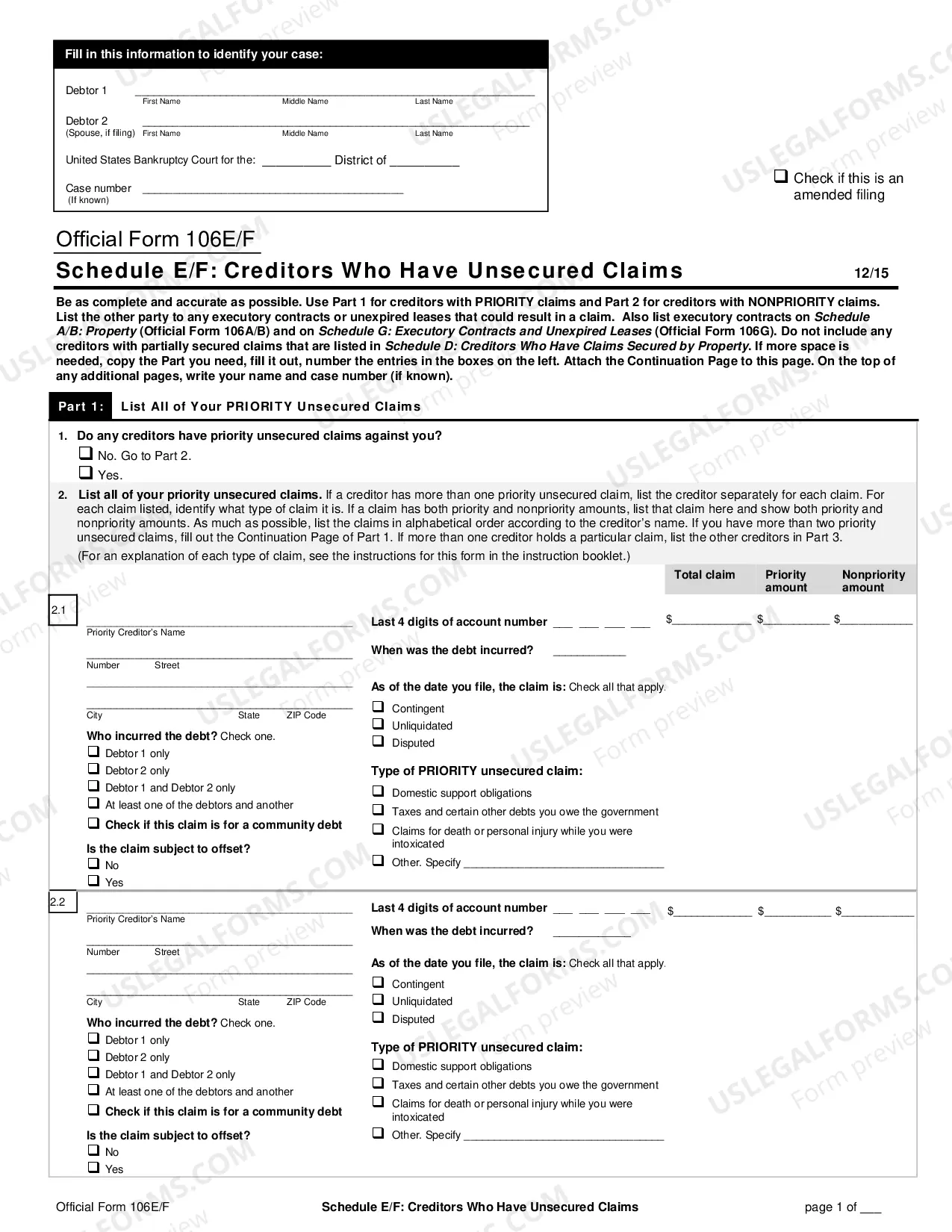
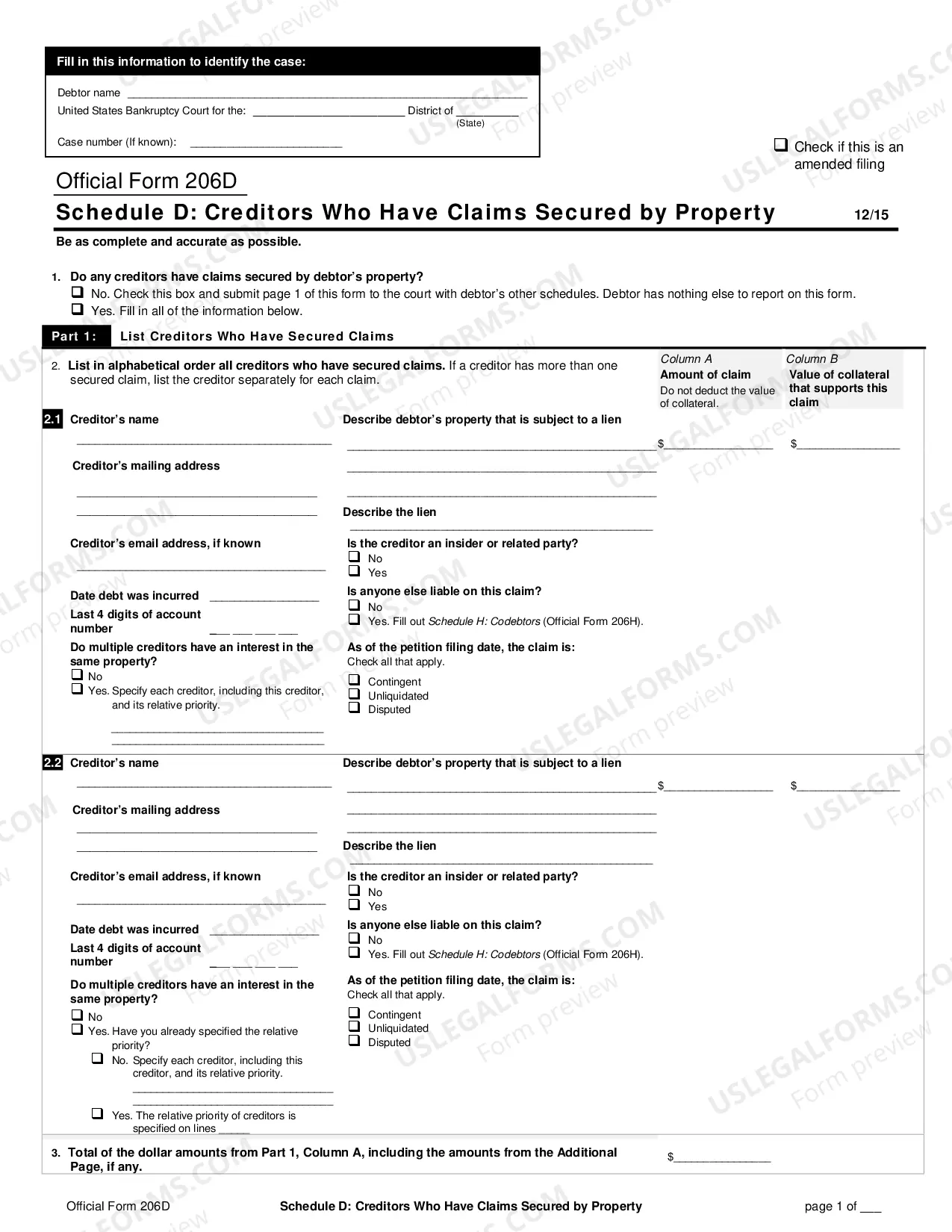
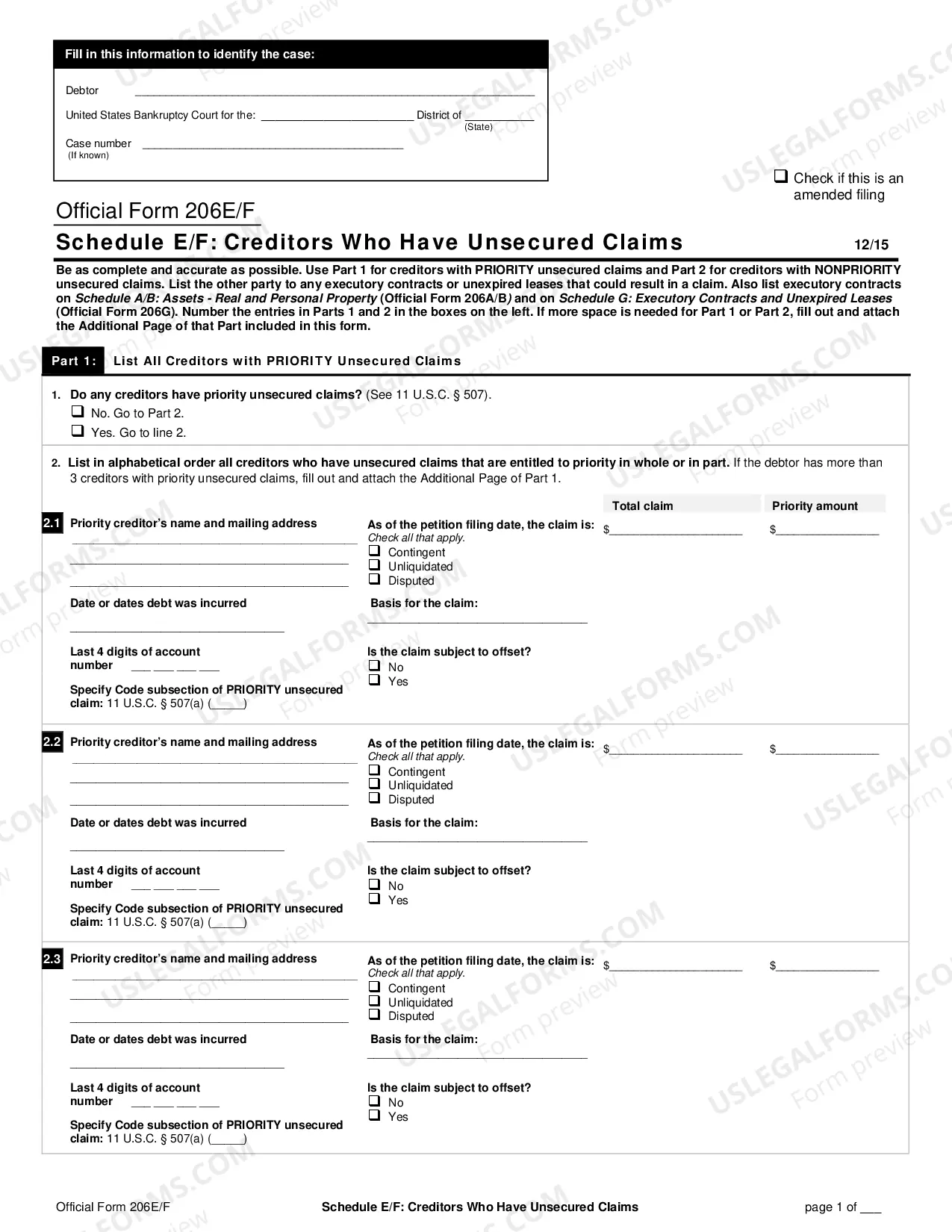
Get your form ready online
Our built-in tools help you complete, sign, share, and store your documents in one place.
Make edits, fill in missing information, and update formatting in US Legal Forms—just like you would in MS Word.
Download a copy, print it, send it by email, or mail it via USPS—whatever works best for your next step.
Sign and collect signatures with our SignNow integration. Send to multiple recipients, set reminders, and more. Go Premium to unlock E-Sign.
If this form requires notarization, complete it online through a secure video call—no need to meet a notary in person or wait for an appointment.
We protect your documents and personal data by following strict security and privacy standards.

Make edits, fill in missing information, and update formatting in US Legal Forms—just like you would in MS Word.

Download a copy, print it, send it by email, or mail it via USPS—whatever works best for your next step.

Sign and collect signatures with our SignNow integration. Send to multiple recipients, set reminders, and more. Go Premium to unlock E-Sign.

If this form requires notarization, complete it online through a secure video call—no need to meet a notary in person or wait for an appointment.

We protect your documents and personal data by following strict security and privacy standards.
Looking for another form?



How to fill out Texas Schedule D: Creditors Who Hold Claims Secured By Property (individuals)?
Preparing official paperwork can be a real stress unless you have ready-to-use fillable templates. With the US Legal Forms online library of formal documentation, you can be confident in the blanks you obtain, as all of them comply with federal and state regulations and are verified by our specialists. So if you need to complete Texas Schedule D: Creditors Who Hold Claims Secured By Property (individuals), our service is the best place to download it.
Getting your Texas Schedule D: Creditors Who Hold Claims Secured By Property (individuals) from our library is as easy as ABC. Previously registered users with a valid subscription need only log in and click the Download button after they locate the proper template. Later, if they need to, users can get the same blank from the My Forms tab of their profile. However, even if you are new to our service, signing up with a valid subscription will take only a few minutes. Here’s a quick guideline for you:
- Document compliance verification. You should carefully examine the content of the form you want and check whether it suits your needs and fulfills your state law regulations. Previewing your document and reviewing its general description will help you do just that.
- Alternative search (optional). If you find any inconsistencies, browse the library through the Search tab on the top of the page until you find a suitable template, and click Buy Now when you see the one you want.
- Account registration and form purchase. Register for an account with US Legal Forms. After account verification, log in and select your most suitable subscription plan. Make a payment to continue (PayPal and credit card options are available).
- Template download and further usage. Select the file format for your Texas Schedule D: Creditors Who Hold Claims Secured By Property (individuals) and click Download to save it on your device. Print it to complete your papers manually, or take advantage of a multi-featured online editor to prepare an electronic copy faster and more efficiently.
Haven’t you tried US Legal Forms yet? Sign up for our service now to get any official document quickly and easily every time you need to, and keep your paperwork in order!
Form popularity
FAQ
In a secured claim contract, if the debtor defaults, or is unable to payback the debt, the creditor can take ownership of the collateral and sell it to pay off what the debtor owes. For example, if a consumer defaults on a mortgage, the bank can claim the house and sell it to pay off the consumer's debt.
A secured claim is a financial obligation for which there is collateral to guarantee the payment of a debt. The collateral can be most any type of property, such as real estate, business inventory and personal goods. With most secured claims, the debtor voluntarily pledges an interest in property to the creditor.
An unsecured claim is a liability for which there is no collateral. Instead, credit was extended solely based on the creditor's evaluation of the debtor's ability to pay.
A secured debt is a debt that is secured by property. If you don't repay the debt ing to your contract?for example, you fail to make your monthly payment?the creditor has the right to take back the secured property, such as your home or car. In contrast, your unsecured creditors don't have the same rights.
Secured debt - A debt that is backed by real or personal property is a ?secured? debt. A creditor whose debt is ?secured? has a legal right to take the property as full or partial satisfaction of the debt.
Secured Creditors are creditors that hold a lien on its debtor's property, whether that property is real property or personal property. The lien gives the secured creditor an interest in its debtor's property that provides for the property to be sold to satisfy the debt in cases of default.
A secured claim is a financial obligation for which there is collateral to guarantee the payment of a debt. The collateral can be most any type of property, such as real estate, business inventory and personal goods. With most secured claims, the debtor voluntarily pledges an interest in property to the creditor.