Texas Sworn Statement for Alternative Service by Delivery to the Premises
What this document covers
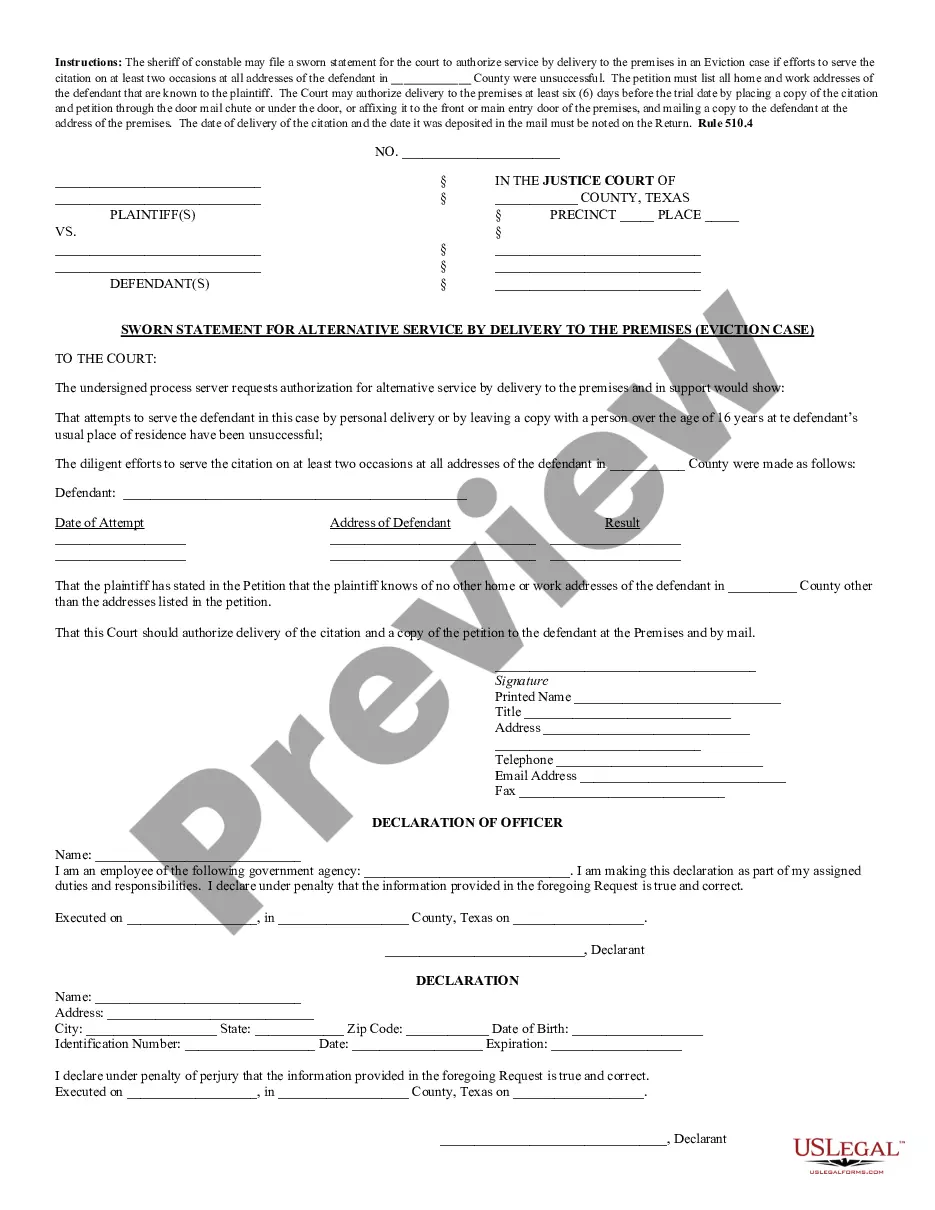
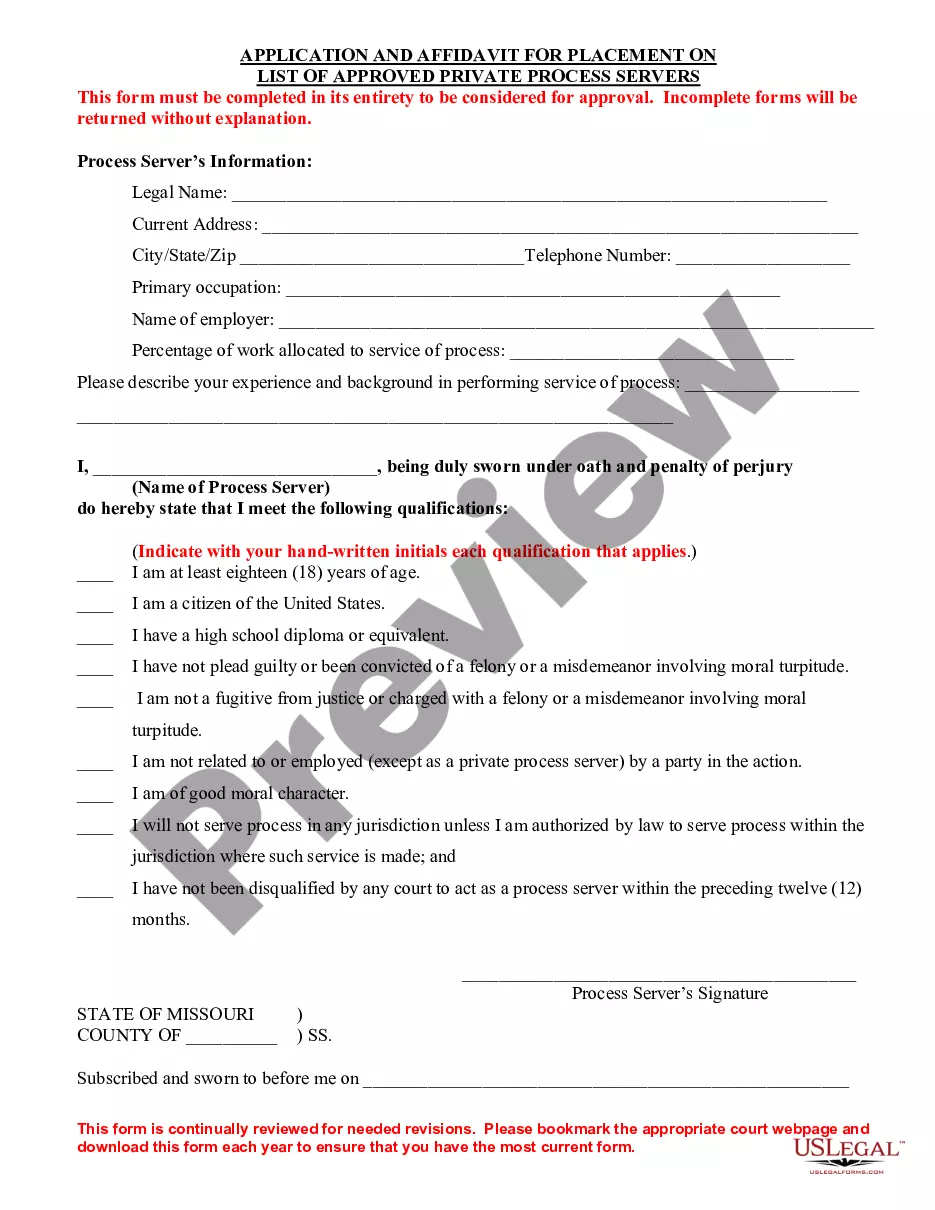
The Sworn Statement for Alternative Service by Delivery to the Premises is a legal document used by a process server. This form requests court authorization to serve legal documents at the defendant's premises after previous attempts at personal delivery have failed. It differs from regular service of process methods by addressing situations where the defendant is unreachable or unresponsive, ensuring that the legal proceedings can still progress despite these obstacles.
Key parts of this document
- Request for Authorization: The process server formally requests permission from the court to serve the defendant at their premises.
- Details of Previous Attempts: Documenting at least two attempts made to serve the defendant, including dates and results.
- Defendant Information: Includes the defendant's name and address for proper identification.
- Plaintiff's Statement: A declaration that no other addresses for the defendant are known.
- Signatures: Requires the signature of the process server and included declarations from officials and the declarant.

When to use this form
This form is necessary when attempts to serve the defendant personally or by leaving documents with someone at their residence have been unsuccessful. It is commonly used in eviction cases where timely legal action is crucial, and the defendant's location remains unknown or evasive. When conventional service methods do not yield results, this form allows for an alternative route to ensure legal documents are delivered properly and the case can proceed.
Intended users of this form
- Process servers hired by plaintiffs to deliver legal documents.
- Attorneys representing a party in an eviction case.
- Self-represented individuals (pro se litigants) seeking to file for alternative service in court.
- Any legal professional needing to document unsuccessful service attempts before seeking alternative methods.
Instructions for completing this form
- Identify the parties involved: Fill in the plaintiff's and defendant's names and addresses.
- Document the service attempts: List dates and results of each attempt to serve the defendant.
- Provide the plaintiff's verification: Confirm that no further addresses for the defendant are known.
- Sign the form: Ensure the process server signs and dates the statement.
- Include any declarations: If applicable, complete the declaration sections for official verification.
Notarization guidance
This form does not typically require notarization unless specified by local law. However, it is advisable to check local regulations to ensure compliance, as requirements may differ based on jurisdiction.
Get your form ready online
Our built-in tools help you complete, sign, share, and store your documents in one place.
Make edits, fill in missing information, and update formatting in US Legal Forms—just like you would in MS Word.
Download a copy, print it, send it by email, or mail it via USPS—whatever works best for your next step.
Sign and collect signatures with our SignNow integration. Send to multiple recipients, set reminders, and more. Go Premium to unlock E-Sign.
If this form requires notarization, complete it online through a secure video call—no need to meet a notary in person or wait for an appointment.
We protect your documents and personal data by following strict security and privacy standards.

Make edits, fill in missing information, and update formatting in US Legal Forms—just like you would in MS Word.

Download a copy, print it, send it by email, or mail it via USPS—whatever works best for your next step.

Sign and collect signatures with our SignNow integration. Send to multiple recipients, set reminders, and more. Go Premium to unlock E-Sign.

If this form requires notarization, complete it online through a secure video call—no need to meet a notary in person or wait for an appointment.

We protect your documents and personal data by following strict security and privacy standards.
Mistakes to watch out for
- Failing to provide complete and accurate details of prior service attempts.
- Not signing the form or missing required signatures.
- Inaccurately stating the defendant's address or other identifying information.
- Ignoring specific local requirements or variations in state law.
Why complete this form online
- Convenience: Download the form anytime without needing to visit a legal office.
- Editability: Fill in the form digitally, making it easy to ensure accuracy.
- Reliability: Forms are drafted by licensed attorneys, ensuring compliance with legal standards.
Looking for another form?


Form popularity
FAQ
(b) Mailbox rule. (1) Service by mail is complete upon deposit of the notice in a prepaid, properly addressed envelope in a post office or official depository under the care and custody of the United States Postal Service.
Rule 11 of the Texas Rules of Civil Procedure lets lawyers and parties to any lawsuit enter into a written agreement on any subject matter of the lawsuit.
Judges, attorneys and clerks are directed to use their best efforts to cause all judgments, decisions and orders of any kind to be reduced to writing and signed by the trial judge with the date of signing stated therein.
(a) The officer shall place the citation inside the premises by placing it through a door mail chute or by slipping it under the front door; and if neither method is possible or practical, the officer shall securely affix the citation to the front door or main entry to the premises.
Without complying with paragraphs (a) and (b), a party may withhold a privileged communication to or from a lawyer or lawyer's representative or a privileged document of a lawyer or lawyer's representative. (2) concerning the litigation in which the discovery is requested. (d) Privilege not waived by production.
(1) Service by mail or commercial delivery service shall be complete upon deposit of the document, postpaid and properly addressed, in the mail or with a commercial delivery service. (2) Service by fax is complete on receipt.
RULE 510.4. ISSUANCE, SERVICE, AND RETURN OF CITATION (a) Issuance of Citation; Contents. When a petition is filed, the court must immediately issue citation directed to each defendant. The citation must: (b) Service and Return of Citation.
The successful party to a suit shall recover of his adversary all costs incurred therein, except where otherwise provided.