Texas Agreement for Mediation
Overview of this form
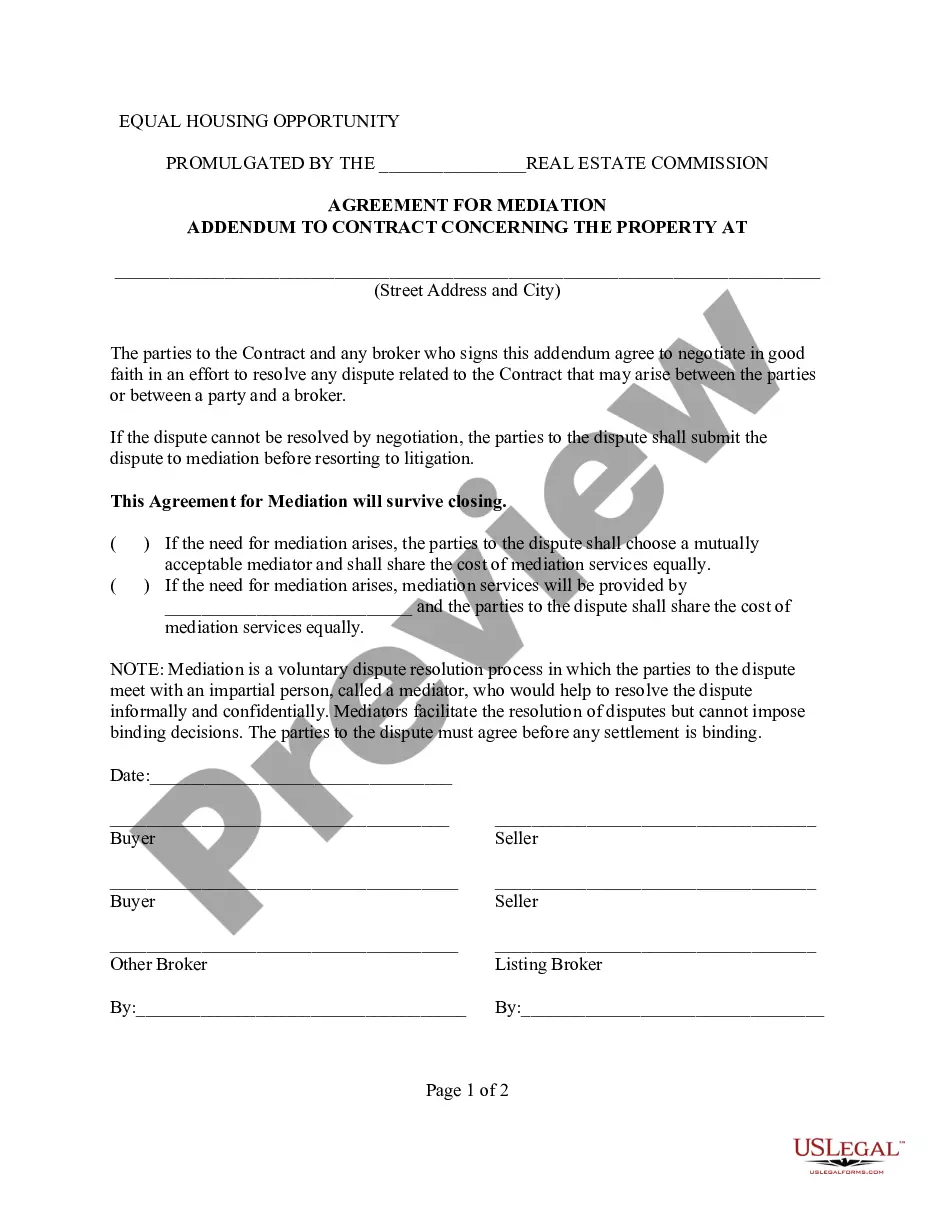
The Agreement for Mediation is a legal document that outlines the process by which parties involved in a dispute agree to mediate their differences before pursuing litigation. It serves as an addendum to a contract and is designed to promote good faith negotiations between the parties. This form emphasizes the voluntary nature of mediation and the role of the mediator in facilitating discussions without imposing decisions, making it a preferable alternative to resolving conflicts through the court system.
Key parts of this document
- Identification of the parties involved in the agreement.
- Agreement to negotiate disputes in good faith.
- Provision for choosing a mutually acceptable mediator if disputes arise.
- Details on cost-sharing for mediation services.
- Clarification that mediation is confidential and non-binding unless agreed upon by all parties.
- Signatures of all parties involved to confirm agreement.


When to use this form
This form should be used when parties entering into a contract anticipate the possibility of disputes that may require mediation. It is particularly useful in real estate transactions, where issues such as property disputes or contract disagreements may arise. By signing this addendum, all parties ensure they have a clear understanding of the process for resolving potential conflicts amicably before resorting to legal action.
Who this form is for
- Buyers and sellers involved in a real estate transaction.
- Real estate brokers facilitating property sales.
- Any parties interested in a proactive approach to managing potential disputes.
Instructions for completing this form
- Identify and list all parties involved in the contract, including brokers.
- Clearly define the property address related to the agreement.
- Fill out the chosen mediator's name or indicate the parties will select one mutually.
- Include any notes regarding the equal sharing of mediation costs.
- Ensure all parties date and sign the document to finalize the agreement.
Notarization guidance
This form does not typically require notarization unless specified by local law. It is advisable to check with local requirements to confirm if notarization is necessary for enforceability.
Get your form ready online
Our built-in tools help you complete, sign, share, and store your documents in one place.
Make edits, fill in missing information, and update formatting in US Legal Forms—just like you would in MS Word.
Download a copy, print it, send it by email, or mail it via USPS—whatever works best for your next step.
Sign and collect signatures with our SignNow integration. Send to multiple recipients, set reminders, and more. Go Premium to unlock E-Sign.
If this form requires notarization, complete it online through a secure video call—no need to meet a notary in person or wait for an appointment.
We protect your documents and personal data by following strict security and privacy standards.

Make edits, fill in missing information, and update formatting in US Legal Forms—just like you would in MS Word.

Download a copy, print it, send it by email, or mail it via USPS—whatever works best for your next step.

Sign and collect signatures with our SignNow integration. Send to multiple recipients, set reminders, and more. Go Premium to unlock E-Sign.

If this form requires notarization, complete it online through a secure video call—no need to meet a notary in person or wait for an appointment.

We protect your documents and personal data by following strict security and privacy standards.
Mistakes to watch out for
- Failing to identify all relevant parties involved in the dispute.
- Not specifying the mediator if chosen at the time of completing the form.
- Omitting signatures, which can render the agreement unenforceable.
- Neglecting to clarify the terms of cost-sharing for mediation services.
Benefits of completing this form online
- Instant access to a professionally drafted legal document.
- Ability to easily edit the form to fit your specific needs.
- Convenient download and print options for quick use.
- Online support available to assist with any questions.
Legal use & context
- Mediation is a voluntary and confidential process aimed at resolving disputes.
- Outcomes reached in mediation are not binding unless agreed upon by all parties.
- Using this form can help parties avoid lengthy and costly litigation.
Summary of main points
- The Agreement for Mediation helps resolve disputes amicably before litigation.
- Mediation is a voluntary and confidential process facilitated by a neutral mediator.
- Proper completion and signing of the form are crucial for its legal effectiveness.
Looking for another form?
Form popularity
FAQ
When mediation is ordered by the court, the agreement that is reached there is often entered into record as an official court order. This means that anything you do to violate the agreement will be a violation of a judge-issued order and you can be fined or jailed as a result.
The mediation agreement is a product of the interaction of two parties willingly coming together to resolve their dispute under the guidance of a skilled mediator.
In Texas, many cases are settled during mediation. An agreement for divorce mediation in Texas is a binding agreement signed by all parties and their attorneys that resolves all of the issues in case. This is a separate process from divorce litigation.
This process requires expert legal representation. In many cases, both parties will need to go to mediation again.However, if the other party does not agree to the changes then you can take them to court. Again, you will usually be expected to pay court costs and mediation fees.
An agreement you reach through mediation can become legally binding by the terms being made into a consent order. A consent order is a legal document usually drawn up by a solicitor setting out what you have agreed during mediation that will then be sent to the court and approved by a judge.
Changes Before A Settlement Is Finalized Usually, two people enter into a divorce settlement after attending a mediation, or after negotiations between their attorneys.If a person changes his or her mind before he or she signs the settlement agreement, the negotiations will simply resume again.
You will need to prove that you were under duress for a judge to agree to overturn a mediation agreement. A lawyer can help you with your burden of proof by searching for related evidence, such as threatening text messages from your ex.
Any agreements made during mediation are not legally binding in the sense of being enforceable in a court. Some people do decide to get a solicitor to look over the agreement, and the agreement can be used in court at a later stage in order to create a Consent Order.
Mediation is free to both parties.If/when a decision is agreed upon during mediation, the agreement becomes legally binding and enforceable by a civil court.