Texas General Warranty Deed from General Partnership to Limited Liability Company
Understanding this form
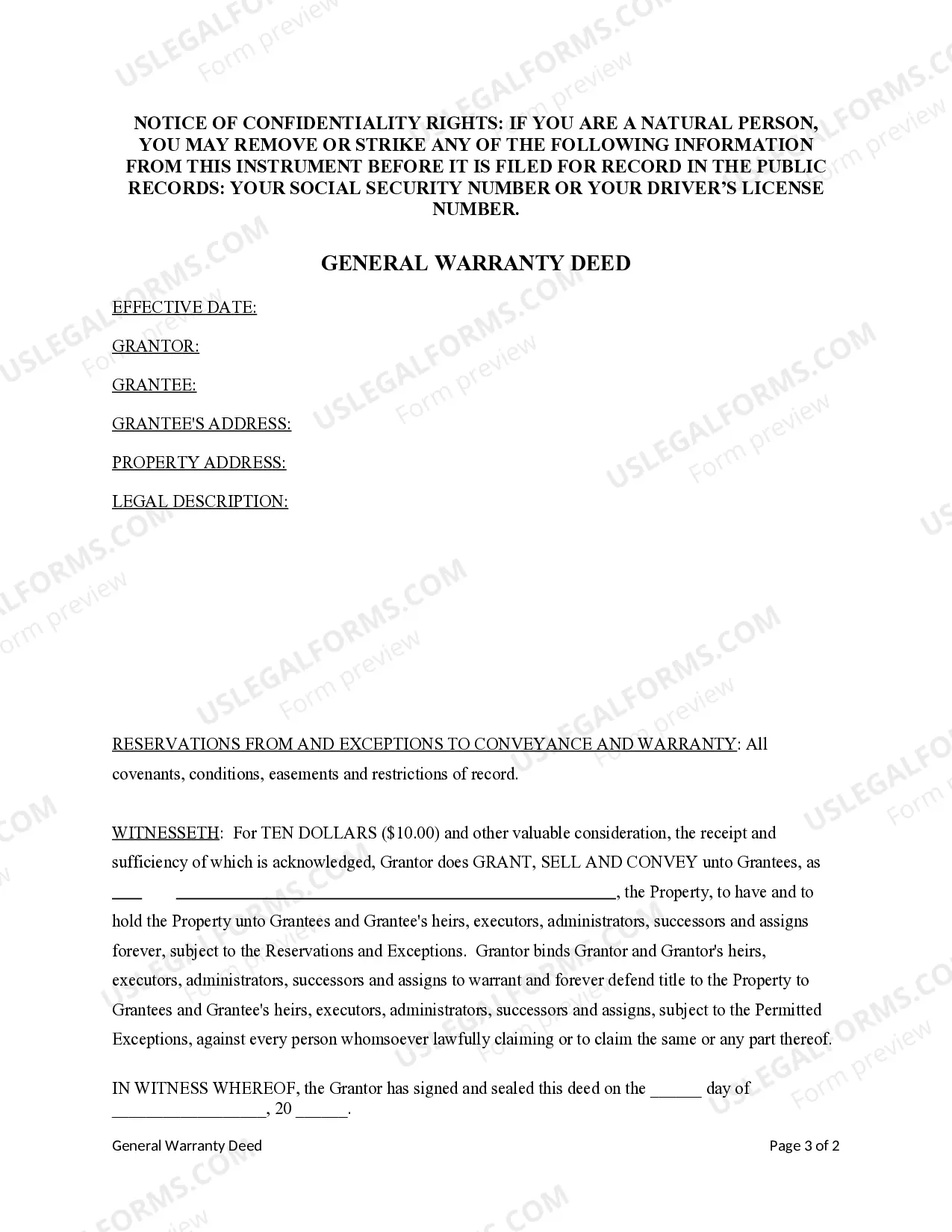
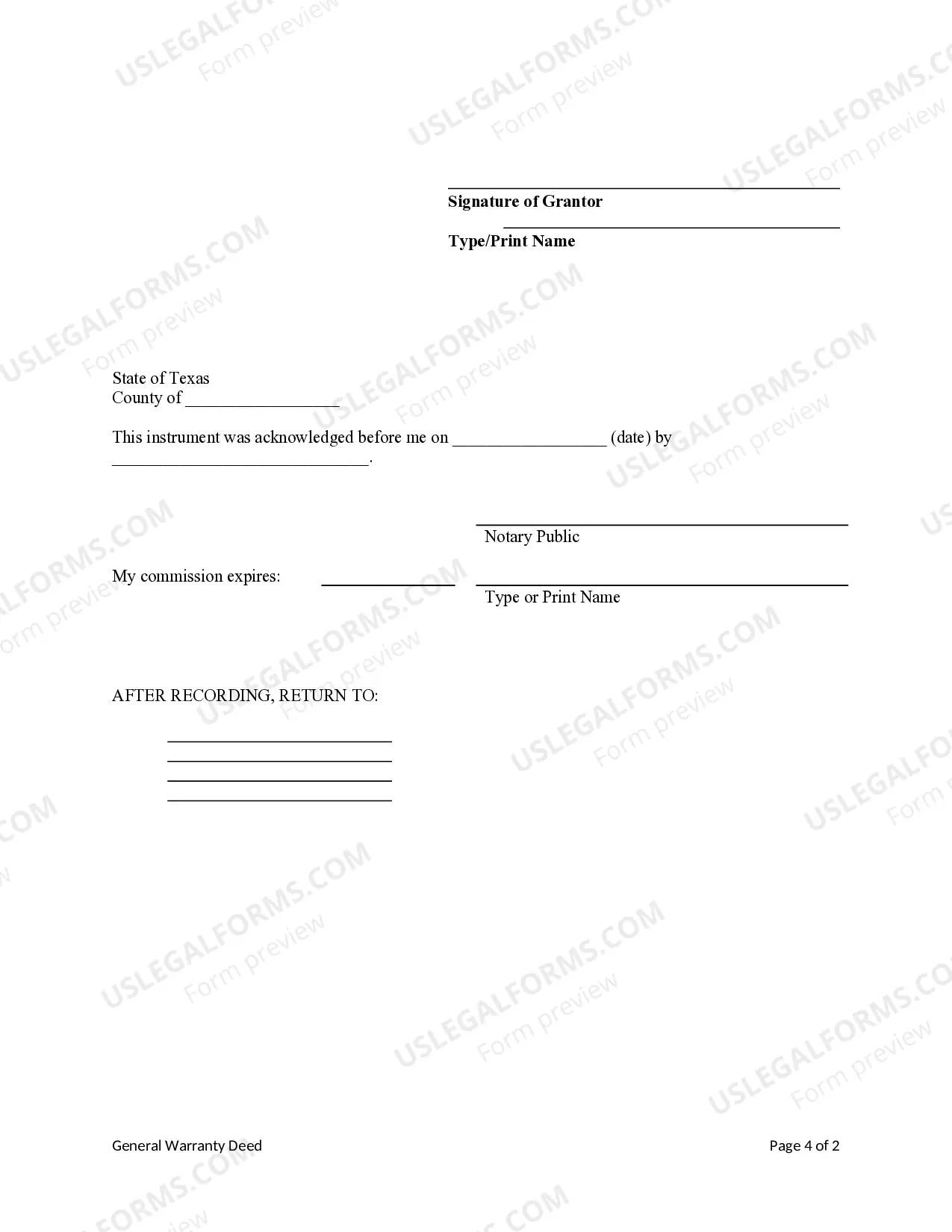
This General Warranty Deed is a legal document that facilitates the transfer of property from a general partnership to a limited liability company (LLC). This form provides comprehensive assurances regarding the title of the property, stating that the grantor (the general partnership) guarantees clear ownership and the right to transfer the property to the grantee (the LLC). Unlike other types of deeds, the General Warranty Deed offers the highest level of protection to the grantee, ensuring that any claims against the property are covered by the grantor.
Form components explained
- Identification of the grantor (general partnership) and grantee (limited liability company).
- Legal description of the property being conveyed.
- Acknowledgment of the consideration (the value exchanged for the property).
- Signatures of authorized representatives from the grantor and the grantee.
- Date of the transaction.


When to use this form
This form is typically used when a general partnership wishes to transfer real estate ownership to a limited liability company. Common scenarios include when members of the partnership decide to formalize their business structure or when property ownership needs to be aligned with liability protections afforded to LLCs. It's essential whenever the transfer includes both businesses and property assets.
Who this form is for
Eligibility for using this form generally includes:
- General partnerships intending to convey property.
- Limited liability companies receiving property as a result of the transfer.
- Business partners who prefer maximum protection during the property transfer.
Steps to complete this form
To complete the General Warranty Deed, follow these steps:
- Identify the grantor and grantee, ensuring the names are correctly spelled and reflect the official business registrations.
- Provide a precise legal description of the property being transferred, which can often be found on the current deed or tax records.
- Enter the amount of consideration being exchanged for the property, typically a monetary value.
- Ensure that all required parties sign the document in the presence of a notary, where applicable.
- Include the date of the transfer and keep copies for both the grantor and grantee for their records.
Notarization guidance
Yes, this form must be notarized to be legally valid. This step ensures that the signatures on the deed are verified and that the document adheres to legal requirements. U.S. Legal Forms offers integrated online notarization services that are available 24/7 via secure video calls, providing convenience and legal equivalence without requiring travel.
Get your form ready online
Our built-in tools help you complete, sign, share, and store your documents in one place.
Make edits, fill in missing information, and update formatting in US Legal Forms—just like you would in MS Word.
Download a copy, print it, send it by email, or mail it via USPS—whatever works best for your next step.
Sign and collect signatures with our SignNow integration. Send to multiple recipients, set reminders, and more. Go Premium to unlock E-Sign.
If this form requires notarization, complete it online through a secure video call—no need to meet a notary in person or wait for an appointment.
We protect your documents and personal data by following strict security and privacy standards.

Make edits, fill in missing information, and update formatting in US Legal Forms—just like you would in MS Word.

Download a copy, print it, send it by email, or mail it via USPS—whatever works best for your next step.

Sign and collect signatures with our SignNow integration. Send to multiple recipients, set reminders, and more. Go Premium to unlock E-Sign.

If this form requires notarization, complete it online through a secure video call—no need to meet a notary in person or wait for an appointment.

We protect your documents and personal data by following strict security and privacy standards.
Avoid these common issues
- Failing to include the complete and accurate legal description of the property.
- Not obtaining signatures from all necessary parties involved in the transaction.
- Omitting the date, which may lead to complications in the transfer process.
- Not ensuring the form is notarized if required by local laws.
Advantages of online completion
- Convenience of completing the form online without the need for physical paperwork.
- Editability allows for quick adjustments without needing to start over on a new document.
- Reliability through professionally drafted templates that conform to current legal standards.
Legal use & context
- A General Warranty Deed provides assurance to the grantee regarding the title of the property.
- The form must adhere to the laws of the state where the property is located.
- Using this form without proper legal consultation may result in future disputes over property ownership.
Main things to remember
- This form is essential for transferring property from a general partnership to a limited liability company.
- It ensures the grantee receives a warranty of clear title to the property.
- Attention to detail during completion is vital to avoid legal complications.
Looking for another form?
Form popularity
FAQ
The deed must be presented to and accepted by the grantee, and it should be filed of record in the county clerk's office to put the public on notice of the transfer. Failure to file the deed can subject the property to future claims by other parties. Most commonly, a grantor provides a general warranty deed.
Write the county where the property is located on line provided next to the words "County of" beneath the words "The State of Texas." Write the name and address of the grantor on the lines provided after the words "Know all men by these presents, That I."
Because partnerships require at least two members or individuals, a partnership becomes a single member LLC if there is only one person left in the business. As such, the IRS allows single-member LLCs to file a Form 8832 to elect treatment as a "disregarded entity" or sole proprietorship, according to UpCounsel.
File a Certificate of Amendment or Restated Certificate of Formation (only when the information in the certificate of formation has changed); Update the Responsible Party with the IRS, if applicable; Update the Membership Transfer Ledger, if applicable; and.
Methods of Conversion The first is to form a new LLC, dissolve the partnership, and transfer all the partnerships assets and liabilities to the new LLC. The second method, available in many states, is to file a form with the state agency in charge of business entities that converts the partnership into an LLC.
Regarding liability, an LLC is always better than a general partnership. You and your partners can form an LLC and limit your personal liability. However, there will be additional costs in setting up and registering an LLC.
Obtain Digital Signature for all the partners. Partners in LLP require a DPIN/DIN. Make an application in RUN-LLP Form for name reservation on MCA website. File Form FiLLiP for Application and Statement for the Conversion of Partnership Firm into LLP.
Find the most recent deed to the property. Start with the most recent deed to the property (the deed that transferred the property to the current grantor). Create a new deed. Sign and notarize the deed. File documents with the county records.
LLCs protect owners against personal liability for business debts and lawsuits. This safeguards the personal assets for all owners. In a general partnership, owners have unlimited, personal liability for the businesses' debts, including, but not limited to, the acts of employees.