Texas General Warranty Deed - Individual to Limited Liability Company
What this document covers
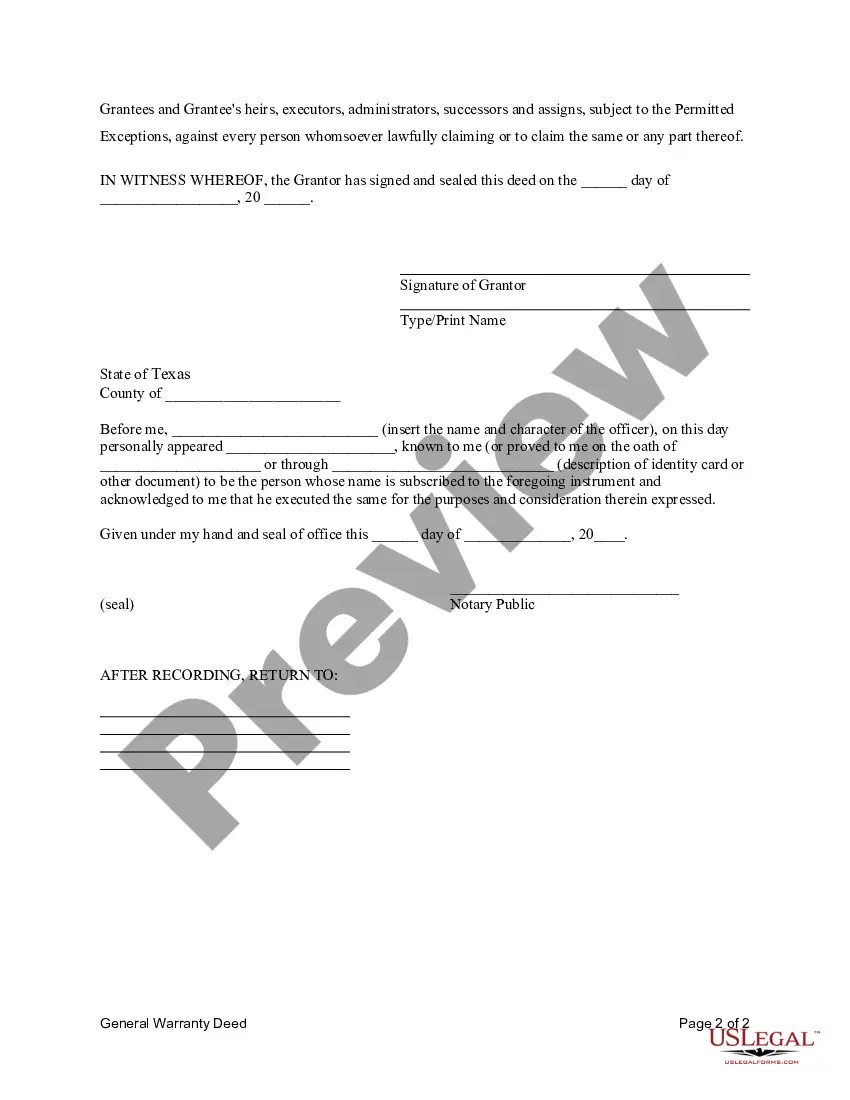
The General Warranty Deed - Individual to Limited Liability Company is a legal document used to transfer ownership of real estate from an individual (the grantor) to a limited liability company (the grantee). This form includes a guarantee from the grantor that they hold clear title to the property and have the right to sell it. Unlike other forms of deeds, this type specifically provides broader protections to the grantee against any claims on the property, ensuring that the title remains free from any encumbrances.
Key parts of this document
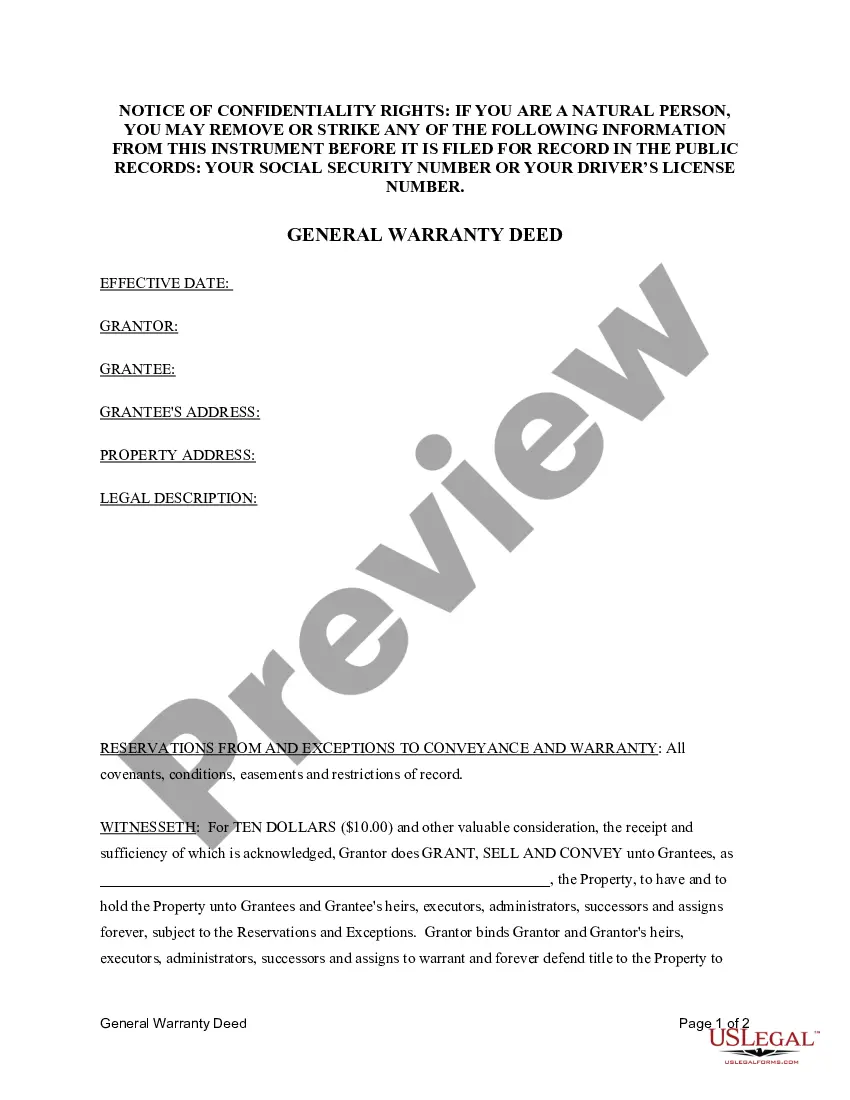
- Grantor's details: Name and signature of the individual transferring the property.
- Grantee's details: Name of the limited liability company receiving the property.
- Property description: A clear and precise description of the property being transferred.
- Consideration: A declaration of the payment or value exchanged for the property.
- Warranties: Clauses that assure the grantee of the grantor's clear title to the property.
- Execution date: The date on which the deed is signed.





Common use cases
You should use the General Warranty Deed when an individual wishes to transfer ownership of real estate to a limited liability company. This may occur in various situations including: establishing a business, simplifying property management, or protecting personal assets. This form is particularly useful for those transferring property they fully own and want to guarantee title security to the new owner.
Intended users of this form
This form is ideal for:
- Property owners who are individuals
- Limited liability companies seeking to acquire real estate
- Real estate investors involved in property transfers
- Attorneys handling property transactions
Steps to complete this form
- Identify the parties: Fill in the name of the grantor and the grantee.
- Specify the property: Clearly describe the property to be transferred.
- Enter consideration: State the amount or value being exchanged for the property.
- Include warranties: Review and complete any warranty clauses as needed.
- Date and sign: Ensure the form is dated and signed by the grantor.
Is notarization required?
This form needs to be notarized to ensure legal validity. US Legal Forms provides secure online notarization powered by Notarize, allowing you to complete the process through a verified video call, available anytime.
Get your form ready online
Our built-in tools help you complete, sign, share, and store your documents in one place.
Make edits, fill in missing information, and update formatting in US Legal Forms—just like you would in MS Word.
Download a copy, print it, send it by email, or mail it via USPS—whatever works best for your next step.
Sign and collect signatures with our SignNow integration. Send to multiple recipients, set reminders, and more. Go Premium to unlock E-Sign.
If this form requires notarization, complete it online through a secure video call—no need to meet a notary in person or wait for an appointment.
We protect your documents and personal data by following strict security and privacy standards.

Make edits, fill in missing information, and update formatting in US Legal Forms—just like you would in MS Word.

Download a copy, print it, send it by email, or mail it via USPS—whatever works best for your next step.

Sign and collect signatures with our SignNow integration. Send to multiple recipients, set reminders, and more. Go Premium to unlock E-Sign.

If this form requires notarization, complete it online through a secure video call—no need to meet a notary in person or wait for an appointment.

We protect your documents and personal data by following strict security and privacy standards.
Typical mistakes to avoid
- Failing to include a full and accurate property description.
- Not properly signing or dating the deed, which can invalidate the transfer.
- Leaving out the consideration amount or value exchanged.
- Not clearly identifying the grantee as a limited liability company.
Advantages of online completion
- Convenience of instant downloading and form completion.
- Editability allows for easy corrections before finalization.
- Reliability through forms drafted by licensed attorneys.
Quick recap
- The General Warranty Deed is crucial for transferring ownership with legal assurances.
- It is specifically designed for transfers from individuals to limited liability companies.
- Completing this form accurately is essential to avoid legal issues regarding property ownership.
- Online access provides flexibility and enhances the ease of document preparation.
Looking for another form?
Form popularity
FAQ
Find the most recent deed to the property. It is best to begin with a copy of the most recent deed to the property (the deed that transferred the property to the current grantor). Create a new deed. Sign and notarize the deed. File the documents in the county land records.
Retrieve your original deed. Get the appropriate deed form. Draft the deed. Sign the deed before a notary. Record the deed with the county recorder. Obtain the new original deed.
Contrary to normal expectations, the Deed DOES NOT have to be recorded to be effective or to show delivery, and because of that, the Deed DOES NOT have to be signed in front of a Notary Public. However, if you plan to record it, then it does have to be notarized as that is a County Recorder requirement.
Write the county where the property is located on line provided next to the words "County of" beneath the words "The State of Texas." Write the name and address of the grantor on the lines provided after the words "Know all men by these presents, That I."
To make the form legally binding, you must sign it in front of a notary public. You must then file your signed and notarized deed with the county office that's in charge of recording property documents. Once the grantee signs the warranty deed, he/she legally has ownership and claim to the property.
Fill out the "grantor" section of the warranty deed. The grantors are the givers, or current owners, of the property. Use the legal name of each grantor and insert current addresses after each grantor's name.
In Texas, you can't add your spouse's name to an existing deed, but you can create a new deed by transferring the property from yourself to you and your spouse jointly. You can do this by using either a deed without warranty or a quit claim deed.
The name and address of the seller (called the grantor) The name and address of the buyer (called the grantee) A legal description of the property (found on the previous deed) A statement that the grantor is transferring the property to the grantee.
The Texas General Warranty Deed is a form that transfers real estate ownership in the clearest possible manner promising the new owner that there are no title defects such as liens or encumbrances.