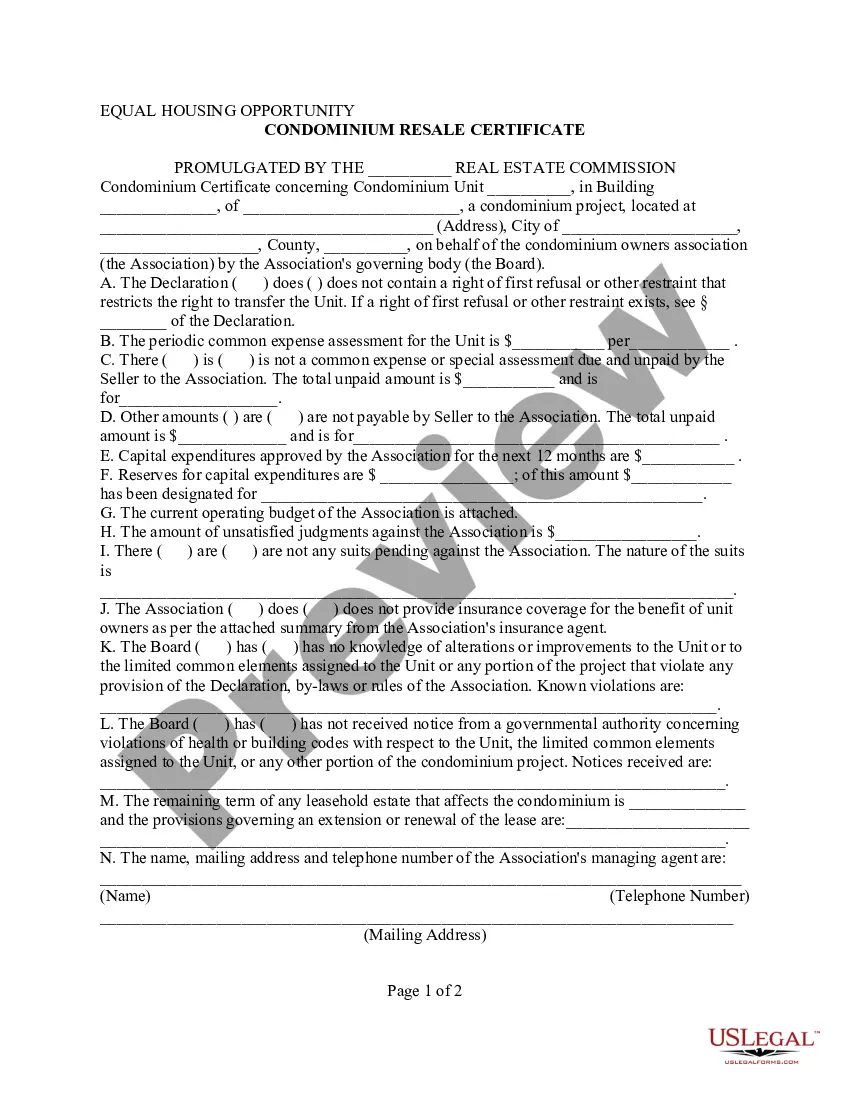
Texas Motion for Order that Deposition be taken at a Designated Place other than that Stated in Notice
What this document covers
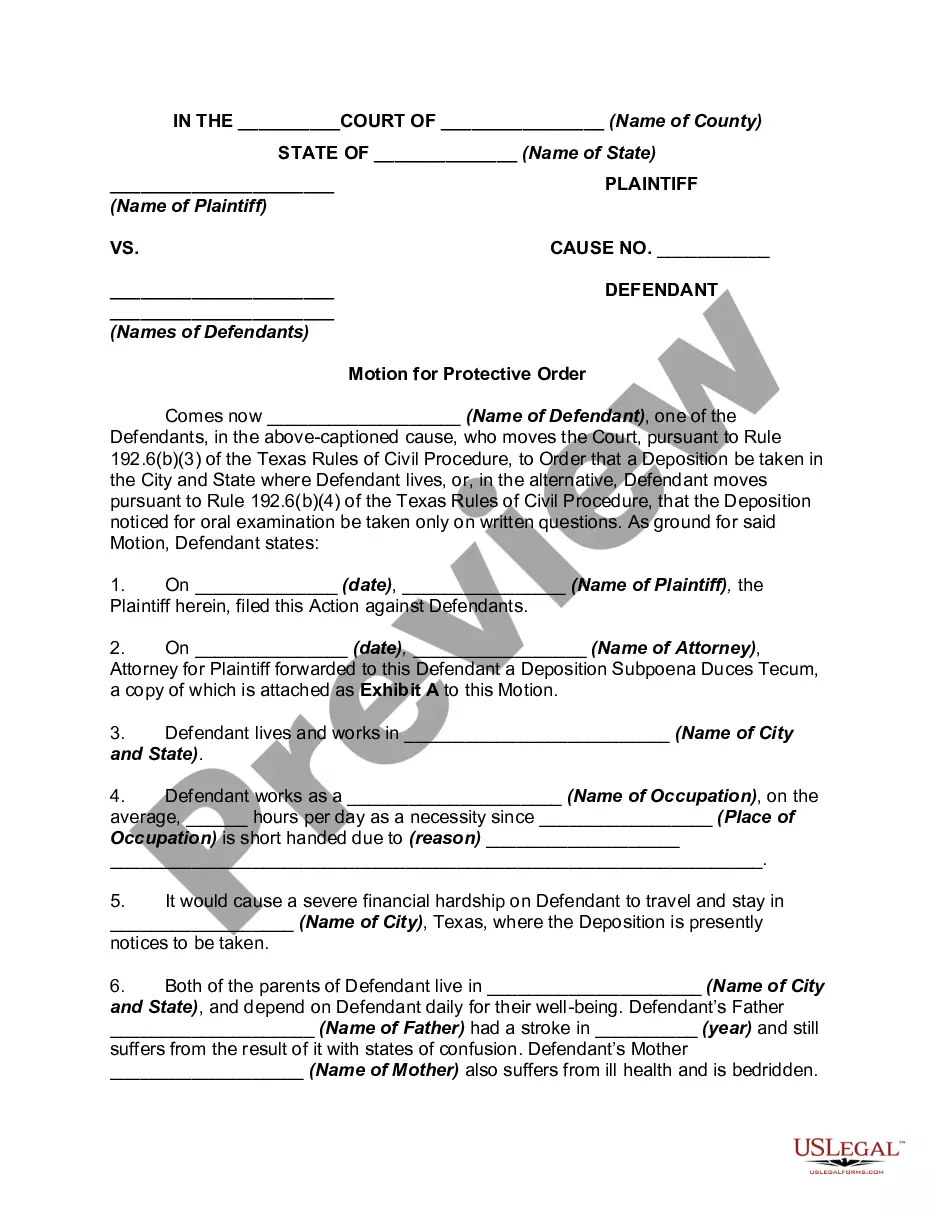
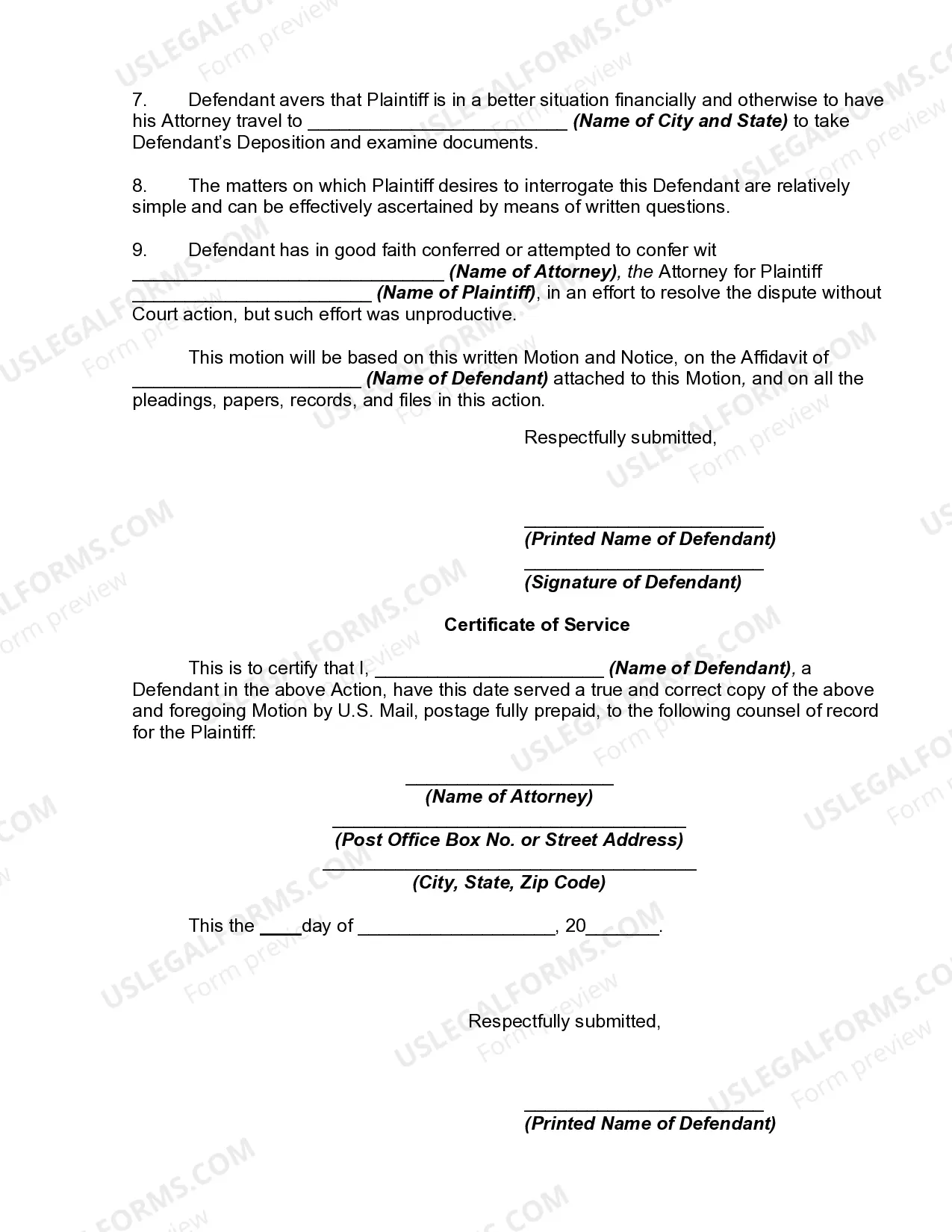
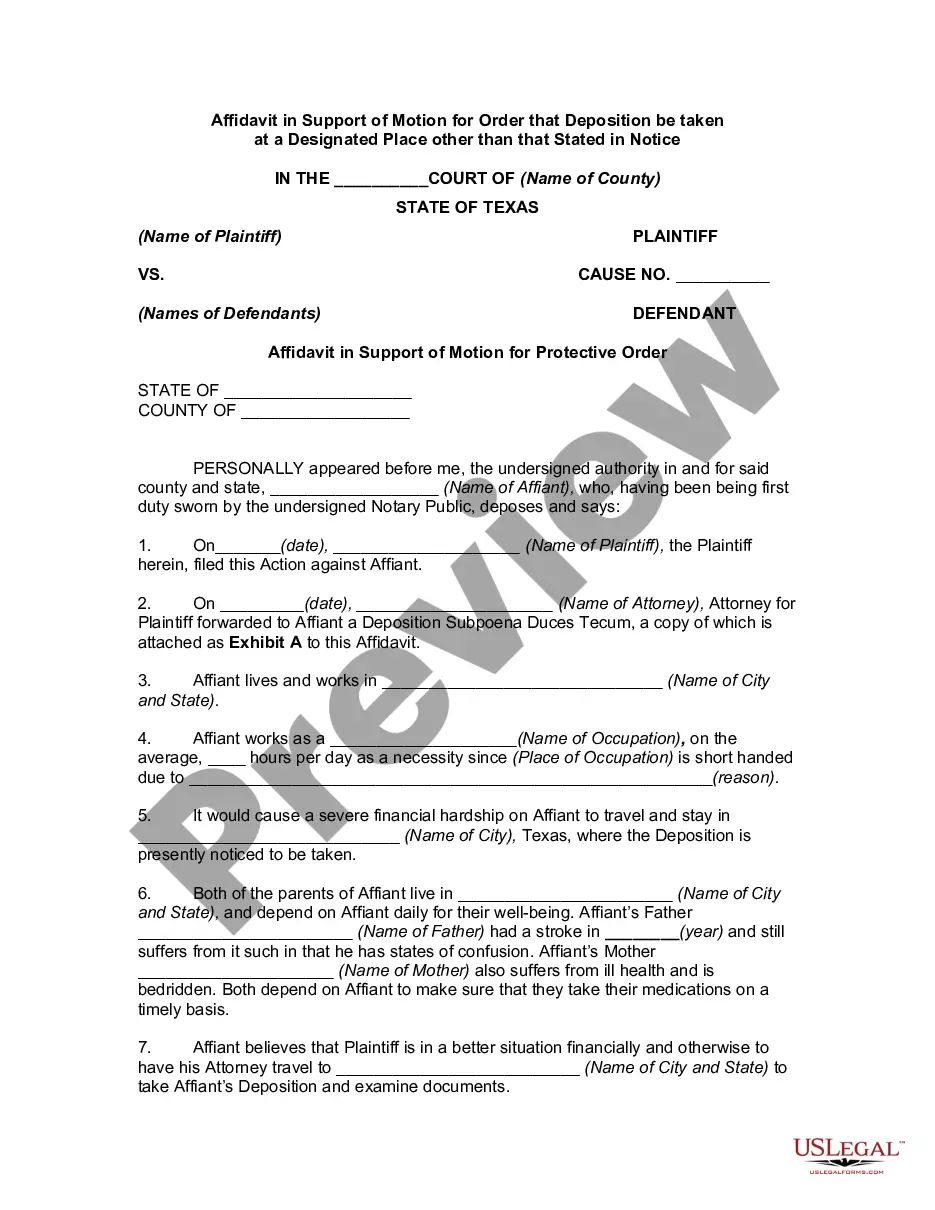
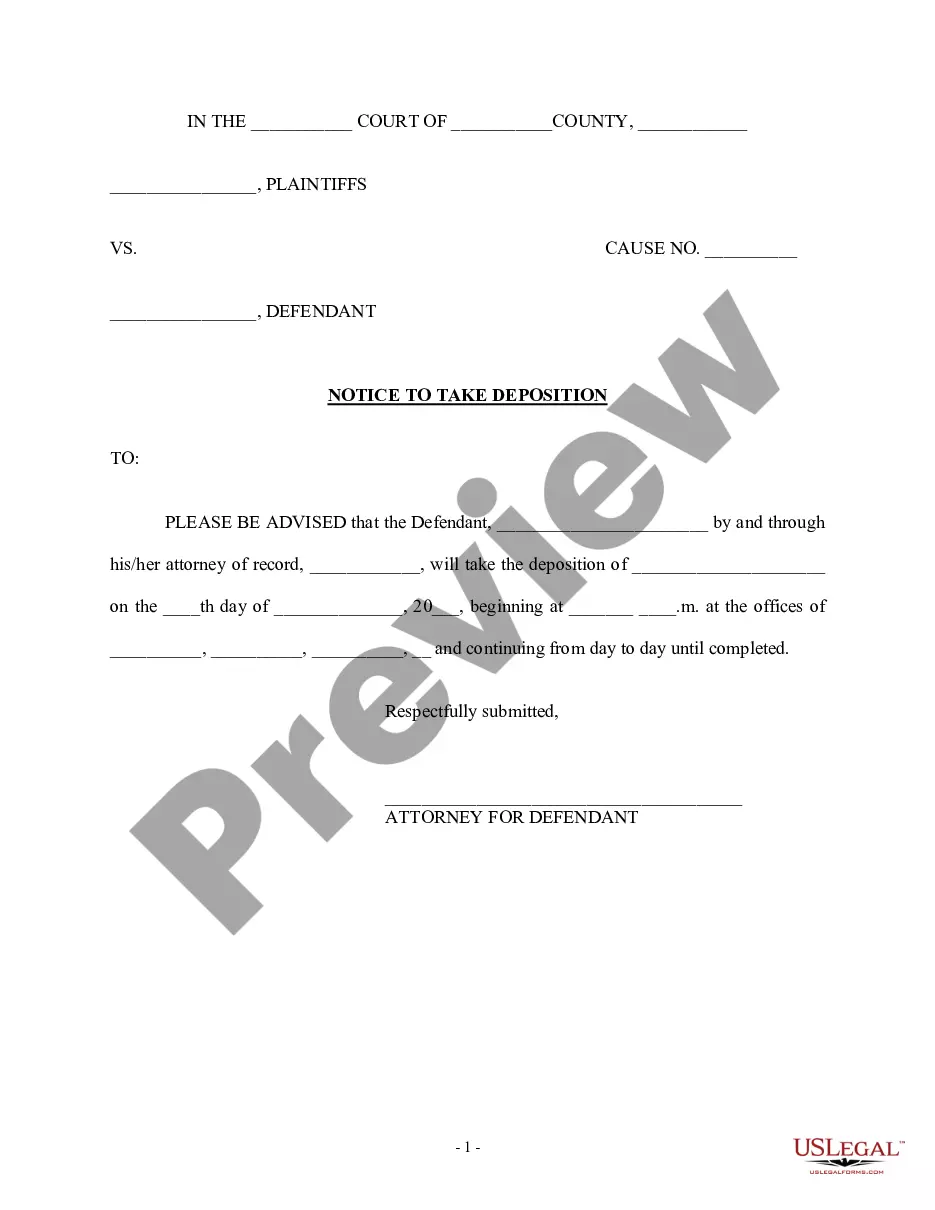
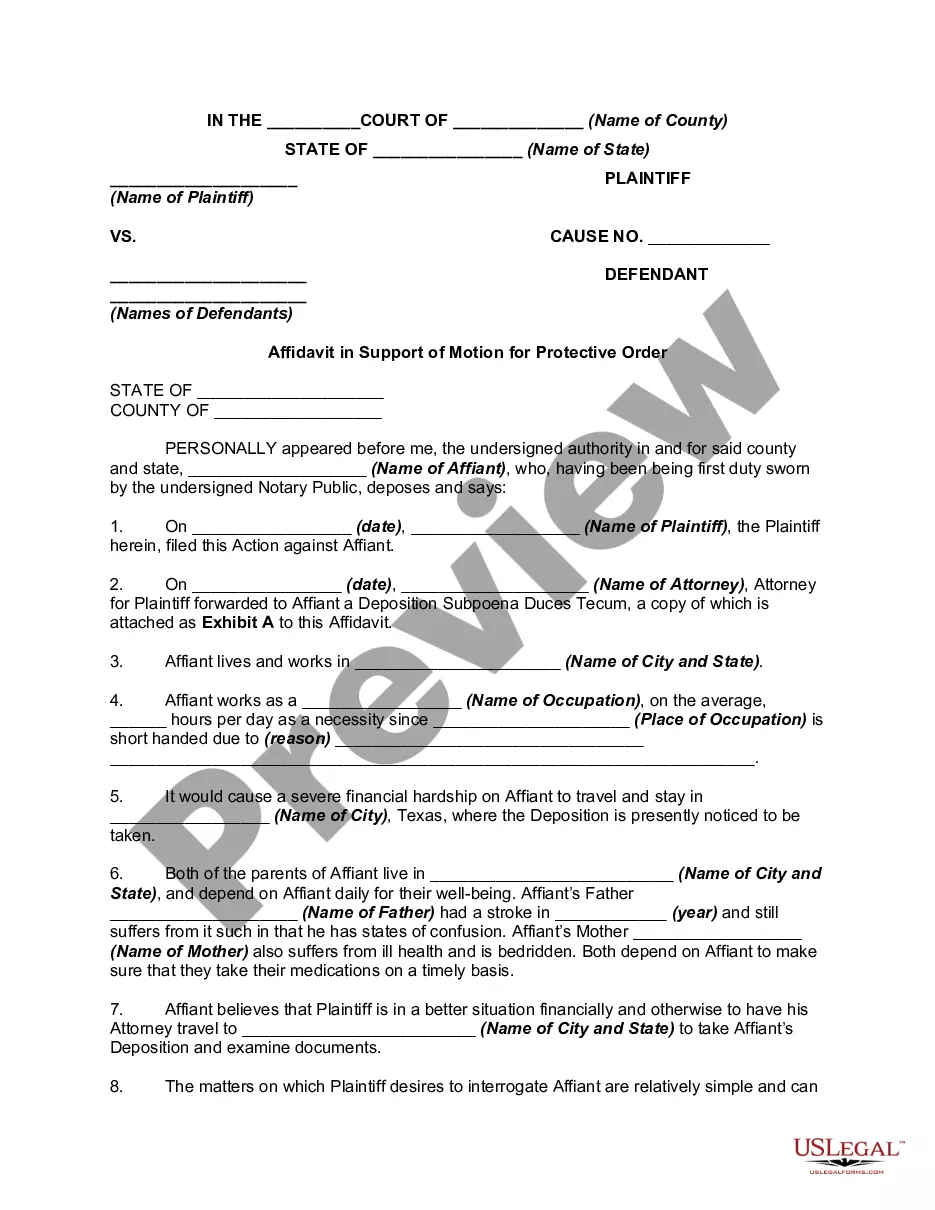
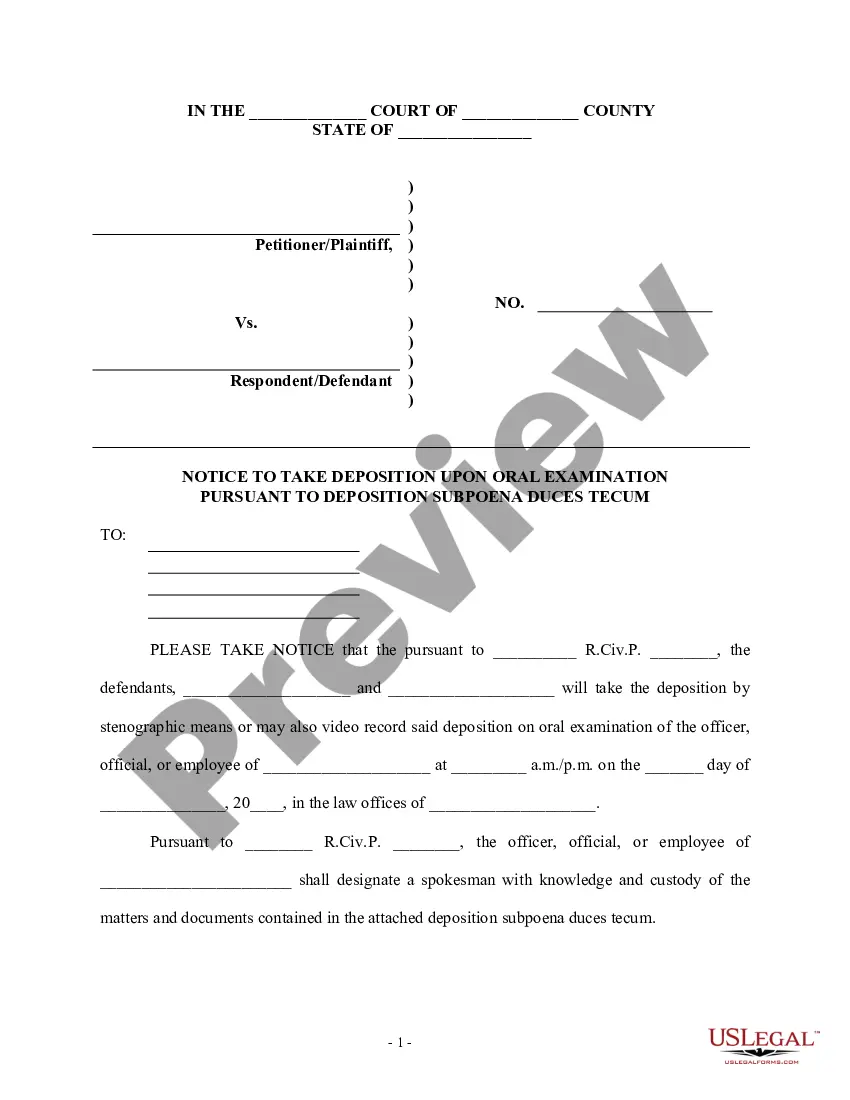
The Motion for Order that Deposition be taken at a Designated Place other than that Stated in Notice is a legal document used in Texas civil procedures. This form allows a defendant to request a change in the location where a deposition is scheduled, providing valid reasons for the request. It ensures the defendant can participate in the discovery process while minimizing unnecessary burdens or costs. This form differs from other discovery motions by specifically addressing the location of the deposition rather than the content or scope of the information requested.
What’s included in this form
- Identification of the parties involved in the case (plaintiff and defendant).
- Statement of the request to change the deposition location, citing the relevant Texas procedural rule.
- Explanation of the reasons for the request, including personal and financial hardships.
- Details about the communication efforts made with the opposing party.
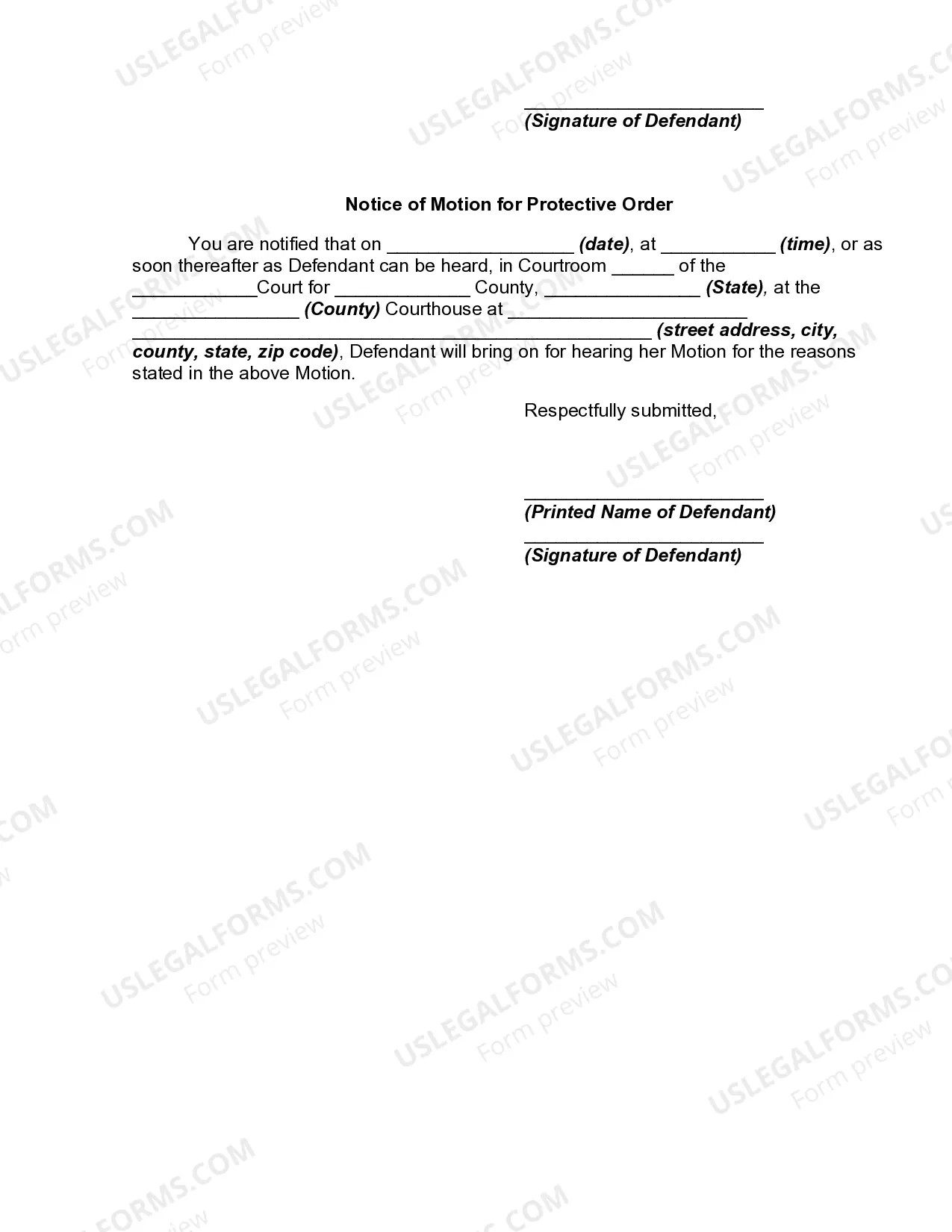
- Notice of the hearing date for the motion in court.

Situations where this form applies
This form is useful in situations where a defendant has received a deposition notice but is unable to attend at the originally specified location due to financial, personal, or logistical challenges. It can be used when the defendant's location is significantly distant from the designated place, or if attending would cause undue hardship.
Who can use this document
- Defendants in a civil lawsuit in Texas who have been served with a notice of deposition.
- Individuals or parties who need to change the location of their deposition for valid reasons.
- Legal representatives seeking to formally document the request for a protective order regarding deposition logistics.
Instructions for completing this form
- Identify the parties involved by filling in names of the plaintiff and defendant.
- State the current schedule and location for the deposition as indicated in the notice.
- Provide a detailed explanation of personal circumstances that justify changing the location.
- Include information about any efforts made to resolve the issue with the opposing party.
- Sign the document and include a certificate of service to notify the involved parties regarding the motion.
Notarization guidance
This form does not typically require notarization unless specified by local law. It is advisable to review the local court requirements or consult an attorney to confirm if notarization is necessary in your circumstance.
Get your form ready online
Our built-in tools help you complete, sign, share, and store your documents in one place.
Make edits, fill in missing information, and update formatting in US Legal Forms—just like you would in MS Word.
Download a copy, print it, send it by email, or mail it via USPS—whatever works best for your next step.
Sign and collect signatures with our SignNow integration. Send to multiple recipients, set reminders, and more. Go Premium to unlock E-Sign.
If this form requires notarization, complete it online through a secure video call—no need to meet a notary in person or wait for an appointment.
We protect your documents and personal data by following strict security and privacy standards.

Make edits, fill in missing information, and update formatting in US Legal Forms—just like you would in MS Word.

Download a copy, print it, send it by email, or mail it via USPS—whatever works best for your next step.

Sign and collect signatures with our SignNow integration. Send to multiple recipients, set reminders, and more. Go Premium to unlock E-Sign.

If this form requires notarization, complete it online through a secure video call—no need to meet a notary in person or wait for an appointment.

We protect your documents and personal data by following strict security and privacy standards.
Typical mistakes to avoid
- Failing to provide sufficient justification for changing the deposition location.
- Not including a certificate of service to inform the opposing party.
- Omitting details about previous attempts to resolve the deposition location issue.
- Not adhering to the timeline required by Texas Rules of Civil Procedure for filing the motion.
Advantages of online completion
- Convenience of downloading and completing the form at your own pace.
- Editability allows for easy customization to fit your specific needs.
- Access to attorney-drafted templates ensures compliance with legal standards.
Legal use & context
- This motion is governed by the Texas Rules of Civil Procedure, ensuring it is a legally recognized method to request a deposition location change.
- If granted, the motion can significantly ease the burden on the defendant and enable proper participation in the discovery process.
- Understanding how to use this form correctly can prevent potential delays or complications in legal proceedings.
Main things to remember
- The motion provides a formal way to request a more convenient deposition location.
- It is essential to include valid reasons for the requested change.
- Proper completion and filing of the motion can protect your rights during the discovery process.
Looking for another form?

Form popularity
FAQ
Lie.Begin an answer with Well to be honest with you2026.Guess and speculate.Engage in casual conversations with the court reporter and other people present in the depositions.Volunteer information.Don't review documents carefully.Lose your temper.Don't take breaks.10 Things Not To Do in Your Deposition\nmallon-lonnquist.com > blog > 10-things-not-do-your-deposition
Hearsay. You're free to object to a question of hearsay during a trial.Assume facts, not in evidence. It depends.Calls for an opinion.Speaking and coaching objections.Privilege.Form.Mischaracterizes earlier testimony.Asked and answered.A Round List of Proper Deposition Objections - PracticePanther\nwww.practicepanther.com > blog > what-proper-deposition-objection
21 provides that misjoinder of parties is not ground for dismissal of an action, and that parties may be dropped or added by court order on motion of any party or of the court's own initiative at any stage in the action and on such terms as are just.
RULE 30(B)(6) SHOULD REQUIRE AT LEAST 30 DAYS' NOTICE IN ORDER TO ENSURE PROPER PREPARATION, AND THE DEPOSITION SHOULD BE SCHEDULED AT A TIME AND DATE AGREEABLE TO BOTH PARTIES. A. Reasonable Notice Is at Least 30 Days Prior to Deposition.
By Jules Epstein. Everyone has seen words taken out of context, and thus given new and unintended meaning.
Rule 306a. Date of Judgment or Order (1981) Rule 306a. Date of Judgment or Order (1981) Judges, attorneys and clerks are directed to use their best efforts to cause all judgments, decisions, and orders of any kind to be reduced to writing and signed by the trial judge with the date of signing stated therein.
Prepare before the deposition: Review any relevant discovery information already provided. Keep responses short, precise, and truthful: The witness should avoid rambling and being over-inclusive in responses. Think before responding: It is a good idea to pause and think before responding.
1Preparation. The most important thing when defending a deposition is to have a well-prepared witness.2Practice Aikido.3Anticipate Objections.4Transcript Awareness!5Protect Your Witness.
1Listen to the question.2Only answer the question that is asked.3Ask the questioner to rephrase questions you don't understand.4Maintain your composure.5Don't interrupt the questioner.6Stick to truthful answers.7Don't use non-verbal communication to answer questions.Some of the Most Commonly Asked Deposition Questions - Jilio-Ryan\nwww.jilioryan.com > blog > some-of-the-most-commonly-asked-depositio...