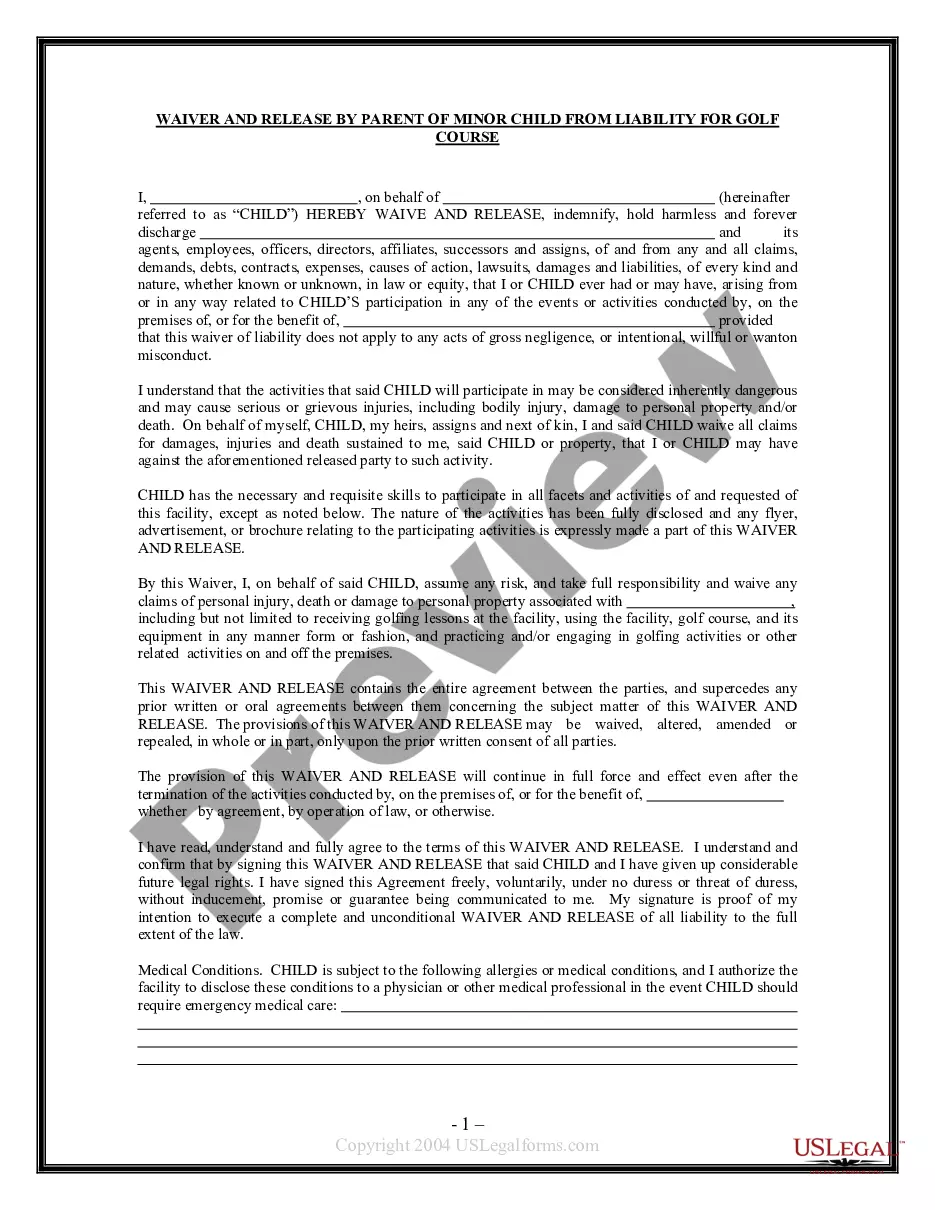
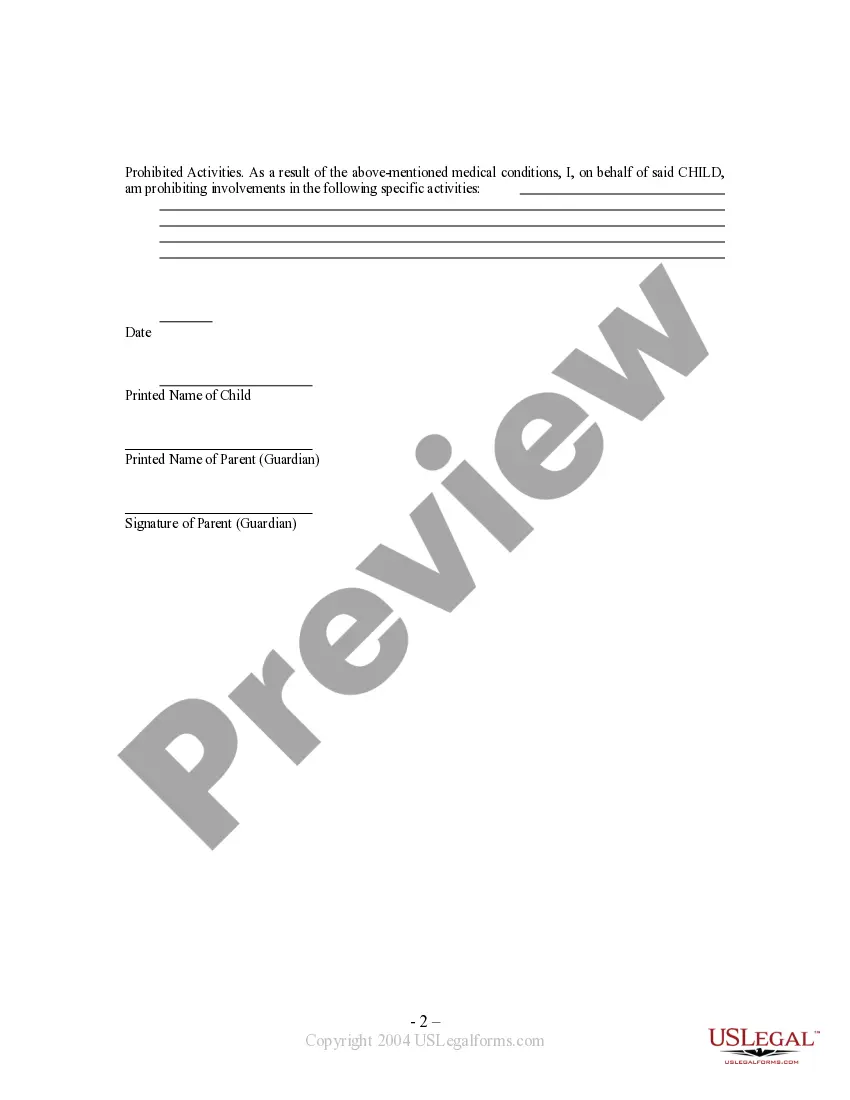
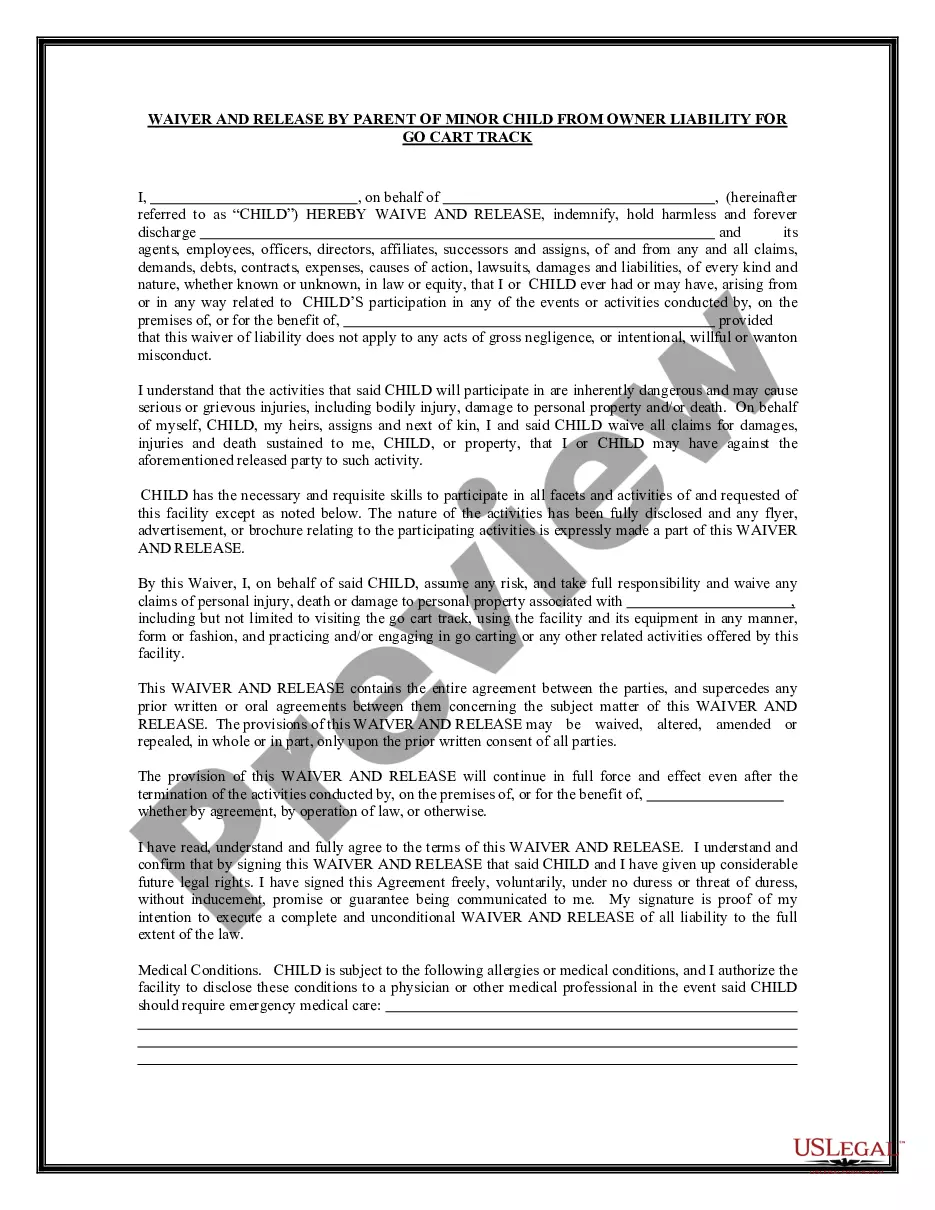
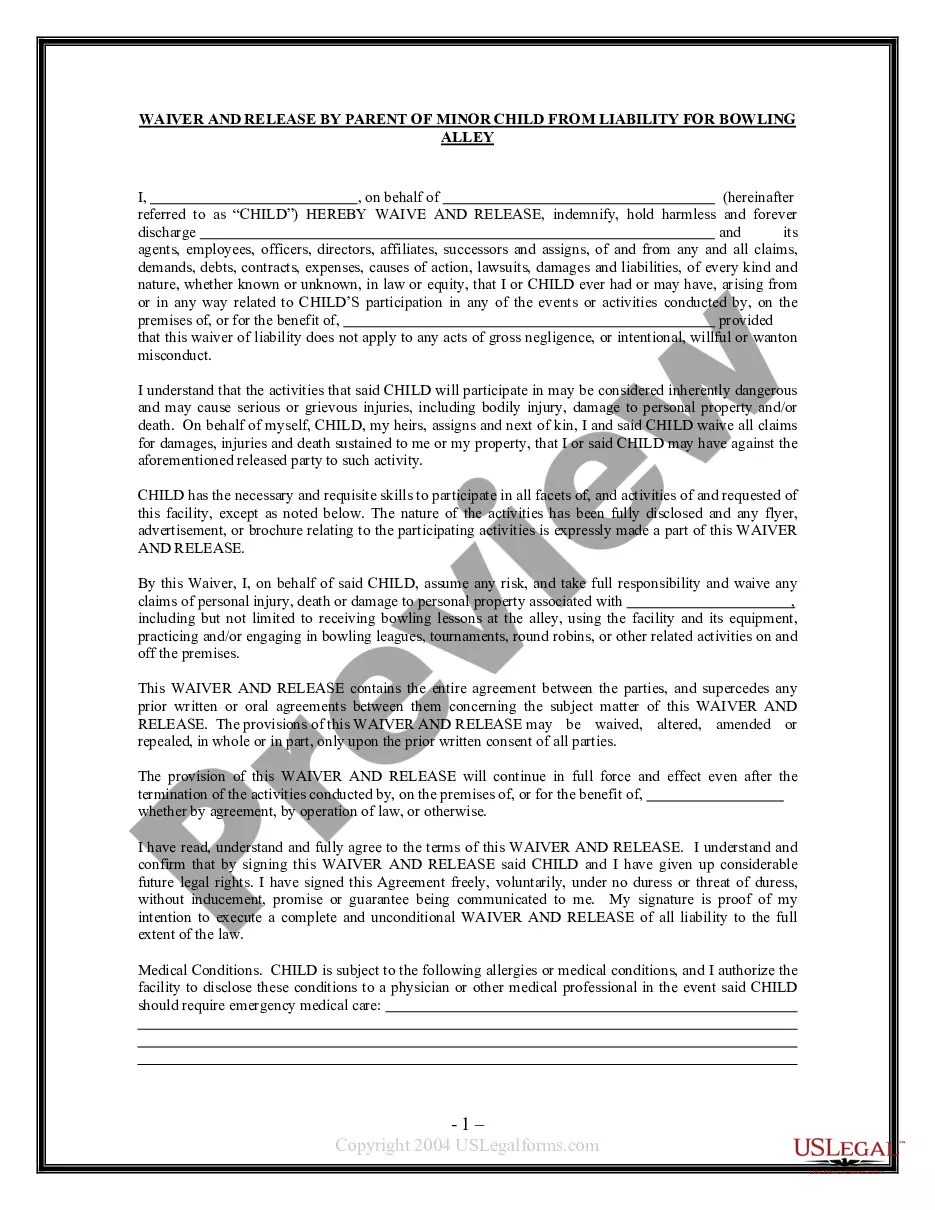
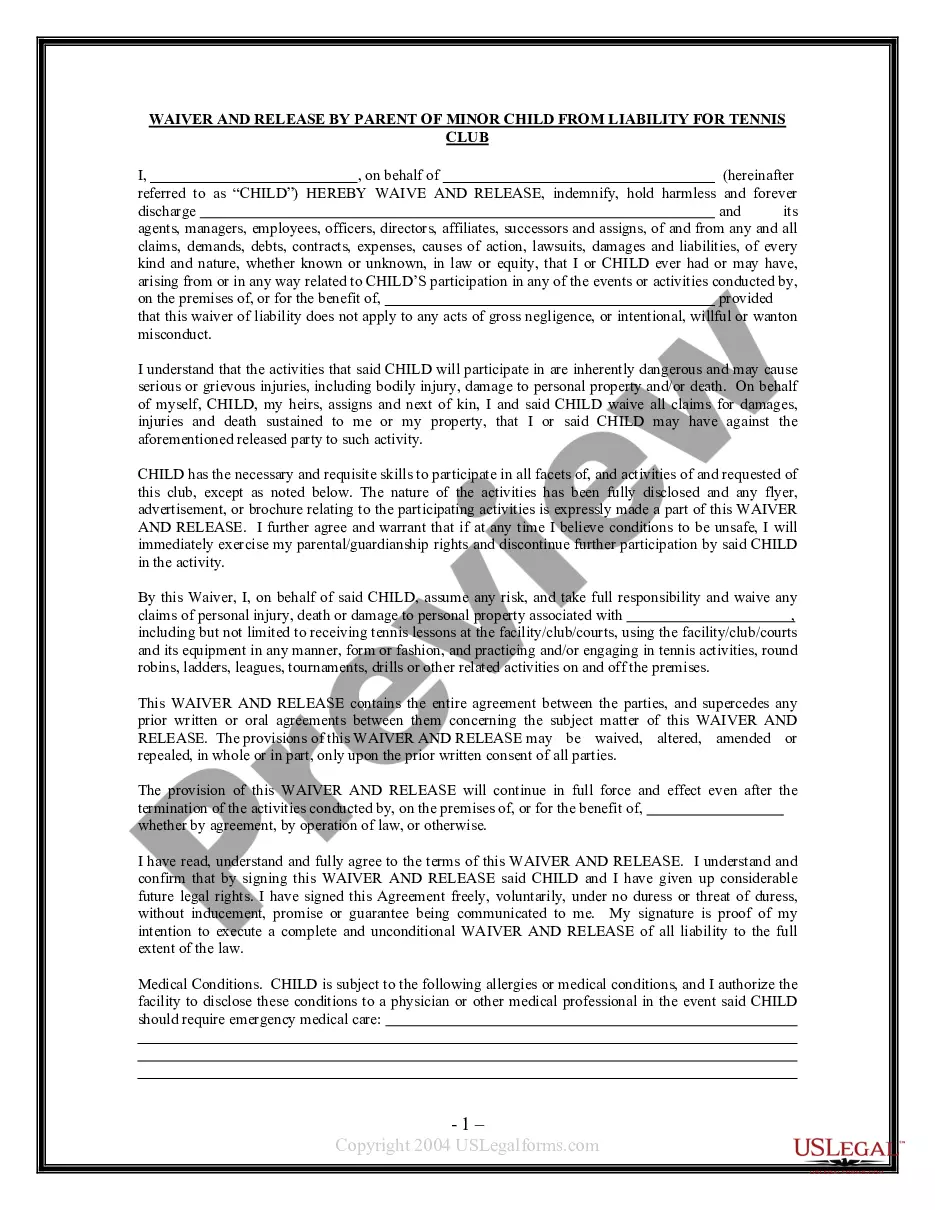
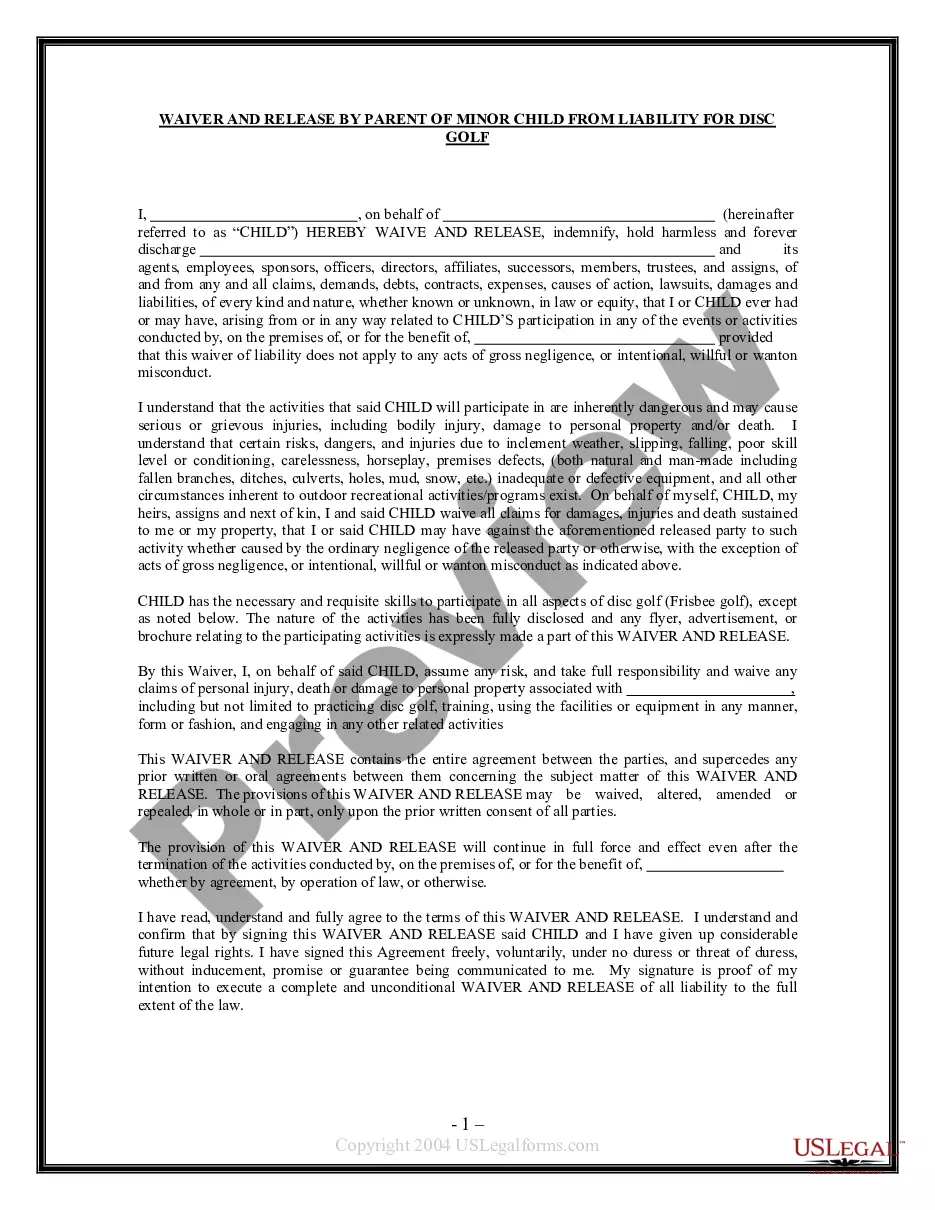
This form allows a parent or guardian to release a golf course facility from liability for injuries which may be incurred by a minor child while on the premises, taking part in activities, etc.
Tennessee Waiver and Release From Liability For Minor Child for Golf Course
Category:
State:
Multi-State
Control #:
US-WAV-07M
Format:
Word;
Rich Text
Instant download
Description
Free preview

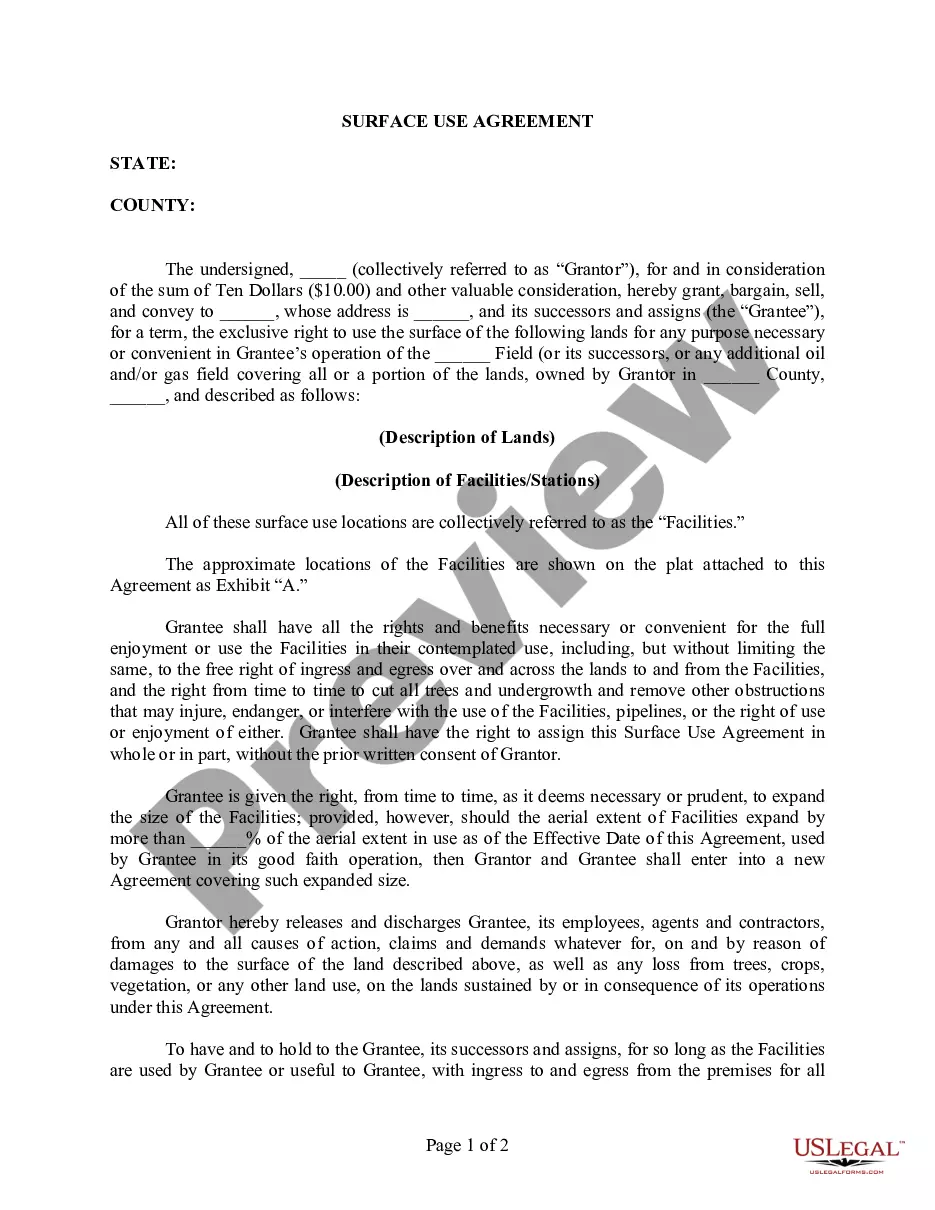
How to fill out Waiver And Release From Liability For Minor Child For Golf Course?
US Legal Forms - one of the largest repositories of legal documents in the United States - offers a variety of legal form templates that you can download or print.
By utilizing the website, you will find thousands of forms for business and personal use, categorized by types, states, or keywords.
You can quickly locate the latest versions of forms such as the Tennessee Waiver and Release From Liability For Minor Child for Golf Course in just seconds.
If the form does not meet your requirements, use the Search field at the top of the screen to find the one that does.
Once you are satisfied with the form, confirm your choice by clicking the Get now button. Then, select the payment plan you prefer and provide your credentials to register for the account.
- If you already have a monthly subscription, Log In and obtain the Tennessee Waiver and Release From Liability For Minor Child for Golf Course from your US Legal Forms collection.
- The Obtain button will appear on each form you view.
- You can access all previously downloaded forms in the My documents tab of your account.
- If you wish to use US Legal Forms for the first time, here are simple instructions to help you get started.
- Ensure you have selected the correct form for your area/state.
- Click on the Review button to examine the form's content.
Form popularity
FAQ
Yes, you can create your own liability waiver, but it’s important to follow legal guidelines to ensure its enforceability. Start by identifying the specific risks tied to the activity, like golfing. Make sure the language is straightforward and that it includes essential elements such as the acknowledgment of risks and a release of liability. If you prefer a structured approach, utilize the Tennessee Waiver and Release From Liability For Minor Child for Golf Course available through uslegalforms.
Writing a simple waiver requires clarity and conciseness. Begin by stating the purpose of the waiver and identifying the parties involved. Clearly describe the risks associated with the activity, such as those inherent to golf. Lastly, ensure there is a clear section for signatures to confirm understanding and agreement. For an effective example, you can refer to the Tennessee Waiver and Release From Liability For Minor Child for Golf Course on uslegalforms.
To create your own liability waiver, start by researching the specific risks related to the activity, like golfing. Write the document in simple language, ensuring it is easy for parents to understand. Include a statement that requires participants to acknowledge the risks and agree not to hold the organization responsible. A reliable resource for this is the Tennessee Waiver and Release From Liability For Minor Child for Golf Course found on uslegalforms.
Creating a liability waiver involves several key steps. First, clearly define the risks associated with the activity, such as golfing. Next, outline the terms of the agreement, ensuring it is understandable and comprehensive. Finally, have participants sign the waiver, ideally in the presence of a witness. For a tailored approach, consider using a Tennessee Waiver and Release From Liability For Minor Child for Golf Course available on uslegalforms.
A hold harmless agreement for youth sports is a legal document that protects organizations and coaches from liability in case of injuries or accidents. By signing this agreement, parents agree not to hold the organization responsible for any injuries their child may sustain while participating. This is particularly important for activities such as golf, where there are inherent risks involved. To ensure your child is covered, you can use a Tennessee Waiver and Release From Liability For Minor Child for Golf Course.
A waiver is a demonstration, usually in written form, of a party's intent to relinquish a legal right or claim. The key point to note is that the relinquishment is voluntary, and can apply to a variety of legal situations. Essentially, a waiver removes a real or potential liability for the other party in the agreement.
AN AGREEMENT NOT TO SUE THE RELEASEES for any loss, injury, costs or damages of any form or type, howsoever caused or arising, and whether directly or indirectly from the participation of my minor child/ward in any aspect of the EVENT; and. 4.
A liability waiver is a legal document that a person who participates in an activity may sign to acknowledge the risks involved in their participation. By doing so, the company attempts to remove legal liability from the business or person responsible for the activity.
The main difference between releases and waivers is the transferring of ownership. When rights are released, they are transferred to another party. When rights are waived, they are gone altogether.
Liability waivers are enforceable in California solely to the extent they shift to the customer the risk of ordinary negligence. Under California law, a liability waiver cannot excuse an injury caused by a defendant's gross negligence, recklessness or intentionally wrongful act.