Tennessee Writ of Possession
What this document covers
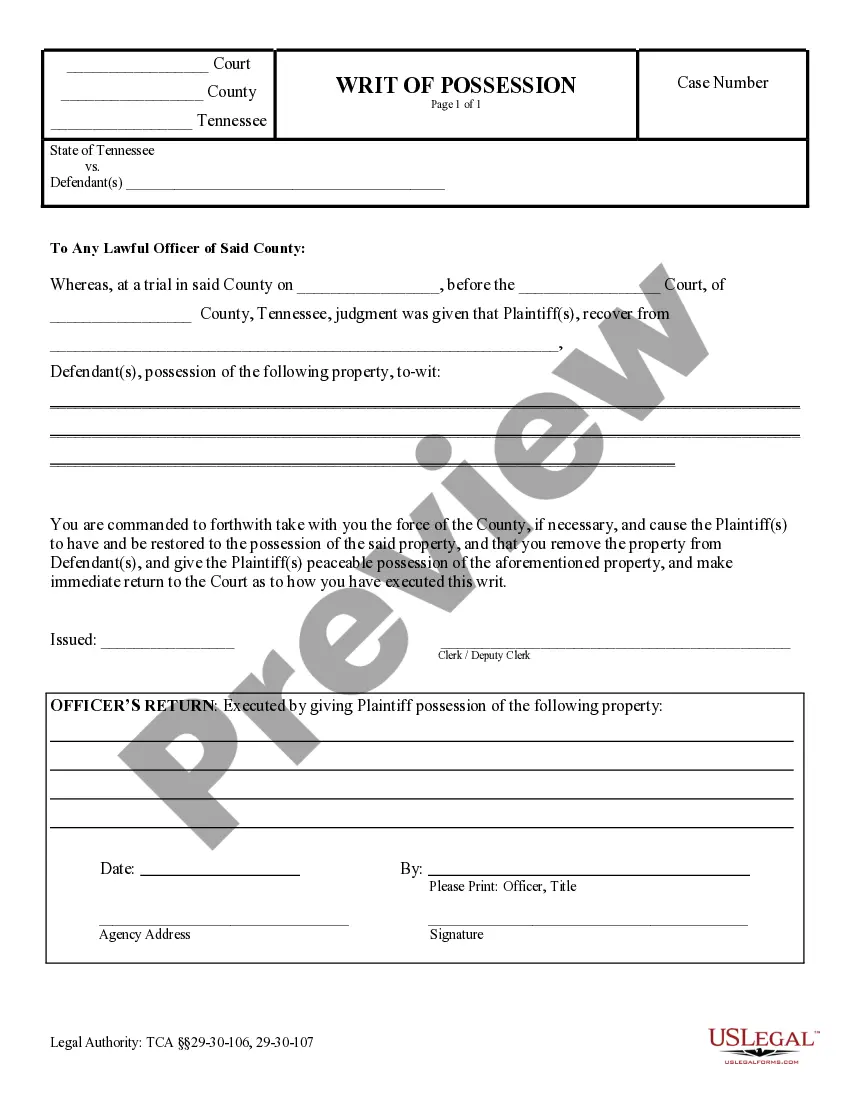
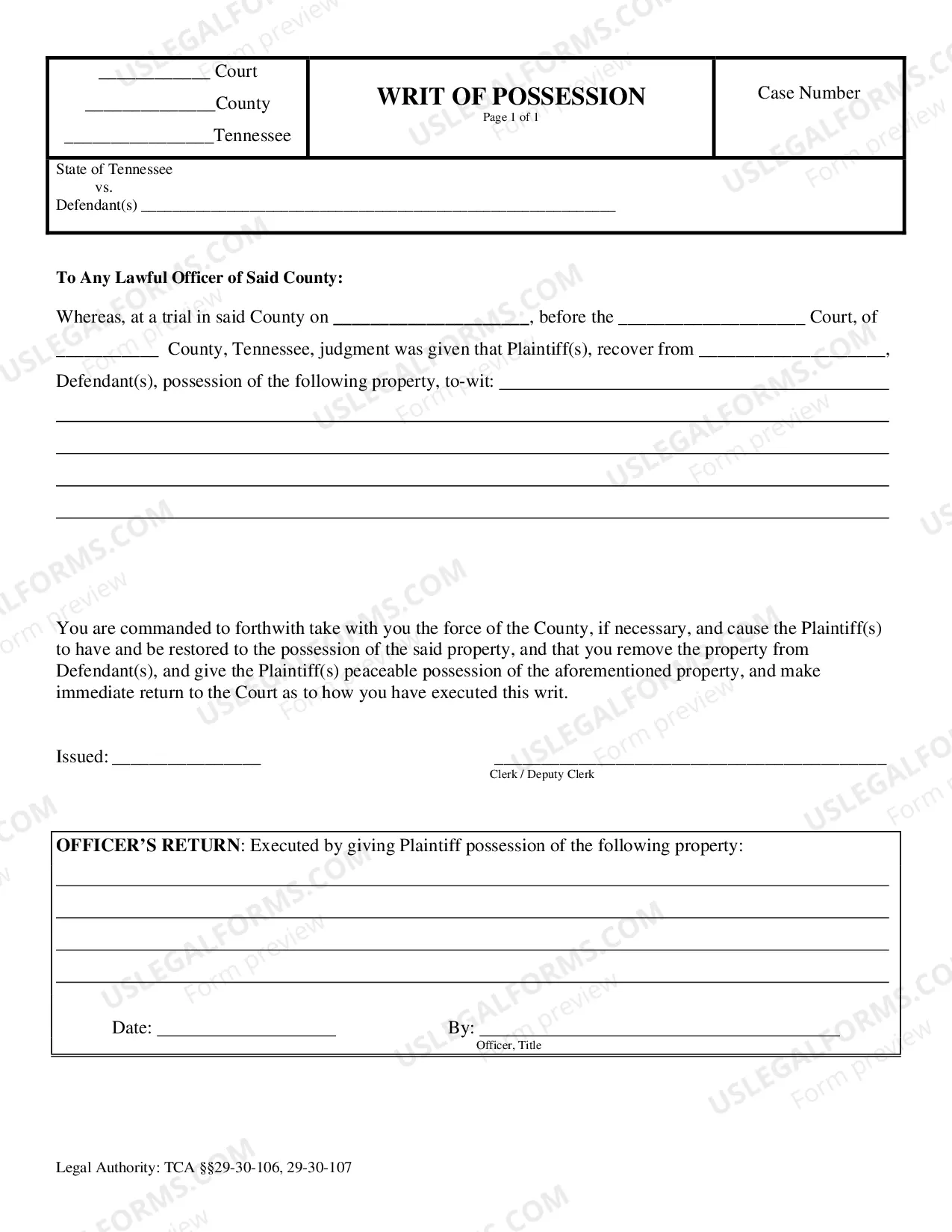
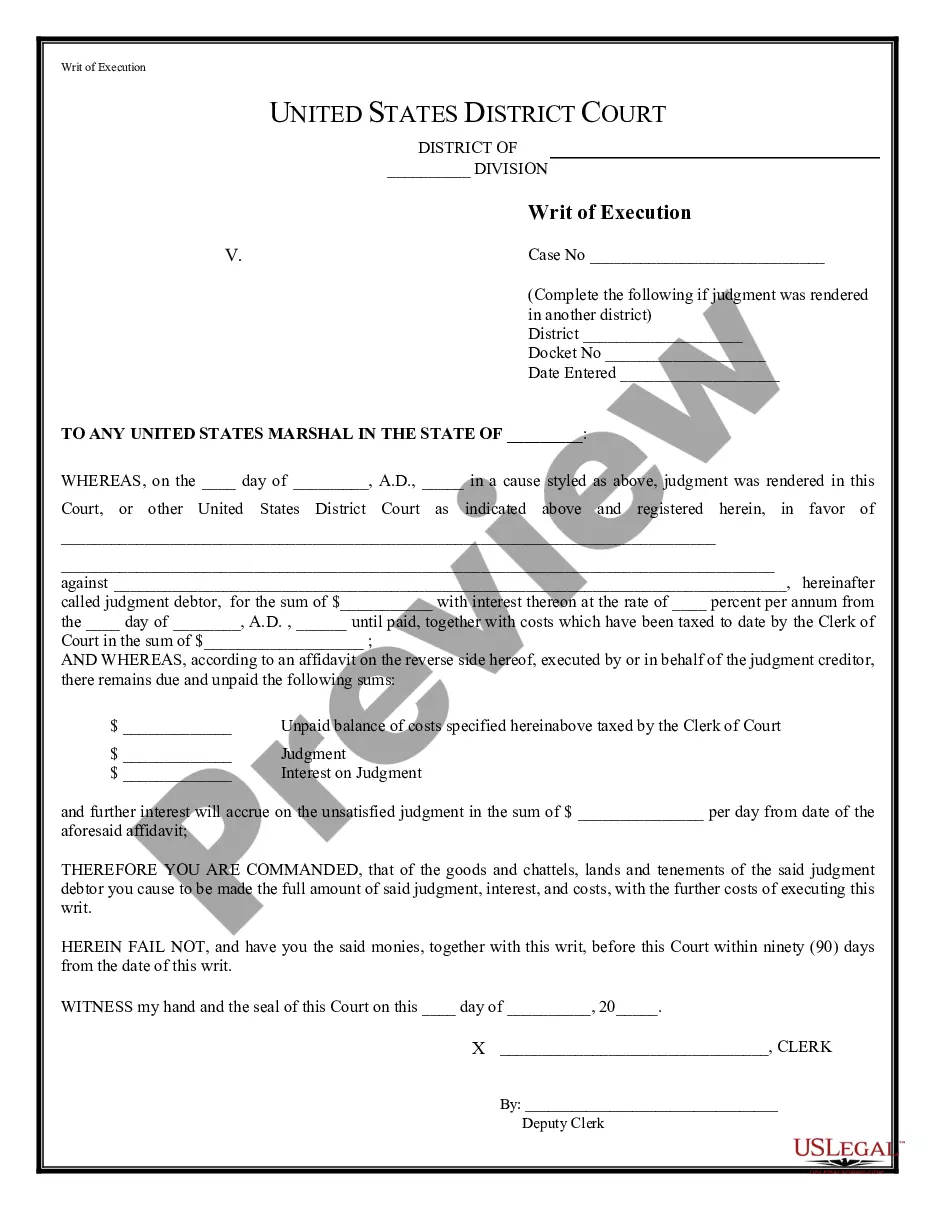
A writ of possession is a legal document that authorizes a sheriff or other lawful officer to restore possession of rental property to the landlord after a court judgment. Unlike other eviction-related forms, a writ of possession specifically instructs the sheriff to remove the tenant and all occupants from the property, ensuring the landlord regains control. This form is essential for landlords seeking to enforce a court decision regarding their property.
Key components of this form
- Case number: Identification of the court case related to the eviction.
- Judgment details: Information on the court ruling that grants possession to the landlord.
- Property description: Specifics about the rental property being reclaimed.
- Commands to the sheriff: Instructions for how the sheriff is to execute the writ, including the possibility of using force.
- Officer's return: A section for the sheriff to note the execution of the writ and provide details about the action taken.
Common use cases
This writ of possession should be used when a landlord has successfully obtained a court judgment for eviction against a tenant but needs official assistance to remove the tenant and return to the property. Situations include non-payment of rent, lease violations, or unauthorized occupants, where a legal decision favors the landlord's right to reclaim their property.
Who should use this form
- Landlords seeking to regain possession of their rental property after a court ruling.
- Property managers acting on behalf of landlords in eviction cases.
- Individuals involved in landlord-tenant disputes that have reached a legal conclusion favoring the landlord.
How to prepare this document
- Enter the county and state at the top of the document.
- Fill in the case number associated with the eviction proceedings.
- Provide the names of the plaintiff (landlord) and defendant (tenant), along with the trial date and court information.
- Clearly describe the property from which possession is being reclaimed.
- Sign and date the writ where indicated, and ensure the clerk has issued it.
Notarization requirements for this form
This form does not typically require notarization unless specified by local law. However, it is essential to check with your local court to ensure compliance with any additional requirements in your jurisdiction.
Get your form ready online
Our built-in tools help you complete, sign, share, and store your documents in one place.
Make edits, fill in missing information, and update formatting in US Legal Forms—just like you would in MS Word.
Download a copy, print it, send it by email, or mail it via USPS—whatever works best for your next step.
Sign and collect signatures with our SignNow integration. Send to multiple recipients, set reminders, and more. Go Premium to unlock E-Sign.
If this form requires notarization, complete it online through a secure video call—no need to meet a notary in person or wait for an appointment.
We protect your documents and personal data by following strict security and privacy standards.

Make edits, fill in missing information, and update formatting in US Legal Forms—just like you would in MS Word.

Download a copy, print it, send it by email, or mail it via USPS—whatever works best for your next step.

Sign and collect signatures with our SignNow integration. Send to multiple recipients, set reminders, and more. Go Premium to unlock E-Sign.

If this form requires notarization, complete it online through a secure video call—no need to meet a notary in person or wait for an appointment.

We protect your documents and personal data by following strict security and privacy standards.
Typical mistakes to avoid
- Failing to accurately complete the case number, which can delay the process.
- Not providing a clear and detailed description of the property.
- Omitting the necessary signatures required for the writ to be legally valid.
- Using incorrect dates or information that does not match court records.
Why complete this form online
- Convenience: Download and complete the form from anywhere without needing to visit a lawyer.
- Editability: Easily fill in the necessary fields and make changes as required before finalizing.
- Reliability: Access templates drafted by licensed attorneys to ensure compliance with legal standards.
Key takeaways
- A writ of possession is crucial for landlords after a successful eviction judgment.
- Ensure all information is accurately completed to avoid delays.
- Understand local requirements to ensure the writ is enforceable.
Looking for another form?
Form popularity
FAQ
Simply put, the Motion to Stay the Writ of Possession is a document filed with the court asking the judge to ?stay? or ?stop? the sheriff from executing the Writ of Possession and removing the resident. It can be a typed or handwritten document filed by the resident or the resident's attorney if one is retained.
The Writ of Possession is a court order which informs the tenant that they must move out of their housing on the property or else they will be forcibly evicted.
A writ of attachment is a form of prejudgment process in which a court orders the attachment or seizure of property described in the writ. The property is seized and held in the custody of an appointed official, such as a U.S. Marshal or law enforcement officer, under court supervision.
A writ of attachment is commonly used by a plaintiff to secure a contingent lien on a defendant's property in the event that the plaintiff obtains a judgment against the defendant. There are various types of attachments including garnishment, sequestration and replevin.
Some examples of attachable property are the following: farm products, inventory, equipment, final money judgements arising out of defendant's conduct of trade, business or profession, homestead exemption, any interest in real property, accounts receivable arising out of conduct by defendant of trade, business, or
One way to defeat the writ of attachment proceeding in a breach of contract action is to demonstrate to the Court that the terms of the contract themselves are ambiguous, and can only be determined through discovery in a case, and possibly through a factual determination by a jury.
If you did something dangerous or threatening, the landlord only needs to give you three (3) days to move out. If you did not pay rent or broke your lease agreement, you may be given a thirty (30) day notice to move out.
An attachment is issued by a specific court and Judge after it is brought to that Court's attention that you failed to comply with an order from the court. The attachment acts as the mechanism by which you can be arrested and brought back before the Court to answer for your failure to comply with the order.