Tennessee Detainer Summons
Understanding this form
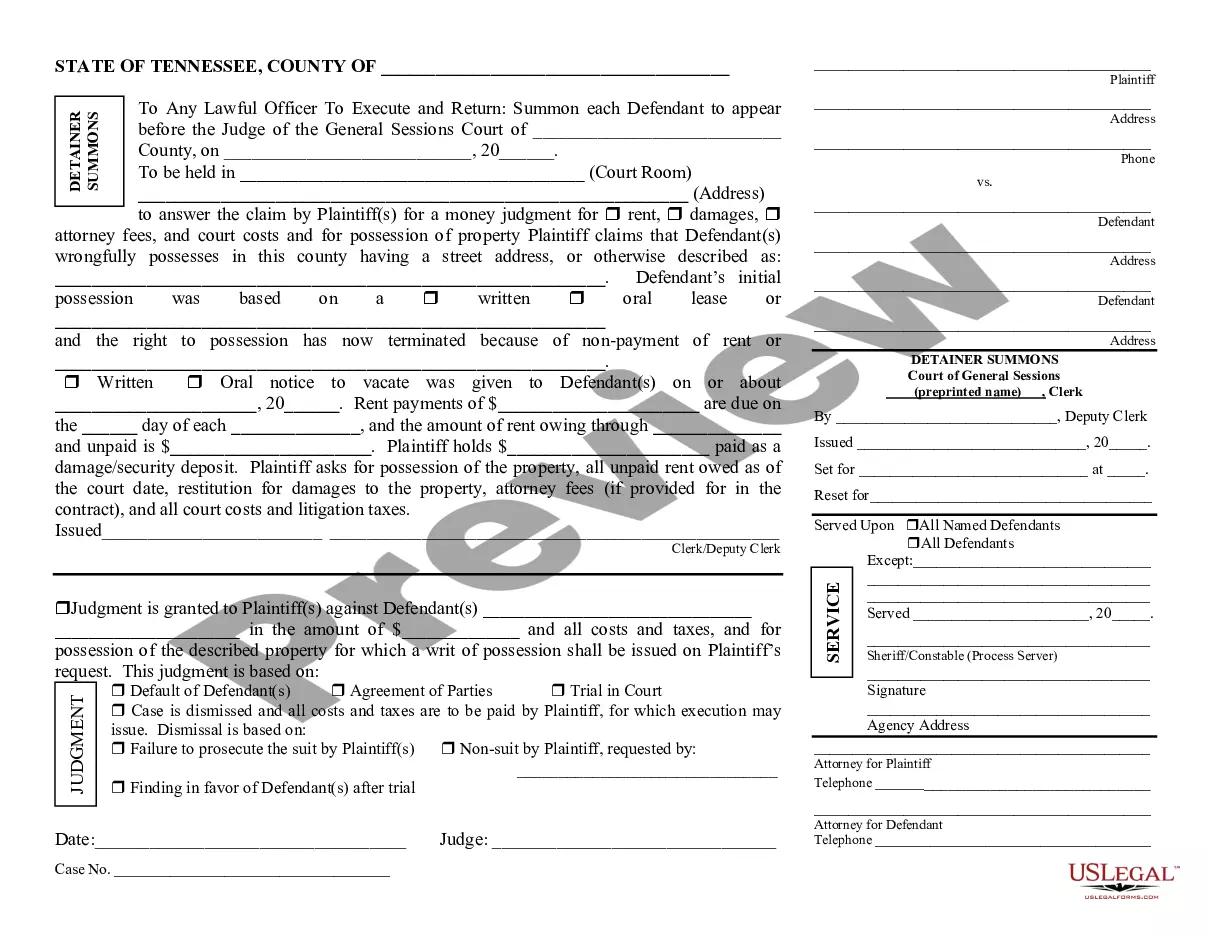
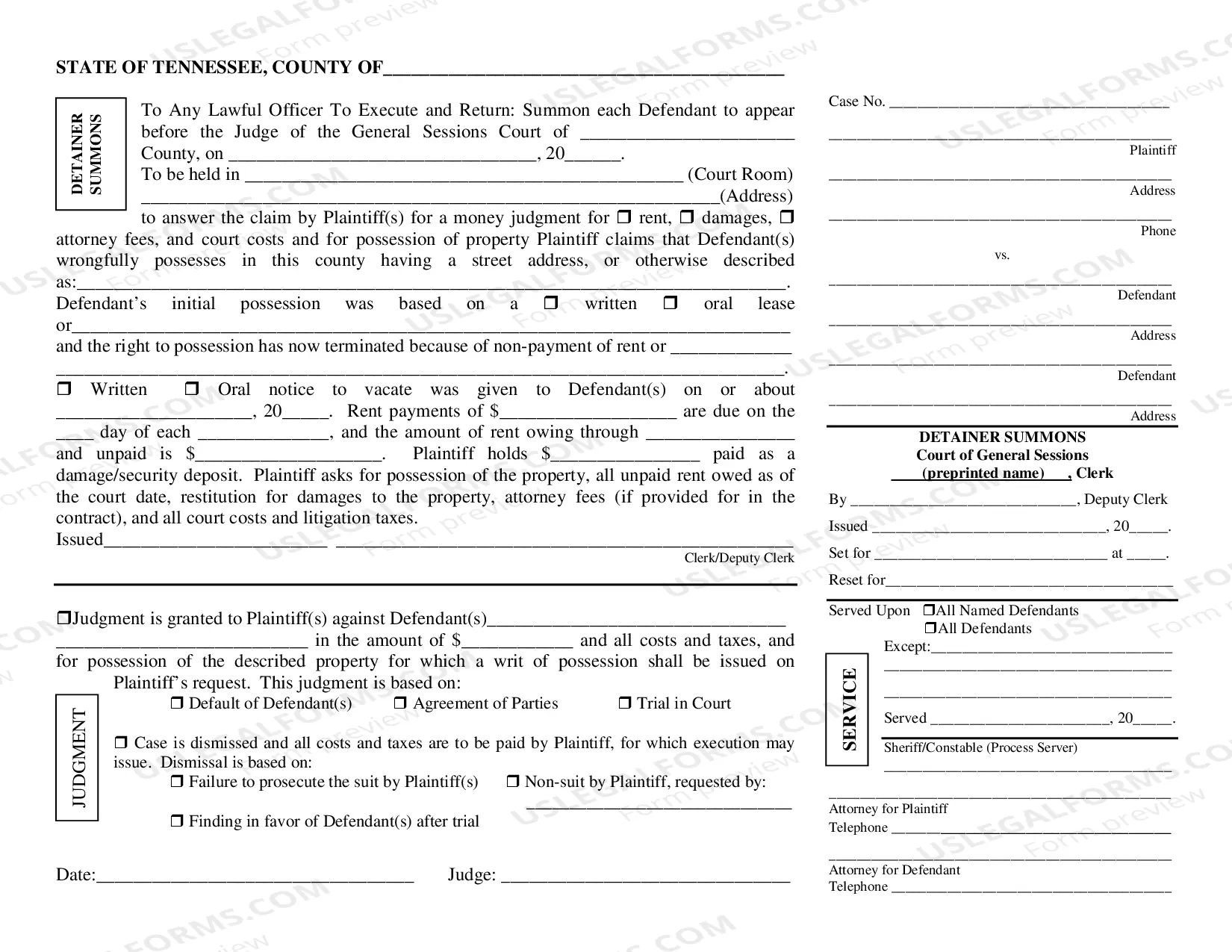
The Detainer Summons is a legal document used when a plaintiff seeks to recover property that has been unlawfully detained by a defendant. This form requires the defendant to appear in court at a specified date and time; failing to do so may result in a judgment against them. Unlike other forms related to property disputes, this summons specifically addresses unlawful detention and aims to facilitate a court order for possession of the property in question.
Main sections of this form
- Parties involved: Names and addresses of the plaintiff and defendant.
- Court information: Details about the court, including the date, time, and address of the hearing.
- Claim description: Summary of the plaintiff's claim for a money judgment and request for property possession.
- Grounds for possession: Explanation of how the defendant came to possess the property and why that right has ended.
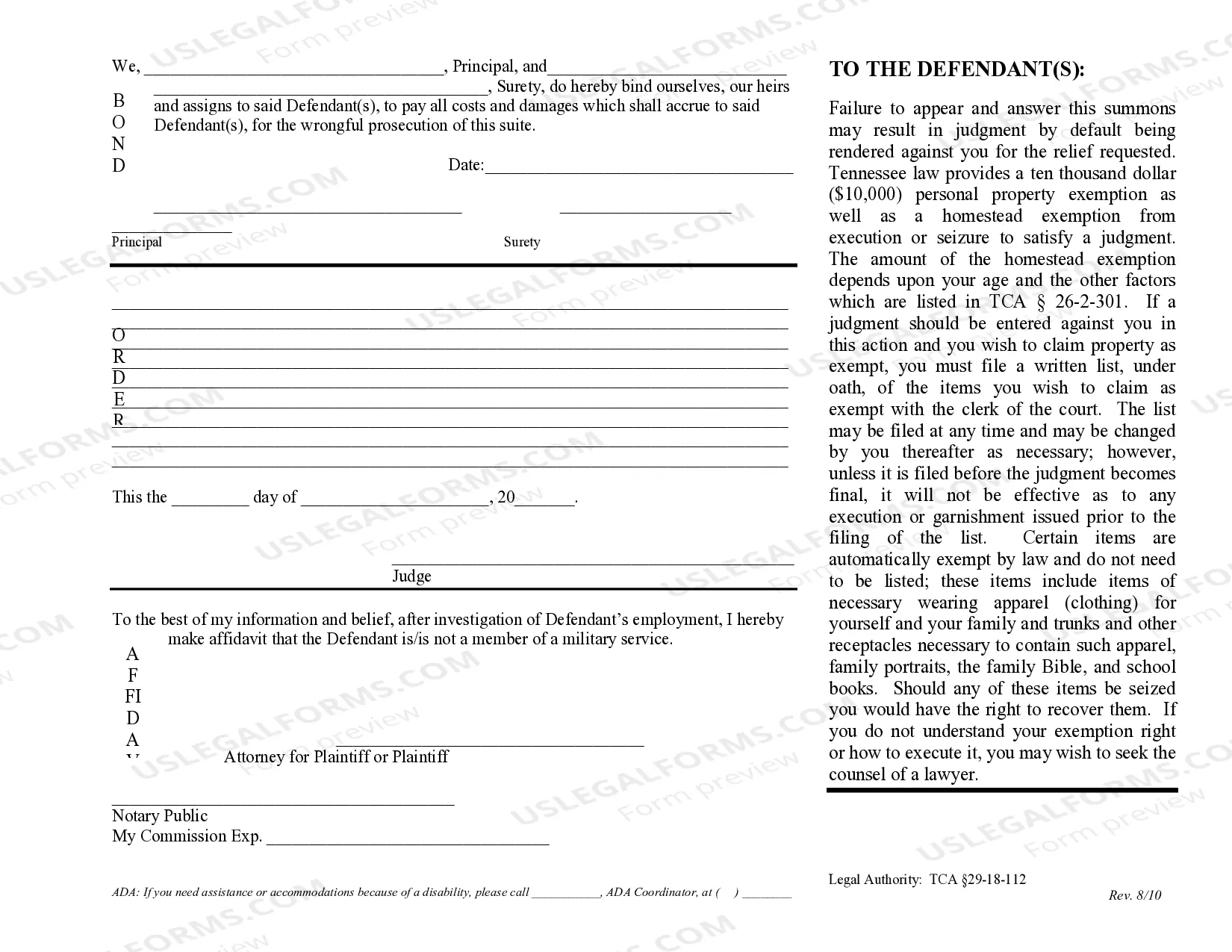
- Judgment details: Information on potential judgment if the defendant fails to respond.
When to use this document
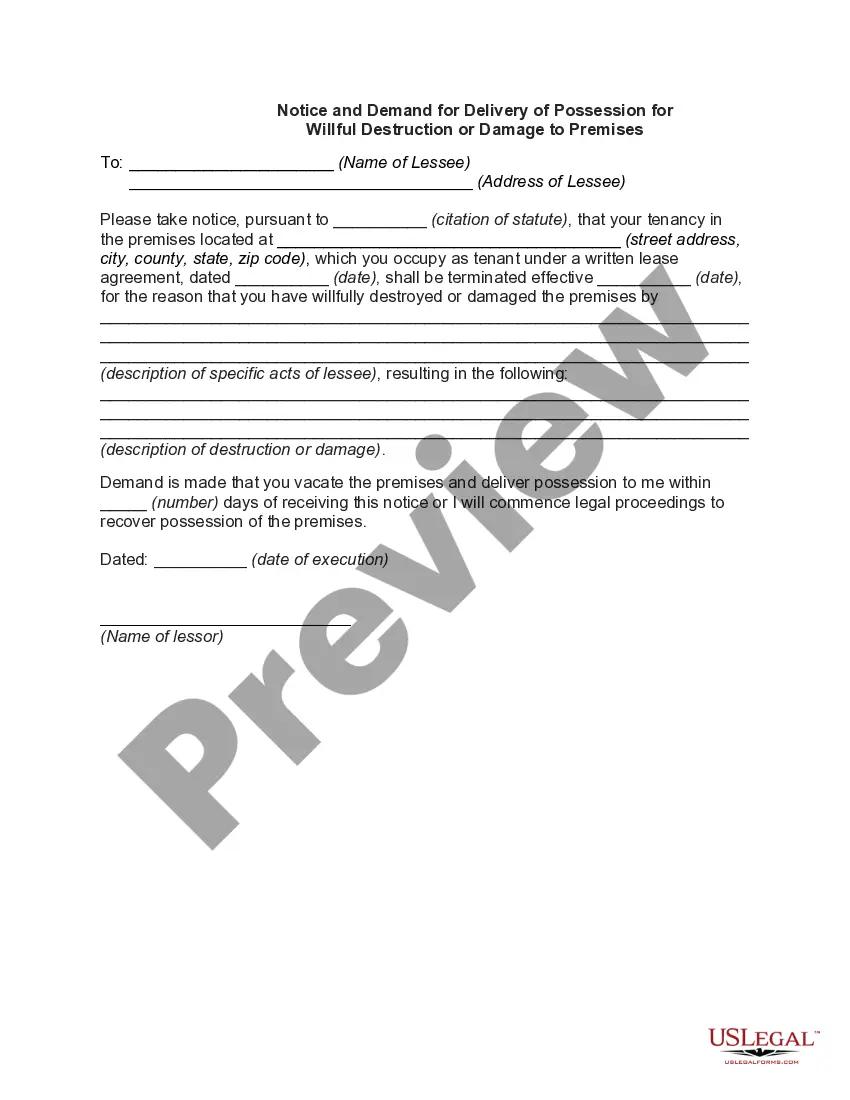
This form should be used when a landlord or property owner believes that a tenant is unlawfully retaining possession of a property, often due to non-payment of rent or violation of a lease agreement. It is also relevant when the property owner has already provided notice for the tenant to vacate but the tenant has not complied.
Who should use this form
- Landlords seeking to reclaim possession of rental property.
- Property owners who have a legal right to the property and need assistance recovering it.
- Attorneys representing clients in property disputes related to unlawful detention of property.
Completing this form step by step
- Identify and enter the names and addresses of all defendants involved.
- Specify the court information, including the county, date, time, and court room.
- Detail the claim being made, including amounts for unpaid rent and damages.
- Describe the basis for possession and any notices that were provided to the defendant.
- Review the document for accuracy and completeness before submitting it for service.
Does this document require notarization?
This form does not typically require notarization unless specified by local law. It is advised to check your jurisdiction's requirements prior to submission to ensure compliance.
Get your form ready online
Our built-in tools help you complete, sign, share, and store your documents in one place.
Make edits, fill in missing information, and update formatting in US Legal Forms—just like you would in MS Word.
Download a copy, print it, send it by email, or mail it via USPS—whatever works best for your next step.
Sign and collect signatures with our SignNow integration. Send to multiple recipients, set reminders, and more. Go Premium to unlock E-Sign.
If this form requires notarization, complete it online through a secure video call—no need to meet a notary in person or wait for an appointment.
We protect your documents and personal data by following strict security and privacy standards.

Make edits, fill in missing information, and update formatting in US Legal Forms—just like you would in MS Word.

Download a copy, print it, send it by email, or mail it via USPS—whatever works best for your next step.

Sign and collect signatures with our SignNow integration. Send to multiple recipients, set reminders, and more. Go Premium to unlock E-Sign.

If this form requires notarization, complete it online through a secure video call—no need to meet a notary in person or wait for an appointment.

We protect your documents and personal data by following strict security and privacy standards.
Common mistakes
- Failing to provide accurate information about the parties involved.
- Not specifying the correct court location and date.
- Neglecting to describe the basis for unlawful possession clearly.
- Omitting necessary signatures or not having the form notarized if required by state law.
Advantages of online completion
- Convenient access to legal documents from anywhere at any time.
- Immediate download allows for quick submission.
- Editability ensures that you can customize the form to fit your specific situation.
- Reliability of attorney-drafted templates for peace of mind.
Looking for another form?

Form popularity
FAQ
A subpoena may be served by any person authorized to serve process, or the witness may acknowledge service in writing on the subpoena. Service of the subpoena shall be made by delivering or offering to deliver a copy thereof to the person to whom it is directed. § 45.04.
RULE 15. AMENDED AND SUPPLEMENTAL PLEADINGS. Upon motion of a party the court may, upon reasonable notice and upon such terms as are just, permit the party to serve a supplemental pleading setting forth transactions or occurrences or events which have happened since the date of the pleading sought to be supplemented.
A defendant shall serve an answer within thirty (30) days after the service of the summons and complaint upon him. A party served with a pleading stating a cross-claim against such party shall serve an answer thereto within thirty (30) days after the service upon him or her.
If a summons is not served within 90 days after its issuance, it shall be returned stating the reasons for failure to serve.
A forcible detainer is where a person enters lawfully or peaceably, and holds unlawfully, and by any of the means enumerated in § 29-18-102 as constituting a forcible entry.
The clerk of the court where the complaint is filed must immediately issue the relevant summons and cause it to be delivered for service to any person authorized to serve Tennessee Process Service, together with necessary copies of the complaint and summons.
(1) Service on the attorney or on a party may be made by delivering to the attorney a copy of the document to be served, or by mailing it to such person's last known address, or if no address is known, by leaving the copy with the clerk of the court.
If a tenant does not leave the property by the end of the 16-day period (30 days after the landlord delivered the notice to quit) the landlord can go to court to request a detainer warrant for the tenant. The sheriff will deliver the detainer warrant to the tenant, which gives the tenant a court date and location.