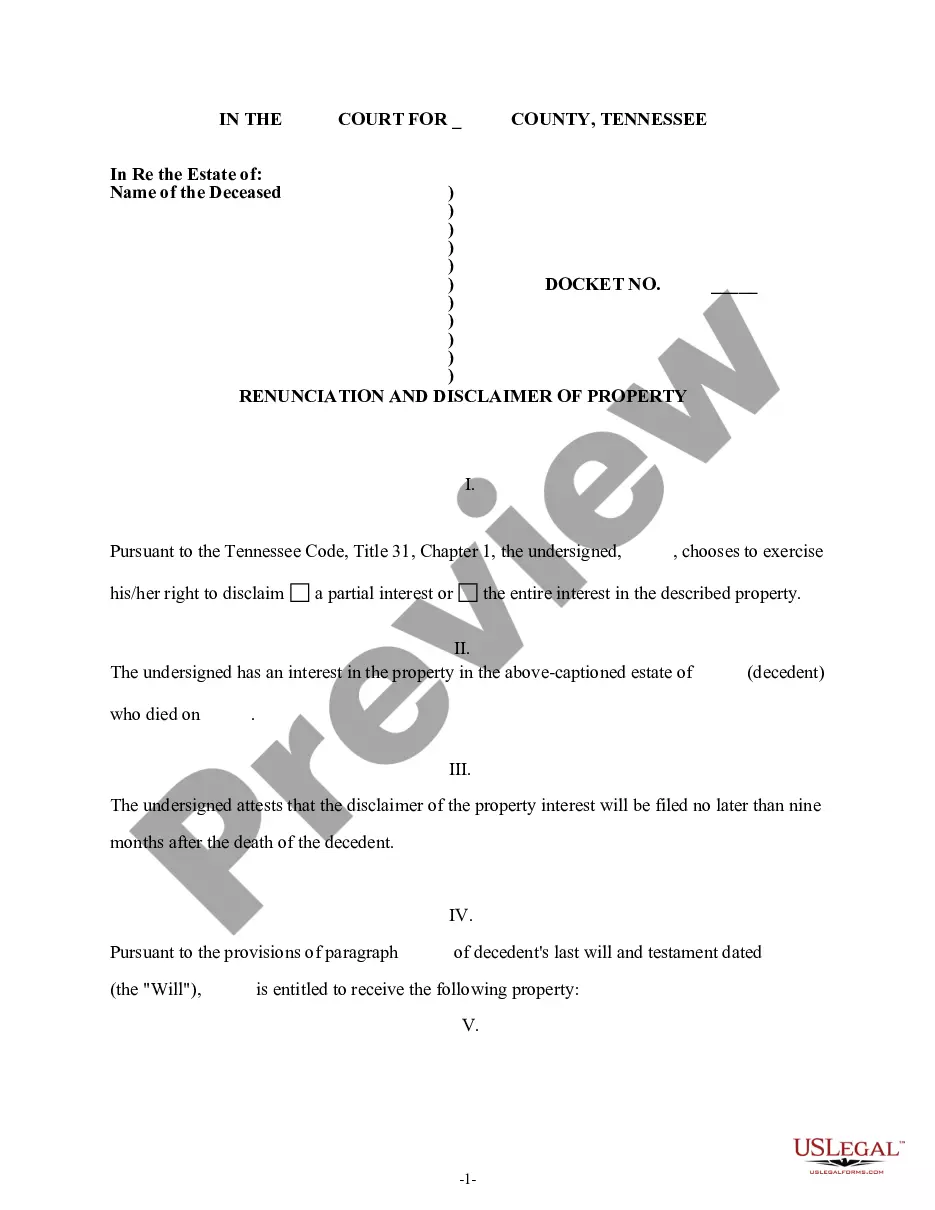
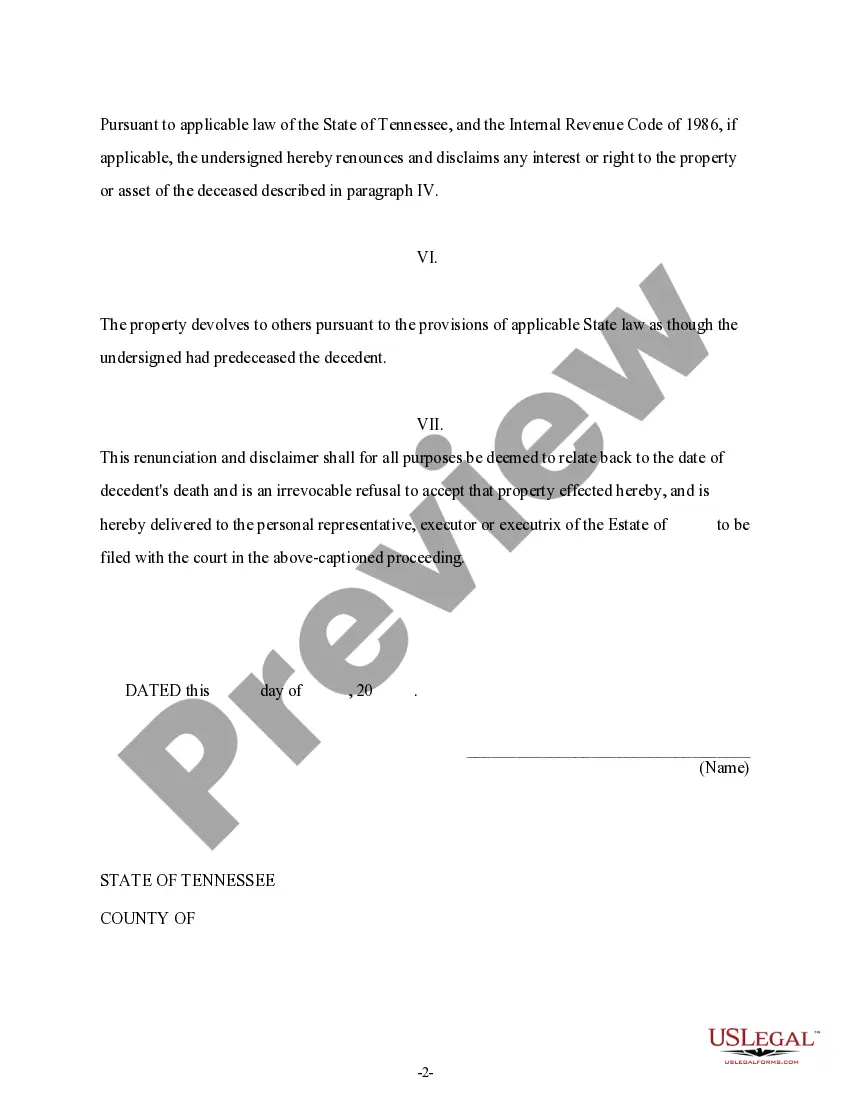
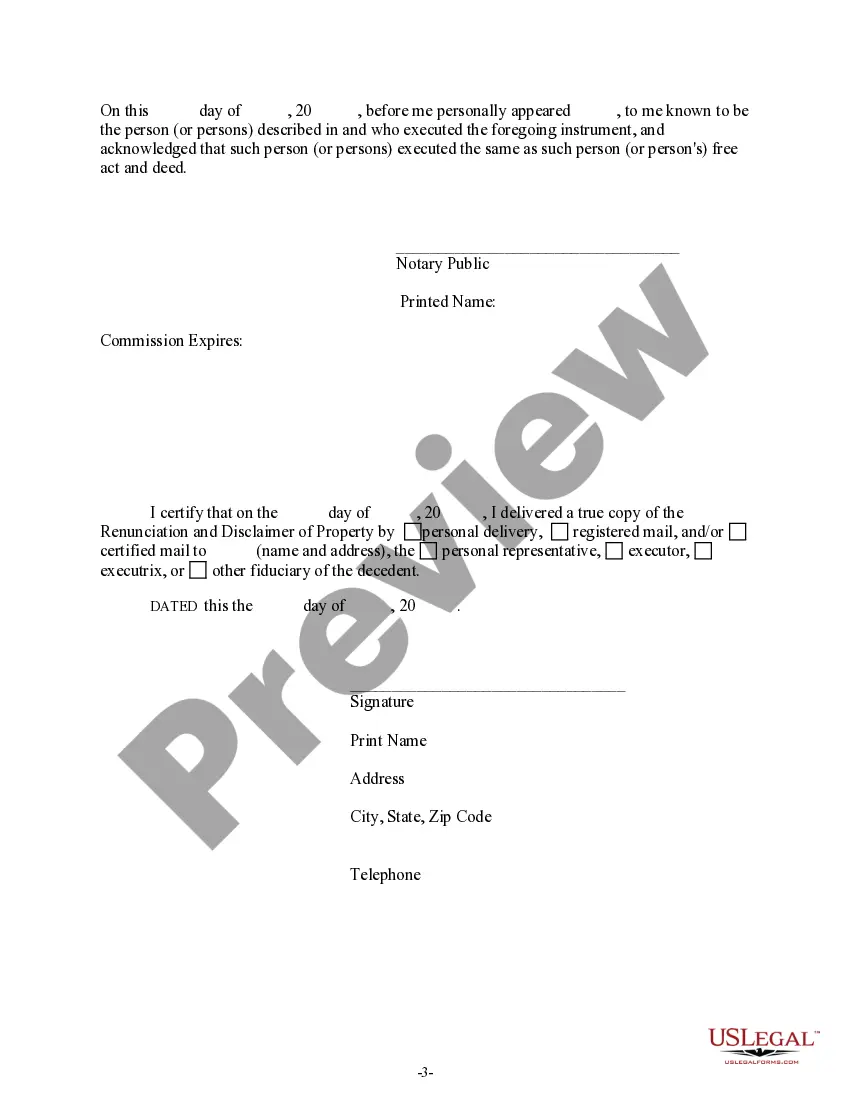
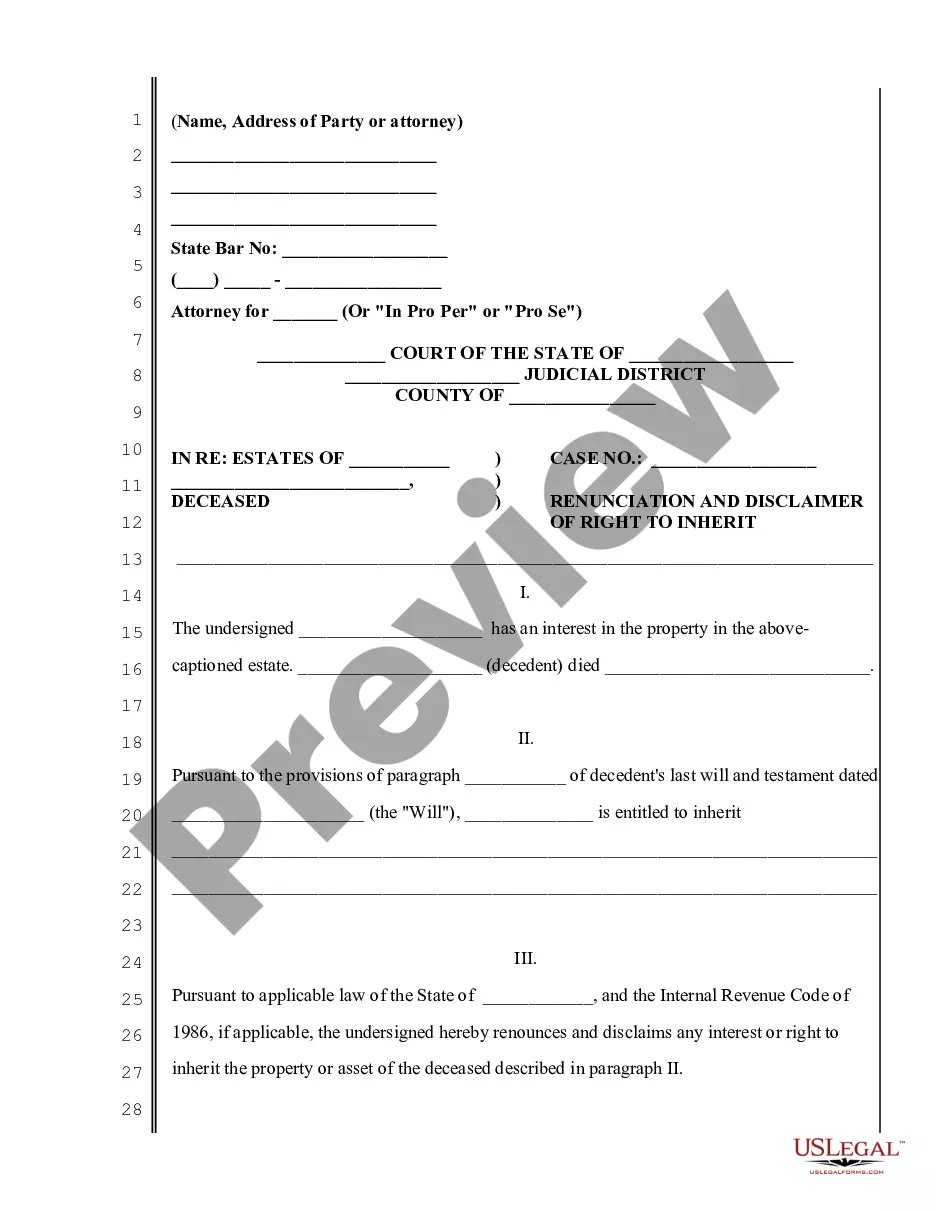
This form is a Renunciation and Disclaimer of Property acquired by the beneficiary through the last will and testament of the decedent, where the beneficiary has chosen to disclaim a portion of or the entire interest in the described property pursuant to the Tennessee Code, Title 31, Chapter 1. The property will devolve to others as though the beneficiary predeceased the decedent. The form also contains a state specific acknowledgement and a certificate to verify delivery.
Tennessee Renunciation And Disclaimer of Property from Will by Testate
State:
Tennessee
Control #:
TN-01-03
Format:
Word;
Rich Text
Instant download
Description
Free preview

How to fill out Tennessee Renunciation And Disclaimer Of Property From Will By Testate?
Access to top quality Tennessee Renunciation And Disclaimer of Property from Will by Testate forms online with US Legal Forms. Prevent hours of misused time browsing the internet and lost money on files that aren’t up-to-date. US Legal Forms gives you a solution to exactly that. Find over 85,000 state-specific legal and tax samples that you could save and submit in clicks within the Forms library.
To receive the example, log in to your account and then click Download. The file will be saved in two places: on the device and in the My Forms folder.
For individuals who don’t have a subscription yet, check out our how-guide below to make getting started simpler:
- Check if the Tennessee Renunciation And Disclaimer of Property from Will by Testate you’re considering is suitable for your state.
- Look at the form using the Preview option and browse its description.
- Visit the subscription page by clicking on Buy Now button.
- Choose the subscription plan to keep on to register.
- Pay out by credit card or PayPal to complete creating an account.
- Choose a favored format to save the file (.pdf or .docx).
You can now open the Tennessee Renunciation And Disclaimer of Property from Will by Testate template and fill it out online or print it and do it yourself. Think about mailing the file to your legal counsel to be certain everything is filled in appropriately. If you make a error, print and fill application again (once you’ve registered an account all documents you save is reusable). Make your US Legal Forms account now and get access to much more forms.
Form popularity
FAQ
Tennessee does not allow real estate to be transferred with transfer-on-death deeds.
Real Estate: Muniment of Title is a legal action used to legally transfer clear title of one type of property (for assets such as real estate, a bank account, or a stock account) to a beneficiary. This procedure is appropriate only if the decedent executed a valid Will.
Routine and simple estates can cost as little as $2000 to $2500. The court costs (fees paid to the clerk) are presently $382.50. This is required to be paid when the estate is started (and can be reimbursed from the decedent's funds).
Probate gives someone--usually the surviving spouse or other close family member--legal authority to gather the deceased person's assets, pay debts and taxes, and eventually transfer assets to the people who inherit them. Probate in Tennessee commonly takes six months to a year.
Under Tennessee law, real property is not included in the probate estate and vests immediately in the heirs or devisees upon death of the owner, unless the will specifically directs for the real property to be administered through the estate and gives the executor the powers and authority to do so.
Yes, a fiduciary can disclaim an interest in property if the will, trust or power of attorney gives the fiduciary that authority or if the appropriate probate court authorizes the disclaimer.The primary reason an executor or trustee might disclaim property passing to an estate or trust is to save death taxes.
When a Will is probated as a Muniment of Title, no executor or executrix is appointed to administer the estate.Muniment of title probate is a simpler way to establish the validity of the Will and pass title to the beneficiaries named in the Will.
The Will must be filed with the probate court in the county where the decedent lived. A Petition for Probate must be filed with the probate court as well. This requests the appointment of an executor.
Disclaimer of interest, in the law of inheritance, wills and trusts, is a term that describes an attempt by a person to renounce their legal right to benefit from an inheritance (either under a will or through intestacy) or through a trust. A disclaimer of interest is irrevocable.