South Dakota Affidavit Termination Spouse's Joint Tenancy Interest in Real Property
What is this form?
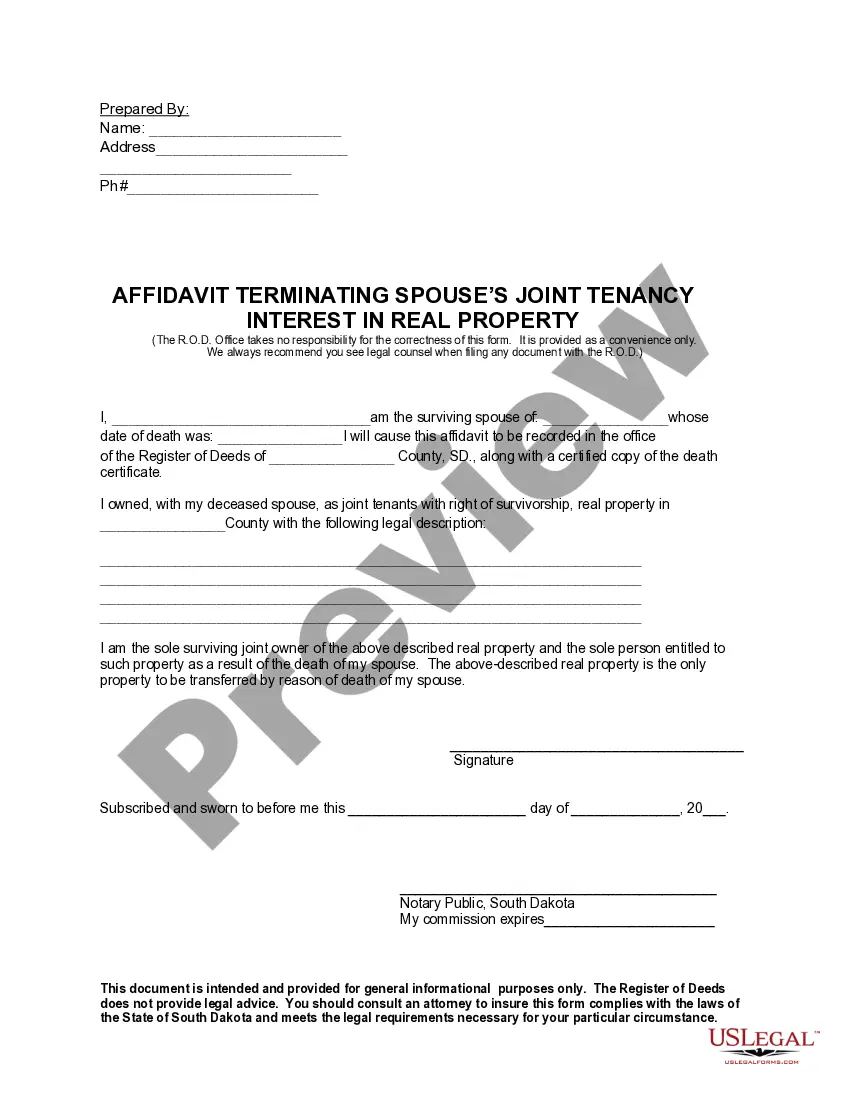
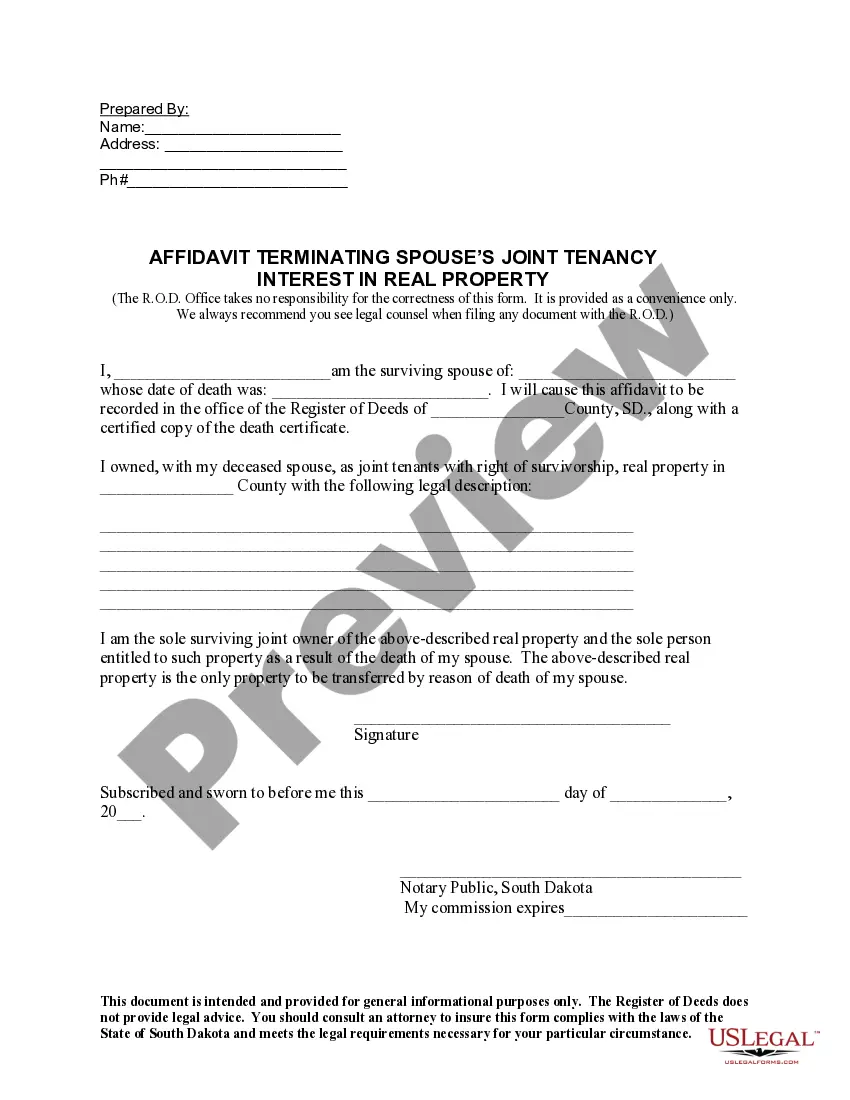
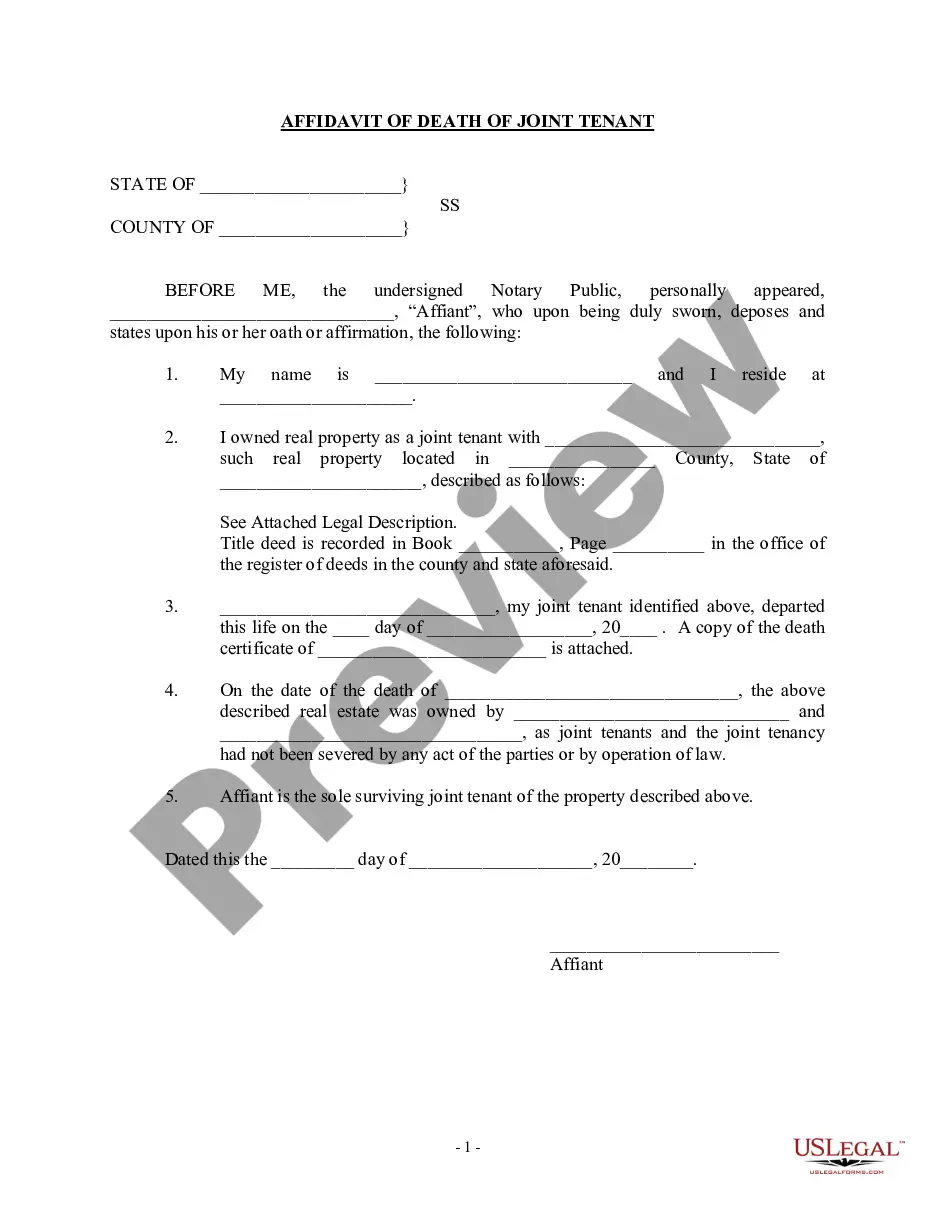
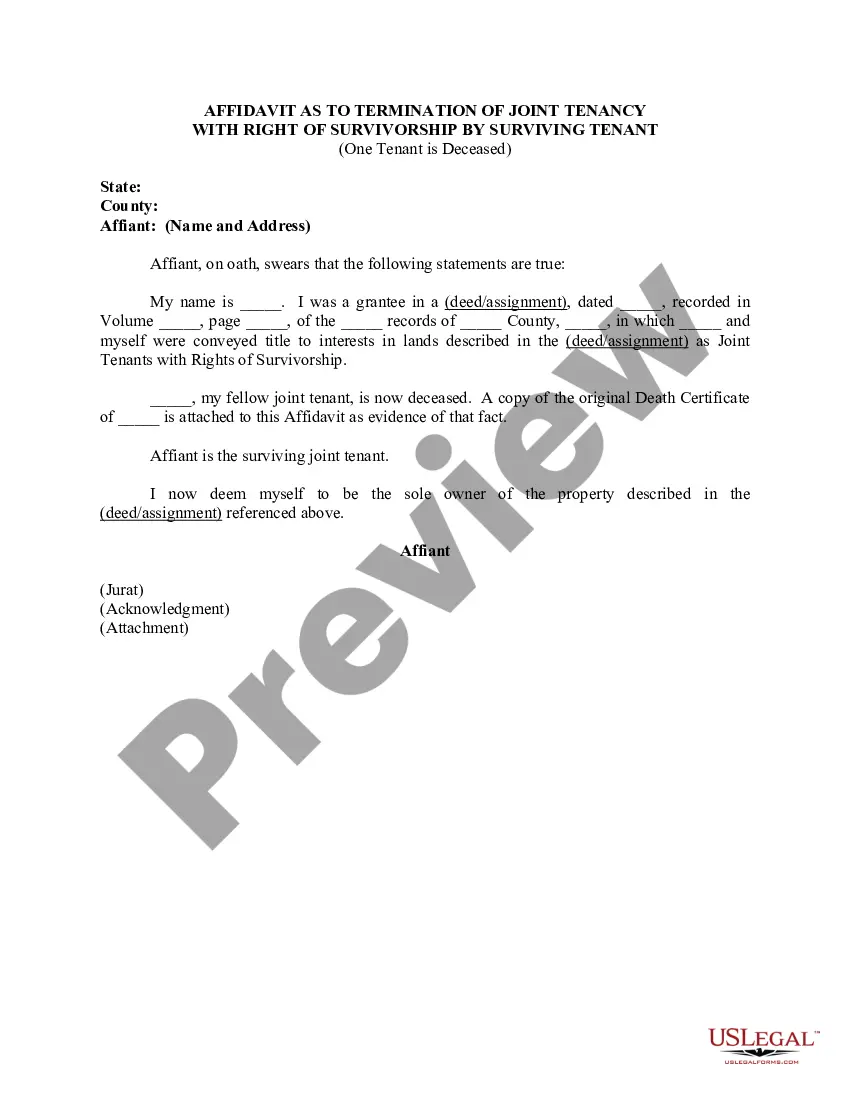
The Affidavit Termination Spouse's Joint Tenancy Interest in Real Property is a legal document that serves as proof that one joint tenant has passed away. This form effectively terminates the deceased spouse's interest in the property and confirms that the surviving spouse is now the sole owner. Unlike other property transfer forms, this affidavit specifically addresses joint tenancy with the right of survivorship and is used after the death of one of the joint tenants.
Key parts of this document
- Names and addresses of the parties involved, including the deceased spouse.
- Date of death of the deceased spouse.
- Identification of the specific real property involved.
- Confirmation of the surviving spouse as the sole owner of the property.
- Instructions for recording in the Register of Deeds' office alongside the death certificate.
Situations where this form applies
This form should be used when one spouse passes away and both spouses held property as joint tenants with rights of survivorship. It is necessary to establish legal ownership of the property by the surviving spouse and to officially update property records with the Register of Deeds. If you need to confirm your sole ownership of the real estate after your spouse's death, this affidavit is essential.
Who this form is for
- Surviving spouses who jointly owned real property with a deceased spouse.
- Individuals looking to update property ownership records following a spouse's death.
- Homeowners wanting to ensure clear title to their property after a joint tenant's passing.
Instructions for completing this form
- Identify the parties: fill in your name and the name of your deceased spouse.
- Enter the date of your spouse's death accurately.
- Specify the real property involved by providing its legal description.
- Include your address as the surviving spouse.
- Sign the affidavit in the presence of a notary public.
Does this document require notarization?
Yes, this form must be notarized to be legally valid. This ensures that the signatures are authenticated and that the affidavit is recognized under the law. US Legal Forms offers integrated online notarization services, providing a secure and convenient way to notarize documents via video call without needing to travel.
Get your form ready online
Our built-in tools help you complete, sign, share, and store your documents in one place.
Make edits, fill in missing information, and update formatting in US Legal Forms—just like you would in MS Word.
Download a copy, print it, send it by email, or mail it via USPS—whatever works best for your next step.
Sign and collect signatures with our SignNow integration. Send to multiple recipients, set reminders, and more. Go Premium to unlock E-Sign.
If this form requires notarization, complete it online through a secure video call—no need to meet a notary in person or wait for an appointment.
We protect your documents and personal data by following strict security and privacy standards.

Make edits, fill in missing information, and update formatting in US Legal Forms—just like you would in MS Word.

Download a copy, print it, send it by email, or mail it via USPS—whatever works best for your next step.

Sign and collect signatures with our SignNow integration. Send to multiple recipients, set reminders, and more. Go Premium to unlock E-Sign.

If this form requires notarization, complete it online through a secure video call—no need to meet a notary in person or wait for an appointment.

We protect your documents and personal data by following strict security and privacy standards.
Mistakes to watch out for
- Failing to include a certified copy of the death certificate.
- Not providing the correct legal description of the property.
- Incorrectly identifying the surviving spouse's name or address.
- Neglecting to have the document notarized if required.
Benefits of completing this form online
- Convenience of completing and downloading forms from home.
- Editability allows users to fill out forms at their own pace.
- Reliability, as forms are drafted by licensed attorneys.
Looking for another form?
Form popularity
FAQ
All co-tenants must acquire equal shares of the property through the same deed at the same time. With their equal interest, joint tenants also share equal financial responsibilities for the property, meaning all co-tenants are liable for any loans taken out against the property.
Unity of interest: The interest of each owner is equal. Unity of time: The interest of the owners is acquired at the same time. Unity of possession: The owners have the right of survivorship. Unity of title: The document must specify a joint tenancy vesting.
Each party in a joint tenancy has an equal interest in the property?the financial obligations as well as any benefits. A joint tenancy creates a right of survivorship, which means that if one party dies, their interest is automatically transferred to the surviving tenant(s).
A joint tenancy with right of survivorship is a form of ownership where each party shares equal rights in a property. If one of the owners dies, their share of the property is not probated with their estate?instead, it is passed on to the other joint tenants.
Generally, to establish a joint tenancy a fourfold unity must exist: interest, title, time, and possession. Joint tenants have the same interest, acquired by the same conveyance, commencing at the same time, and held by the same possession.
Joint tenants own equal shares of the property and each one has the right to possess the property. When a joint tenant dies, the other joint tenants automatically inherit the property. Not every deed that describes the co-owners as joint tenants is sufficient to create a joint tenancy.