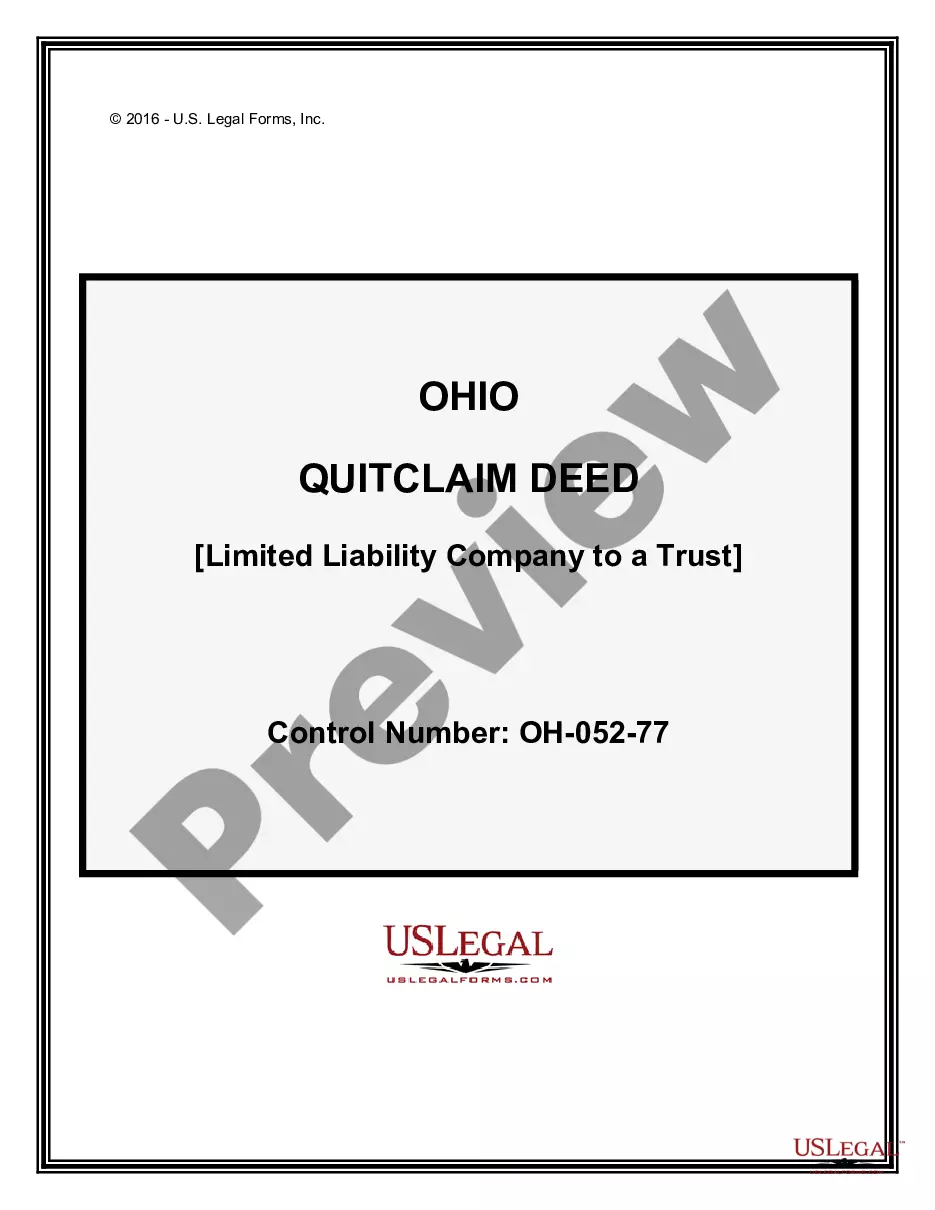
Ohio Quitclaim Deed - Limited Liability Company to a Trust
What is this form?
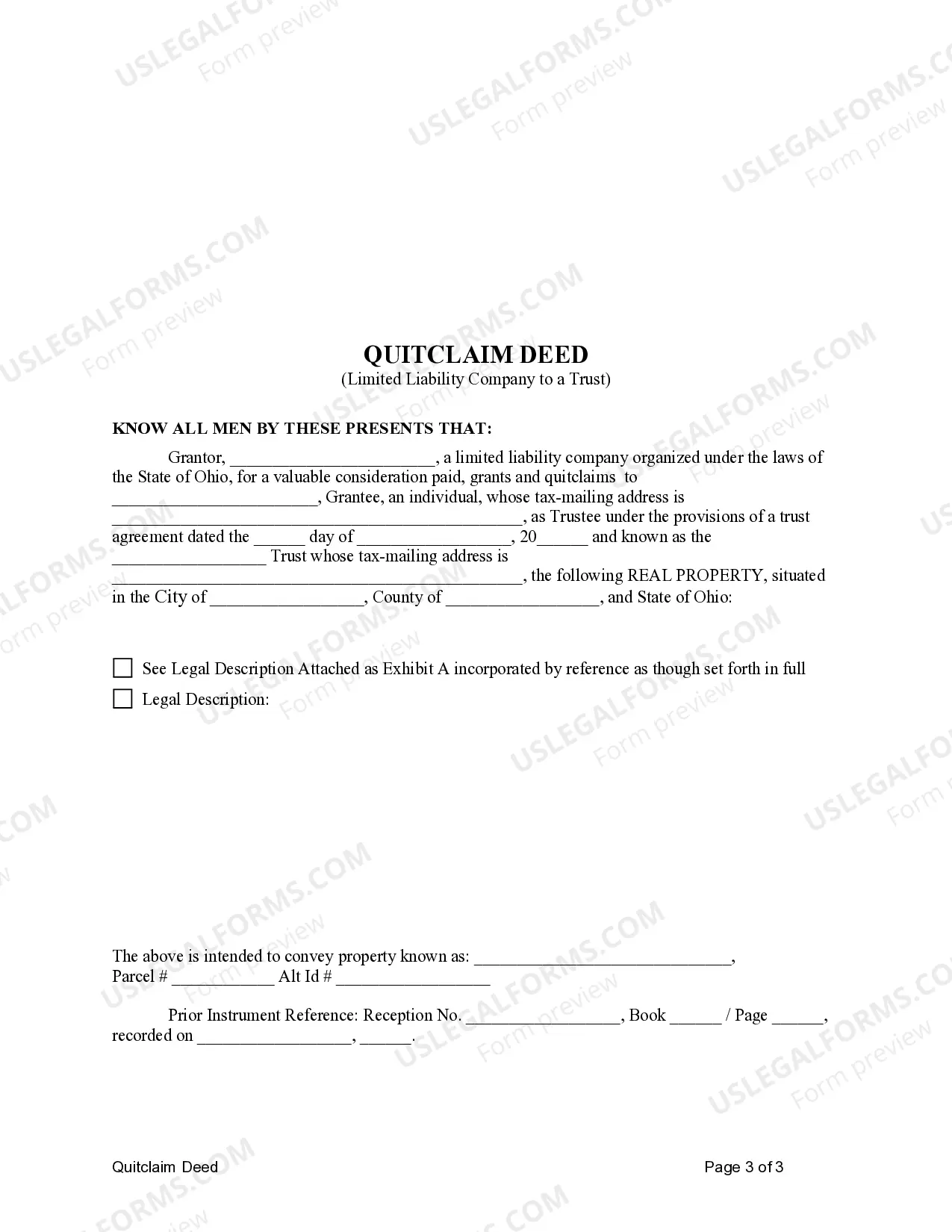
The Quitclaim Deed - Limited Liability Company to a Trust is a legal document that allows a limited liability company (LLC)âthe grantorâto transfer any interest it holds in a specific property to a trustâthe grantee. Unlike other deeds, a quitclaim deed does not guarantee that the grantor holds any valid title to the property; instead, it simply conveys whatever interest the grantor has at the time of transfer. This specific type of quitclaim deed is essential when an LLC needs to transfer property into a trust for estate planning or asset protection purposes.
Key components of this form
- Identification of the grantor (limited liability company) and grantee (trust).
- Legal description of the property being transferred.
- Prior instrument reference, including details of previous recordings.
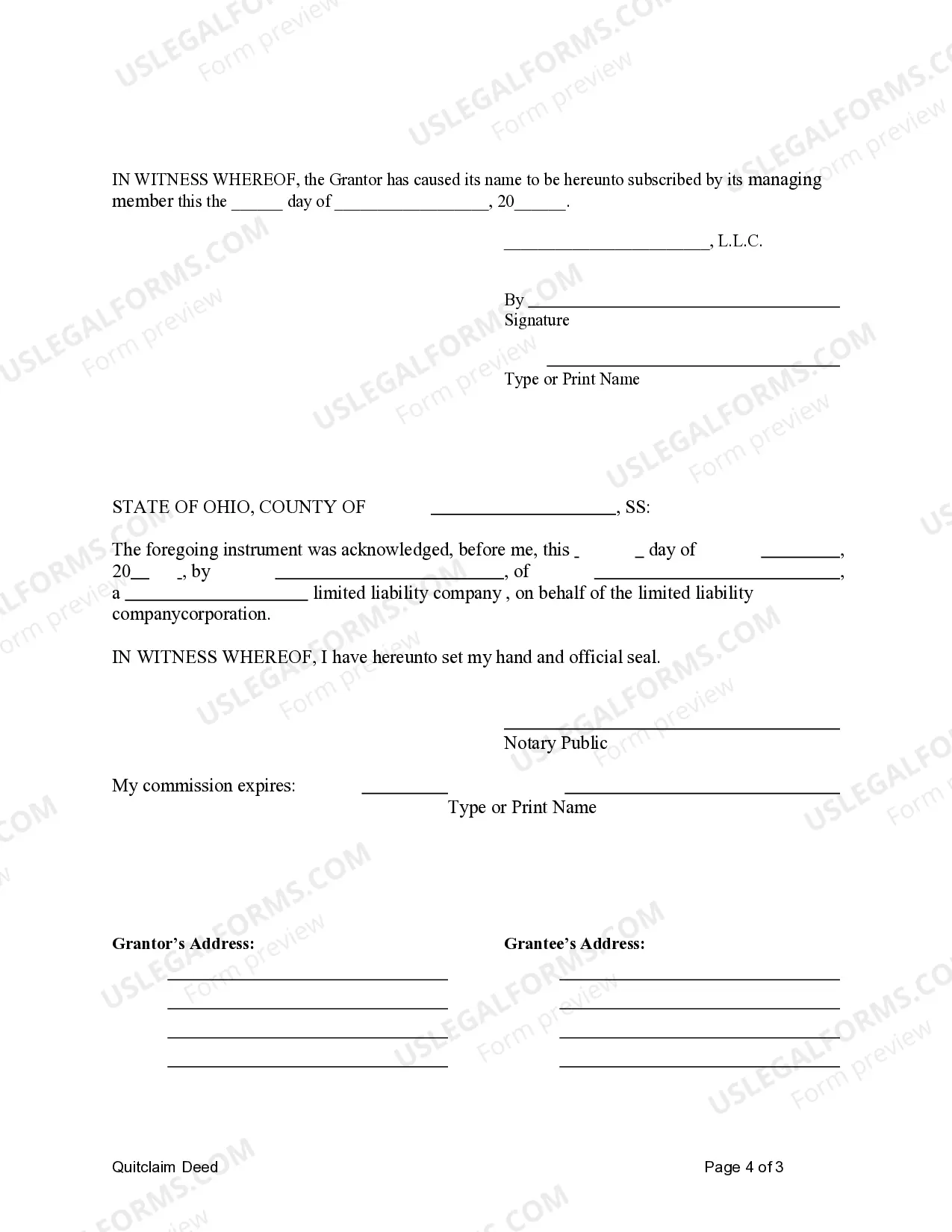
- Signature field for the authorized representative of the LLC.
- Date of execution, indicating when the deed is completed.






When to use this document
This form is commonly used when an LLC wishes to transfer ownership of property to a trust as part of an estate planning strategy or to simplify the management of the property. It may also be used in situations where the LLC wants to ensure that property is held in the trust for the benefit of its beneficiaries without creating liability associated with property ownership.
Who this form is for
The following individuals or entities may find this form suitable:
- L.L.C. owners looking to transfer property to a trust.
- Trustees managing a trust that will receive property from an LLC.
- Individuals involved in estate planning or simplifying asset management.
How to complete this form
- Identify the parties: Input the legal names of the LLC and the trust.
- Specify the property: Include a thorough legal description of the property being transferred.
- Fill in the prior instrument details: Provide the prior instrument reference number and recording details.
- Obtain necessary signatures: Ensure the authorized representative of the LLC signs the form.
- Enter the date of execution: Record the date the deed is executed to finalize the transfer.
Notarization requirements for this form
This form does not typically require notarization unless specified by local law, but having it notarized can add an additional layer of validation in some jurisdictions.
Get your form ready online
Our built-in tools help you complete, sign, share, and store your documents in one place.
Make edits, fill in missing information, and update formatting in US Legal Forms—just like you would in MS Word.
Download a copy, print it, send it by email, or mail it via USPS—whatever works best for your next step.
Sign and collect signatures with our SignNow integration. Send to multiple recipients, set reminders, and more. Go Premium to unlock E-Sign.
If this form requires notarization, complete it online through a secure video call—no need to meet a notary in person or wait for an appointment.
We protect your documents and personal data by following strict security and privacy standards.

Make edits, fill in missing information, and update formatting in US Legal Forms—just like you would in MS Word.

Download a copy, print it, send it by email, or mail it via USPS—whatever works best for your next step.

Sign and collect signatures with our SignNow integration. Send to multiple recipients, set reminders, and more. Go Premium to unlock E-Sign.

If this form requires notarization, complete it online through a secure video call—no need to meet a notary in person or wait for an appointment.

We protect your documents and personal data by following strict security and privacy standards.
Typical mistakes to avoid
- Failing to include a complete legal description of the property.
- Not having the authorized representative of the LLC sign the deed.
- Omitting prior instrument reference details, leading to confusion about the ownership history.
Benefits of completing this form online
- Convenient access: Download and complete your form without leaving home.
- Editability: Fill out and modify the form easily using your computer.
- Compliance assurance: Forms are designed to meet legal standards and requirements.
Summary of main points
- A Quitclaim Deed - Limited Liability Company to a Trust is used to transfer property from an LLC to a trust.
- The form must be filled out accurately to ensure clear property transfer.
- It is essential to understand state-specific requirements and consult with a legal professional if needed.
Looking for another form?
Form popularity
FAQ
Yes, a quit claim deed supercedes the trust. The only thing that can be done is to file a suit in court challenging the deed as the product of fraud and undue influence. A court action like that will cost thousands of dollars, but might be worth it if the house was owned free and clear.
The act of transferring a property that is owned by an individual into a trust, will see the trust liable to pay stamp duty on acquisition of the asset. Additionally, the individual who is transferring ownership to the trust, will be liable to pay capital gains tax on the disposal of the asset.
Locate your current deed. Use the proper deed. Check with your title insurance company and lender. Prepare a new deed. Sign in the presence of a notary. Record the deed in the county clerk's office. Locate the deed that's in trust. Use the proper deed.
No. And unless the deed identifies the trust as an owner, then father is the owner of an interest. It is a common mistake to set up a trust and then fail to deed property into the trust. However, you cannot force him to make the changes you are...
Retrieve your original deed. Get the appropriate deed form. Draft the deed. Sign the deed before a notary. Record the deed with the county recorder. Obtain the new original deed.
Transferring Real Property to a Trust You can transfer your home (or any real property) to the trust with a deed, a document that transfers ownership to the trust. A quitclaim deed is the most common and simplest method (and one you can do yourself).
How To Establish A Trust. You will need to retain an estate attorney to draft and execute your trust document. For a simple revocable or irrevocable trust, it may cost anywhere from $2,000 $5,000.
No. And unless the deed identifies the trust as an owner, then father is the owner of an interest. It is a common mistake to set up a trust and then fail to deed property into the trust. However, you cannot force him to make the changes you are...
Determine the Current Title and Vesting to Your Property. Prepare a Deed. Be Aware of Your Lender and Title Insurance. Prepare a Preliminary Change of Ownership Report. Execute Your Deed. Record Your Deed. Wait for the Deed to be Returned. Keep the Property in the Trust.