Ohio Quitclaim Deed from a Limited Liability Company to an Individual
What this document covers
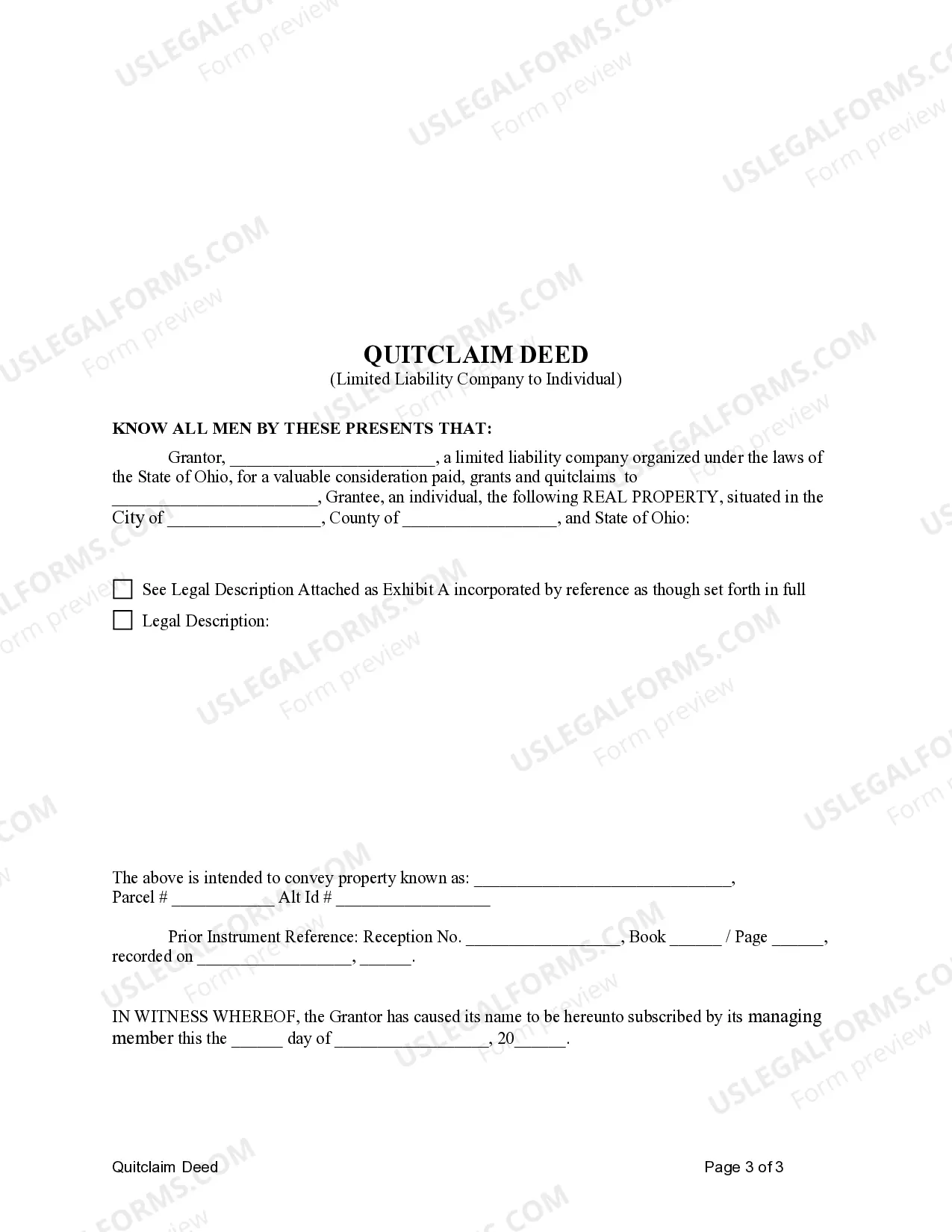
This form is a Quitclaim Deed, where the Grantor is a limited liability company and the Grantee is an individual. It allows the Grantor to convey and quitclaim any interest in the property to the Grantee. Unlike a warranty deed, this form does not guarantee that the Grantor has clear title to the property. It is essential in transferring property ownership without definitive assurances regarding the title's condition.
Key components of this form
- Identification of the Grantor (limited liability company) and Grantee (individual).
- Description of the property being transferred.
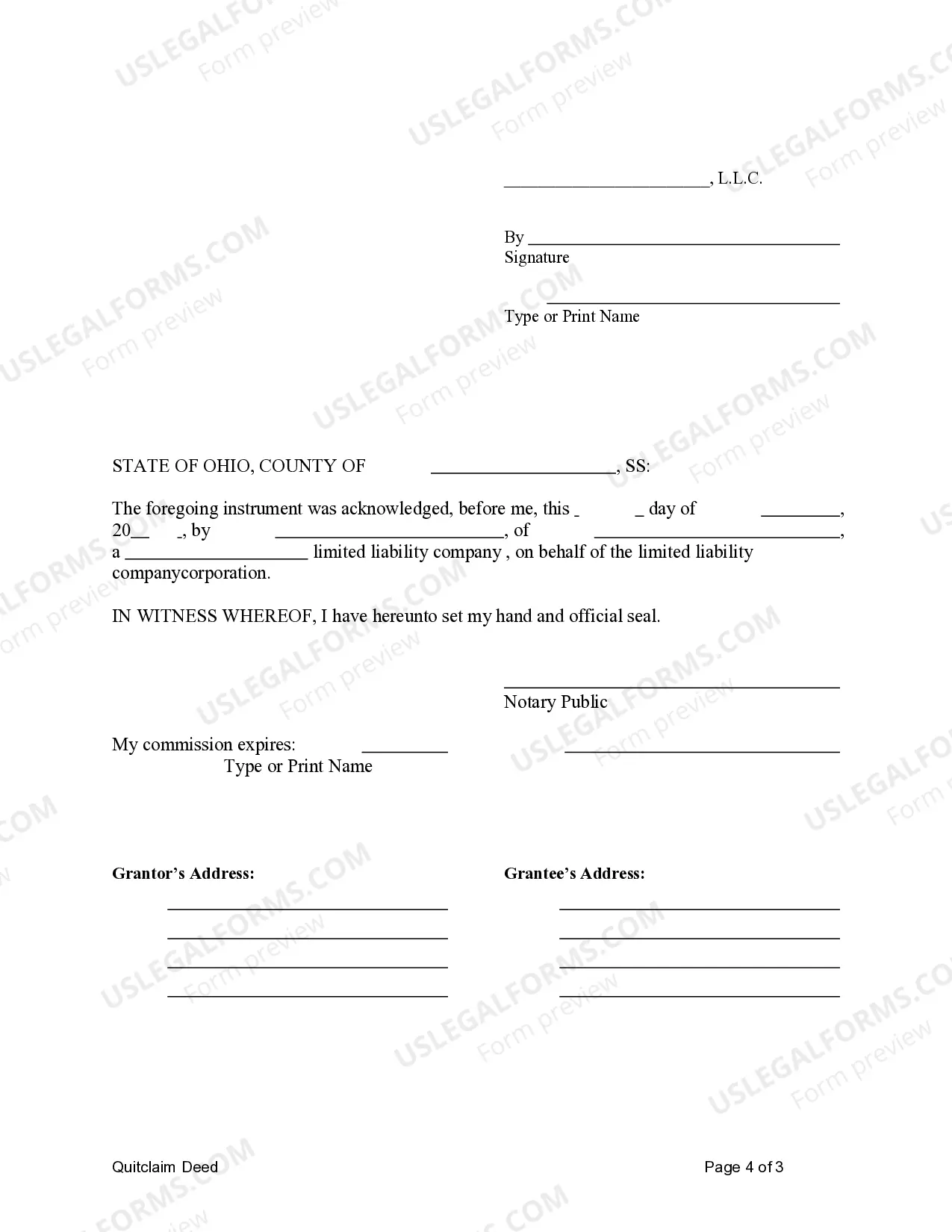
- Legal acknowledgment of the transfer of interest.
- Signature and date fields for both parties.
- Legal description of the property attached as Exhibit A.







When to use this document
You should use this Quitclaim Deed when a limited liability company wants to transfer property ownership to an individual without providing any guarantees about the title. This form is often utilized in situations where property is being sold, gifted, or transferred within family members or between business partners as a quick means to convey interests without extensive legal processes.
Who should use this form
This form is typically used by:
- Limited liability companies transferring property to individuals.
- Individuals receiving property ownership from a company.
- Business owners or partners involved in real estate transactions.
How to complete this form
- Identify the legal names and addresses of the Grantor and Grantee.
- Provide a clear description of the property being conveyed.
- Complete the legal description section, referring to Exhibit A.
- Sign and date the form in the presence of a notary public if required.
- Ensure all information is accurate before submitting the deed for recording.
Is notarization required?
This form does not typically require notarization unless specified by local law. However, signing in front of a notary public can provide an extra layer of validation for the transfer.
Get your form ready online
Our built-in tools help you complete, sign, share, and store your documents in one place.
Make edits, fill in missing information, and update formatting in US Legal Forms—just like you would in MS Word.
Download a copy, print it, send it by email, or mail it via USPS—whatever works best for your next step.
Sign and collect signatures with our SignNow integration. Send to multiple recipients, set reminders, and more. Go Premium to unlock E-Sign.
If this form requires notarization, complete it online through a secure video call—no need to meet a notary in person or wait for an appointment.
We protect your documents and personal data by following strict security and privacy standards.

Make edits, fill in missing information, and update formatting in US Legal Forms—just like you would in MS Word.

Download a copy, print it, send it by email, or mail it via USPS—whatever works best for your next step.

Sign and collect signatures with our SignNow integration. Send to multiple recipients, set reminders, and more. Go Premium to unlock E-Sign.

If this form requires notarization, complete it online through a secure video call—no need to meet a notary in person or wait for an appointment.

We protect your documents and personal data by following strict security and privacy standards.
Common mistakes
- Forgetting to include the property's legal description.
- Not having the form notarized if required.
- Failing to ensure both parties' names are correct and consistent.
- Leaving sections blank or incomplete.
Why use this form online
- Convenient access to legal documents for immediate use.
- Editability to ensure all information is accurate before printing.
- Compliance with state laws integrated into the form structure.
- Secure storage and easy retrieval of completed forms.
Legal use & context
- This Quitclaim Deed is recognized as a valid method of property transfer in most jurisdictions.
- It is recommended for simple transactions where no warranty of title is needed.
- Users should be aware of the potential risks of using a Quitclaim Deed without legal assurances.
Looking for another form?
Form popularity
FAQ
Contact the county auditor's office to find out about the county's property transfer tax and exemptions. Contact the county recorder's office to find out the volume and page numbers for the prior deed on the property. Fill in the deed form. Print it out.
In Ohio, you need to have the quitclaim deed signed by both parties and notarized by a notary public. Step 6: File the deed at the Recorder's Office. The deed must be filed at the Recorder's Office in the county where the property is located to finalize the transfer.
Yes, you can use a Quitclaim Deed to transfer a gift of property to someone. You must still include consideration when filing your Quitclaim Deed with the County Recorder's Office to show that title has been transferred, so you would use $10.00 as the consideration for the property.
No you can't. A single member LLC is just you as far as the IRS is concerned. You're just living in your own property. You can't rent your own house to yourself.
Step 1: Form an LLC or Corporation. You can't transfer your real estate property, or any other personal property, into your LLC or corporation until you've actually formed a new legal entity. Step 2: Complete a Quitclaim Deed. Step 3: Record Your Quitclaim Deed.
Retrieve your original deed. Get the appropriate deed form. Draft the deed. Sign the deed before a notary. Record the deed with the county recorder. Obtain the new original deed.
You can't transfer your real estate property, or any other personal property, into your LLC or corporation until you've actually formed a new legal entity.Typically you'll need to register a business name and file the LLC or corporation paperwork with your secretary of state's office.
LLC ownership can be expressed in two ways: (1) by percentage; and (2) by membership units, which are similar to shares of stock in a corporation. In either case, ownership confers the right to vote and the right to share in profits.
Since LLCs are more like partnerships, you cannot force partnerships between people without their agreement. You can only transfer an LLC's ownership interests if all the other LLC owners agree, and even then, only if the state law allows for it.