Ohio Limited Warranty Deed from two Individuals to Corporation
What this document covers
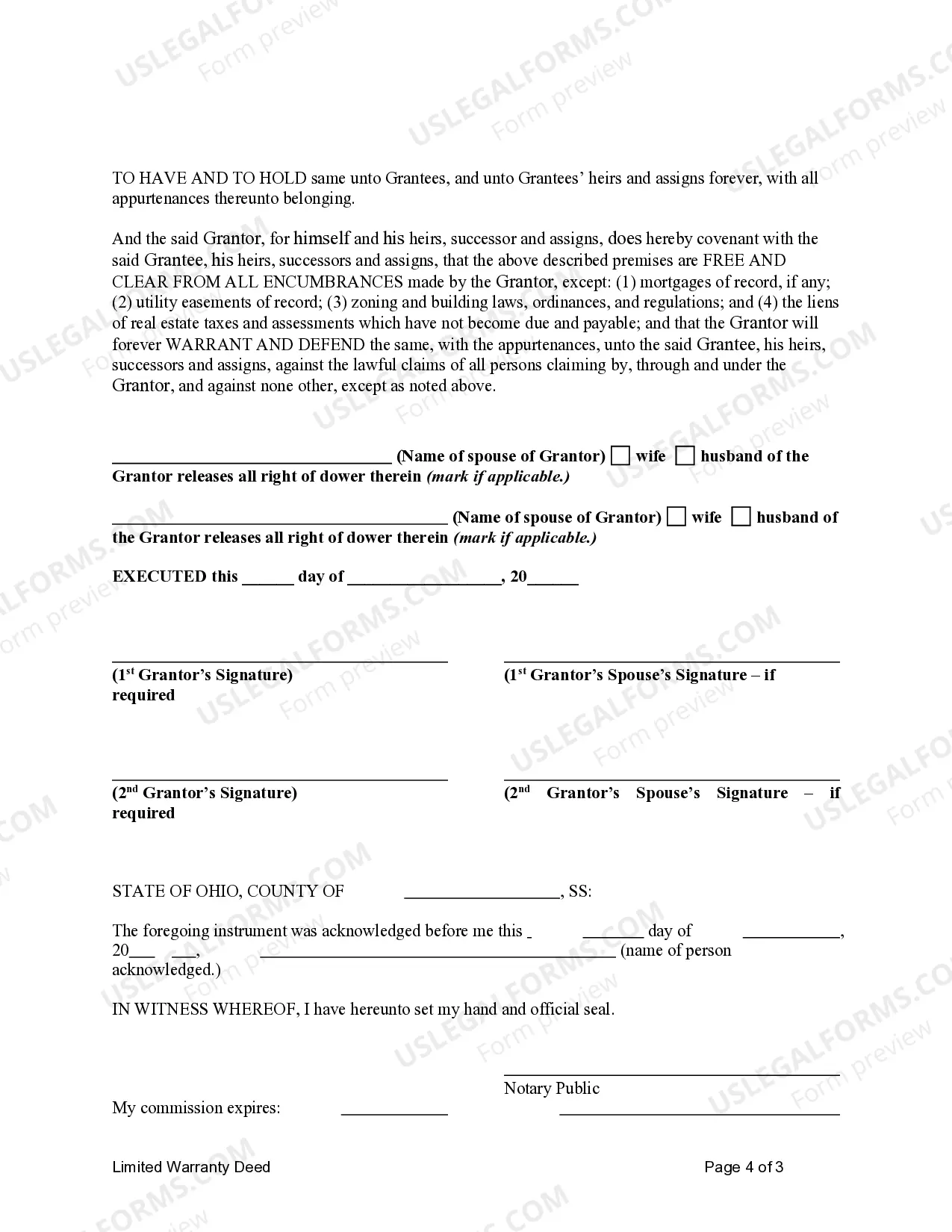
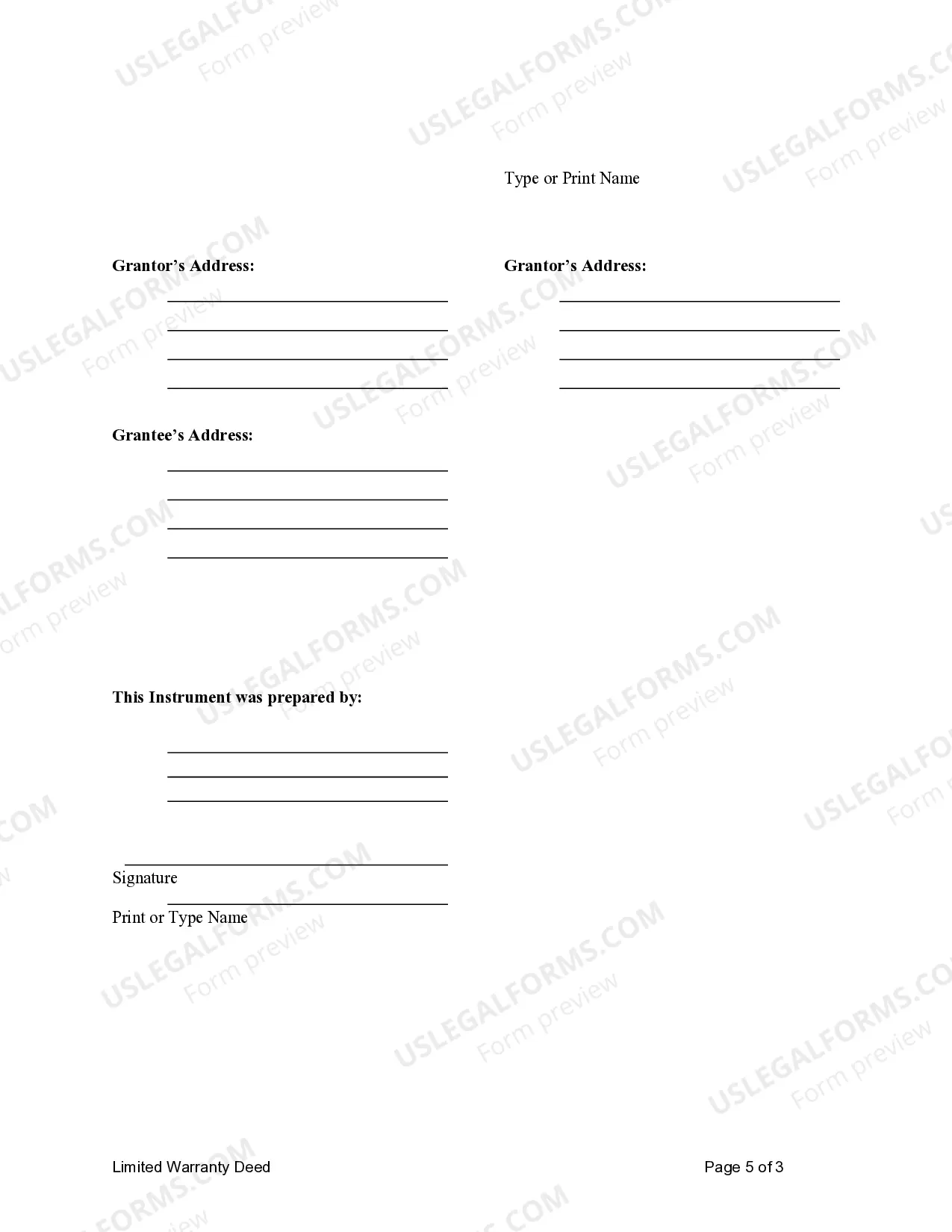
The Limited Warranty Deed from two Individuals to Corporation is a legal document that allows two individuals (the Grantors) to convey property ownership to a corporation (the Grantee). This deed ensures that the property is free from liens or encumbrances caused by the Grantors. Unlike a general warranty deed, this form provides limited guarantees about the property's title, making it essential for transactions involving corporate ownership.
Main sections of this form
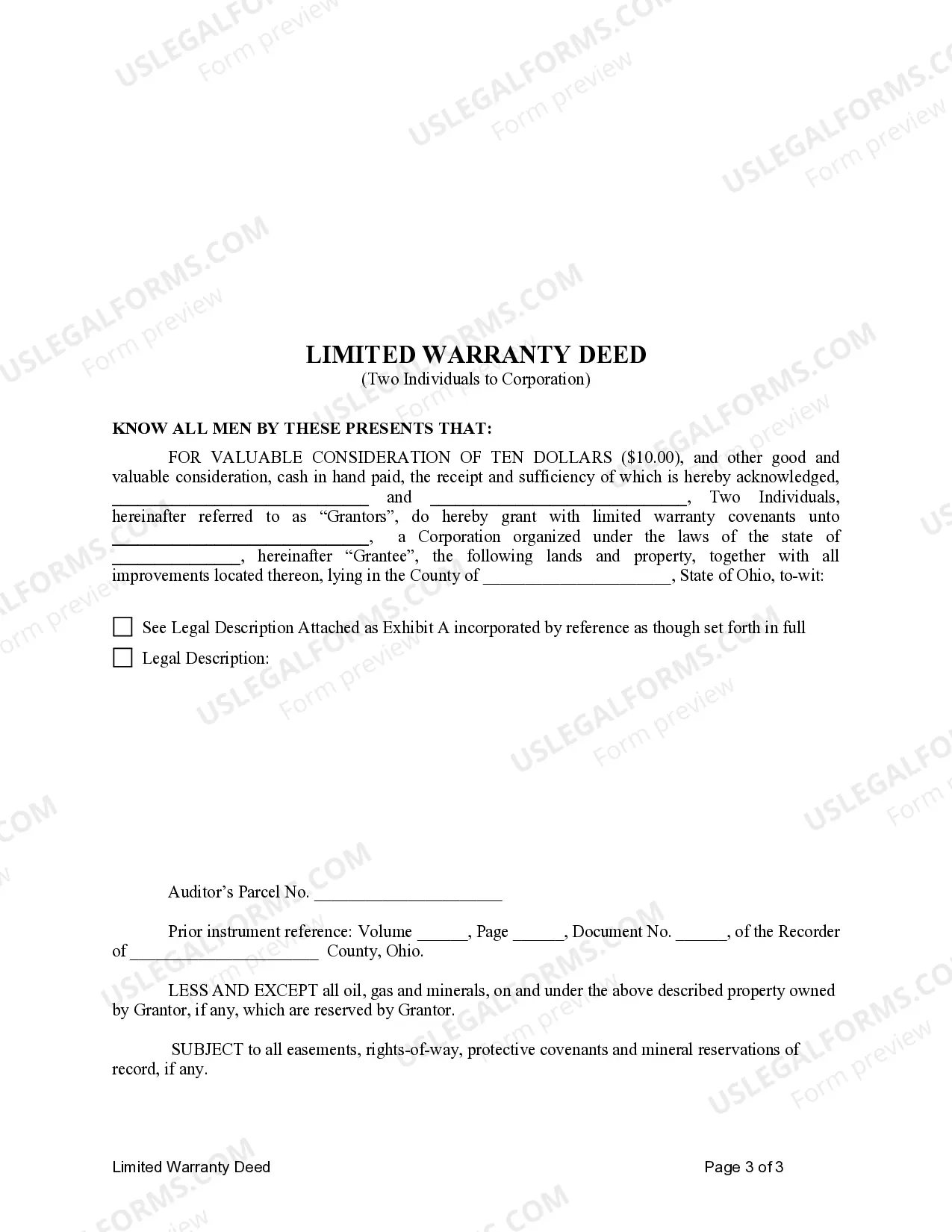
- Identification of Grantors and Grantee
- Description of the property being conveyed
- Statement of warranty regarding liens and encumbrances
- Execution clause for signatures and dates
- Legal compliance with state laws




When this form is needed
This form should be used when two individuals are transferring property ownership to a corporation and require assurance that the property is free of liens. Common scenarios include a family-owned business reorganizing, selling real estate to a newly formed corporation, or transferring property held jointly by individuals to a corporate entity for better management and liability protection.
Intended users of this form
This form is suitable for:
- Individuals or couples looking to transfer property ownership to their corporation
- Business owners restructuring their ownership during incorporation
- Real estate agents or attorneys facilitating corporate property transactions
How to complete this form
- Identify the Grantors (two individuals) and the Grantee (corporation).
- Provide a detailed description of the property being transferred.
- Specify any exemptions from warranties, such as existing easements or recorded liens.
- Each Grantor must sign and date the document at the designated signature lines.
- Ensure the form is filed in accordance with local recording requirements.
Notarization requirements for this form
This document requires notarization to meet legal standards. US Legal Forms provides secure online notarization powered by Notarize, allowing you to complete the process through a verified video call, available 24/7.
Get your form ready online
Our built-in tools help you complete, sign, share, and store your documents in one place.
Make edits, fill in missing information, and update formatting in US Legal Forms—just like you would in MS Word.
Download a copy, print it, send it by email, or mail it via USPS—whatever works best for your next step.
Sign and collect signatures with our SignNow integration. Send to multiple recipients, set reminders, and more. Go Premium to unlock E-Sign.
If this form requires notarization, complete it online through a secure video call—no need to meet a notary in person or wait for an appointment.
We protect your documents and personal data by following strict security and privacy standards.

Make edits, fill in missing information, and update formatting in US Legal Forms—just like you would in MS Word.

Download a copy, print it, send it by email, or mail it via USPS—whatever works best for your next step.

Sign and collect signatures with our SignNow integration. Send to multiple recipients, set reminders, and more. Go Premium to unlock E-Sign.

If this form requires notarization, complete it online through a secure video call—no need to meet a notary in person or wait for an appointment.

We protect your documents and personal data by following strict security and privacy standards.
Mistakes to watch out for
- Failing to accurately describe the property or the parties involved.
- Not including required signatures or dates from all Grantors.
- Omitting details about existing liens or encumbrances on the property.
- Not understanding the limitations of the warranty provided in the deed.
Benefits of completing this form online
- Convenience of downloading and completing the form at your own pace.
- Editability allows for easy adjustments before finalizing.
- Access to legally vetted templates, ensuring compliance with state laws.
- Suitable for individuals with varying levels of legal experience.
Legal use & context
- This Limited Warranty Deed is enforceable under Ohio law, provided it is executed correctly.
- It protects the Grantee from claims related to the Grantors' actions but does not extend to claims made outside of those parameters.
- Always consider seeking legal advice to ensure compliance with state laws.
Quick recap
- The Limited Warranty Deed facilitates property transfer from individuals to a corporation.
- It limits warranties regarding the property's title, focusing on claims made by the Grantors.
- Ensure all required signatures are obtained and that the document adheres to local legal standards.
Looking for another form?
Form popularity
FAQ
Limited Warranty Deeds In a Limited Warranty Deed, the seller usually gives two warranties. The seller only warrants to the buyer that: The seller personally has not done anything to the title that the seller received.
A warranty deed guarantees that: The grantor is the rightful owner of the property and has the legal right to transfer the title.The title would withstand third-party claims to ownership of the property. The grantor will do anything to ensure the grantee's title to the property.
A special warranty deed to real estate offers protection to the buyer through the seller's guarantee that the title has been free and clear of encumbrances during their ownership of the property. It does not guarantee clear title beyond their ownership.
The Ohio limited warranty deed is similar to a warranty deed in that it conveys property interests with a guarantee. However, unlike a warranty deed, the grantor is only guaranteeing that he or she did not encumber the property while he or she owned it.
Go to the Deed Transfer Department to obtain a transfer form for a quit claim deed or warranty deed. Take the form, along with the person to whom the the property is being transferred, to a notary public. Take the form back to the Deed Transfer Department and turn it in to the County Auditor.
To add a spouse to a deed, all you have to do is literally fill out, sign and record a new deed in your county recorder's office.
The Deed Transfer Department transfers the owner's name and address on the real estate tax list and duplicate. The department also collects the transfer tax/ conveyance fee ($4.00 per $1,000 of sale price) and the transfer fee ($. 50 per parcel).
Ohio Deeds: Warranty Deeds A warranty deed is a type of deed where the grantor (seller) guarantees that he or she holds clear title to a piece of real estate and has a right to sell it to the grantee (buyer).
Contrary to normal expectations, the Deed DOES NOT have to be recorded to be effective or to show delivery, and because of that, the Deed DOES NOT have to be signed in front of a Notary Public. However, if you plan to record it, then it does have to be notarized as that is a County Recorder requirement.