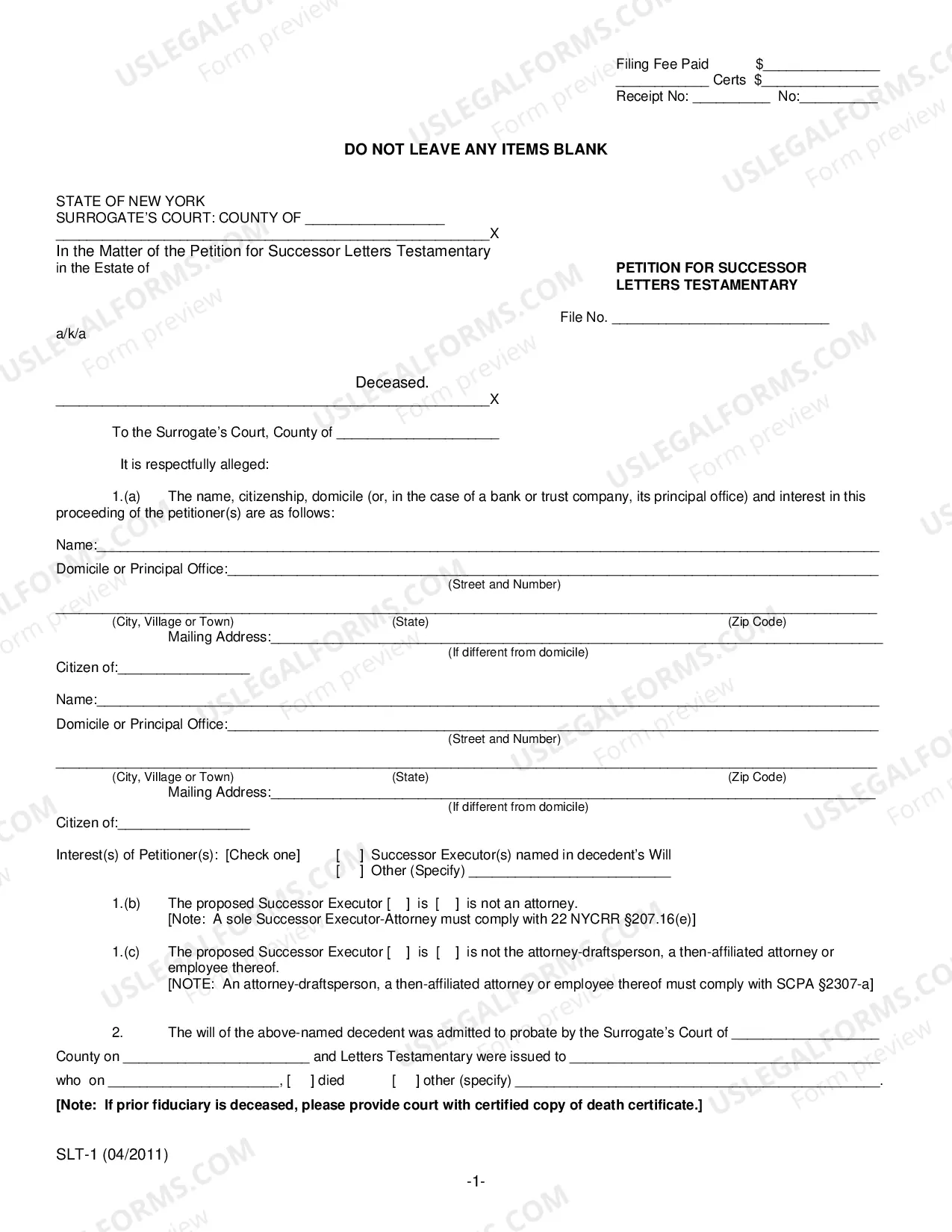
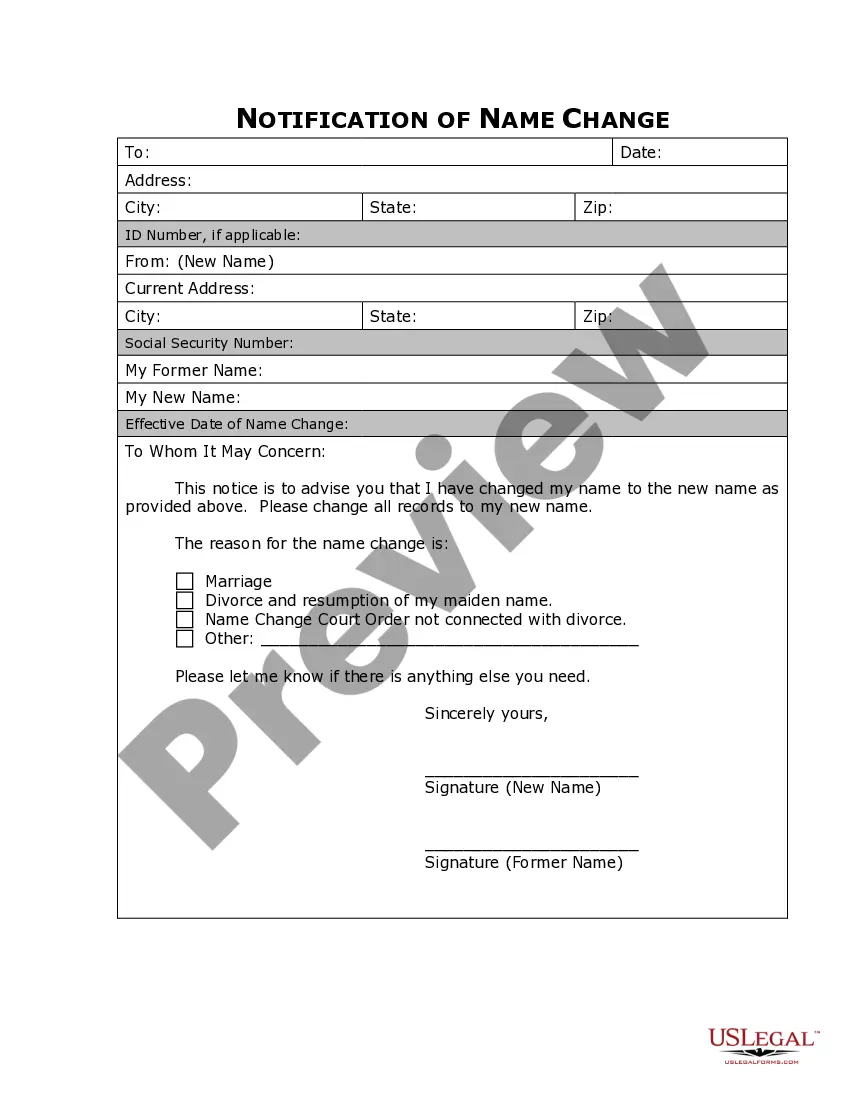
South Dakota Name Change Notification Form
What is this form?
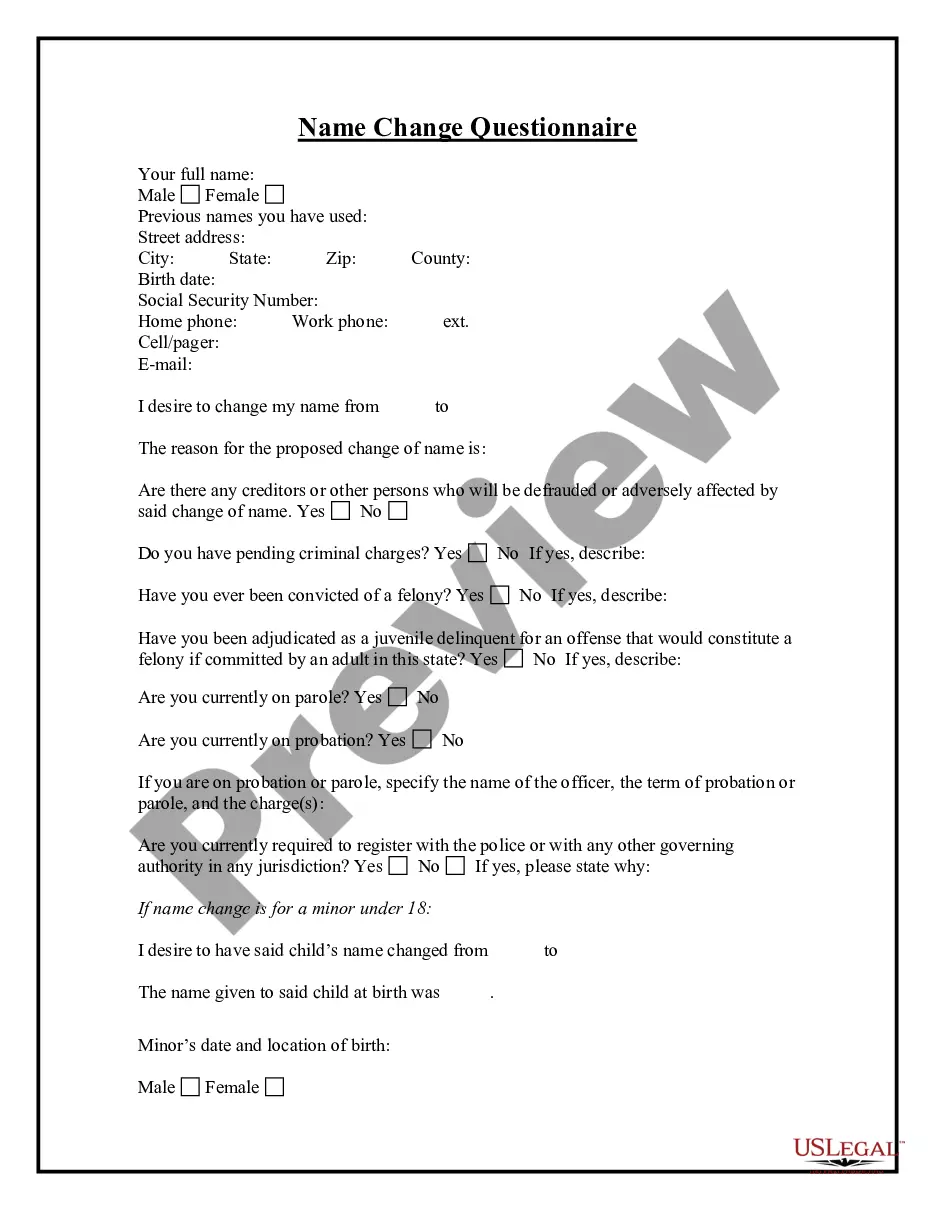
The Name Change Notification Form is a legal document used to inform various entitiesâsuch as companies, organizations, and government agenciesâof your new name after a legal name change. This form ensures that your records are updated to reflect your current legal name, distinguishing it from forms that may be used for requesting or applying for a name change.
What’s included in this form
- Personal information: Your old name and new name.
- Contact details: Your current address, phone number, and email.
- Notification recipients: List of entities to be informed about the name change.
- Date of name change: The date when the legal name change was finalized.
- Signature: Your signature affirming the accuracy of the information provided.


Common use cases
This form should be utilized after you have legally changed your name. It is essential for situations where you need to update your name with relevant companies, organizations, and government agencies to avoid any confusion or discrepancies in records.
Who this form is for
- Individuals who have completed a legal name change.
- People needing to update their name with banks, utility companies, or other organizations.
- Anyone who requires documentation to officially notify various entities of their new legal name.
How to prepare this document
- Provide your old name and the new name you wish to use.
- Include your contact details for any follow-up communications.
- List the companies and organizations you need to inform.
- Enter the date when your name change became effective.
- Sign the form to confirm that all information is correct.
Does this form need to be notarized?
This form does not typically require notarization unless specified by local law.
Get your form ready online
Our built-in tools help you complete, sign, share, and store your documents in one place.
Make edits, fill in missing information, and update formatting in US Legal Forms—just like you would in MS Word.
Download a copy, print it, send it by email, or mail it via USPS—whatever works best for your next step.
Sign and collect signatures with our SignNow integration. Send to multiple recipients, set reminders, and more. Go Premium to unlock E-Sign.
If this form requires notarization, complete it online through a secure video call—no need to meet a notary in person or wait for an appointment.
We protect your documents and personal data by following strict security and privacy standards.

Make edits, fill in missing information, and update formatting in US Legal Forms—just like you would in MS Word.

Download a copy, print it, send it by email, or mail it via USPS—whatever works best for your next step.

Sign and collect signatures with our SignNow integration. Send to multiple recipients, set reminders, and more. Go Premium to unlock E-Sign.

If this form requires notarization, complete it online through a secure video call—no need to meet a notary in person or wait for an appointment.

We protect your documents and personal data by following strict security and privacy standards.
Typical mistakes to avoid
- Forgetting to notify all necessary entities.
- Inaccurately filling out your old or new names.
- Failing to sign the form.
- Not including the date of the name change.
Why use this form online
- Convenience of downloading and printing the form from anywhere.
- Editable fields to ensure accuracy in information.
- Reliability of using attorney-drafted content to ensure legal compliance.
Quick recap
- The Name Change Notification Form is essential for updating your name legally across various entities.
- Completing the form accurately prevents discrepancies in legal documents.
- Use the form promptly after your name change to ensure timely updates.
Looking for another form?
Form popularity
FAQ
What are the steps for an adult name change? Adults in South Dakota must file a Verified Petition For Adult Name Change Forms (UJS-026) with the clerk of court's office in the county where they live; provided they have resided there for more than six months. You will also be required to pay the civil case filing fee.
Documentary evidence of a change of name can be in a number of forms, such as a marriage certificate, decree absolute, civil partnership certificate, statutory declaration or deed of change of name.
Attach the Notice of Hearing and Filing Statement to the Petition and file them with the court clerk at your county's Circuit Court. The fee for filing a minor name change petition is $70.
The passport office (see more details below) The DVLA (driving licence, vehicle registration) HM Revenue and Customs. Child Benefit. Local Authority (Council tax and electoral register) Land Registry. Student Loans. Your employer.
In most states, you have to pay a fee (usually $150 to $200) to file your name change petition in court. It also costs a small amount of money to get forms notarized. And if you're getting married, you may want to pay for additional certified copies of your marriage certificate to use as proof of your new last name.
Petition to change your name by filling out a name change form, an order to show cause for legally changing your name, and a decree to legally change your name. Take these forms to the court clerk and file them along with your state's required filing fees.
It's a long process. While a legal document such as a marriage certificate or court granted petition will allow you to change your name, it won't be truly official until you've submitted name change applications with the Social Security Administration, the DMV, and other relevant institutions.
In order to legally change a name you must file a Verified Petition For Adult Name Change form with the clerk of court's office in the county where you reside provided you have resided there for more than six months. You will also be required to pay the civil case filing fee.
Social Security Administration. Department of Motor Vehicles. Passport Office. Post Office. IRS. Voter Registration. Banks and other financial institutions. Credit Card companies (or issuers)