South Dakota Warranty Deed - One Individual to Two Individuals
About this form
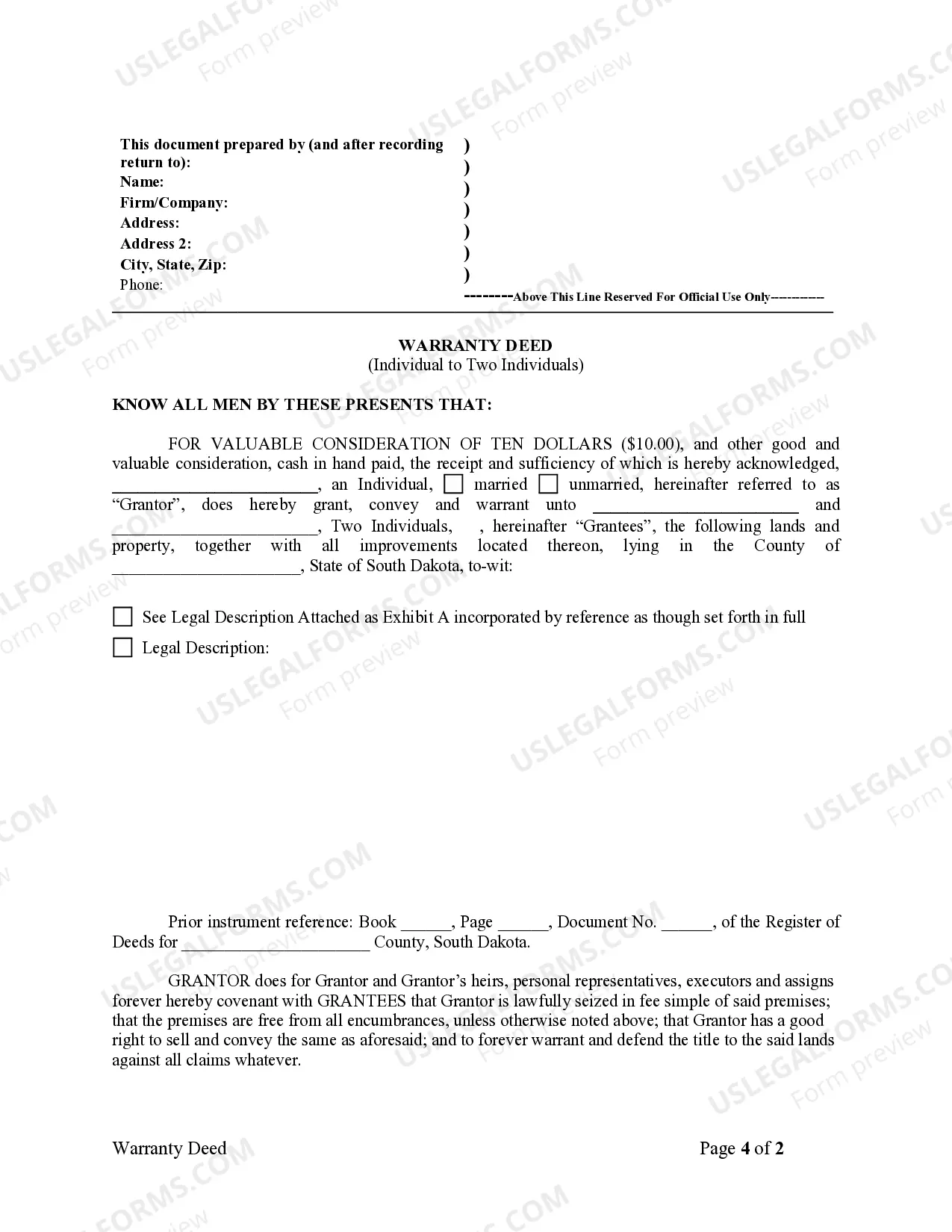
This Warranty Deed is a legal document in which one individual, known as the grantor, transfers property ownership to two individuals, referred to as the grantees. This deed allows the grantees to hold the property either as tenants in common or as joint tenants with the right of survivorship. It complies with statutory laws, ensuring clarity and legal validity.
Key parts of this document
- Identification of the grantor and grantees.
- Description of the property being conveyed.
- Specification of how the grantees will hold the property (tenants in common or joint tenants).
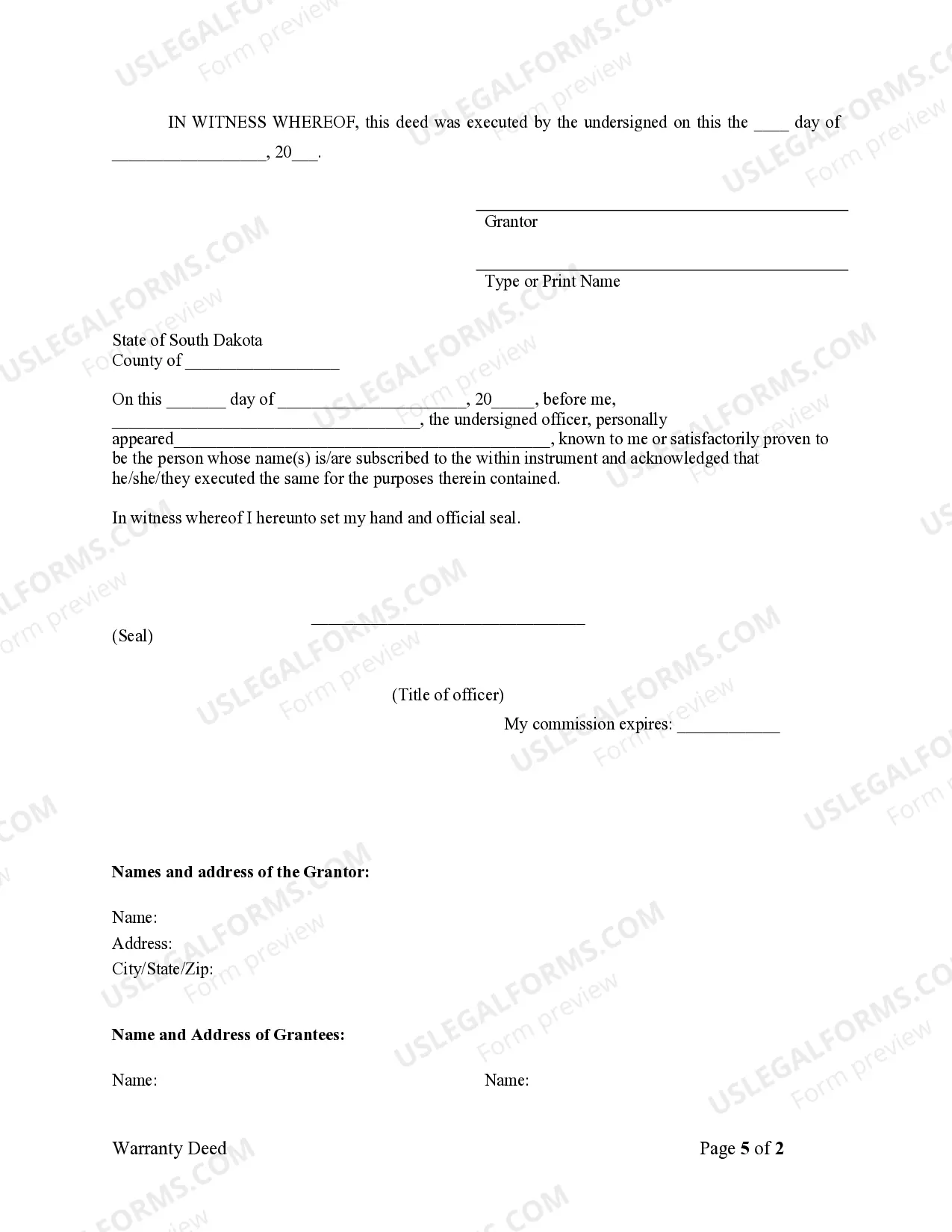
- Signature lines for the grantor and any required witnesses.
- A certificate of real estate value may be required with this document in some jurisdictions.






When this form is needed
This Warranty Deed should be used when an individual wishes to transfer property ownership to two other individuals. Common scenarios include gifting property, inheritance distribution, or sales where joint ownership is intended. It is particularly useful when multiple parties are involved in ownership, ensuring all parties have clear legal rights to the property.
Intended users of this form
This form is suitable for:
- Property owners looking to transfer ownership to multiple individuals.
- Individuals involved in real estate transactions seeking a legally recognized method of transferring property interests.
- Those managing inheritance matters involving real estate.
Steps to complete this form
- Identify the grantor and the two grantees by entering their full names.
- Specify the property being transferred, including a legal description of the property.
- Indicate how the grantees will hold the property: as tenants in common or as joint tenants with the right of survivorship.
- Both grantor and any necessary witnesses should sign the form.
- Check if additional documentation, like the Certificate of Real Estate Value, is required, and complete it accordingly.
Notarization guidance
To make this form legally binding, it must be notarized. Our online notarization service, powered by Notarize, lets you verify and sign documents remotely through an encrypted video session.
Get your form ready online
Our built-in tools help you complete, sign, share, and store your documents in one place.
Make edits, fill in missing information, and update formatting in US Legal Forms—just like you would in MS Word.
Download a copy, print it, send it by email, or mail it via USPS—whatever works best for your next step.
Sign and collect signatures with our SignNow integration. Send to multiple recipients, set reminders, and more. Go Premium to unlock E-Sign.
If this form requires notarization, complete it online through a secure video call—no need to meet a notary in person or wait for an appointment.
We protect your documents and personal data by following strict security and privacy standards.

Make edits, fill in missing information, and update formatting in US Legal Forms—just like you would in MS Word.

Download a copy, print it, send it by email, or mail it via USPS—whatever works best for your next step.

Sign and collect signatures with our SignNow integration. Send to multiple recipients, set reminders, and more. Go Premium to unlock E-Sign.

If this form requires notarization, complete it online through a secure video call—no need to meet a notary in person or wait for an appointment.

We protect your documents and personal data by following strict security and privacy standards.
Common mistakes
- Failing to accurately describe the property may lead to legal disputes.
- Not specifying how the grantees will hold the property can create ownership issues later.
- Omitting signatures or failing to have the required witness signatures can invalidate the deed.
Benefits of using this form online
- Easy access to the Warranty Deed template allows for quick completion and submission.
- Editable fields make it convenient to fill out and personalize the document to meet your needs.
- Reliable and legally compliant forms minimize the risk of errors in your property transactions.
Looking for another form?
Form popularity
FAQ
A special warranty deed to real estate offers protection to the buyer through the seller's guarantee that the title has been free and clear of encumbrances during their ownership of the property. It does not guarantee clear title beyond their ownership.
A warranty deed guarantees that: The grantor is the rightful owner of the property and has the legal right to transfer the title.The title would withstand third-party claims to ownership of the property. The grantor will do anything to ensure the grantee's title to the property.
It will depend what state the property is in. For example, the minimum fee payable when changing the title to have someone removed from a property title in NSW is $133.48. This fee must be paid to the NSW Government Land & Property Information Department.
A warranty deed guarantees that: The grantor is the rightful owner of the property and has the legal right to transfer the title.The title would withstand third-party claims to ownership of the property. The grantor will do anything to ensure the grantee's title to the property.
Special warranties allow the transfer of property title between seller and buyer. The purchase of title insurance can mitigate the risk of prior claims to the special warranty deed.
It's important to note that a warranty deed does not actually prove the grantor has ownership (a title search is the best way to prove that), but it is a promise by the grantor that they are transferring ownership and if it turns out they don't actually own the property, the grantor will be responsible for compensating
Today's question is is it possible to deed real estate to someone without them knowing it? Strictly speaking, the answer is no. Because it does not meet the acceptance element of a valid deed transfer. Us lawyers must learn to speak in elements because it governs everything that we do.
It will not protect against title issues that arose prior to the time the seller took occupancy. Consequently, it offers less protection to buyers, and more protection to sellers, than a general warranty deed, which is the most common option for selling or buying a property.
In most states you can file a disclaimer or deed of disclaimer that says specifically you were placed in title without your knowledge or consent and disclaim the deed.