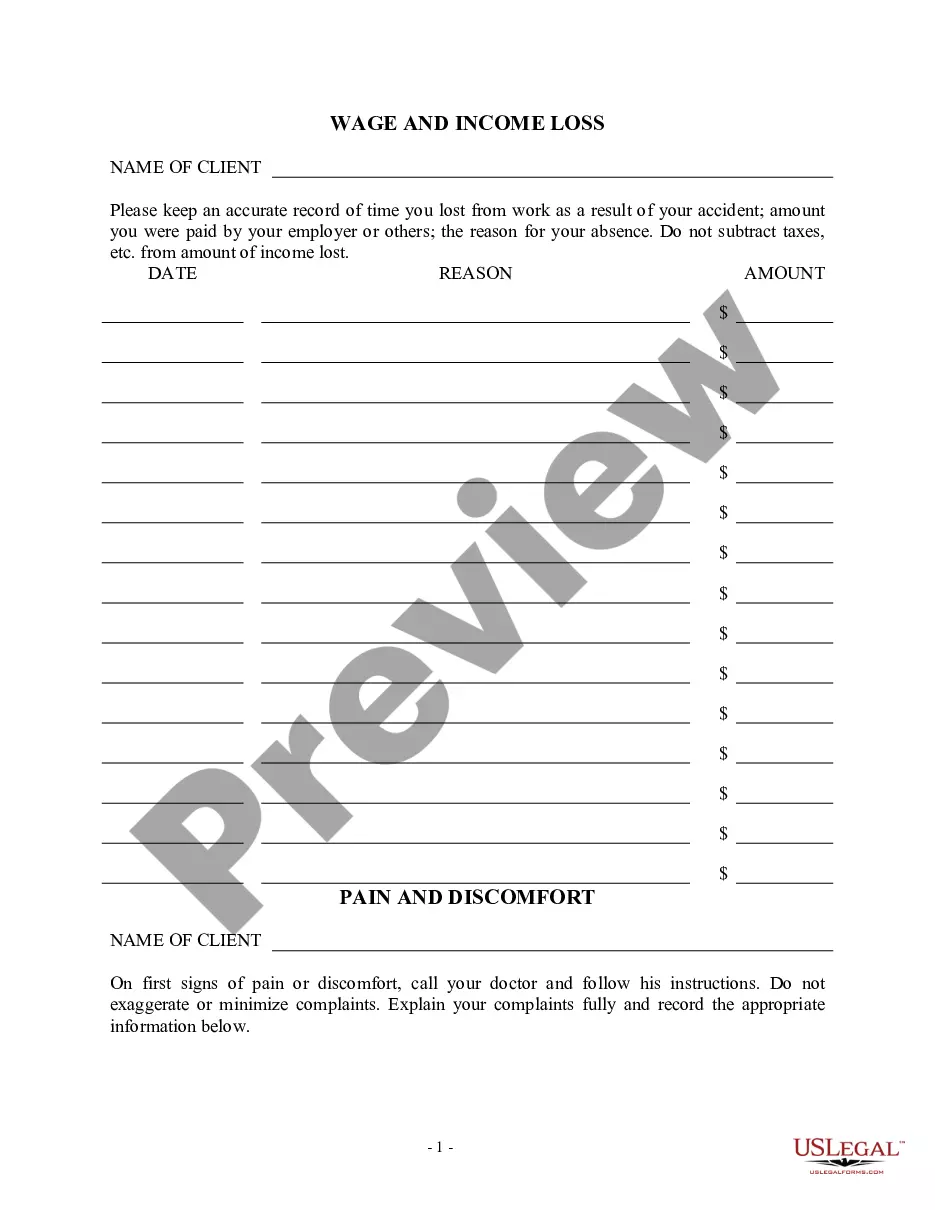
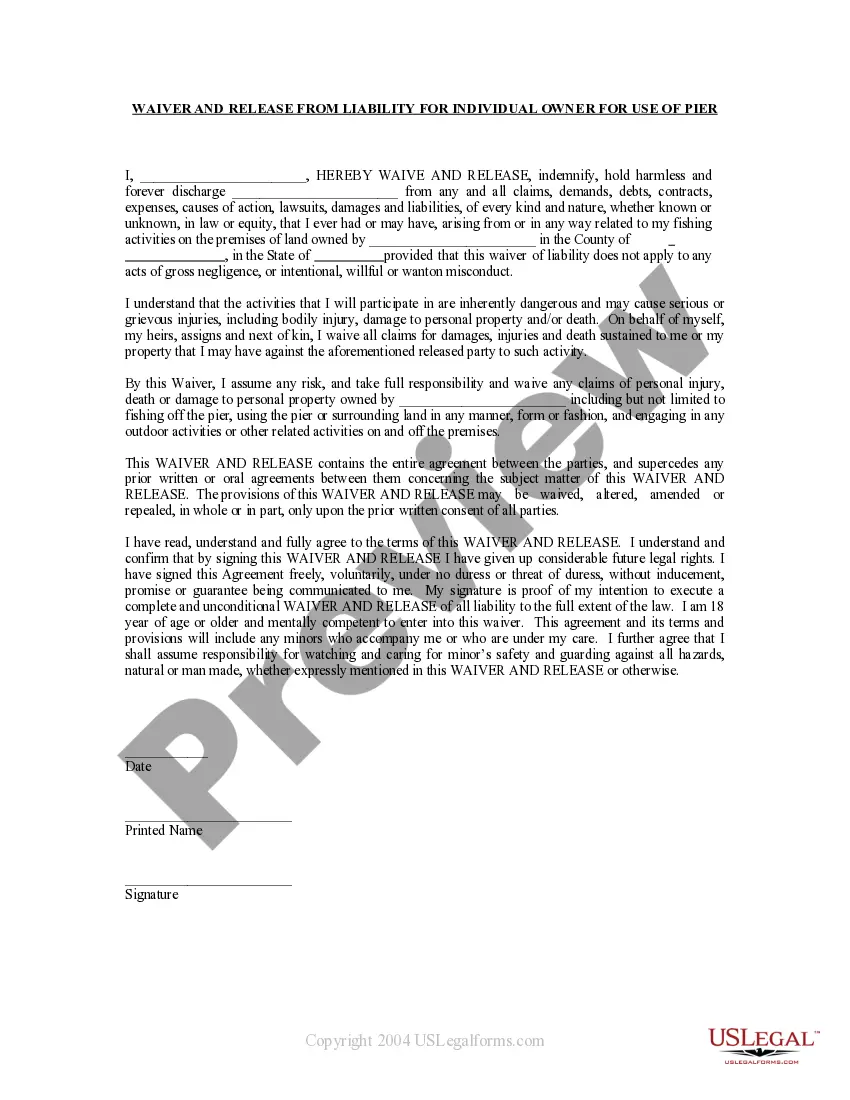
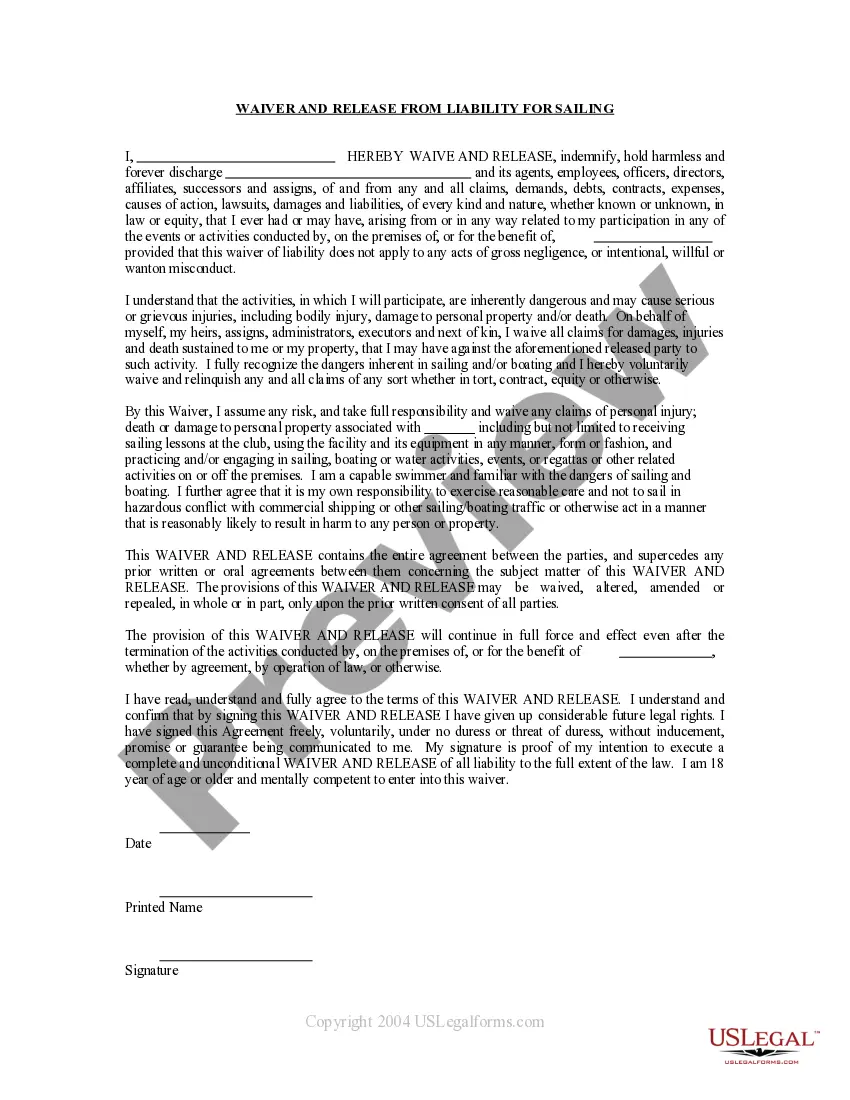
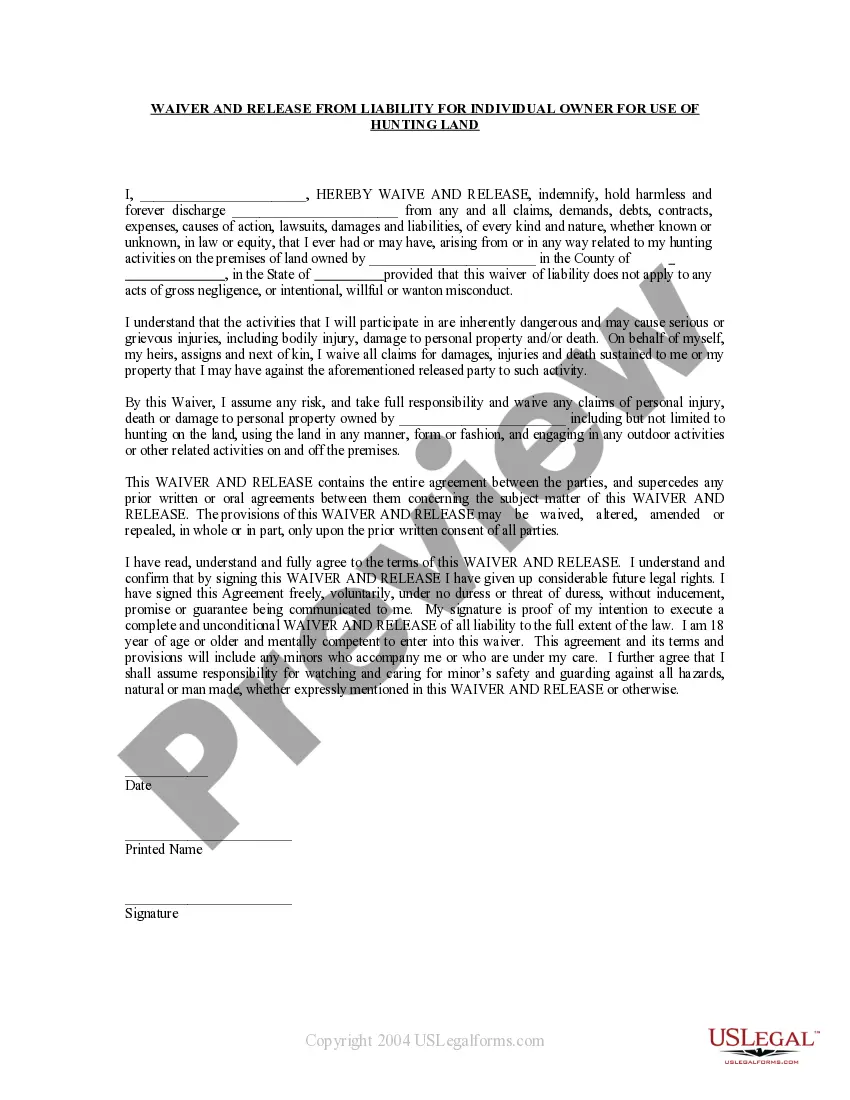
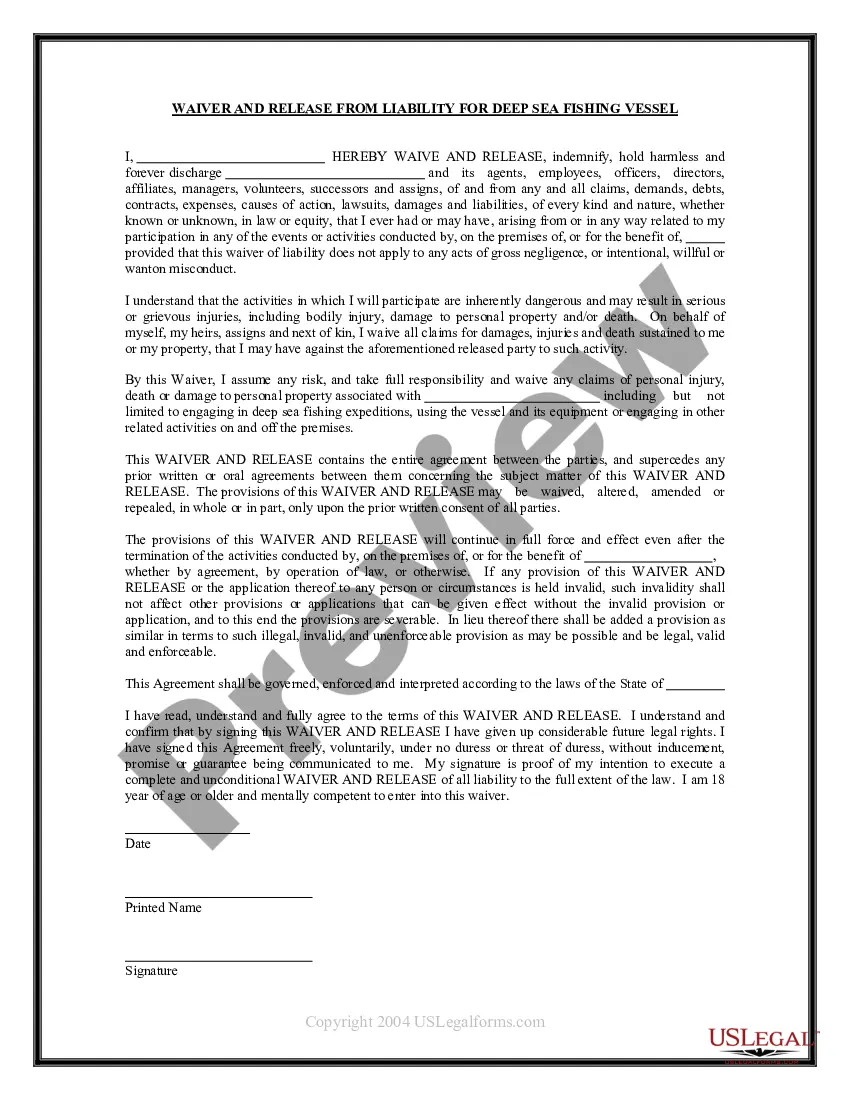
This form releases a property owner from liability for permitting an individual from fishing from the property owner's pier.
South Carolina Waiver and Release From Liability For Adult for Individual Fishing
Category:
State:
Multi-State
Control #:
US-WAV-54A
Format:
Word;
Rich Text
Instant download
Description
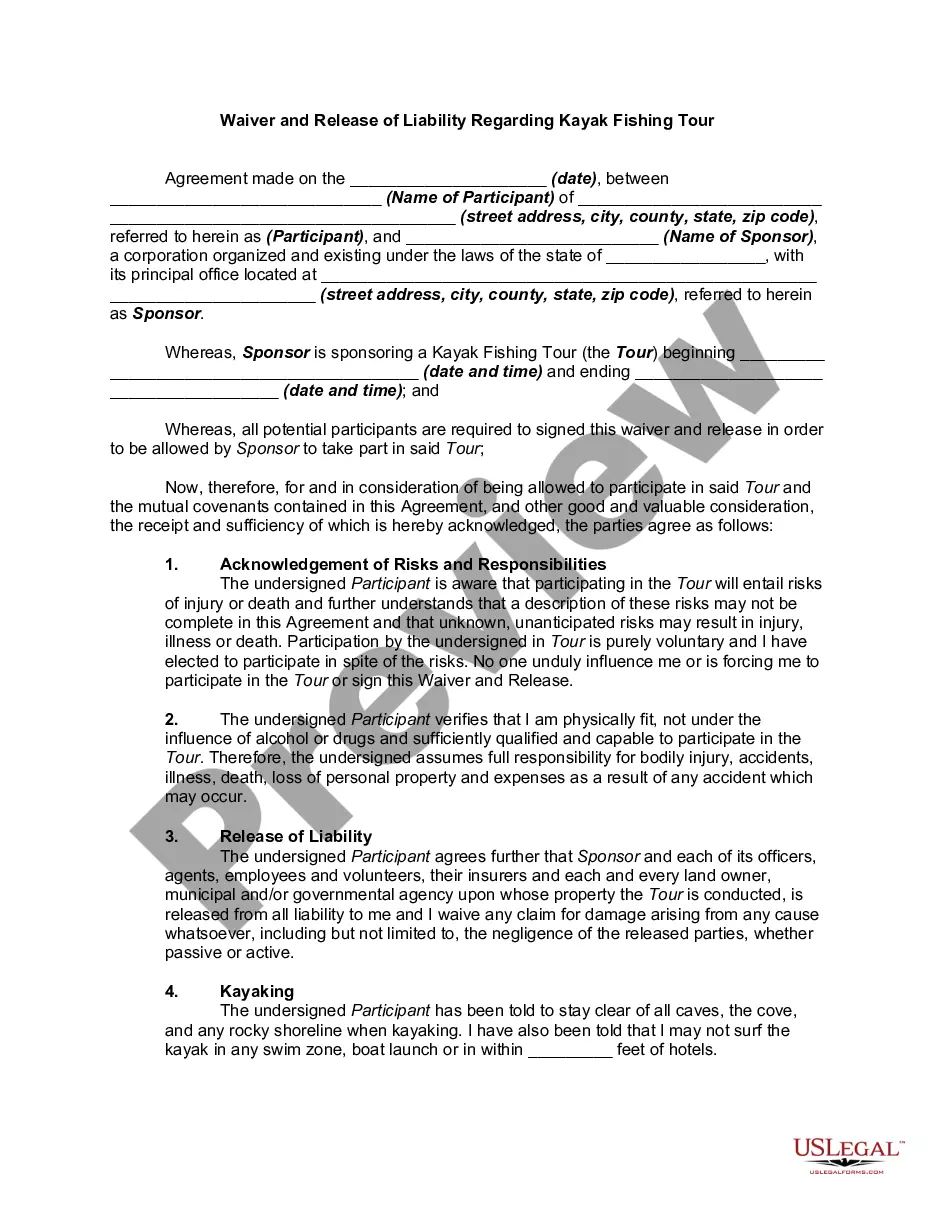
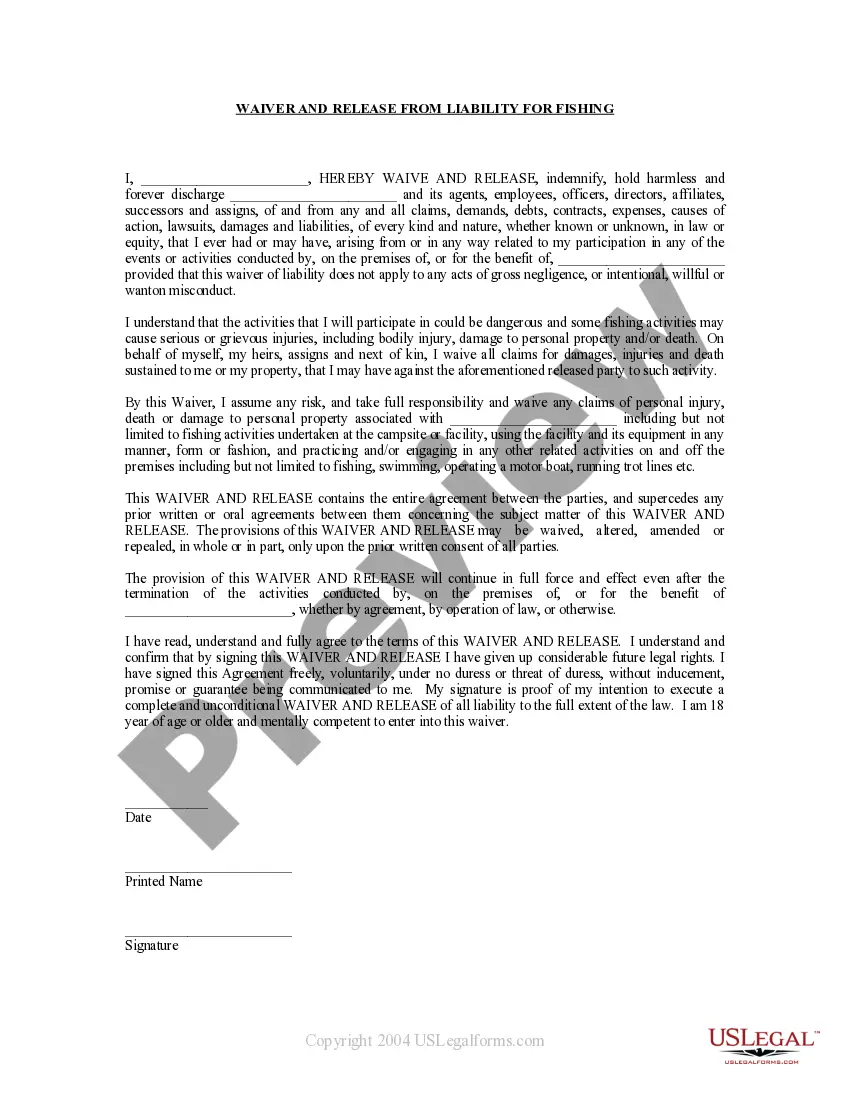
How to fill out Waiver And Release From Liability For Adult For Individual Fishing?
Are you presently in a scenario where you frequently require documents for organizational or personal reasons.
There are numerous legal document templates available online, but finding reliable ones isn’t easy.
US Legal Forms offers a vast array of form templates, such as the South Carolina Waiver and Release From Liability For Adult for Individual Fishing, designed to comply with state and federal regulations.
Once you find the correct form, simply click Buy now.
Select the pricing plan you need, fill in the required information to create your account, and pay for the transaction using your PayPal or credit card. Choose a convenient document format and download your copy. Find all the document templates you have purchased in the My documents menu. You can obtain another copy of the South Carolina Waiver and Release From Liability For Adult for Individual Fishing anytime, if necessary. Just select the desired form to download or print the document template. Use US Legal Forms, the most comprehensive collection of legal forms, to save time and avoid mistakes. The service provides professionally crafted legal document templates that can be utilized for various purposes. Create an account on US Legal Forms and start making your life a bit easier.
- If you are already acquainted with the US Legal Forms website and have an account, simply Log In.
- Then, you can download the South Carolina Waiver and Release From Liability For Adult for Individual Fishing template.
- If you do not have an account and wish to start using US Legal Forms, follow these steps.
- Locate the form you need and ensure it is for your correct area/region.
- Utilize the Review button to evaluate the form.
- Examine the details to ensure you have chosen the appropriate form.
- If the form isn’t what you are looking for, use the Search field to find the form that suits your needs and requirements.
Form popularity
FAQ
Here is all that pertains writing an effective liability waiver:Get help. Writing a waiver should not be complicated.Use the correct structure.Proper formatting.Include a subject line.Include a caution!Talk about the activity risks.Do not forget an assumption of risk.Hold harmless.More items...?
The main difference between releases and waivers is the transferring of ownership. When rights are released, they are transferred to another party. When rights are waived, they are gone altogether.
Page Content. 200bWaiver and Release FAQ: WHAT ARE WAIVERS AND RELEASES? Waivers and/or releases of liability (releases) are legal agreements designed to transfer responsibility for injuries and property damage from one party to another.
A release and waiver agreement is an enforceable promise not to pursue legal action in exchange for compensation. The releasee gives money or some other form of compensation to the releasor, who then agrees not to press charges, sue, or take any other legal action against the releasee.
A waiver is a document that obtains written confirmation from an individual that they are relinquishing a right or privilege. Businesses often use a waiver toward customers to minimize the risk of legal implications if a customer or client gets injured, however, waivers can be used in a variety of situations.
A generic form of release agreement for use when parties to a commercial contract are terminating or have terminated the contract (or a portion of it) and have agreed to deliver a mutual release of claims. This Standard Document has integrated notes with important explanations and drafting tips.
Release Agreement means an agreement, substantially in a form approved by the Company, pursuant to which Executive releases all current or future claims, known or unknown, arising on or before the date of the release against the Company, its subsidiaries and its officers.
Examples of waivers include the waiving of parental rights, waiving liability, tangible goods waivers, and waivers for grounds of inadmissibility. Waivers are common when finalizing lawsuits, as one party does not want the other pursuing them after a settlement is transferred.
Liability waivers are enforceable in California solely to the extent they shift to the customer the risk of ordinary negligence. Under California law, a liability waiver cannot excuse an injury caused by a defendant's gross negligence, recklessness or intentionally wrongful act.
The main difference between releases and waivers is the transferring of ownership. When rights are released, they are transferred to another party. When rights are waived, they are gone altogether. If intellectual property rights are waived, the IP can be used by any other party that has access to it.