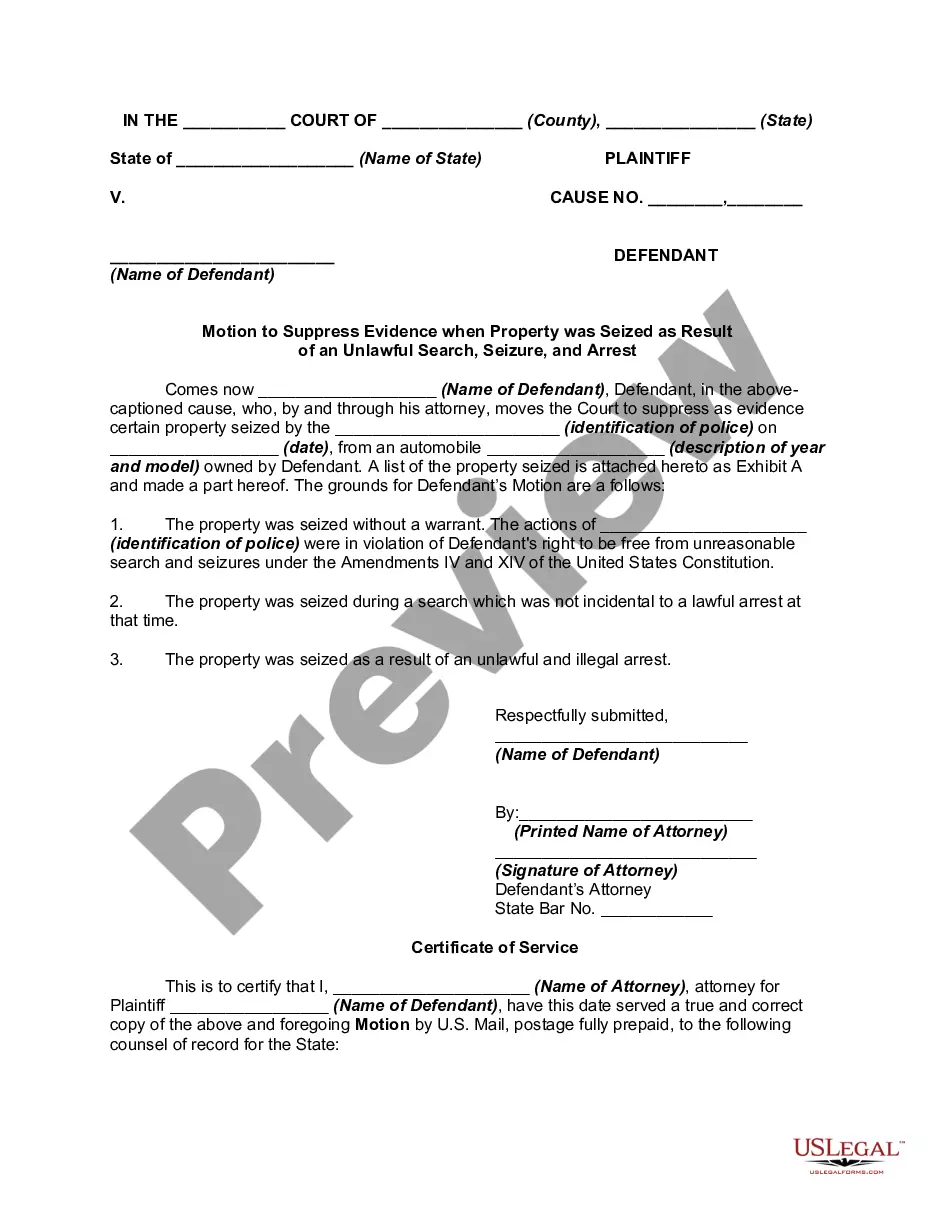
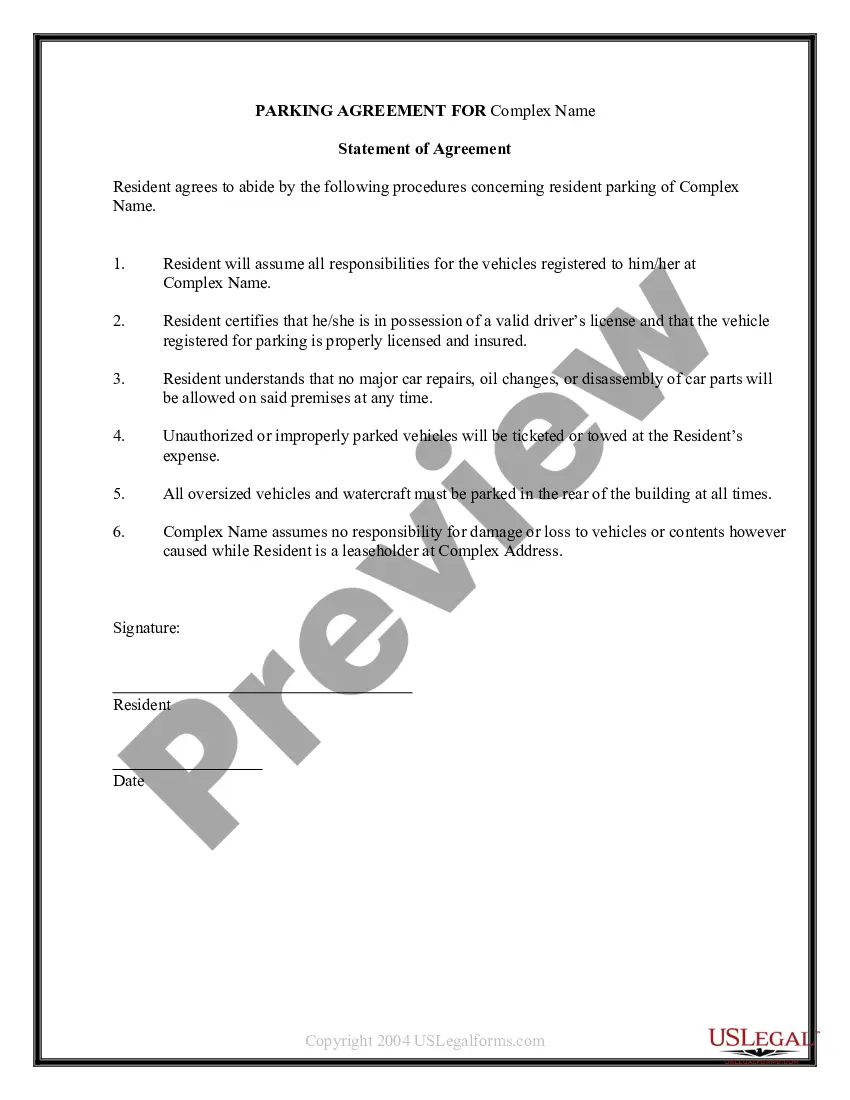
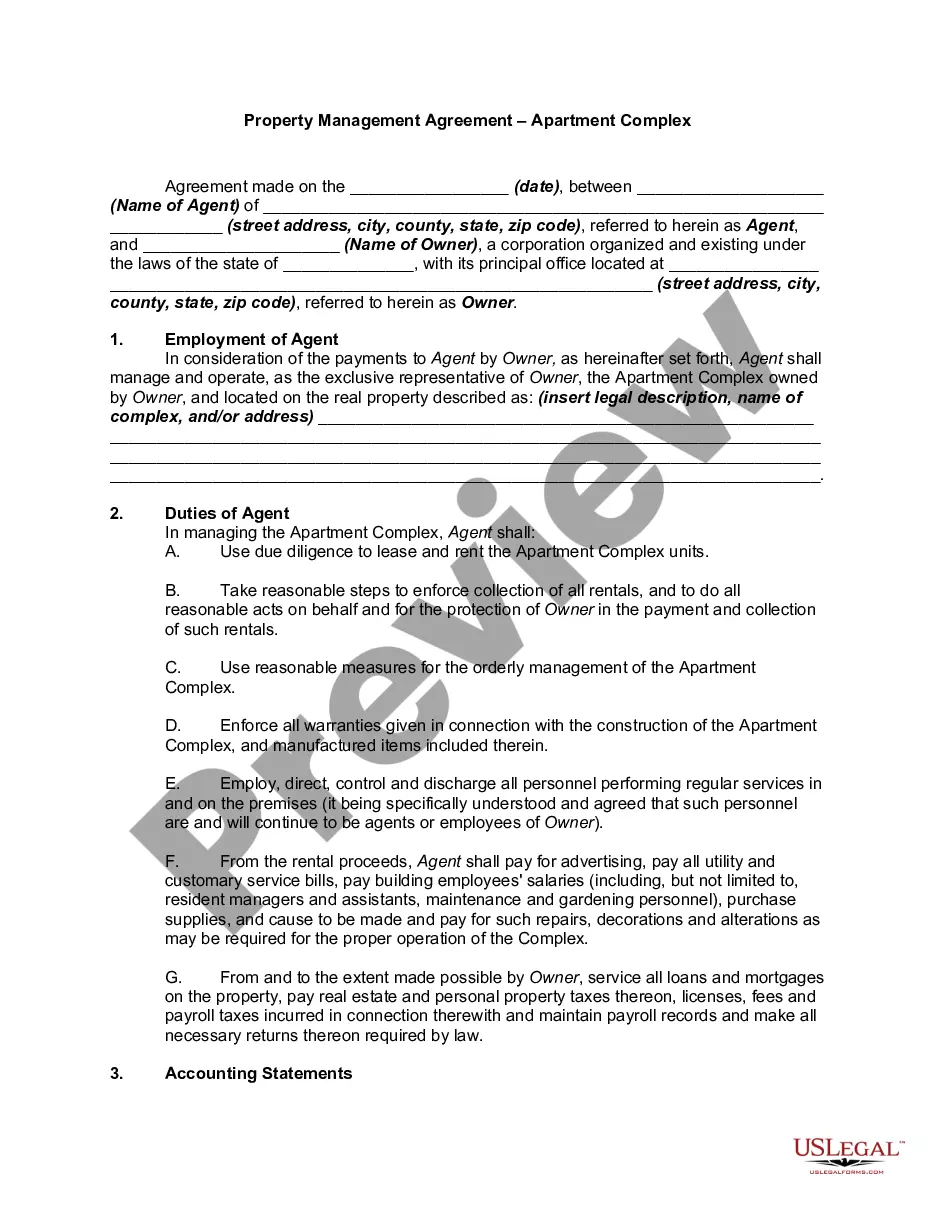
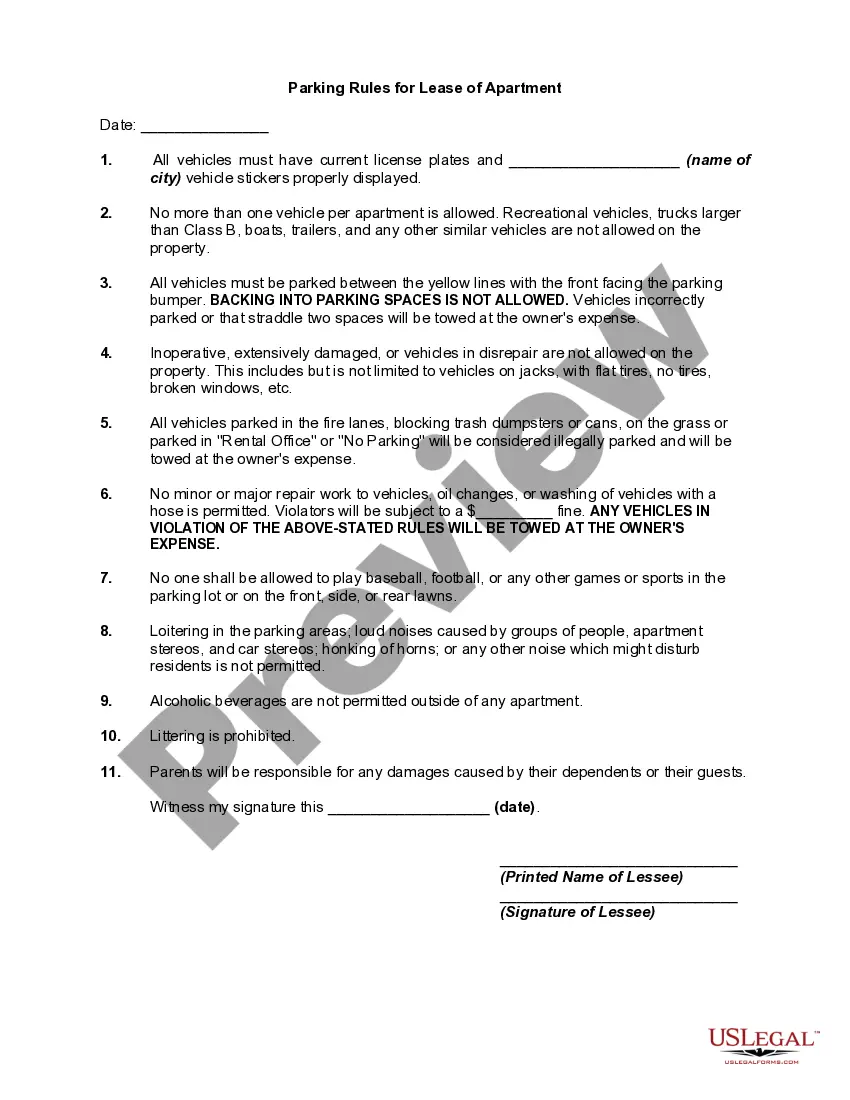
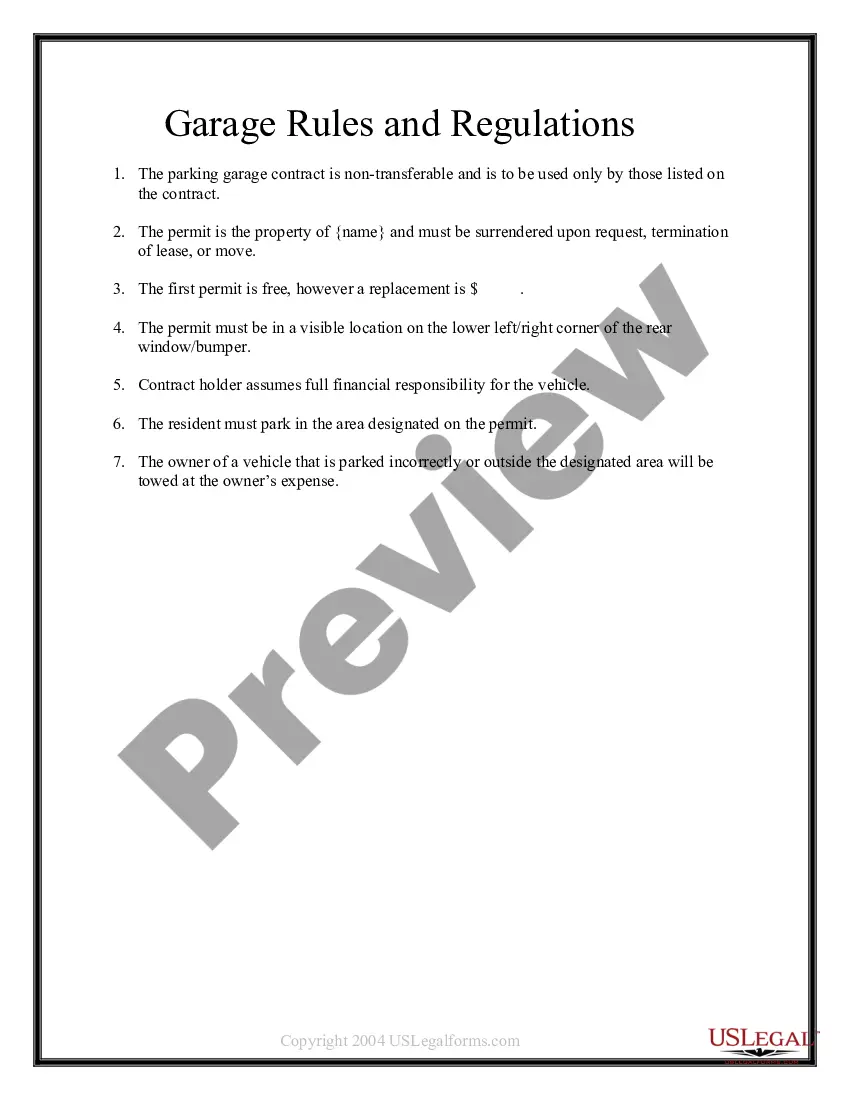
Apartment policy concerning the use of the complex parking lot.
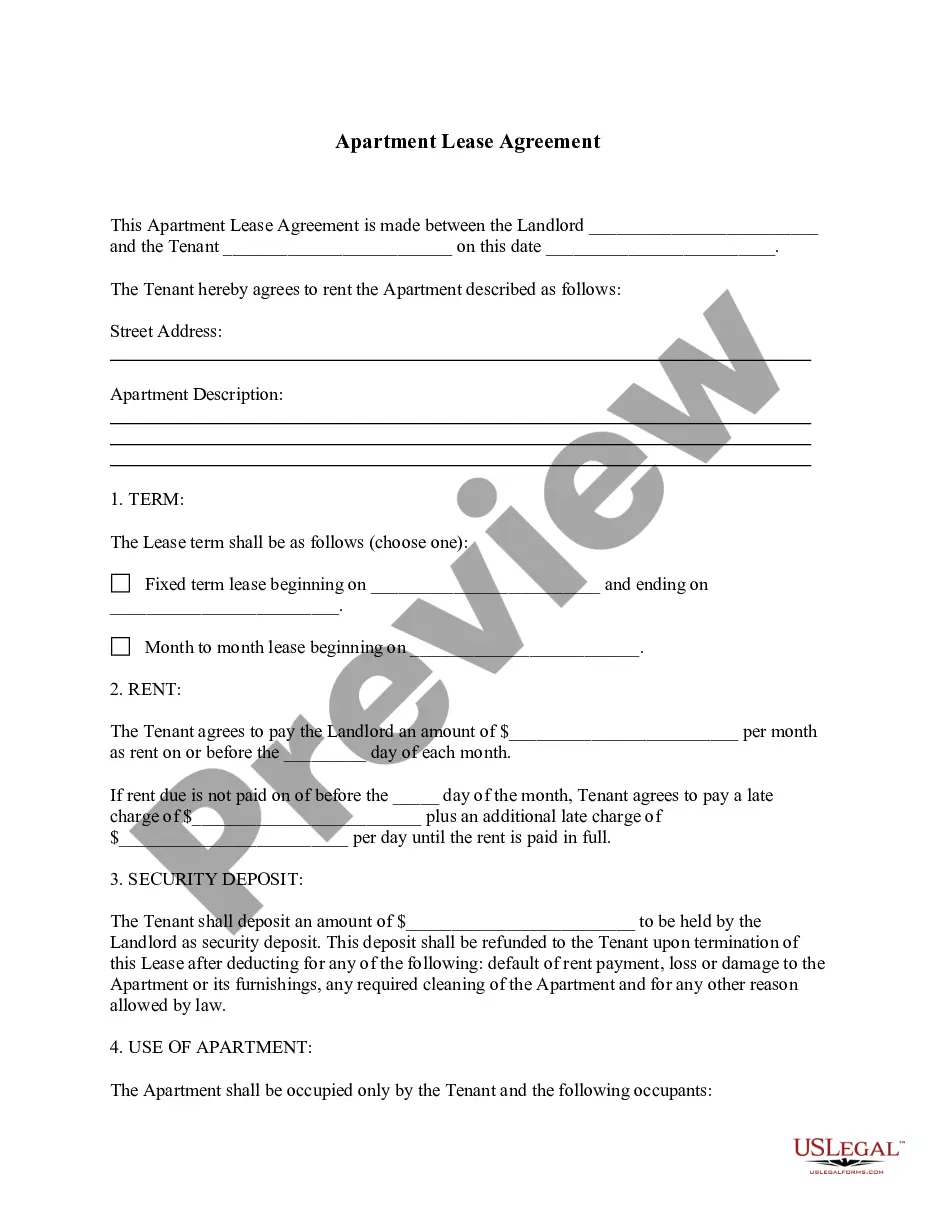
South Carolina Apartment Complex Parking Agreement
Category:
State:
Multi-State
Control #:
US-900LT
Format:
Word;
Rich Text
Instant download
Description
Get your form ready online
Our built-in tools help you complete, sign, share, and store your documents in one place.
Built-in online Word editor
Make edits, fill in missing information, and update formatting in US Legal Forms—just like you would in MS Word.
Export easily
Download a copy, print it, send it by email, or mail it via USPS—whatever works best for your next step.
E-sign your document
Sign and collect signatures with our SignNow integration. Send to multiple recipients, set reminders, and more. Go Premium to unlock E-Sign.
Notarize online 24/7
If this form requires notarization, complete it online through a secure video call—no need to meet a notary in person or wait for an appointment.
Store your document securely
We protect your documents and personal data by following strict security and privacy standards.

Make edits, fill in missing information, and update formatting in US Legal Forms—just like you would in MS Word.

Download a copy, print it, send it by email, or mail it via USPS—whatever works best for your next step.

Sign and collect signatures with our SignNow integration. Send to multiple recipients, set reminders, and more. Go Premium to unlock E-Sign.

If this form requires notarization, complete it online through a secure video call—no need to meet a notary in person or wait for an appointment.

We protect your documents and personal data by following strict security and privacy standards.
Looking for another form?






How to fill out Apartment Complex Parking Agreement?
US Legal Forms - one of the largest repositories of legal documents in the United States - offers a variety of legal document templates that you can download or print.
Through the website, you can discover thousands of forms for business and personal purposes, organized by categories, states, or keywords. You can find the most recent forms like the South Carolina Apartment Complex Parking Agreement in just moments.
If you hold a subscription, Log In and download the South Carolina Apartment Complex Parking Agreement from your US Legal Forms collection. The Download button will appear on each form you view. You can access all previously downloaded forms in the My documents section of your account.
Complete the purchase. Use your Visa or Mastercard or PayPal account to finalize the transaction.
Choose the format and download the form to your device. Make edits. Fill out, modify, print, and sign the downloaded South Carolina Apartment Complex Parking Agreement. Each template you added to your account does not have an expiration date and is yours permanently. Therefore, if you wish to download or print another copy, simply navigate to the My documents area and click on the desired form. Access the South Carolina Apartment Complex Parking Agreement with US Legal Forms, the most comprehensive library of legal document templates. Utilize thousands of professional and state-specific templates that meet your business or personal requirements and standards.
- Make sure you have chosen the correct form for the city/county.
- Click the Preview button to review the content of the form.
- Read the description of the form to ensure you have selected the right one.
- If the form does not meet your needs, use the Search field at the top of the screen to find one that does.
- If you are satisfied with the form, confirm your choice by clicking the Purchase now button.
- Then, select the payment plan you prefer and provide your credentials to register for an account.
Form popularity
FAQ
To prevent unauthorized parking at your South Carolina apartment complex, you need to establish clear rules outlined in the South Carolina Apartment Complex Parking Agreement. Signage indicating parking policies can also serve as a deterrent. Additionally, implementing a system for issuing parking permits can help manage who has access to reserved spaces.
term rental agreement in South Carolina typically refers to a lease for a period of 30 days or less. These agreements are often used for vacation rentals or temporary housing. It's crucial to understand that such agreements may have different stipulations regarding parking and usage of common areas in apartment complexes to ensure a smooth stay.
As long as the tenant does not violate any rules, they can stay until their rental period ends. However, a tenant can be evicted if they stay in the property even a day after their written lease term ends (and have not arranged for a renewal).
The big take-away is that in most circumstances a landlord cannot enter a property without agreement from the tenant. And If the landlord ignores the law and enters the property without permission, the tenant may be able to claim damages or gain an injunction to prevent the landlord doing it again.
The illegal condition(s) cannot be enforced. You may sue your landlord in court and get money damages and reasonable attorney's fees. Other parts of the lease may still be enforced. Just because one part of the lease is illegal doen not mean the entire lease is illegal.
The law requires the landlord to comply with building and housing codes materially affecting health and safety. The landlord must make all repairs and do whatever is reasonably necessary to put and keep the rental unit in a fit and livable condition.
The right to know the identity of your landlord. The right to live in the property undisturbed. The right to see the property's energy performance certificate (EPC), which, except in very specific circumstances, should be rated a minimum of E. The right to be protected from unfair rent and unfair eviction.
Landlords cannot enter tenanted properties without giving proper notice. Landlords cannot arbitrarily end someone's tenancy before the lease expires. Arbitrary, mid-lease rent increases are not permitted unless specified in certain circumstances in the lease or by the municipality.
Landlord Entry in South Carolina South Carolina landlords are, in general, required to give at least 24 hours of notice before entering an inhabited property. Landlords and tenants can create their own entry notice agreement in the lease agreement. Landlords are allowed to enter without permission in emergencies.
Tenant Rights to Withhold Rent in South CarolinaTenants may withhold rent or exercise the right to "repair and deduct" if a landlord fails to take care of important repairs, such as a broken heater. For specifics, see South Carolina Tenant Rights to Withhold Rent or "Repair and Deduct".