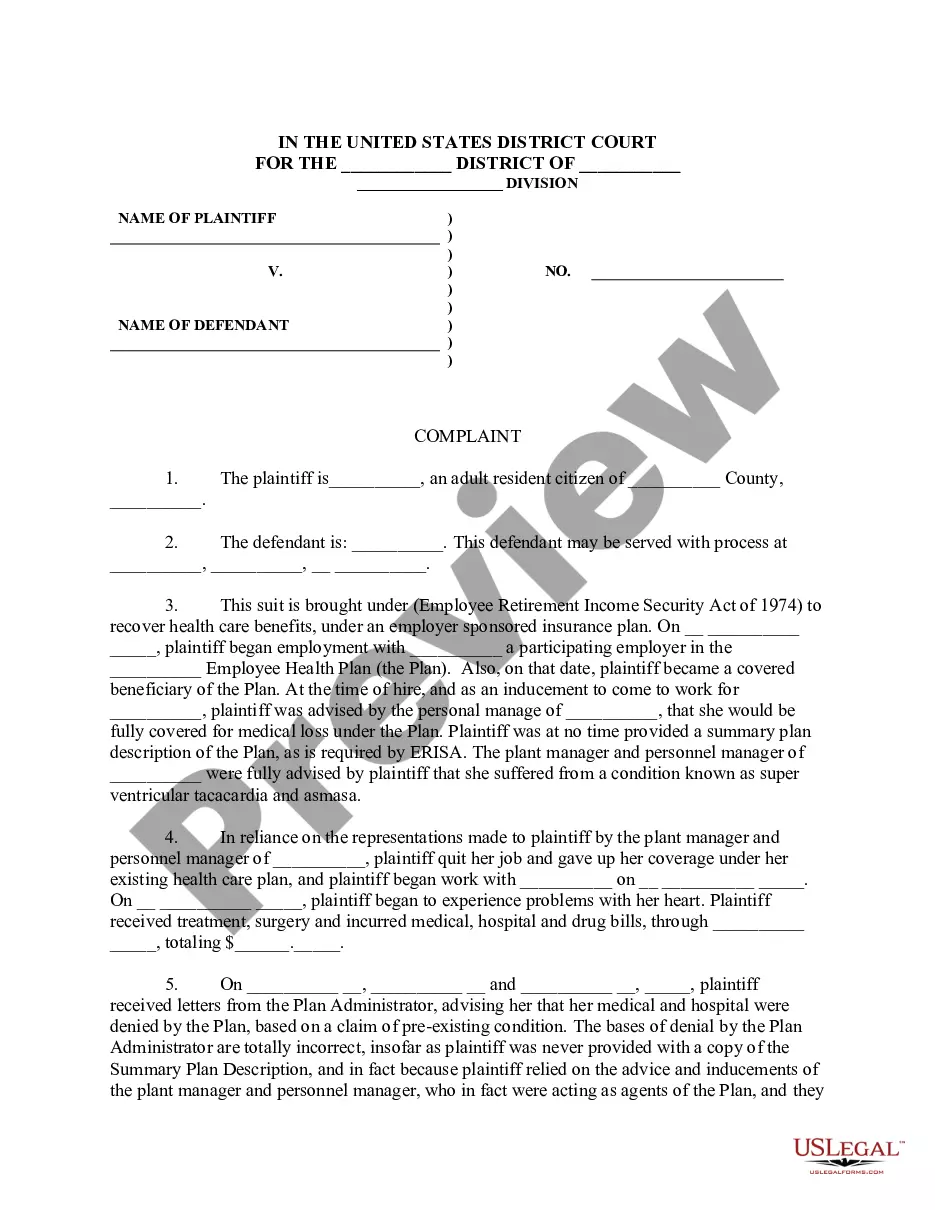
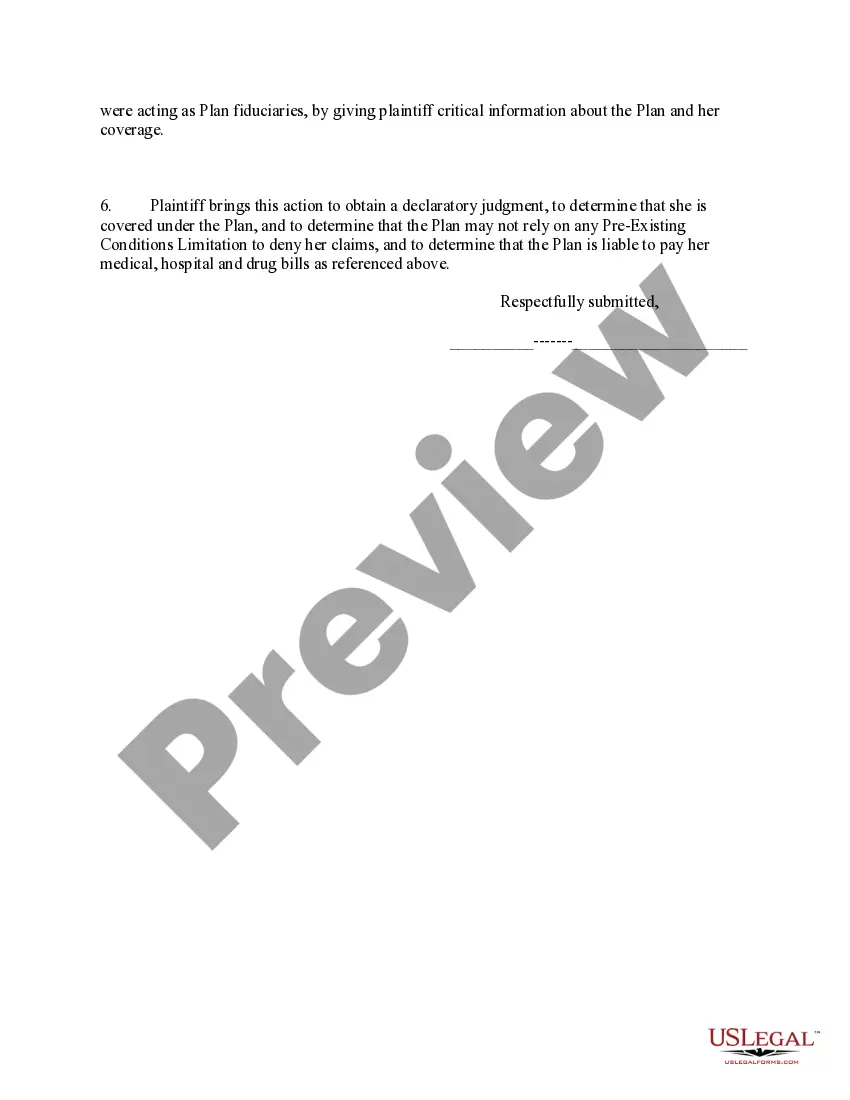
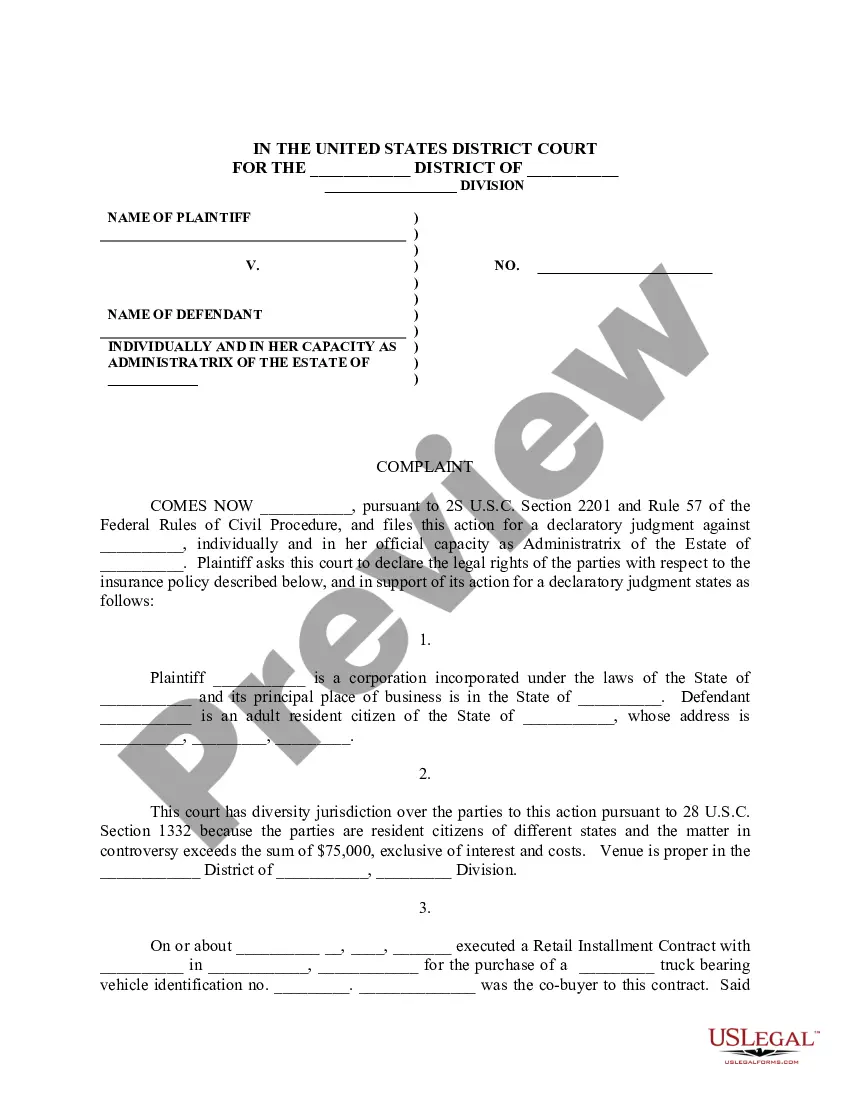
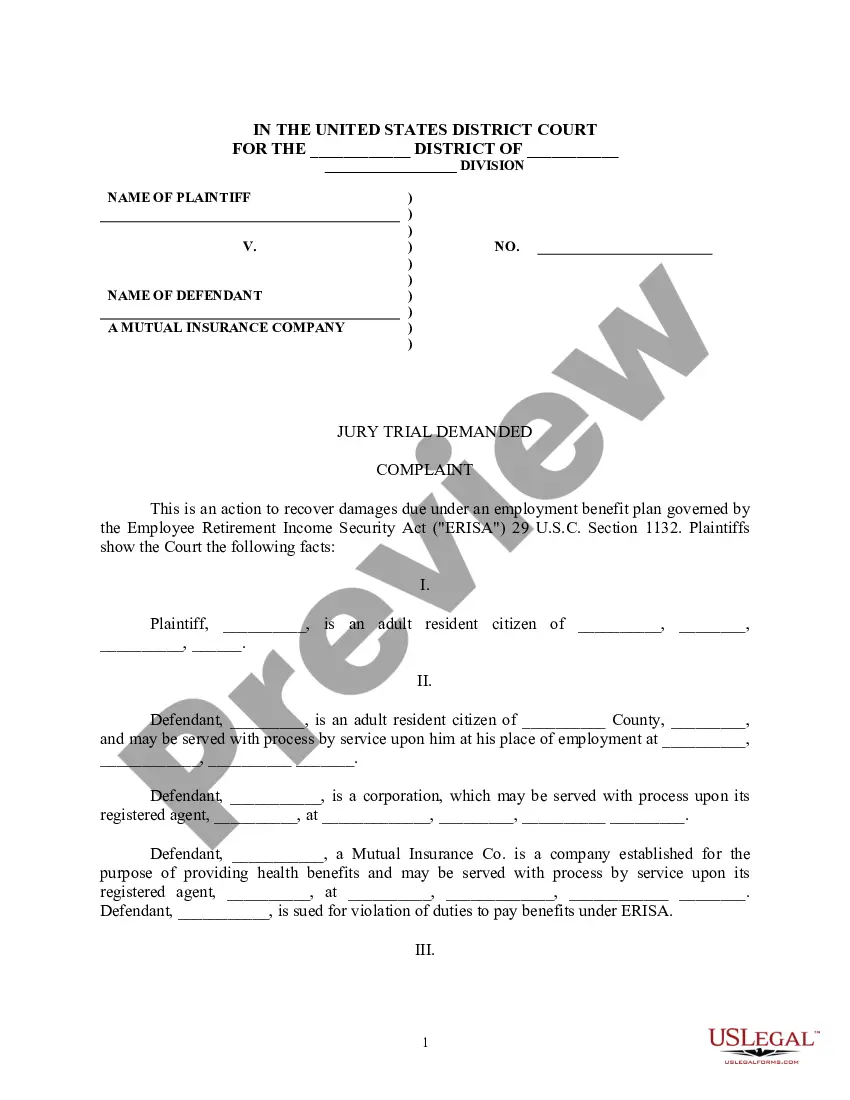
This form is a Complaint For Declaratory Judgment To Determine ERISA Coverage. Adapt to your specific circumstances. Don't reinvent the wheel, save time and money.
South Carolina Complaint For Declaratory Judgment To Determine ERISA Coverage
Instant download
Description
Free preview
Get your form ready online
Our built-in tools help you complete, sign, share, and store your documents in one place.
Built-in online Word editor
Make edits, fill in missing information, and update formatting in US Legal Forms—just like you would in MS Word.
Export easily
Download a copy, print it, send it by email, or mail it via USPS—whatever works best for your next step.
E-sign your document
Sign and collect signatures with our SignNow integration. Send to multiple recipients, set reminders, and more. Go Premium to unlock E-Sign.
Notarize online 24/7
If this form requires notarization, complete it online through a secure video call—no need to meet a notary in person or wait for an appointment.
Store your document securely
We protect your documents and personal data by following strict security and privacy standards.

Make edits, fill in missing information, and update formatting in US Legal Forms—just like you would in MS Word.

Download a copy, print it, send it by email, or mail it via USPS—whatever works best for your next step.

Sign and collect signatures with our SignNow integration. Send to multiple recipients, set reminders, and more. Go Premium to unlock E-Sign.

If this form requires notarization, complete it online through a secure video call—no need to meet a notary in person or wait for an appointment.

We protect your documents and personal data by following strict security and privacy standards.
Looking for another form?


How to fill out Complaint For Declaratory Judgment To Determine ERISA Coverage?
If you require to finalize, acquire, or generate valid document templates, utilize US Legal Forms, the largest compilation of valid forms available online.
Take advantage of the site’s straightforward and hassle-free navigation to obtain the documents you need.
Numerous templates for business and personal applications are categorized by types and jurisdictions, or keywords.
Step 4. After locating the form you need, click the Acquire now button. Select the payment plan you prefer and enter your information to register for the account.
Step 5. Complete the transaction. You can use your Visa, Mastercard, or PayPal account to finalize the purchase.
- Employ US Legal Forms to secure the South Carolina Complaint For Declaratory Judgment To Determine ERISA Coverage with just a few clicks.
- If you are already a US Legal Forms client, Log In to your account and then click the Obtain button to access the South Carolina Complaint For Declaratory Judgment To Determine ERISA Coverage.
- You can also retrieve forms you previously saved in the My documents section of your account.
- If you are using US Legal Forms for the first time, consult the instructions below.
- Step 1. Ensure you have chosen the form for the appropriate city/state.
- Step 2. Use the Preview option to review the form’s content. Don’t forget to read the description.
- Step 3. If you are not content with the form, utilize the Search area at the top of the screen to find other variations of the legal form template.
Form popularity
FAQ
In South Carolina, punitive damages are typically not insurable. This means that if a court awards punitive damages, the responsible party cannot claim these costs under their insurance policy. When dealing with cases related to a South Carolina Complaint For Declaratory Judgment To Determine ERISA Coverage, understanding the implications of punitive damages is crucial. If you have questions about insurability and ERISA-related matters, consider utilizing the resources available on the US Legal Forms platform for comprehensive guidance.
An insurance company may request a declaratory judgment when there is uncertainty about the coverage provided under a policy. This often occurs in cases involving complex issues, such as the interpretation of benefits or eligibility under the Employee Retirement Income Security Act (ERISA). By filing a South Carolina Complaint For Declaratory Judgment To Determine ERISA Coverage, insurers seek clarity on their obligations and the rights of the insured. This legal action helps to prevent disputes and can lead to a more efficient resolution.
A DOI complaint, or Department of Insurance complaint, is a formal request you file to address issues with insurance policies or claims. In the context of a South Carolina Complaint For Declaratory Judgment To Determine ERISA Coverage, it helps clarify your rights under ERISA regulations. This type of complaint can be a crucial step when you face disputes regarding your insurance coverage. By understanding and utilizing this process, you can effectively navigate your legal options and protect your interests.
To complain about insurance in South Carolina, you can contact the South Carolina Department of Insurance. They provide a formal process for consumers to file complaints against insurers regarding unfair practices. Additionally, if your complaint involves ERISA issues, you may find that filing a South Carolina Complaint For Declaratory Judgment To Determine ERISA Coverage is beneficial, as it can help resolve disputes regarding your rights under an employer-sponsored plan.
Section 38-59-40 in South Carolina addresses the standards for insurance policies and the rights of policyholders. This section ensures that insurers comply with state regulations while providing fair treatment to policyholders. Understanding this section can be crucial when filing a South Carolina Complaint For Declaratory Judgment To Determine ERISA Coverage, as it may relate to how your insurance claim is handled.
The U.S. Department of Labor (DOL) primarily enforces ERISA violations. They oversee compliance and investigate any reported issues related to employee benefits. If you believe your ERISA rights have been violated, you may consider filing a South Carolina Complaint For Declaratory Judgment To Determine ERISA Coverage, which can help clarify your rights and obligations under the law.
To file a complaint with the South Carolina Insurance Commission regarding a South Carolina Complaint For Declaratory Judgment To Determine ERISA Coverage, you need to start by gathering all relevant documents related to your case. Then, visit the Commission's official website and locate the complaint form. After filling it out, submit your complaint through their online portal or mail it directly to their office. For a more streamlined process, consider using the uSlegalforms platform, which provides templates and guidance tailored to your specific needs.